Showing posts with label Cadmus. Show all posts

Wednesday, 11 December 2013

The Birth of Bacchus

Of all the Olympian deities at the head of the Classical Pantheon, one was something of an enigma among the rest. Dionysus, or Bacchus as the Romans knew him, had a curious pedigree. His mother was no grand spirit of the forest nor thundering deity, but an otherwise ordinary mortal woman. His father, on the other hand, was none other than Zeus the Thunderer, King of the Gods and son of the Titan Kronos. From this peculiar union came a peculiar child, brought forth in a most peculiar birth...


Jupiter and Semele
Painting by Sebastiano Ricci
Daughter of Cadmus, founder of the great city of Thebes and sower of the Dragon's Teeth, and Harmonia his wife, Semele lived a relatively ordinary life in the Boeotian countryside as a priestess of Zeus. That was, although, until the day came when after a sacrifice, she swam in the river Asopus. Far overhead, an eagle soared. Regal though the imperial bird was, its feathered form within concealed the true Emperor of the Sky. For no eagle it was in truth, but Zeus himself, come to collect his offering. But the eyes of an eagle are keen indeed, and from on high the Thunderer spotted the one from whom this offering had come. Under the gentle, glassy surface of the Asopus his baleful gaze pierced, and there his priestess he saw. Not for the first time nor the last did the Son of Kronos become ensnared by a mortal woman. Down to the earthly plain the thunderous monarch descended, and so began the affair that would spell her doom. No mortal yet had resisted the charms of Zeus, and hapless Semele would not be the first. The deed done, back to Olympus he retreated, assured of secrecy. Or so he thought.

Hera alone, Queen of the gods, ever watchful of the infidelities of her husband, scoured the earthly plain. Her feud with Semele's kin ran deep, for she "joy'd to see the race of Cadmus bleed; for still she kept Europa in her mind". A nameless spy in her league brought word to her that Semele, daughter of Cadmus was rich with the seed of a god, and carried in her womb a future god. Her paranoia and suspicions flared, and to terrible fury was she roused. "Are my reproaches of so small a force? 'Tis time I then pursue another course: It is decreed the guilty wretch shall die, if I'm indeed the mistress of the Sky". In the Classical World, the dark powers had no fury like a Hera scorned, and she concocted a vile stratagem in her vengeful mind, and vowed that Semele would die, and her slayer would be none other than Zeus himself.


In a golden cloud she descended to the Earth, coming to the gates of Semele's lodge. But no divine form did she take, but the wrinkled visage of Beroe, Semele's nurse. "In her trembling gait she totters on, and learns to tattle in the nurse's tone". Greeting oblivious Semele as only the special bond between nurse and child can, she was welcomed warmly into the daughter's house. Veiling her rage, Hera beguiled Semele with softly spoken stories and fables of old. Semele confided in her nurse the affair, and that she indeed bore the seed of Jove. If her veins of ichor thundered with anger, the goddess buried it deep within. She sowed doubt in Semele's mind, and asked how she could know that this man was indeed the Lord of Olympus. To test the veracity of her suspicion, the nurse proposed a simple test:


                  " Bid him, when next he courts the rites of your affection,
                    Descend triumphant from th' ethereal sky,
                    In all the pomp of his divinity,
                    Encompass'd round by those celestial charms... "
                         - HERA'S RUSE


The Birth of Bacchus
Painting by Nicolas Poussin
The unwary girl, snared on Hera's trap, was racked with doubt at what she said. Who was in truth the father of her as yet unborn child? She had to know, and would not rest until she knew. So when Zeus the father of gods and men came once more to the maiden's fold, Semele confronted him, though hid her ruse. She asked the Son of Kronos if she could have but one thing. Zeus replied "Whate'er you ask, may Styx confirm my voice, choose what you will, and you shall have your choice". Powerful indeed are the winds of Fate, for though mighty indeed was the ruler of Olympus, even he to Fate must bow, and to renege on a promise would be to overturn the cosmos in fire. He dare not refuse her request now. "Then", said Semele, "when next you seek my arms, may you descend in those celestial charms...". Zeus immediately felt a pang of dread, for no mortal could bear to look upon a god in his full glory, too fiery to behold to mortal eyes. He longed to defeat her call, but he had given his word and dare not refuse.


Bacchus Enthroned
Painting by Rubens
So resigned to his beloved's fate, Zeus the Thunderer rose to Olympus. "To keep his promise he ascends, and shrouds his awful brow in whirlwinds and in clouds; whilst all around, in terrible array, his thunders rattle, and his light'nings play". The Son of Kronos to him summoned all ethereal powers of the Heavens, the very essence of a god, the powers which wove the Universe together, the power to rend it asunder, the power to level mountains and the power to induce love and hate, the power to shatter pride and citadel alike, the power to melt the Earth and freeze the Sea, the power to give rise to live and the power to obliterate it all. To him now he called these things, there to show the true power of no mere god, but the god of gods himself. Worked up to holy fire and divine conflagration, radiating with power, "the illustrious god, descending from his height, came rushing on her in a storm of light". As the mightiest tidal wave summoned from Poseidon's depths crashes upon the lowliest shell upon the beach, the power of Zeus fell upon mortal Semele now. To feeble her frame, to weak her sight, even with eyes closed, in face of ageless omnipotence and thunder's fury, amidst all the wonders she desired Semele was consumed, her mortal form blasted asunder as Hera knew it would be. So her vile schemes bore the accursed fruit, for her rival had been undone by the adulterer himself.

Torn with grief, a tear dropped from the eye of Zeus, until through saddened sight he saw one ray of hope. A child, where once Semele stood, lonely and alive amid the destruction screaming lay. Spared his poor mother's fate, for within his veins flowed the life force of the father, Bacchus drew his first breath. Yet the boy was not yet fully formed. Nine cycles of the moon had not yet come to pass since his conception:


                 " But, to preserve his offspring from the tomb,
                   Jove took him smoking from the blasted womb:
                   and, of on ancient tales we may rely,
                   Inclos'd th' abortive infant in his thigh... "
                         - ZEUS TAKES THE INFANT BACCHUS


So the Thunderer took his son under his alas omnipotent wing. Months passed and Zeus felt a pain in his leg. Knowing the time had come, to the land of the Niseans he came, and from the thigh of Zeus was Bacchus born again, complete at last. To the care of their people the Thunderer placed the babe, where in peace and serenity he would be raised nurtured on Nisean milk. But the adventures of Bacchus had all but begun, and the rage of Hera was far from quenched...


United Kingdom

Penguin Classics
Metamorphoses: A New Verse Translation (Penguin Classics)
(A version which favours ease of understanding than high poetry)

Oxford World's Classics
Metamorphoses (Oxford World's Classics)
(A version which favours ease of understanding than high poetry)

United States

Penguin Classics
Metamorphoses (Penguin Classics)
(A version which favours ease of understanding than high poetry)

Oxford World's Classics
Metamorphoses (Oxford World's Classics)
(A version which favours ease of understanding than high poetry)

Wednesday, 7 November 2012

Cadmus

The beginning of things is always a moment enshrined in history. The greater the thing, the greater the myth, especially for those few who founded entire civilisations, for whom myth and history can be so closely intertwined as to be nigh on indistinguishable. One such hero was Cadmus.


The Rape of Europa
Painting by Titian
Far past, in the distant mists of time, there ruled over the great city of Tyre the King Agenor and his Queen Telephassa. Under their happy and benevolent rule Tyre rose to great heights, and the the Tyrians were blessed with a formidable progeny. To the royal family were born three sons; Phoenix, Cilix and Cadmus, and a daughter, Europa. Tyre rejoiced in the splendour of each of her heirs, each magnificent to behold and strong of heart. As the four grew up, the future seemed radiant for the great city. But it was not only man and woman who admired the majesty of these four, for they, as all things, could not escape the gaze of the Olympians on high. No mere nymph, dryad or spirit, but Zeus himself, King of the all gods, became enamoured of the young princess Europa. One sun drenched day, Europa danced merrily by the ocean's edge, under the Thunderer's watchful gaze. Transfixed by her beauty, Zeus came down to the Earth as a mighty white bull, of gleaming horns and glistening coat. Europa looked up, entranced at the majestic sight before her. Laying a fair hand upon the Bull's shining mane, in a bewitching trance she dared to mount its back. Gently, the Bull turned toward the surf, and sauntered into the waves. Triumphant, Zeus spirited her beyond the horizon, glorying in his prize, as the maiden held on, taken up in the thrill of adventure, as the land fell away behind her. Never again was she to be seen again on Tyrian shores.


When word reached King Agenor's ears of his daughter's flight, he was stricken with anguish. Summoning his three sons before him, he bade each search every coast far and wide, across the world, in search of Europa, unbeknownst to him that a god's hand was at work. With ready abandon did each brother set forth in search of his sister, three directions did they depart, and in three ways did they journey, and for an endless age did they go. To the South and West did Phoenix go, after time giving his name to the land of Phoenicia. To the North did Cilix go, after time giving his name to the land of Cilicia. To the West did young Cadmus go, landing soon upon Grecian shores. Time passed and the maiden could not be found, for what mortal can pursue the Thunder god himself? Weary from ageless toil, Cadmus decided to seek out the Oracle, and know her counsel. High upon the Delphic road he thus trod, with kindred Tyrians in tow, coming to the Pythian Halls. Intoxicated by the mists of prophecy, the Oracle thus did cry:


                      " Behold among the fields a lonely cow,
                        Unworn with yokes, unbroken to the plow;
                        Mark well the place where first she lays her down,
                        There measure out thy walls, and build thy town,
                        And from thy guide Boeotia call the land,
                        In which the destin'd walls and town shall stand... "      
                             - THE ORACLE SPEAKS TO CADMUS


The Prince of Tyre was taken aback by the command of Heaven. To find his sister was to be a destiny not his, it seemed, but as the founder of a nation. No sooner had he departed the towering sanctum, pondering deep his divine mission, than he spied in the fields that sacred cow, unshackled by rope or chain, unfitted with plow. The cow raised her head and saw the Prince of Tyre. Both looked into the eyes of the other for a brief moment, before the beast turned and trod. At a distance Cadmus stalked, in silence, praying to the god whose path he followed now. Through mountain high and plain wide Prince and beast continued their strange dance, crossing the silvery rapids of the river Cephisus, when all of a sudden, the cow raised her head to on high, bellowing thrice, before turning back to gaze at he, and laying in the grass. Cadmus saw the sign, and gave thanks to on high, thanks for his destiny, thanks for the nameless place, pastures and mountains which would be the land of his progeny. Turning to his kin, he bade them seek water with all haste from living streams, so as to prepare a sacrifice to Zeus the father of men and gods. So, over the wide plain his comrades trod, for their lay in a dark vale beyond a shady wood, its boughs hanging heavy over unlit grass, pathless and thick with brambles in the scrub.


Cadmus and the Dragon
Painting by Hendrick Goltzius
Yet Death incarnate lay in the darkness of the trees. For deep in the dank forest, sacred to Ares, lord of War, a powerful dragon lay, "bloated with poison to a monstrous size; fire broke in flashes when he glanc'd his eyes: his tow'ring crest was glorious to behold, his shoulders and his sides were scal'd with gold...". The Tyrians searched wide for water in the eerie glade, and with their vessels upturned, they gathered from the stream. From side to side their urns bounded, the ripples echoing deep into the infernal pond. Upon the the wyrms's crest they crashed, rousing the beast from evil slumber. Evil stirs, and with a hiss that shrivels the skin of the very sky, the dragon rose from the stagnant pool, his many tongues flickering, his many eyes darting to and fro. The Tyrians gave a shout of fear, their urns lying, shattered, discarded, upon the soil, now their grave. The dragon, towering high into the sky, then saw trembling men in his glade, and fell upon them in a rage. To their arms some Tyrians look, but in vain, to flight from the evil glade others. But no man there would breath the fresh air again, no man live to see the destiny of their prince. Some lie broken underfoot, others devoured by the monstrous creature, their final screams masked by the roar of the wyrm's ghastly breath.


The Sun began to rise into the warm, midday sky, and Cadmus began to wonder where his comrades had got to. Impatient to commence the rites the Olympians themselves had ordained him to do, the Prince of Tyre at once set forth to search for them, casting his eyes upon the fell glade in the distance, a place where the rays of the Sun never shone. The hide of a lion he wore around his muscled form, a raised spear in his hand, but a heart of valour was his greatest arm by far. Not long did he tread in the forest's eaves before the  broken bodies of his kin his eyes did spy, the monstrous beast in their midst, feasting upon his friends, gore spattering his jaw. In a shout of rage and grief, Cadmus heaved a mighty boulder, no ten men today could lift it, weak as men are now, and hurled it at the creature. The mightiest rock flung by the mightiest engine of war never had cast so mighty a payload at a towering wall, yet harmlessly did the stone deflect from the iron scales. His slumber disturbed a second time, the dragon seared with fury, and bore down upon the Prince of Tyre with thundering haste. Undaunted, the young Prince took up his spear, taking careful aim. The strength of the greatest of men, and beyond, he put into the throw, casting the dart into creature's spine. More success this time, as the iron tip burrowed between the scales, punching into the vile flesh. A screeching hiss the serpent wailed, sending eerie chill down Cadmus' spine. The powerful body writhed and turned, and monstrous teeth closed around the shaft of wood, splintering Tyrian spear. Pain feeding his building rage, the wyrm's eyes clouded a hideous red, hate pounding in every vein, as from his mouth a putrid gale blew, spraying a lethal foam about the clearing. Plant, flower and tree all wither under its hail, but not the Prince of Tyre. Uncoiling now, the monster lunges, a torrent of power. Desperate now, Cadmus seized the ruined spear, as the serpent's jaws clamped upon the point, mixing blood and venom raw. Not a moment to spare, the Prince dived behind a tree, as the mighty trunk deflects his foe's strike. Seizing his chance, Cadmus took the shattered point and thrust it will all his might and will to live, deep into the creature's throat. Labouring hard for breath, the accursed wyrm writhed in a final agony, crashing to the dust, lifeless as stone.


Cadmus sows the Dragon's Teeth
Painting by Maxfield Parrish
Not a moment did young Cadmus have to relish his triumph before a terrible voice roared throughout the dale, the voice of a god. "Why dost thou thus with secret pleasure see, insulting man! What thou thy self shalt be?" With horror chill did the Prince of Tyre realise, the voice of Ares, god of war himself, thundered all around, in anger at the slaying of his sacred beast. It was then that Athena, lady of wisdom, soared down from the Olympian heights, favouring the innocent Prince. Quickly, she bade him act, plow the field and scatter the teeth of the dragon as though the seed of a crop, for from them shall arise the people of his new city. Confused, but piously obedient, Cadmus obeyed. Plowing the field, and readying the seed, the Prince bent low over the wyrm's lethal teeth, wrenching them from the scaly cadaver:


       " He sows the teeth at Pallas' command,
         And flings the future people from his hand.
         The clods grow warm, and crumble where he sows;
         And now the pointed spears advance in rows;
         Now nodding plumes appear, and shining crests,
         Now the broad shoulders and the rising breasts;
         O'er all the field the breathing harvest swarms,
         A growing host, a crop of men and arms "
               - CADMUS SOWS THE DRAGON'S TEETH

To his utter amazement, the furrowed ground churned, and from the teeth of the dragon, fully armed and fierce men sprang. As the warlike men began to seek out their creator, Cadmus, wary of their bloodlust, cast a stone in their midst. It struck one of the men, who immediately rounded on his comrade to his rear, believing him to be the culprit, and struck him cold dead to the floor. Consternation broke out in the battalion of the Teeth, as brother turned against brother, and blood ran in torrents, the evil glad awash with gore anew.  Soon, all but five had been slain, and in that moment, Pallas Athena stayed their hands, and at her command, their arms to the ground did fall, as they embraced the way of peace. Before them now did the Prince of Tyre appear, and call each man his brother, and at last he set about the business of raising his great city. Thebes, the city would be called, and Cadmus her King, and the five men the fathers of the great noble families. Raising a high cliff in the city's heart, they named it for their founder, the Cadmeia (which you can visit today if you go to ancient Thebes), and thus began the days of Thebes, and the Royal House of Cadmus.

Long did Cadmus reign in peace, and to him the gods gave a wife, Harmonia, a symbol of new concordance between men and gods. Yet there was one in their midst who reeled with spite, proud Ares, his anger great still at the desecration of his sacred beast. Upon Cadmus and his progeny he placed a terrible curse. Ever after the Royal House of Thebes was plagued by misfortune. The grandson of Cadmus, Actaeon (whose own downfall you can read about here), and many generations later, his descendant Laius (whose fate you can read of here), father of Oedipus, would feel the curse's wrath. Many long years later, Cadmus ripe with age lamented the ill omens that plagued his family, raising his head to the Heavens. If the gods troubled so over the life of a serpent, he would rather be one himself than a mortal man. Upon him pity fell, and granted was his wish. Before his very eyes his skin was as scales, his teeth as fangs, his legs a whipping tail. His beloved Harmonia upon him gazed, imploring the gods to spare her pain of separation from him. To her too the gods gave their gift, and in a flash she too slithered upon the ground, freed from the evils of man and their ways forever...

What happened to Europa, you might ask? Zeus the Thunderer spirited her away to the island of Crete, and upon those radiant shores he revealed his true form. To the stars he flung his Bull like form, and the constellation Taurus was thus born. Upon Europa's head the crown of Crete the god did place, but greater still was to be her legacy. For even today the Continent of Europe bears her name...


United Kingdom

Metamorphoses:
Metamorphoses: A New Verse Translation (Penguin Classics)
(The Source for many of the myths of ancient lore, written by a Roman poet)

United States

Metamorphoses:
Metamorphoses (Penguin Classics)
(The Source for many of the myths of ancient lore, written by a Roman poet)

Wednesday, 28 March 2012

The Hounds of Actaeon

There were times, in the lore of the ancient world, when the gods and goddesses rewarded the benevolent, humbled the proud, cursed the wicked and blessed the pure. Yet the gods could succumb just as readily to the passions and impulses of nature as the mortals they ruled over. In the order of the Cosmos, there were and will always be casualties of imbalance, and pure misfortune. One such man, who tragically suffered so, was Actaeon.


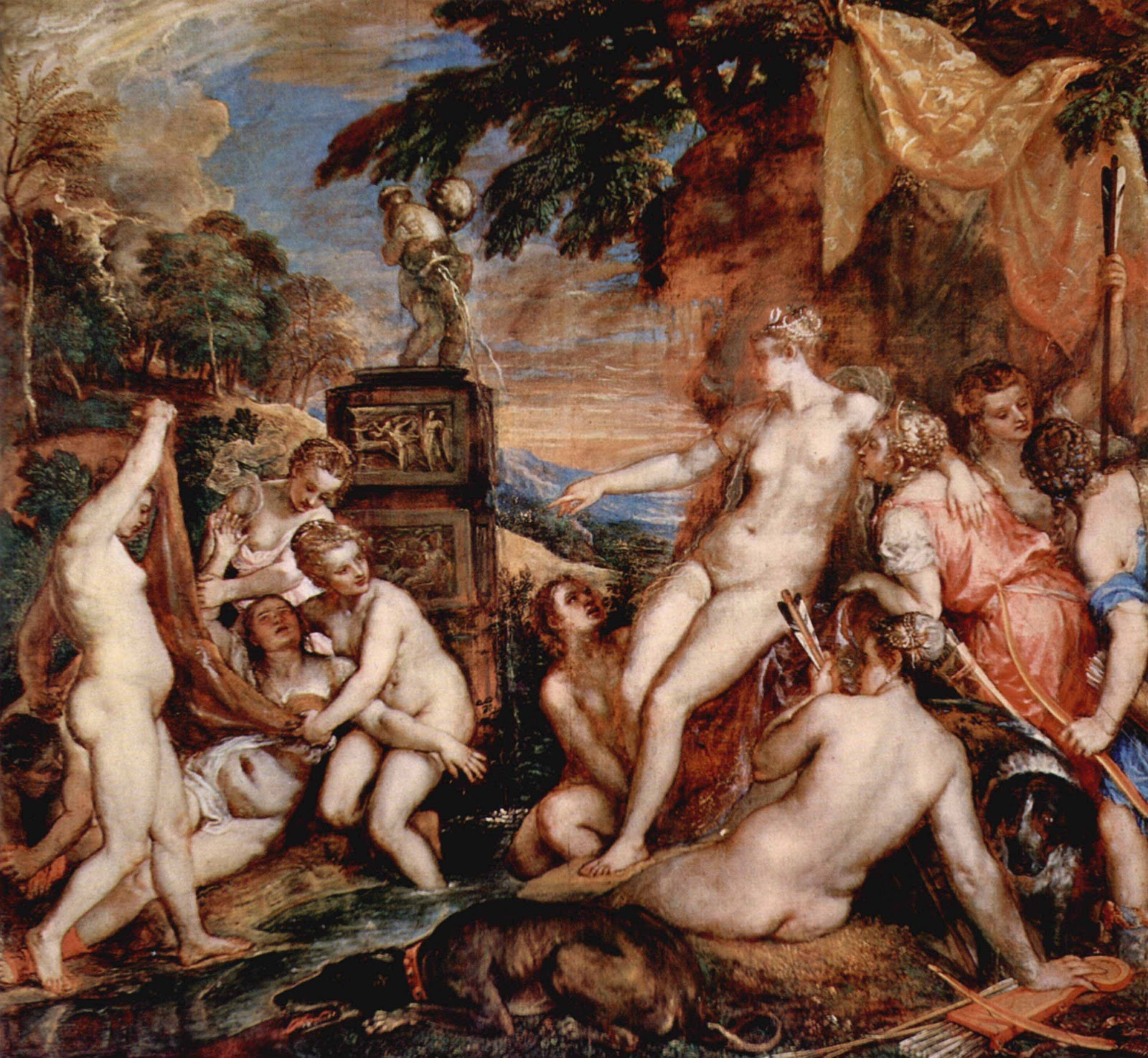
Diana - the Lady of the Hunt
Painting by Titian
King Cadmus, founder of the great city of Thebes and hero of his people, had enjoyed a wondrous life. Now in his old age, he watched his grandsons mature to adulthood, and nothing gave him more joy, especially when it came to his favourite - Actaeon. But alas, that ancient maxim cannot be forgotten, "Call no man happy until he is dead" (for the story behind this saying, please click here). For such a tragedy there scarcely was when the grandson of Cadmus fell afoul of chance. Actaeon had grown into a strong young man, handsome, and skilled in the pursuits of men. Indeed, more than anything else, he was impressively skilled as a hunter. His fellow men marvelled at the vast array of game he could bring back in one ride, many times more than any of them. Though he triumphed so often through his immense prowess, it was the strong bond that Actaeon shared with his beloved dogs which set him apart. He knew each of their names, and each of their talents. First there was Blackfoot, always the first to sound out their quarry. Then there was Tracker, bred on Crete, who never missed a scent. Of Wingdog too, no there was no swifter hound than he. White as the snow on the high mountains was the coat of Sheen, and black as night was the body of Soot. Such a din there was when Yelper let out his bark, verily did one's eardrums shake! Poor Sylvan, a valiant beast but limping now, a savage boar had gored his flank. Then came Harpy with her puppies, eager to serve. Blacklock too, first to maul their chosen quarry, followed by Beast-Killer and Mountain-Boy, who never desisted from their prey. Never before has man and beast bonded so closely as Actaeon and his dogs. As one, they were a match for the lady Diana herself, chaste goddess of the hunt.


One day, as the chariot of the Sun god rode high in the Heavens, far below in the wooded glades rode Actaeon and his gathered friends. The morning had been kind. The hunters' party had an impressive array of game, though of course, none eclipsed Actaeon's. The day grew late and soon the mighty Actaeon called a halt to the day's chase. The nets were soaked and their spears wet with blood. His faithful dogs, delighted to have caught so many for their master, wagged their tails eagerly, keen for a morsel when they returned home. Actaeon's friends laughed merrily at the thought of the magnificent feast that was sure to come that night, and bent down to pack away the panoply of the hunt.


Actaeon stumbles upon Diana
Painting by Titian
But the towering man himself decided to take a stroll in the pleasant late-afternoon sun. The falling sun was just bursting through the trees, its golden touch cast on the dappled forest floor. It all seemed so quiet, so tranquil, that Actaeon kept walking on. Soon, the serene silence was weakened. A strange, ethereal sound drifted through the trees. It was a little while before Actaeon recognised it as the sound of song, the sound of women singing not far ahead. He could not explain why he followed it, there was just something about it, so beautiful and pure, that he felt compelled to follow. Imagine, if you can, a secret valley, alive with bushy pine and towering cypress, holding a tranquil lake in their leafy embrace. No man had ever come here; all was as Gaia had first made it, pure from the mightiest trunk to the smallest droplets of water on the tips of the leaves. It was here that the lady Artemis and her maids came to bathe. Diana, the goddess of the moon, childbirth and the hunt, was fiercely chaste. Many a god had sought her hand in marriage, such was the beauty of the daughter of Zeus and the Titaness Leto, but she scorned them all. It was here, in the shade of the forest, that the goddess, weary from the hunt, would come to rest her weary limbs. Handing her bow and quiver to her maidens, she stepped into the perfectly calm water, while others unrobed her. Taking her golden hair in her hands, her nymphs gently poured urns of water over her head. This was the scene which the grandson of Cadmus stumbled upon.


Actaeon's tragic end
Painting by Titian
Unsure of where he was, this was unfamiliar forest to him, Actaeon rounded the clearing and then, he saw it all. For a moment he could not move, so stunned by the sight was he. Never before had he seen such beauty, and no matter how great he tried, he could not turn his eyes from this forbidden scene. For just a moment, there was blissful peace. But then, aware of the presence of a man, a terrible scream rent the air. The nymphs bounded forward, frantically reaching for their mistress' clothes. They surrounded her, shielding her from view, but the daughter of Zeus, alas was taller by far than they. Her blushing cheeks red as the setting sun, shock and fury mingled in her immortal form. Fury that her bow was not to hand, fury that she could not slay the intruder with a murderous arrow. Desperate now, Actaeon tried to find something to say, to express his sincere sorrow, for truly he was, but the great huntress gave him not a chance. Words cannot describe the terror poor Actaeon felt as he gazed into those merciless eyes, but worse was yet to come. In a flash, the unstoppable goddess took up a handful of water from the peaceful pool, and hurled it in Actaeon's face:


                          " Now you may tell the story of seeing Diana naked -
                             if storytelling is in your power! "
                                                  - THE CURSE OF DIANA


Panic flooded over Actaeon as a towering wave, as his body convulsed violently. A stabbing pain, and as he placed his sorry head in his hands, he felt to his horror two stumps growing rapidly out of his head. His neck began to stretch itself outward painfully, and his ears lurched into points. In his humility he looked down, and saw his once powerful feet harden and shrink before his eyes, now cloven to a point. Coarse fur rent its way through his flesh, until soon all his body was enveloped in a mighty coat. Then the huntress filled his mind with thoughts only of flight, and verily did Actaeon run. With a speed most extraordinary, the grandson of Cadmus bounded to a nearby pool, and gazed within its glassy waters. Gone was the handsome face of Actaeon, instead, the head of a mighty stag. The terrible realisation dropped like a stone. The vengeful goddess had made him into a beast. Tears streaming from his eyes, poor Actaeon moaned "Oh, dear god!", but no words came from within,  strange sounds and deep grunts instead.


Diana and Actaeon
Painting by Francesco Albani
Frantically, Actaeon thought of what to do, but each plan seemed helpless. Go back to the palace? But he could not speak, how would tell them what had transpired in that wretched glade? Or hide in the woodland? But to live forever as a beast, and know only melancholy forever more? "He wavered in fearful doubt". It was then that Actaeon knew the meaning of terror. For the silence of the wood was broken once again. This time, however, it was not a beautiful sound. Barking. Dogs barking. Hunting dogs barking. His dogs barking. Actaeon recognised at once the cry of Yelper, and it was the cry that betrayed that Tracker had caught a scent. The scent of prey. Frantically, Actaeon took to flight from his dearest friends, his friends who now spelled his doom. "Stop! It is I, Actaeon, your master. Do you not know me?", he cried in vain. But all that was heard was his desperate baying, drowned under the roar of the hunt. As he sprinted for his very life, he felt it. Sharp teeth sank into his neck, as Blacklock was first onto his prey. Then came Beast-Killer and Mountain-Boy. Moaning with agony under his wounds, his majestic body crashed into the ground, as the hounds pinned their own master. Just then, human voices. His breath giving away, Actaeon called out in vain hope, pleading to his friends. It was his friends, shouting in exultation at the magnificent stag they had caught. "Actaeon! Actaeon!... Why aren't you here, you indolent man, to enjoy the sight of this heaven-sent prize?" With that, his spirit broken at last, so passed Actaeon grandson of Cadmus, as his beloved hounds tore at his mortal form, eager to bring back another catch for their beloved master...

United Kingdom

Penguin Classics:
Metamorphoses: A New Verse Translation (Penguin Classics)
(A classic Roman epic poem, which has a good blend of readability and poetic meter)

Oxford World's Classics:
Metamorphoses (Oxford World's Classics)
(A classic Roman epic poem, which is charmingly archaic, but possibly too much so for some - choose if you like poetry of the 'old ways')

United States

Penguin Classics:
Metamorphoses (Penguin Classics)
(A classic Roman epic poem, which has a good blend of readability and poetic meter)

Oxford World's Classics:
Metamorphoses (Oxford World's Classics)
(A classic Roman epic poem, which is charmingly archaic, but possibly too much so for some - choose of you like poetry of the 'old ways')