Showing posts with label Gorgon. Show all posts

Wednesday, 7 September 2011

The Redemption of Heracles

With one last task standing between Heracles and his ascension to godhood, the mortal hours of the son of Zeus were numbered. Since the curse of Hera eight long years ago, the hero had toiled endlessly in the service of King Eurystheus, travelling far and wide, and facing some of the most terrible creatures which walked the earth (for the previous episode in this saga, please click here). Having thoroughly proved himself on the mortal plain, just one arena remained to be overcome...


Cape Taenarum today
Photograph taken by 'Eliasar'
Having travelled to the furthest boundaries of the Great Ocean, deceived the mighty Atlas and borne the divine Apples of the Hesperides to Tiryns, the contempt Heracles had all along received from Eurystheus was at last turning to reverence. The last enemy that remained to be conquered was death itself. For his final Labour, the King declared that Heracles must descend into the land of the dead, and bring the hound of Hades himself, Lord of the Dead, before him. The beast which guarded the gates to the inner sanctum of the Underworld was no ordinary dog, however. For Cerberus was another of the vile brood of the monster gods Typhon and Echidna (for their role in the Creation, please click here), and brother to such beings as the Hydra, the Lion of Nemea, the Chimaera and the hell hound Orthus. Gigantic in stature, triple headed (some tales speak of a hundred heads), dragon tailed and with serpentine heads bursting from its back, there was no more terrible doorman to the realm of the dead than Cerberus. Excited at the coming end, Heracles enthusiastically departed the mighty walled city of Tiryns on what he hoped would be his final quest. Rumours abound of several gateways on Earth through which one can enter the Underworld. One such one was a deep fissure in the Earth at Cape Taenarum - the most southerly point on Mainland Greece, a prominence which speared forth into the Mediterranean Sea. Southwards the son of Zeus journeyed, until the horizon was the unbroken line of the distant Sea. Finding an eerie silence, devoid of birdsong, the sound of the winds in the trees or the calls of other beasts, Heracles knew he was close. Coming to the pitch blackness of the mouth of a cavern, dauntless, the hero descended into its murky depths.


Cerberus
Painting by William Blake
Deeper and darker the path fell, as the son of Zeus became aware that he was being watched. The shades of the deceased began to stir, and relentlessly approached. With a start Heracles suddenly saw a grim sight before him. Slithering into the faint light, a woman's form, but for a reptilian tail and a head of hissing snakes for hair, the abomination gazed upon the hero. Medusa herself was looking him right in the eye. In a flash, Heracles drew his sword and advanced upon the creature. With a burst of sudden light, Hermes appeared before Heracles and stayed his hand. The messenger of the gods reassured him that this was the domain of the deceased, and Medusa was no more than a ghostly apparition of her former self. The only one of the Gorgons that was mortal, Medusa had been slain by the hero Perseus, and henceforth banished to this realm (for this story, please click here). Her murderous stare died with her. Continuing upon the dark road, Heracles began to see others he recognised. Many souls stumbled forth to embrace the hero, including the hero Theseus, hoping to be rescued from this grim land, but their ethereal hands simply passed through his flesh. Lacking corporeal form, the spirits of the dead were devoid of speech, requiring a sacrifice of blood to grant them awareness. Seeing a paddock of cattle nearby, Heracles started towards it, and slaughtered the largest bull he could find, eager to hear the words of the dead. Their herdsmen, however, was angered that Heracles had dared touch the cattle of Hades, and launched himself at the hero. The two wrestled frantically, the dead circling around them. Using his divine strength, Heracles clamped his arms around the herdsmen's chest, and wrenched with all his might. A sickening crack rent the air, heralding the shattering of the herdsman's ribs. Triumphant, Heracles turned to find himself with Hades himself, god of the dead, and Persephone, Queen of the Underworld.


Heracles and Cerberus
Image taken from a 6th century BC Etruscan Vase
Persephone scolded Heracles for his violence, as Hades demands the reason for his presence in this realm, a realm the living should not tread. The son of Zeus boldly told the god of his task, and asked Hades for permission to take Cerberus. Reluctantly, Hades agreed that he could take him, on the condition that he do so without harming the hound in any way, and that he use no weapons to overpower the beast. Agreeing to this, Heracles ventured deeper into the Halls of Erebus, coming ever close to the Gates of Tartarus. Coming to Acheron, the River of Pain, on the boundaries of the deepest parts of the Underworld (as it is in Dante's Inferno, see here), Heracles glimpsed the hell hound in the distance. Towering, and snarling, Cerberus stood guard over fiery Tartarus. Heracles watched for a moment as the souls of the damned appeared behind Cerberus. Fawning and docile toward any who approached his domain, Cerberus allowed readily any soul to enter Tartarus. But behind, any accursed shade that tried to escape their hellish prison was seized by the hound and brutally slashed. Remembering Hades' warning, Heracles sheathed his sword, but was careful to wrap the lion skin tightly around him. Approaching the Gate, Heracles was relieved to see that Cerberus was calm, expecting Heracles to enter Tartarus. Suddenly diving at the monster, Heracles grappled with its three heads. Like lightning, as though possessed, Cerberus thrashed against the hero. Thrown by the hound's sudden fury, Heracles grip loosened, and Cerberus slammed one of his many jaws shut on the hero's arm. Though in terrible agony from the savage bite, Heracles gritted his teeth and held on for dear life, as Cerberus, and the surrounding Gate, shuddered violently. For an age man and beast struggled, as Heracles began the long, agonisingly slow march back to Tiryns, wrestling the great dog the entire way. With his last reserves of strength, Heracles heaved Cerberus into the hall of King Eurystheus, who was so terrified of the hound he had hidden in a nearby jar. Shouting from within it, he pleaded with Heracles to return it to the Underworld, declaring his tasks and an end, and his oath fulfilled.


The Apotheosis of Heracles
Painting by François Lemoyne
A wave of euphoria gripped Heracles. At last. At long last he was free. Nearly ten years had passed since he first set out for the Lion of Nemea, and now so much had changed. Now the heroic wanderings of Heracles began, as the son of Zeus travelled far across the known world, revered as a living god by his fellow men. Countless wars were ended by his club, cities were founded in his name, and other fell creatures were hurled to the House of Death by his hand. He fought the first war with Troy, conquered the Giants, travelled with the Argonauts to the Golden Fleece and founded the Olympic Games. It was at the climax of this Golden Age that his final fate unfolded. One day, mighty Heracles arrived in the Kingdom of Calydon, eager to win the hand of the King's daughter, Deianeira, in marriage. Though humbled by the presence of so mighty a man, King Oineus resolved to hold a contest of worthiness. Heracles and the River God Acheloos stepped forward to compete, as the issue would be settled by a wrestling match. Even though Acheloos was a shape shifter, and became the form of a bull, Heracles won with little difficulty, after enduring all he had in his Labours. Delighted, King Oineus gave Deianeira to Heracles for a bride. The two departed happily for new lands, coming to the banks of the River Evenos. By the fast flowing river stood a Centaur, astride a small boat. The Centaur introduced himself as Nessus, and offered to ferry the two across. Seeing that the craft was not big enough for all of them, Heracles bade Deianeira take the ferry, whilst he would swim across. Just as they were halfway across, Heracles heard screaming. True to the debauched nature of Centaurs, Nessus had seized hold of Deianeira, and attempted to steal her away. The Centaur had not forgotten Heracles' slaying of many of his brethren many years ago when he sought the Erymanthian Boar (see here), and determined to take revenge. Furious, Heracles took up his bow and fired an arrow through the Centaurs hind leg. Since the arrows of Heracles were impregnated with the Hydra's poison (see here), Nessus' fate was sealed, as he began to die an agonising death. Seeing one last opportunity to take vengeance, Nessus gave his bloodsoaked tunic to Deianeira, telling her secretly that the blood of Centaurs was a powerful love potion.

Some years later, Heracles prepared to give his final sacrifice to Zeus. Ordering his servant Lichas to bring to him some fine clothing so he could conduct the ritual, Heracles began his preparations. Lichas came before Deianeira with Heracles request. Rumour, however, had reached her ears that Heracles had fallen for a foreign princess. Fearing he would leave her forever, Deianeira took a linen shirt and smeared some of Nessus' blood upon it, confident it would restore her husband's fidelity. Lichas bore the tunic back to his master, who immediately put it on and stood before the sacrificial fire. As the shirt grew warm, suddenly Heracles was struck with blinding agony.

His very skin was as though alight, as white hot pain spread across his body. Unknown to the hero, the tunic was drenched in the blood of Nessus, which in turn was saturated in the Hydra's poison. Heracles, who had used the monster's poison to slay some of the mightiest beasts on Earth, now knew their pain. In desperation, Heracles tried to rip the tunic from him, but his skin was torn with it, so potent was the Hydra's poison. Knowing that his death was at hand, Heracles was struck mad by the intense agony, and hurled Lichas from a cliff, believing him to have done this. When word reached Deianeira of what had happened, she hanged herself in shame. Resolving not to die like this, Heracles built his own pyre, as his strength rapidly dwindled. Climbing on to it, Heracles desperately called for someone to set it alight and end his suffering. Poias, a faithful Argonaut, moved to tears at what he saw, was the only one willing to do so. In return, Heracles bequeathed his great bow to him, as the flames began to lick his body.

The fire blazed, and with mighty tremor and roar of thunder, Heaven suddenly opened in the sky, and the clouds parted. In a glorious flash of lightning, Zeus himself came down to Earth to claim Heracles. The fire had burned away the hero's mortal side, but his immortal spirit was untouched. The Thunderer bore his son up to Mount Olympus, and at last, Heracles entered the light. Moved by his suffering, Hera at last took pity on Heracles, and declared her feud at an end. Welcomed in Heaven, Heracles had earned his place in the company of gods...


United Kingdom

The Library of Greek Mythology:
The Library of Greek Mythology (Oxford World's Classics)
(A vast collection of stories from old Greece, written and compiled in ancient times)

United States

The Library of Greek Mythology:
The Library of Greek Mythology (Oxford World's Classics)
(A vast collection of stories from old Greece, written and compiled in ancient times)

Wednesday, 1 June 2011

To Lower Hell

Shaken from the sight of the wrathful souls at war with each other, Dante is surprised to suddenly see before him in the distance a towering wall of stone (for the previous episode of this, please click here). Seized by curiosity, he sees great flames bursting upon its lofty battlements, just too far away to perceive. Before his questions can be answered however, an ancient craft appears in the dank waters of the Styx. A boat, ragged with age breaks the surf, steered by a fearsome man, bent with age. He is Phlegyas, boatman of the Styx (and also, in life, was the father of Ixion - for more see here).


The Furies taunt Dante
Engraving by Gustave Doré.
His spiteful exhortations rebuked by swift words of Virgil, Phlegyas steps back to receive his crew. Our pilgrim notices that only when he places a foot in the skiff does it sink with the weight - the weight of the living. Sweeping across the Styx low in the waves, Dante spies in horror a slimy hand emerge from the dark depths. "Who are you, who come before your time?" the shade enquires. The poet recognises the dead man's face; it is Filippo Argenti, a man he once knew in life, an arrogant and foul man. "May you weep and wail, stuck here in this place forever, you damned soul!" Dante bravely replies. Argenti tries in vain to reach for the boat, but harsh words from Virgil lash him back to the depths. Virgil turns to his protégé and commends his rebuke of so vulgar a soul. Reaching the foot of the walls, they set foot upon land once more. A reddish glow seems to rise beyond the citadel. This is the city of Dis, a keep which guards the lower regions of Hell, reserved for graver crimes yet.

The bright glow Dante sees is that of the Eternal Fire burning beyond, maiming so many souls yet to come. Atop the battlements of Dis lurk many thousand Fallen Angels, who once rose in impious war against God himself (for this story, please click here). Intimidated by their jeers, Dante is reassured by Virgil, who tells him that none can harm him, by God's command, they are fearsome to the mind and eyes alone. Approaching the gate, they find their way barred by the demonic host. Awaiting aid, the two poets rest awhile, as Virgil once more strengthen Dante's resolve, reassuring him that he has passed this gate once before. Just then a new apparition appears, but it is no servant of Heaven. The Three Furies; Megaera, Alecto and Tisiphone, and in their wake the Gorgon Medusa (whose story is told here). Quickly clapping his hands over Dante's eyes, Virgil does not trust to chance that our poet may allow curiosity to defeat his fear. For one the glance of the Gorgon will ensure Dante never leaves this place. The fell spirits taunt and chide the pilgrim for his life, and his fear. But, just then, an angel arrives from Heaven, scattering the evil spirits and condemned shades afar. Denouncing the Fallen Angels for their futile resistance, the shining spectre opens the gates for the two poets, and their journey begins in Lower Hell.


The Heretics
Engraving by Gustave Doré.
The land of Hell is different here. 'A countryside of pain and ugly anguish' stretches before Dante's eyes. Scattered in the plain all about are countless graves, open too, their lids cast aside, and roaring flames pouring from within. To his anguish, Dante can just make out the screams of the tortured souls, bound in their deathly graves. Here, in the Sixth Circle of Hell, are condemned those who spread heresy in life. Just as their fiery tongues spread malice in life, so now they bathe in fire in Hell. False prophets of Christendom lie afire, as do ancient philosophers of the Epicurean school, who believed that the soul died with the body on Earth. Nor are the deep graves for one soul each. Each sarcophagus is home to many, all packed within the inferno. Yet another soul, Farinata, is one Dante knew in life, who was his enemy in Florence in days of old. The two speak of the ills of Florence and her scheming politics, as another soul rises from its fiery grave. He was once Cavalcanti in life, and begs Dante tell him of his son, does he still live? Shocked by the shade's emotion, Dante cannot speak. Misinterpreting his silence, Cavalcanti believes his son dead, and retires, weeping, to his ordeal, cursed to ponder it for all time. Dante begs Farinata to go and tell the spirit of Cavalcanti that his son is indeed alive on Earth, and that his silence was not meant as he took it. Seized by curiosity once more, Dante enquires as to why so many souls have asked him of the current affairs on Earth. The souls damned in Hell, Farinata tells him, are cursed to see the future, and future alone, and know nothing of the present, "this much the sovereign lord grant us here". When the Final Judgement comes, the future will be closed off to them, and all hope will be lost, left to see nothing but their own endless torment.


The Violent against people and property
Engraving by Gustave Doré.
Moving on at Virgil's bidding, and coming to a steep bank, a dreadful stench rises from a nearby pit. It is a vast grave, vomiting forth vile miasma. The inscription on the coffin lid nearby states "Within lies Anastasius, the Pope". Indeed, a great many men of the cloth are condemned in Hell, neither Pope nor Cardinal is safe from judgement. Coming to another ridge, they spy a monster, the Minotaur of Crete, lying at the edge of the abyss, guarding the Seventh Circle of Hell. Virgil cries out to the Bull, reminding him that he is cursed there too, cast down to the House of Death by Theseus long ago. The Minotaur writhes in rage, an anger so intense the beast cannot rise, shuddering pathetically by the Pit. Here, in the three rings of the Seventh Circle, are punished the violent, each guilty of malicious violence to a different being. Descending into the first ring, a vast river of boiling blood flows past in cruel torrents. Burning in this foul current are those who through violence injured other men or their property in life. Galloping around the rim of the river Phlegethon are a herd of Centaurs, who hunt with their arrows any soul which tries in desperation to claw its way up from the river. Our pilgrim recognises powerful men of old burning up to the eyebrows, he sees Alexander, the tyrant Dionysius, even Attila, King of the Huns and the Scourge of God, all tormented in the sanguine waves. Eyeing the two poets with suspicion, Chiron, leader of the Centaurs, demands their purpose, lest they be shot too. Once again, Virgil takes control, and asks guidance for the way beyond, ordered thus by the Almighty. Dante, as a living man, cannot touch the Phlegethon, and is borne across a ford by the Centaur Nessus, as they approach the second ring.


The Suicides
Engraving by Gustave Doré.
Reaching a grand forest, the poets enter the second ring. No leaf here was green however. Twisted, gnarled and entangled trees sprouted forth leaves of charcoal black, as cruel thorns of poison bloomed where flowers should be. This is a forlorn place, one of sorrow and melancholy. In the high branches, harpies stir, foul birds, shrieking eerie calls. Wails and lamentations of grief sounded all about, and Virgil eyes our pilgrim:


                       " And so my teacher said, 'If you break off
                                a little branch of any of these plants,
                                what you are thinking now will break off too'.

                        Then slowly raising up my hand a bit
                               I snapped the tiny branch of a great thornbush,
                               and its trunk cried: 'Why are you tearing me'... "
                                                           - DANTE UNCOVERS THE TORMENTED
                                                       
To his horror, Dante realised that all of the trees of this forest are souls, cruelly bound as trees. As blood spurts forth from the stump, the soul cries in pain. Here are punished the suicides. Just as they scorned the gift of their bodies in life, now they are denied their own form here in Hell. The soul reveals himself to have once been Pier delle Vigne, an advisor to King Frederick II of Sicily. He was once his most loyal servant, but due to the intrigues of jealous courtesans, fell from favour and was cast into jail. Lamenting his injustice and losing all hope, he took his own life, dashing his head against the cell wall. He came to Hell, and his earthly body was torn away from him, as King Minos hurled his soul down here. Just as he had shown no care for his body in life, no care was shown for his soul in Hell. His soul fell in this land, and germinated a tree. The Harpies relentlessly feed on his leaves, and their constant movements break off branches, leaving him in constant agony. Just then new souls run into the clearing, terrified and lost. They are profligates, who recklessly did violence to their own property in life. One hides in desperation in a thorny bush. Suddenly a pack of ferocious hounds charge in, snapping branches as they go, as they maul the poor soul, tearing his flesh with their fangs. The thorny bush laments in pain, a soul who was once a Florentine in life who hanged himself in his home. Dante is left to ponder the bond he feels to his native city, weeping at so many others like him now cursed in Hell... Yet much remained along the path of the Inferno...


United Kingdom

Penguin Classics:
(A nice edition which even has the original Italian on the left hand side of the page!)

Oxford World's Classics:
The Divine Comedy (Oxford World's Classics)
(Accessible and well annotated, also includes Purgatorio and Paradisio)

United States

Penguin Classics:
The Divine Comedy: Volume 1: Inferno (Penguin Classics) (Pt. 1)
(A nice edition which even has the original Italian on the left hand side of the page!)

Oxford World's Classics:
The Divine Comedy (Oxford World's Classics)
(Accessible and well annotated, also includes Purgatorio and Paradisio)

Wednesday, 8 September 2010

Perseus and Medusa

Even today the monstrous Medusa, whose gaze spelled doom for all who looked upon her dread visage, is an iconic figure in our shared psyche, featured in Greek verse, Roman poetry, Renaissance painting, Baroque sculpture and modern cinema alike. But how many know the story behind the serpents? How many know for example, that Medusa was once a normal, mortal woman, who became a hideous creature cursed by the gods? Where is this stuff written? - The story, one of the earliest stories of heroes and monsters, can be found in many places; the two most prominent places being in a poem called The Metamorphoses and in one of the many stories which make up the Library of Greek Mythology.

Perseus
Sculpture by Benvenuto Cellini.
The story begins one day when King Acrisius of Argos (a powerful city on the eastern shores of Greece) heard from the Oracle of Delphi that should his daughter, Danaë, give birth to a son, he would die at his hands. So as to prevent the prophecy from ever coming to pass, Acrisius imprisoned Danaë in a high tower, forbidding her any visitors. The machinations of man were mere playthings to gods however, and the barred windows of the lady’s cell were no barrier to the King of the Gods. Zeus took the form of a shower of gold and cascaded through the bars and gave Danaë a son – Perseus. Acrisius was furious and bound Danaë and the demigod in a chest and hurled them into the sea.

Danaë prayed desperately to the gods, and the Thunderer heard her prayers. The chest washed up on the shore of the isle of Seriphos, where it was found by the fisherman Dictys. Dictys raised Perseus in the humble life of the fisherman until he was a man. Dictys’ brother Polydectes was a cruel and scheming man however, and the King of Seriphos. He desired to take Danaë for himself, and destroy the young Perseus. One day Polydectes summoned all his friends to him, and told them he was collecting contributions in order to be wed to the lady Hippodameia. Many gave horses as a gift to the king, but Perseus had no horse to give, and so asked the king to name anything and he would bring it. Polydectes seized his chance and ordered Perseus to bring him the head of the Gorgon.

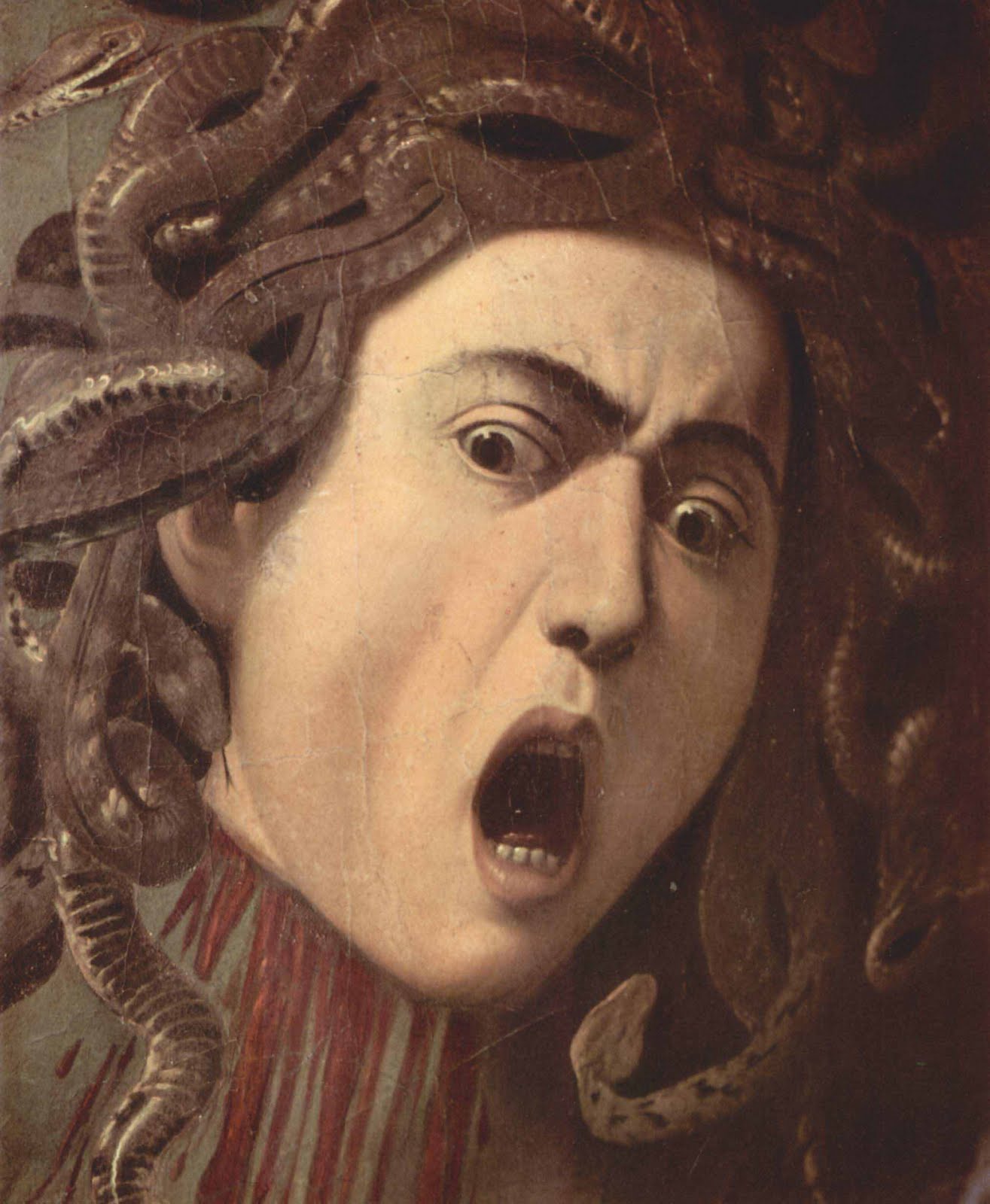
The Gorgons were three sisters by the names of Stheno, Euryale and Medusa. They were grotesque beings with snakes for hair, tusks like those of a boar, hands of bronze, wings of gold and their glance was death to man. Of the three, only Medusa was mortal and vulnerable, having once been a woman:


Medusa
Painting by Caravaggio.
“Medusa was once an exceedingly beautiful maiden,

Whose hand in marriage was jealously sought by an army of suitors,

According to someone who told me he’d seen it, her marvellous hair

Was her crowning glory. The story goes that Poseidon the sea god

Defiled this glorious creature inside the shrine of Athena.

The daughter of Zeus screened her virginal eyes with her aegis in horror,

And punished the sin, by transforming the Gorgon’s beautiful hair

Into horrible snakes.”
                        - PERSEUS RECOUNTS THE TALE OF MEDUSA


So Perseus set out to vanquish the blasphemous monster. Athena came to his aid, and told him to seek the nymphs known as the Hesperides, who possessed weapons which could conquer the Gorgon. Perseus sought out the old witches, and asked where he might find these nymphs. The witches were the sisters of the Gorgons, old women from birth who shared but a single eye and a single tooth between them. At first the witches taunted and mocked Perseus, and refused to reveal the nymph’s whereabouts. Through cunning and trickery, Perseus seized the eye and tooth, and offered them back only if they gave him what he needed. Reluctantly, the witches told him all they knew.

Perseus came to the Hesperides, where the nymphs gave Perseus a magnificent set of gifts to aid him against Medusa. The nymphs gave him a magical wallet to contain the Gorgon’s head and then the enchanted helm of Hades, which had been forged by the Cyclopes during the War of the Titans, which rendered the wearer invisible. The gods themselves also gave, and Hermes lent to Perseus his winged sandals so as to grant him the gift of flight, as well as an adamantine blade to pierce Medusa’s reptilian hide. Athena gave a fine shield, whose polished bronze surface rendered the perfect reflection. Armed with his divine tools, Perseus took flight across the vast Ocean, to the ends of the Earth and arrived at the Gorgon’s cave. Over to the sleeping beasts he crept, eyes fixed on their ghastly reflection of in his shield, and with a mighty strike he severed Medusa’s head. From her bleeding neck sprung the winged horse Pegasus. Out too came Chrysaor – the result of her and Poseidon’s violation in Athena’s sanctuary. Medusa’s fellow Gorgons awoke with a start and gave chase, but Perseus quickly slipped the foul head into the wallet and made good his escape, shielded under Hades’ helm.

On his return to Polydectes, Perseus stopped in the land of Ethiopia, kingdom of Cepheus and his queen Cassiepeia. Cassiepeia proudly declared herself to be more beautiful than the Nereids (The sea nymphs) themselves, bringing down upon her kingdom the wrath of Poseidon, who unleashed a terrible Leviathan upon the people. An Oracle told the people that the land could be saved only by sacrificing the Princess Andromeda to the monster, and so King Cepheus mournfully gave the order to chain her to the rocks. Perseus offered to slay the creature if he could take Andromeda as his wife. The King eagerly agreed, and Perseus flew to the princess’ rescue:

Perseus rescues Andromeda
Painting by Paolo Veronese.
“Poised on his swift wings, Perseus eluded his ravening enemys’ jaws

And went for his weak points, hacking away with his hooked sword,

Now at its barnacled back and then at the ribs, then again

At the narrowest point of the tail where it tapered into a fish.

The monster spewed forth seawater mingled with crimson blood...”
                                               - PERSEUS SLAYS THE LEVIATHAN

Perseus was hailed as a hero, and was given Andromeda as his bride. However the brother of Cepheus, Phineus, demanded Andromeda for himself and confronted the hero. Perseus revealed the Gorgon’s head and turned Phineus and his fellow conspirators to stone.

Perseus shows the Gorgon's head to Phineus
Painting by Luca Giordano.
Returning home to Seriphos triumphant, he found his mother and the fisherman Dictys in hiding from cruel Polydectes, who now received his wish – the Gorgon’s head. Indeed he even got to look the evil thing in the eye, and was transfixed in bloodless stone. Perseus gave the throne to the fisherman Dictys and set off to confront the man behind all of this – Acrisius, who had fled Argos when he heard of the hero’s coming. Perseus competed in the pentathlon at the athletic games in the land of the Pelasgians (northern Greece), whereupon he hurled his discus. The gods made the wind blow suddenly strong, carrying the disc into the head of Acrisius, sending him to the Underworld in a single blow. The prophecy at last fulfilled, Perseus buried Acrisius outside the walls of Argos, as he himself became King of Tiryns and founded Mycenae. Andromeda gave birth to many sons and daughters, the first son taking the name of Perses – from whom the Persian race claimed origin. Perseus and Andromeda lived long lives and became the progenitors of the Danaan race, to whom many great dynasties of Greece would claim descent, even to the day they had all been trodden under the iron shod boot of the Roman legions. To be descended from the Thunder god himself was to have powerful blood flowing through your very veins. To trace your lineage through one the god’s most illustrious sons was to add even greater lustre to the sheen.

The story of Perseus is one of the most famous in Greek mythology, and both Perseus and Medusa are famous cultural icons across the West. The stories are as enchanting in the original poetry as they were read aloud. The story can be found easily and at a discounted price at Amazon:

United Kingdom

Penguin Classics:
Metamorphoses: A New Verse Translation (Penguin Classics)
(The famous poem of Publius Ovidius Naso, a joy to read and 'the poetic account')

Oxford World's Classics:
The Library of Greek Mythology (Oxford World's Classics)
(A library of mythology, less poetic but contains the whole story of Perseus)

United States

Penguin Classics:
Metamorphoses (Penguin Classics)
(The famous poem of Publius Ovidius Naso, a joy to read and 'the poetic account')

Oxford World's Classics
The Library of Greek Mythology (Oxford World's Classics)
(A library of mythology, less poetic but contains the whole story of Perseus)