Wednesday, 28 March 2012

The Hounds of Actaeon

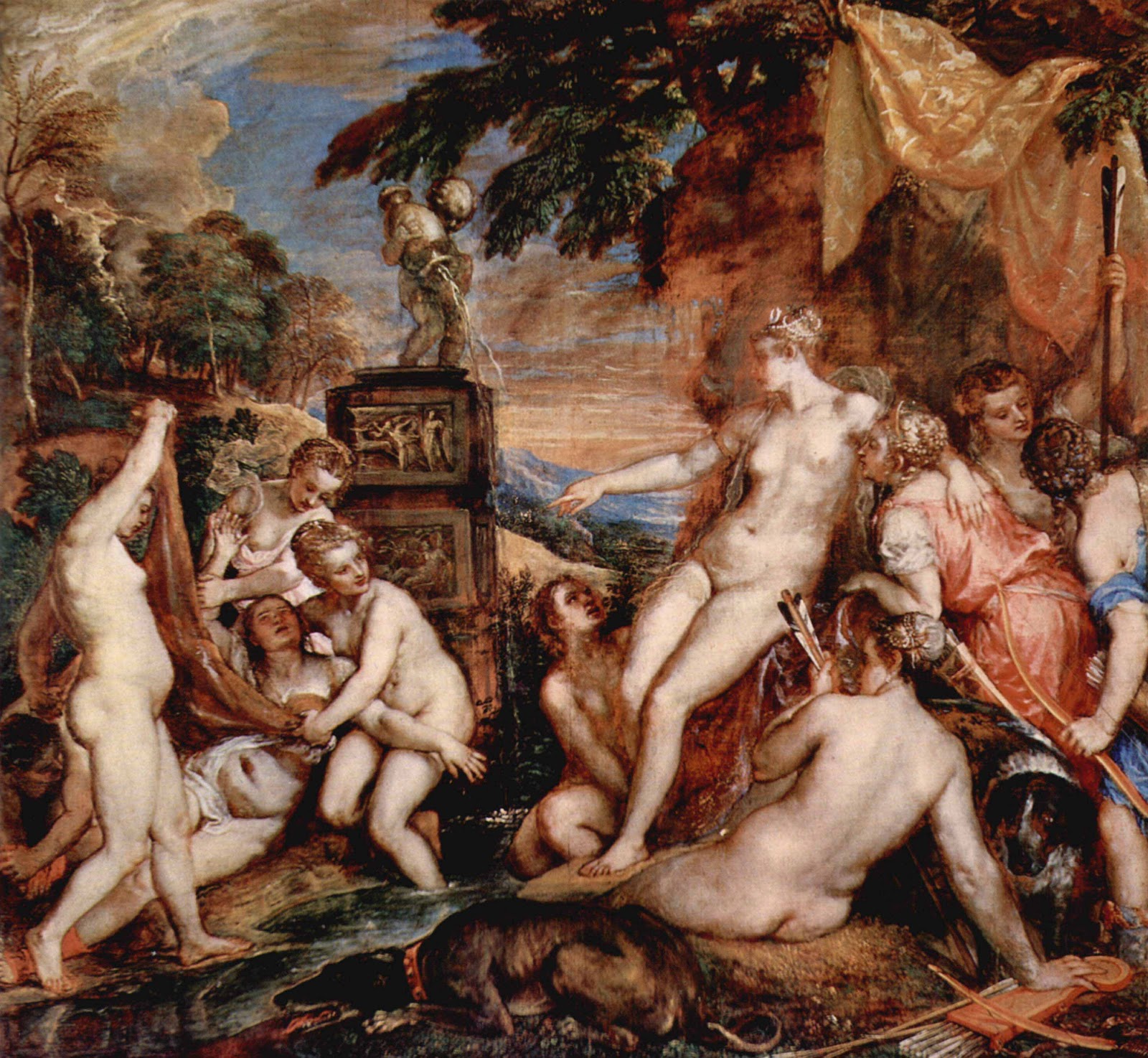
There were times, in the lore of the ancient world, when the gods and goddesses rewarded the benevolent, humbled the proud, cursed the wicked and blessed the pure. Yet the gods could succumb just as readily to the passions and impulses of nature as the mortals they ruled over. In the order of the Cosmos, there were and will always be casualties of imbalance, and pure misfortune. One such man, who tragically suffered so, was Actaeon.


Diana - the Lady of the Hunt
Painting by Titian
King Cadmus, founder of the great city of Thebes and hero of his people, had enjoyed a wondrous life. Now in his old age, he watched his grandsons mature to adulthood, and nothing gave him more joy, especially when it came to his favourite - Actaeon. But alas, that ancient maxim cannot be forgotten, "Call no man happy until he is dead" (for the story behind this saying, please click here). For such a tragedy there scarcely was when the grandson of Cadmus fell afoul of chance. Actaeon had grown into a strong young man, handsome, and skilled in the pursuits of men. Indeed, more than anything else, he was impressively skilled as a hunter. His fellow men marvelled at the vast array of game he could bring back in one ride, many times more than any of them. Though he triumphed so often through his immense prowess, it was the strong bond that Actaeon shared with his beloved dogs which set him apart. He knew each of their names, and each of their talents. First there was Blackfoot, always the first to sound out their quarry. Then there was Tracker, bred on Crete, who never missed a scent. Of Wingdog too, no there was no swifter hound than he. White as the snow on the high mountains was the coat of Sheen, and black as night was the body of Soot. Such a din there was when Yelper let out his bark, verily did one's eardrums shake! Poor Sylvan, a valiant beast but limping now, a savage boar had gored his flank. Then came Harpy with her puppies, eager to serve. Blacklock too, first to maul their chosen quarry, followed by Beast-Killer and Mountain-Boy, who never desisted from their prey. Never before has man and beast bonded so closely as Actaeon and his dogs. As one, they were a match for the lady Diana herself, chaste goddess of the hunt.


One day, as the chariot of the Sun god rode high in the Heavens, far below in the wooded glades rode Actaeon and his gathered friends. The morning had been kind. The hunters' party had an impressive array of game, though of course, none eclipsed Actaeon's. The day grew late and soon the mighty Actaeon called a halt to the day's chase. The nets were soaked and their spears wet with blood. His faithful dogs, delighted to have caught so many for their master, wagged their tails eagerly, keen for a morsel when they returned home. Actaeon's friends laughed merrily at the thought of the magnificent feast that was sure to come that night, and bent down to pack away the panoply of the hunt.


Actaeon stumbles upon Diana
Painting by Titian
But the towering man himself decided to take a stroll in the pleasant late-afternoon sun. The falling sun was just bursting through the trees, its golden touch cast on the dappled forest floor. It all seemed so quiet, so tranquil, that Actaeon kept walking on. Soon, the serene silence was weakened. A strange, ethereal sound drifted through the trees. It was a little while before Actaeon recognised it as the sound of song, the sound of women singing not far ahead. He could not explain why he followed it, there was just something about it, so beautiful and pure, that he felt compelled to follow. Imagine, if you can, a secret valley, alive with bushy pine and towering cypress, holding a tranquil lake in their leafy embrace. No man had ever come here; all was as Gaia had first made it, pure from the mightiest trunk to the smallest droplets of water on the tips of the leaves. It was here that the lady Artemis and her maids came to bathe. Diana, the goddess of the moon, childbirth and the hunt, was fiercely chaste. Many a god had sought her hand in marriage, such was the beauty of the daughter of Zeus and the Titaness Leto, but she scorned them all. It was here, in the shade of the forest, that the goddess, weary from the hunt, would come to rest her weary limbs. Handing her bow and quiver to her maidens, she stepped into the perfectly calm water, while others unrobed her. Taking her golden hair in her hands, her nymphs gently poured urns of water over her head. This was the scene which the grandson of Cadmus stumbled upon.


Actaeon's tragic end
Painting by Titian
Unsure of where he was, this was unfamiliar forest to him, Actaeon rounded the clearing and then, he saw it all. For a moment he could not move, so stunned by the sight was he. Never before had he seen such beauty, and no matter how great he tried, he could not turn his eyes from this forbidden scene. For just a moment, there was blissful peace. But then, aware of the presence of a man, a terrible scream rent the air. The nymphs bounded forward, frantically reaching for their mistress' clothes. They surrounded her, shielding her from view, but the daughter of Zeus, alas was taller by far than they. Her blushing cheeks red as the setting sun, shock and fury mingled in her immortal form. Fury that her bow was not to hand, fury that she could not slay the intruder with a murderous arrow. Desperate now, Actaeon tried to find something to say, to express his sincere sorrow, for truly he was, but the great huntress gave him not a chance. Words cannot describe the terror poor Actaeon felt as he gazed into those merciless eyes, but worse was yet to come. In a flash, the unstoppable goddess took up a handful of water from the peaceful pool, and hurled it in Actaeon's face:


                          " Now you may tell the story of seeing Diana naked -
                             if storytelling is in your power! "
                                                  - THE CURSE OF DIANA


Panic flooded over Actaeon as a towering wave, as his body convulsed violently. A stabbing pain, and as he placed his sorry head in his hands, he felt to his horror two stumps growing rapidly out of his head. His neck began to stretch itself outward painfully, and his ears lurched into points. In his humility he looked down, and saw his once powerful feet harden and shrink before his eyes, now cloven to a point. Coarse fur rent its way through his flesh, until soon all his body was enveloped in a mighty coat. Then the huntress filled his mind with thoughts only of flight, and verily did Actaeon run. With a speed most extraordinary, the grandson of Cadmus bounded to a nearby pool, and gazed within its glassy waters. Gone was the handsome face of Actaeon, instead, the head of a mighty stag. The terrible realisation dropped like a stone. The vengeful goddess had made him into a beast. Tears streaming from his eyes, poor Actaeon moaned "Oh, dear god!", but no words came from within,  strange sounds and deep grunts instead.


Diana and Actaeon
Painting by Francesco Albani
Frantically, Actaeon thought of what to do, but each plan seemed helpless. Go back to the palace? But he could not speak, how would tell them what had transpired in that wretched glade? Or hide in the woodland? But to live forever as a beast, and know only melancholy forever more? "He wavered in fearful doubt". It was then that Actaeon knew the meaning of terror. For the silence of the wood was broken once again. This time, however, it was not a beautiful sound. Barking. Dogs barking. Hunting dogs barking. His dogs barking. Actaeon recognised at once the cry of Yelper, and it was the cry that betrayed that Tracker had caught a scent. The scent of prey. Frantically, Actaeon took to flight from his dearest friends, his friends who now spelled his doom. "Stop! It is I, Actaeon, your master. Do you not know me?", he cried in vain. But all that was heard was his desperate baying, drowned under the roar of the hunt. As he sprinted for his very life, he felt it. Sharp teeth sank into his neck, as Blacklock was first onto his prey. Then came Beast-Killer and Mountain-Boy. Moaning with agony under his wounds, his majestic body crashed into the ground, as the hounds pinned their own master. Just then, human voices. His breath giving away, Actaeon called out in vain hope, pleading to his friends. It was his friends, shouting in exultation at the magnificent stag they had caught. "Actaeon! Actaeon!... Why aren't you here, you indolent man, to enjoy the sight of this heaven-sent prize?" With that, his spirit broken at last, so passed Actaeon grandson of Cadmus, as his beloved hounds tore at his mortal form, eager to bring back another catch for their beloved master...

United Kingdom

Penguin Classics:
Metamorphoses: A New Verse Translation (Penguin Classics)
(A classic Roman epic poem, which has a good blend of readability and poetic meter)

Oxford World's Classics:
Metamorphoses (Oxford World's Classics)
(A classic Roman epic poem, which is charmingly archaic, but possibly too much so for some - choose if you like poetry of the 'old ways')

United States

Penguin Classics:
Metamorphoses (Penguin Classics)
(A classic Roman epic poem, which has a good blend of readability and poetic meter)

Oxford World's Classics:
Metamorphoses (Oxford World's Classics)
(A classic Roman epic poem, which is charmingly archaic, but possibly too much so for some - choose of you like poetry of the 'old ways')

Wednesday, 21 March 2012

Heart of the Inferno

Shivering violently in the chill wind, Dante and Virgil ventured onward, closer and closer to very centre of the Inferno. Leaving the deranged shouting of Count Ugolino far behind (for the previous episode in the story of the Inferno, please click here), our poet could not veil his fear, try though he might, for he was grimly aware that somewhere down here, the greatest of all traitors must lie - Lucifer himself...


Dante and Virgil upon Cocytus
Painting by Gustave Doré
After a precarious march further along the frozen lake of Cocytus, Dante noticed that the souls appeared to be fixed deeper into the ice, with all but their tortured faces swallowed by Cocytus. The souls were in agony, for in their plight they wept, but the sheer cold had frozen their tears, as though each bore a visor of crystal over their faces. One such soul gave a muffled cry, and begged our pilgrims to break the ice from his stricken face. Dante, hearing his voice, called back, "If this is what you want, tell me your name; and if I do not help you, may I be forced to drop beneath this ice!" The sinner replied that he was Friar Alberigo, and that he paid the price in Hell even whilst his body still lived on, far above. Years before, at a banquet, he had ordered the deaths of his own brother and nephew. The Friar had called for some figs, and at this prearranged signal, his guards had rushed in and slain his kin. For his heinous betrayal of his guests and family, his immortal soul had been cast by Fate into Hell, as a demon took possession of his mortal form. This penultimate area of Cocytus was Tolomea, Round Three of the Ninth Circle of Hell, to which are condemned those who violate the holy bond between a host and his guest. Unlike all other regions of Hell, the sinners here can well still be alive on Earth, yet bound too, in unholy Cocytus. The Friar speaks too of Branca D'Oria, a fellow sinner bound in the ice, a man whom Dante knew in life. Stunned at this news, and appalled at his crimes, Dante ignored the Friar's plea to clear the ice from his eyes, and sternly walked on.


Lucifer
Photograph taken by the author in the Baptistery
of St. John, Florence
At last, after braving all the perils of the Inferno, Dante had now arrived at the final lair of evil, Judecca, the Fourth Round of the Ninth Circle of Hell. To here are banished the very gravest of sinners, those who have betrayed their own benefactors. In the distant fog, a gargantuan outline began to take form, just as a mountain emerges from a thick mist. The deathly cold gale was so intense that Dante held his head down, as his eyes fell upon a morbid sight. For here, the souls of the damned were frozen deep within Cocytus, their condemned bodies held in suspended animation, in cruelly contorted positions, for as far as the eye could see into the depths of the lake. Completely submerged in ice, no sound came from their lips, but for frantic whimpering destined never to be heard. Dante shuddered at the eerie silence, but Virgil took his arm and led him on. The time had come. Bracing him, Virgil consoled his fellow poet:


                            " This is he, this is Dis; this is the place
                               that calls for all the courage you have in you.

                               How chilled and nerveless, Reader, I felt then;
                               do not ask me - I cannot write about it -
                               there are no words to tell you how I felt.

                               I did not die - I was not living either!
                               Try to imagine, if you can imagine,
                               me there, deprived of life and death at once... "
                                           - DANTE LOOKS UPON THE FACE OF SATAN


Satan Bound
Engraving by Gustave Doré
The mist lifted, and there, in all his infernal glory, lay Lucifer himself, bound to the waist by the icy clutches of Cocytus. Once the most beautiful of all the angels of Heaven, Lucifer, the Morning Star, was perfect in all things but for the most terrible of things, his pride. Refusing to bow to the Son of God, he dared to openly challenge God for the throne of Heaven, and open war thundered across the vaults of Heaven (for more about this, please click here). Defeated, he, along with the one third of the angelic host that had sided with him, were cast out of Heaven, and hurled to ruinous perdition in Hell. Taking the new name of Satan, as one of only two beings to have committed open treachery against God, he now endured an eternity of retribution for his crimes, at the very Pit of Hell. Dante stood transfixed, overcome with awe at the sight of him. Nothing could have prepared him for the colossal being now bound before him. "My height is closer to the height of giants than theirs is to the length of his great arms", Dante remarks. The former archangel towered high above Cocytus, even though his body from the waist down stretched far below the surface. From his titanic head, three faces burst angrily forth, each holding a sinner tight in its jaws. A pair of vast, bat like wings lay fixed below each, the pure white plumage that once adorned them having been burned away after his treachery against the Most High. Tears flowed from his blazing eyes, tears of rage mingled with grief at his lost Paradise. Six streams of tears flowed down his body, mixing with the blood dripping from his mouth. Still he sought to escape his infernal prison, as he violently flapped his enormous wings, desperate to break free of Cocytus. But in his pride, he was blind to the reality that the icy winds generated by his wings merely prolonged his suffering, constantly freezing the waters of the lake.

In the jaws of the left face, one as black as the night, a sinner convulsed in desperation. Virgil revealed to Dante his identity as Marcus Junius Brutus, the man who drove the blade into Julius Caesar, betraying his ruler, and the united Italy that he brought. In the jaws of the right face, one yellow as sulphur, another sinner jerked in pain. He was Gaius Cassius Longinus, a fellow conspirator of Brutus, and another of the assassins of Caesar. But in the central face, one red with fury, was the only other soul apart from Satan himself who had directly betrayed God, all for thirty pieces of silver - Judas Iscariot. The teeth of Satan crunched down upon his twitching body without end, but he also suffered another brutal torture, as the claws of the devil slashed open his body, tearing the flesh asunder.


Dante gazes upon Mount Purgatory
Painting by Bronzino 
The grisly sight caused a ripple of nausea in Dante, and Virgil saw that the time had come to leave the Inferno at last, though alas there was only one way to leave. Waiting for the opportune moment, Virgil seized Dante's arm and dashed forwards, latching onto the tangled and matted hair that grew on Satan's sides. Dante held on for dear life to Virgil's shoulder, as the great Roman poet descended down and down, past the surface of freezing Cocytus. Then, just as the two pilgrim reached Satan's thigh, the world seemed to Dante to turn on its head. Virgil adjusted his grip, and turned to face the feet of the devil, and began to climb. Puzzled, Dante held on still. At last, they came to a rocky cavern, and the two stopped for a rest. Glancing back, there stood the two towering legs of Satan, bursting forth into the air. For they had passed the very core of the cosmos, and gravity had turned on its head. Virgil explained that Satan had been thrown down to Hell with such force that he had smashed his way through the Earth, and now lay frozen in the same position he had fallen, many millennia ago. The very cavern they sat in now was caused when the land had been forced upward by the Morning Star's fall. Eager to put as much distance between themselves and Satan as possible, the two set off together along the rising road, in darkness. After what seemed an age, Dante spotted something that seemed more glorious than anything he had seen for an age. Stars! They had done it, they had reached the surface at last. But for Dante, the adventure had only just begun. Ahead lay a vast mountain, towering high. The Mountain of Purgatory...

With this, the story of the Inferno comes to an end, but the Divine Comedy has only begun, as Dante slowly makes his way toward the ultimate destination, the light of God in Heaven itself. The Inferno, however, has become legendary in its own right, and immortalised Dante as the greatest of all Italian poets, and a father of Western literature. Written in short and easily read chapters, or cantos as they are called, the Inferno is a remarkable read, as engaging today as it was when Dante wrote it as an exile from his native Florence, in the early years of the fourteenth century. Few things have been written which so emphatically warn of the consequences of evil...

The Inferno is readily, and easily available from Amazon, and is more than worthy of a position on your shelf:


United Kingdom

Penguin Classics:
Dante: Inferno (Penguin Classics)
(A translation which retains much of the poetic meter, with good illustrations and notes, as well as the original Italian alongside the English)

Oxford World's Classics:
The Divine Comedy (Oxford World's Classics)
(A combined translation of all three parts of the Divine Comedy; the Inferno, the Purgatorio and the Paradisio, all in a highly accessible style)

United States

Penguin Classics:
The Divine Comedy: Volume 1: Inferno (Penguin Classics) (Pt. 1)
(A translation which retains much of the poetic meter, with good illustrations and notes, as well as the original Italian alongside the English)

Oxford World's Classics:
The Divine Comedy (Oxford World's Classics)
(A combined translation of all three parts of the Divine Comedy, the Inferno, the Purgatorio and the Paradisio, all in a highly accessible style)

Wednesday, 7 March 2012

Heroes of the Republic

Some months ago, we looked at the story of Horatius Cocles, and his incredible valour in defence of the city of Rome at the birth of the Republic (for the story, please click here). Through tremendous bravery, Rome had been saved from destruction at the hands of the Etruscans, and their mighty King Lars Porsenna of Clusium. Yet, despite this extraordinary moment, Tarquinius Superbus, the exiled seventh and final King of Rome, refused to give in. Through treachery, deceit and lies he had been forced from his rightful throne, and would not so easily be stopped in getting it back...


The City of Clusium today
Photograph taken by the author
Though impressed by Horatius' fortitude, Lars Porsenna pushed forward, and for the first time since her foundation two hundred and forty four years earlier, Rome herself endured the humiliation of a siege. Tarquin demanded Porsenna to force the surrender of Rome, and the submission of her people to him once more. Not only had the Romans expelled him from the city, the Senate had decreed that the property of Tarquin was now public land. The theft of his land drove the king into fits of rage at the very mention of his old city. Fearing the might of the Tarquins still, Porsenna dared not disobey his fellow king and ally. Through his own strategic brilliance, Porsenna cut off Rome from her supplies, and overran her lands, but could not extinguish the city itself, well defended as it was. The siege grew in its ferocity. Starvation began to stalk the streets of Rome, slowly strangling the life out of her people. The Senate, in desperation, sent envoys to the Latin cities to the South, calling for aid. Alas it was in vain, for the Latin ambassadors saw the Roman plight as hopeless, and made their peace with the Etruscans. Rome was on her own. Lars Porsenna, a shrewd yet honourable man, saw the desperation of the Romans, sent envoys to the city one last time. The war, and their famine, could all be over if they would just accept Tarquin once more. Though dire was their state, the Romans held their honour still. Never again would a Roman bow to an Etruscan King, and the envoys returned with a defiant refusal to their king. The end seemed near, for though they retained their freedom, for now, it seemed they had condemned themselves to death. It was from this hopelessness that a man emerged among the Romans.


His name was Gaius Mucius, an aristocrat of considerable position, yet little known at the time, but whose name would one day be legend. Unable to tolerate the shame that Rome now endured any longer, Mucius summoned the Senate to put forward a proposition. Careful to avoid revealing too much, lest a traitor unveil his ploy to the foe, Mucius' request was cryptic, yet brief. "'I wish', he said, 'to cross the river and to enter, if I can, the enemy's lines. My object is neither plunder nor reprisals, but, with the help of God, something more important than either'". Intrigued, and filled with desperate hope, the Senate granted his request. Concealing a dagger in his clothes, Mucius took leave of the city.


Scaevola thrusts his hand into the fire
Painting by Rubens and Van Dyck
Emerging on the far side of the Tiber, Mucius approached the Etruscan camp. Successfully deceiving the guard on account of his not carrying any weapon openly, and his knowledge of their language, which he had learned from his Etruscan nurse as a boy, Mucius made his way to the heart of their encampment. Passing the endless stretches of tents, Mucius came at last to a clearing, in which a vast crowd were gathered, all apparently queuing before a raised dais at the centre. Atop the platform there were seated two men in magnificent attire - robed in purple and bearing the symbols of power, each looked every part the king of the great city of Clusium. No one stopped Mucius as he approached, seeing no weapon, and now was his chance. But he was wracked with uncertainty. He did not know what Porsenna looked like - which was he?! One of the two was receiving a great many addresses from the crowd, and Mucius reasoned that this must be the king. With a shout of fury, Mucius revealed his concealed blade, and drove it into the man. In an instant, as blood spurted from the man's throat, a hundred pairs of hands seized Mucius and dragged him before the other man. Mucius realised to his horror that he had stabbed the wrong man, for it was the king's secretary now lifeless on the floor. It was pay day for the army, and the soldiers had simply been collecting their wages from him. There was no help at hand, the situation was desperate. But brave Mucius flinched not once as the true Lars Porsenna fixed him with a baleful glare, demanding to know who this man was before he died:


"'I am a Roman', he said to the king, 'my name is Gaius Mucius. I came here to kill you - my enemy. I have as much courage to die as to kill. It is our Roman way to do and to suffer bravely. Nor am I alone in my resolve against your life; behind me is a long line of men eager for the same honour. Gird yourself, if you will, for the struggle - a struggle for your life from hour to hour, with an armed enemy always at your door. That is the war we declare against you: you need fear no action in the field, army against army; it will be fought against you alone, by one of us at a time...'"
                   - SCAEVOLA'S THREAT


Scaevola and Porsenna
Painting by Matthias Stom
In rage mingled with alarm, Porsenna at once ordered the prisoner to be burned alive unless he immediately revealed the plot he at alluded to. Mucius, with a shout of "See how cheap men hold their bodies when they care only for honour!", thrust his right hand into the nearby fire, and left it there to burn. The flames roared and licked his arm, and his flesh charred away, yet Mucius held it still. Never once did the Roman shout in pain, never once did he flinch in agony, never once did he pass out through pain. The gathered crowd looked on, stunned into silence, unable to believe what they saw. Porsenna himself, astonished at Mucius' seemingly divine endurance, ordered his guards to set the man free, so impressed was he. The king blessed his staggering courage, and promised Mucius that "I, as an honourable enemy, grant you pardon, life and liberty". Withdrawing his hand from the conflagration without any hint of the terrible agony he had just felt, Mucius bowed, and revealed to the king that three hundred other men, young and of noble blood like himself, had all sworn to kill him in their turn, and that he drew the first lot. "The rest will follow, each in his turn and time, until fortune favour us and we have got you". So impressed was the King of Clusium at the valour of the Roman people, and so shaken was he at the thought of three hundred more assassins, he at once bade envoys to go to Rome to negotiate peace.


Mucius returned to Rome a hero. He became known ever after as Scaevola (Latin for ' the Left-Handed Man') and his fame was everlasting, his descendants holding the very highest offices of state in the Republic for centuries to come. The people of Rome shouted his name, and the Senate lavished gifts upon him, and even today, you will find Scaevola and the immolation of his hand immortalised through painting in the finest palaces across the world. Soon the ambassadors of the Clusian King came before the Senate once more. Lars Porsenna had been astounded by the resolve of the Romans, but had not yet been robbed of his sense of reality. Once again, bound by honour to his ally, he urged the Romans to accept Tarquin's rule. Once again, the Romans refused. Unfazed, the king demanded the return of territory to the Etruscans that Rome had taken in ages past. Seeing this as fair, the Senate agreed, on the condition that the Etruscans withdraw their garrison from the Janiculum Hill. This Porsenna agreed to, on the condition that he be handed over hostages as a sign of good faith. Both sides agreed, and the Clusians withdrew with their prisoners.


Cloelia and the women of Rome
Painting by Rubens
But such was the heroism of Scaevola, now all Romans were inspired to emulate him. Another hero of the Republic now rose, though this time it was no great nobleman or warrior, but a young girl. Not long after Scaevola's triumphant return, on the banks of the Tiber alongside the Etruscan camp, the hostages lay. Rising up, the maiden Cloelia rallied the women in the camp to action, for the sake of their honour. Then, for the glory of Rome, she hurled herself into the Tiber, breaking free of the guards. Under a hailstorm of arrows and javelins, the women followed her, shaking off their bonds and forcing their escape. With selfless devotion, Cloelia led them all ashore and back to the city. Tarquin was furious that the treaty had been broken, and ordered Porsenna to take them back. But the King of Clusium had never before been faced with such a conflict within. The women were received with more glory than even Horatius and Scaevola, and the morale of the Roman people soared to towering heights. The Senate, however, ridden with guilt over the breach of the oath, send ambassadors to Porsenna, declaring that the women had acted of their own accord, and not under order. The king was impressed at the valour of the women of Rome, and requested only that they return Cloelia as a hostage - the others, he declared, were free. He assured them, however, that he believed Cloelia to be greater than Scaevola or Horatius, and that if they returned her, he would set her free too.


Both Roman and Etruscan were loyal to honour, and ill feeling between Roman and Clusian was sapping away. Cloelia willingly returned of her own accord to Porsenna. The guards approached to restrain her, but Porsenna stayed their hand. Praising her and offering his protection, the king offered her to choose which other hostages she might take with her back to Rome. It is said that off all of them, she chose the young men out of her maiden modesty, and so that Rome's future could be assured. Delighted, Porsenna ordered them all released, and not for the first time, Cloelia was received in triumph back in Rome. To her the Senate accorded a special honour - they raised a magnificent statue of her on horseback on the Sacred Way, an accolade no woman had ever received before.


Cloelia and the women of Rome make their escape
Painting by Wouters
Tarquin, however, was vehement in his condemnation. When he sent forth a squadron to intercept the women on their return, Porsenna's mind was made up, and they were protected. The Roman Senate, grateful for his support, sent to the Etruscan King a rare embassy. Roman and Clusian could be enemy no more, but friend. The Roman ambassadors urged Lars Porsenna not to ask again if they would accept the yoke of the Tarquins. "There was not a man in the city who did not pray that the end of liberty, should it come, might also be the end of Rome", and they urged Porsenna that, "if he had the good of Rome at heart, to accept the fact that she would never surrender liberty". Lars Porsenna of Clusium was deeply impressed. "'Since', he said, 'it is clear that nothing can shake your determination, I will no longer weary you with requests which I know now to be useless; nor shall I deceive the Tarquins with the hope of aid which I have no power to give. They must find - by force of arms or otherwise, as they please - some other place to spend exile in: for nothing must disturb the friendly relations between myself and Rome'". The king's actions spoke even greater than his words, as he released all prisoners, and returned to Rome to territory he had taken. Severing his alliance once and for all, he renounced his cause to restore the Tarquins to the Roman throne. After a public vote, the Roman people gave to Porsenna a throne of ivory, a crown of gold and a triumphal robe. Peace was at hand. Rome and Clusium parted company as firm friends. But there was one among them all who was far from happy. For Tarquin the Proud withdrew in cold fury. The Siege of Rome was over, but Tarquin's ambition was not. For he was a Roman King, and once a Roman, always a Roman. He could never give in. Setting out one final time, Rome's old king would return in vengeance, and deliver one last blow to the city which had betrayed him...


United Kingdom

Livy:
The Early History of Rome: Bks. 1-5 (Penguin Classics)
(The full story of the Rise of Rome, from its humble origins to its mastery of the world, which recounts the stories of the heroism of the Romans during the siege)

Dionysius of Halicarnassus:
Roman Antiquities: v.3: Vol 3 (Loeb Classical Library)
(The third volume of a vast history of Rome, told with more detail than Livy, and in more archaic language)

United States

Livy:
Livy: The Early History of Rome, Books I-V (Penguin Classics) (Bks. 1-5)
(The full story of the Rise of Rome, from its humble origins to its mastery of the world, which recounts the stories of the heroism of the Romans during the siege)

Dionysius of Halicarnassus:
Dionysius of Halicarnassus: Roman Antiquities, Volume III, Books V-VI, 48 (Loeb Classical Library No. 357)
(The third volume of a vast history of Rome, told with more detail than Livy, and in more archaic language)

Wednesday, 29 February 2012

The Great Bell of Beijing

The Mongol Empire at its greatest extent
Map created by the author

When the year 1368 came, for over one and a half centuries many of the nations of the world had been living in a state of constant fear for their very existence. With good reason. From humble origins as nomadic tribesmen on the Asian steppe, the Mongol armies of Genghis Khan and his successors had exploded across the known world. Every nation that had stood up to them lay in flames and countless armies that had been sent to desperately try and stop them had been utterly destroyed. When the hordes of Kublai Khan, grandson of Genghis Khan, fell upon China, the Song Dynasty and thousands of years of Chinese independence were hurled aside like a rag doll. The Mongol Khagan now ruled over the largest land empire the world has ever known, stretching from the East China Sea to the Mediterranean. It was indeed through the Mongol trade routes that the Black Death, the deadliest pandemic in history which left one in three Europeans dead, would extend the hand of Death with breath taking speed. Mongols had fought both Koreans and Hungarians, yet Koreans had never even heard of Hungarians, and were oblivious that they were fighting the same foe, so vast was the Mongol domain...


The Ming Empire
Map created by the author
In 1241, having routed the armies of Christian Europe, the Mongols were bearing down upon the gates of Vienna when news suddenly reached them of the death of the Khagan, Ogedei Khan. As was Mongol custom, all princes were required to return to the Mongol heartland to elect a successor, and the hordes at once returned to Asia. Only by a stroke of extreme good luck, therefore, was Europe saved from almost certain destruction. Over time, as the descendants of Genghis Khan grew mistrustful of each other, and drunk on their dazzling spoils of conquest, the Great Mongol Empire split into four. Each quarter was still vastly greater in size than many countries put together, but herein marked their decline. The Yuan Dynasty, or Mongol rule of China, was weakened, and after an enormous uprising, the Chinese at last threw off the Mongol yoke in 1368. The Chinese Emperor was restored to the Dragon Throne in the newly born Ming Dynasty, which would see China rise to new heights of learning and the arts. In 1403, the Yongle Emperor, third of the Ming Dynasty, decided to reassert Chinese traditions, and made a momentous decision. Leaving the Imperial Capital of Nanjing, he decided instead to make a new capital city on the ruins of Dadu, the old stronghold of Mongol rule. To this city he gave the name Beijing. Here is the story of something that happened in the new city.


The Forbidden City
Built between 1406 - 1420
The Chinese were free, but at a heavy price. Much of China was in a state of devastation, poverty and vulnerability. The Yongle Emperor, however, was a shrewd and ambitious ruler. His many edicts traversed the land in a whirlwind of speed, and soon the future looked bright for China. The farms were working once more, the army well equipped, the people fed and the treasury full. The Emperor attracted all the most learned minds in China, and soon the court, and city, of Beijing began to radiate the glory that the Mongols had all but destroyed. The most skilled poets set about writing great works of literature, the most skilled generals set forth to liberate more lands from foreign rule, and the most skilled artisans set to work on building a grand new city to house the Dragon Throne - The Forbidden City. As was tradition in Chinese cities, two towers were raised; one to house a Great Drum, to watch over the surrounding lands, and the other to house a Great Bell, to raise the alarm should any enemy march on the city. Great care and attention was lavished upon these two structures. The Mongols may have been beaten, but they still loomed as a terrifying threat on the northern borders of the Great Wall, and the newly liberated Chinese had no wish to endure the humiliation of occupation again. The Drum Tower was soon finished, and the Drum within was sounded. The booming thuds thundered across the city, loud enough such that even roosting birds on the other side of the city might be roused to flight from the trees.


As the Bell Tower was nearing completion, the Emperor decided that it should be crowned with a truly magnificent bell, worthy of the glorious home that had been made for it. Hearing of a gifted smith called Kuan Yu, the Yongle Emperor granted him a generous gift of money, and ordered the man to craft a bell which, when struck, could be heard in all parts of the city at the slightest alarm. Honoured at being chosen, Kuan Yu returned to his home, and set work on the Great Bell of Beijing. The Emperor's money paid for a vast retinue of the most skilled metal smiths to help, and the finest metals. It was some months before the mould was at last ready, and Kuan Yu announced to the Emperor that the casting could begin. In splendid array, the Emperor and his court came to the forge to witness the casting. As the exuberant parades died down, ready for the event, the bellmaker's excitement grew, eager as he was to honour his Emperor. At the signal, the channel opened, and the molten metal rushed forth into the mould. The anticipation grew as the metal cooled, and Kuan Yu stepped forward to break away the mould. Kuan Yu was craftsman, who took immense pride in the quality of his work, and when he pulled aside the mould to find the bell honeycombed with pits in many places, he was mortified. The Bell was ruined. The Emperor despaired at the time, labour and money that had been wasted on it. But he was an understanding and forgiving man at heart, and so gave to Kuan Yu another pouch of money, ordering him to try again.


The shocked bellmaker heeded the Emperor's word, and immediately set to work on a new Bell. As he once more laid out the mould, he was wracked with self-doubt and confusion. Nothing like this had ever happened before; it was not like him to fail so completely. Resolving that the mistake was as a result of an oversight on his part, Kuan Yu doubled his efforts and concentration, determined that his error be forgotten. After months of hard work, the mould was ready, and the glowing furnaces burned in readiness. Once more, the Yongle Emperor and his flamboyant court took up position to watch. At the signal, the channel opened at the radiant metal poured in. Kuan Yu, wiping the sweat from his nervous brow, approached the mould. Gently prising it away, he felt terror flood his body. For once again, the Bell was ruined. The Emperor despaired, as the gathered crowds got up to leave in disappointment. But this time, the Emperor spoke to Kuan Yu. He gave the bellmaker another pouch of money, and a warning. For to err once is understandable, twice forgivable, but three times punishable. He gave Kuan Yu one last chance, and if, on the third time it was a failure, he would pay with his life.


The Yongle Emperor
Ink parchment by anonymous artist,
Early Ming Dynasty
Kuan Yu returned home a broken man. What offense had his ancestors committed, such as to earn him such misfortune? Twice he had failed his Emperor, and he could not see how to avoid a third time. Now, if there was one thing Kuan Yu treasured more than his professional pride and honour, it was his daughter. Sixteen years of age and astonishingly beautiful, she had "almond-shaped eyes, like the autumn waves, which, sparkling and dancing in the sun, seem to leap up in joy". She was modest too, and prodigious in talent for many fine things. She was the apple of her father's eye, and the two lived together happily, though the bellmaker's wife had tragically died long ago. Ko-ai, as she was called, returned his affection, and when she saw him, distraught, she begged to know the source of his grief. When her father told her of his failures, she comforted him, resolving to offer daily prayers for his success this time. "Are we not told that out of evil cometh good?" she asked. Soothed by her words, Kuan Yu set about the hard work of forging one last bell, newly invigorated. The months passed, and soon the day for the unveiling approached. Every night, Ko-ai had prayed, but suddenly she had the idea of visiting a respected seer, in the hope that he might know the cause of both failures. "The next bell will fail", he replied. Ko-ai was mortified, but the seer continued, "unless the blood of a young girl is poured in with the metal".


The fateful day of the third casting arrived. Much of the city, it seemed, had come to witness the scene with the Emperor. There was a nervous tension in the air, for the day would end only in honour, or death for Kuan Yu. The bellmaker could hardly restrain his fear as he walked bravely up to the mould, ready to pour the molten metal in. The signal was given, and Kuan Yu reached for the lever, but just then, a shout startled the crowd. It was Ko-ai. "For my father", she called in defiance, as she hurled herself from the walkway into the boiling metal. "KO-AI!!!" the bellmaker shouted, but it was too late. One of the workmen reached out for her as she fell, but could only save her shoe. As the girl's hands touched the fiery liquid, an unearthly scream resounded from her lips, and soon Ko-ai and metal were one. Kuan Yu's sanity shattered. Many men were needed to forcibly drag him home, as he bellowed deranged words. A workman broke open the mould and, as the seer had prophesied, the bell stood proud, unblemished, unbroken, with not a trace to suggest the horror within.


Some days later, the hour had come. By order of the Yongle Emperor, the Great Bell was raised to its new home atop the tower. All Beijing had gathered for this moment, and all had heard rumours of its making. The Emperor gave the order, and the Bell was struck with a hammer. Such a boom it was! With a ringing clash as though of thunder, the sound rolled out to the very highest mountains. It seemed the Bell was in that moment Kuan Yu's truly greatest legacy. But then, as the deafening tone began to die, a low sound followed it. A sound remarkably like the shout of a woman in terrible agony, and it sent a chill down the spine of all. As the tone quietened, the word shoe was distinctly heard in the ringing. Even today, when the Great Bell is rung, passers-by flinch and remark, "There's poor Ko-ai's voice calling for her shoe..."

United Kingdom

Myths of China:
Myths and Legends of China - The Original Classic Edition
(A vast collection of stories and myths, including that of the Great Bell of Beijing, from China, translated into English)

United States

Myths of China:
Myths and Legends of China - The Original Classic Edition
(A vast collection of stories and myths, including that of the Great Bell of Beijing, from China, translated into English)

Wednesday, 22 February 2012

The Cyclops

After the most grueling siege in history, after ten long years Troy fell to the Greek armies. Some of the greatest heroes ever born had fought and died on both sides, Olympus was divided and the world would never be the same again. But the ordeal of many of the Greek heroes was far from over. Indeed for one man above all others, it had only just begun...


Odysseus
Second Century Greek Sculpture, housed
in the Villa of the Roman Emperor Tiberius
at Sperlonga
Cunning Odysseus, King of Ithaca and sacker of cities, was the man who won the Trojan War. Renowned the world over for his sagacity and brilliant mind, it had been he who had masterminded the stratagem of the Wooden Horse, a deception famous the world over even today. But now, nearly ten years after the Trojan citadel burned, a weary and despairing man sat before King Alcinous of Phaeacia. The Phaeacians had been most intrigued when a strange and ragged looking man had been washed up on their shores, but Alcinous was a kindly man, and entertained the stranger in his palace. That night, at the banquet, the court bard struck up a song, a song which rang with the deeds of those famous men at Troy so long ago now. The gathered crowd cheered as the song turned to the valiant heroism of those who fought inside Troy's walls as the city fell to its knees, most of all proud Odysseus, blessed by Athena. At the sound of the bard's song, the memories welled up afresh in the stranger's mind, and choked with emotion, tears fell from his eyes. Seeing his distress, Alcinous bade the bard fall silent, and prayed the stranger to reveal his as yet unknown name, and what force had brought him here. Realising he could remain anonymous no longer, the stranger replied "Where shall I begin, where end, my tale? For the list of woes which the gods in Heaven have sent me is a long one... I am Odysseus, Laertes' son. The whole world talks of my stratagems, and my fame has reached the Heavens...". The room fell silent. All were entranced by the hero's words, stunned and saddened at his melancholy. So, with a heavy heart, Odysseus began his mighty tale.

Ten long years ago, Odysseus and his men departed Trojan shores, desperate to see beloved Ithaca again. The journey should have been quick and easy, but little could they have known that it would be as arduous and perilous as the War had ever been. For the gathered Greek Kings had made sacrifices to the gods on the shores of Troy, giving praise for their triumph. But the rituals were in vain. For the Greek soldiers had desecrated the holy places within Troy when they stormed the city, burning her temples and slaughtering her priests. In their rage, the gods decreed a terrible retribution upon the Greeks...


Odysseus rescues his men from the Lotus Eaters
Engraver unknown
Odysseus' ships made landfall in the land of the Cicones, a vicious and warlike tribe who despised all foreign men. The Ithacans sacked their citadels, eager for plunder to take home for their families as they were. But the Cicones struck back, and many were killed in the ensuing slaughter. Rallying his men, Odysseus sounded their retreat, as they continued South on their journey home. Zeus the Thunderer, however, gathered the storm clouds and unleashed a tempest upon the sea, and for nine days the Greek ships were blasted across the Mediterranean, coming to the strange land. Odysseus sent two men to investigate the local tribe, and determine if they were hostile. The locals, however, were not violent at all, on the contrary they gave Odysseus' men lotus fruit to eat. As soon as the sweet, luscious fruit touched their lips, however, the men lost all thought of home and the worries of the world. All they desired was to remain here and feast on the Lotus flower for ever more. With a great struggle did Odysseus drag his men back to the ships, urgently making for distant shores, lest his whole crew fall victim to the dangerous fruit.

Home seemed more distant than ever when, sometime later, the ships chanced upon a dense fog which descended upon them, shrouding the moonlight. So dark was the night that the ships ran aground upon a peculiar island, not a large land, but a bountiful one. Lush and verdant, this island was teeming with life, and the weary crew dined well on the plentiful goat population of the island. For the first time in many long months, Odysseus and his men enjoyed a peaceful sleep. When Dawn arrived, and the light hit Odysseus' eyes, he awoke to the beauty of the island. Across the strait, however, there was a land that night had veiled. A wild and mountainous sight it was too, in the shadow of a towering volcano - Mount Etna. When the ships were filled to bursting with supplies, curious Odysseus picked his best ship's crew, and together they set sail across the strait, inquisitive as to the local peoples and their ways. Odysseus ordered gifts to be brought, in the form of wine taken from the groves sacred to Apollo, a wine fit for Olympus itself, such was the floral aroma that rose from it. A fitting present for the local leader who, Odysseus hoped, might grant hospitality to his men in return. How very wrong he would be.


The Sack of Troy
Painting by Johan Georg Trautmann
Making landfall upon the beach, Odysseus noticed high up on the slopes an enormous cavern. Fighting an ominous sense of foreboding, the King and his twelve finest warriors scaled the cliff and gazed within the towering entrance. The sight that waited there so amazed them that all thoughts of doubt left their minds. Baskets of the most luxurious cheeses towered high, pails full to the brim with milk and pens laden with the finest lambs all stretched before them. His comrades begged him to let them take some and swiftly make their flight. How much better if would have been for them all if they had, Odysseus mournfully confessed to the Phaeacian King, but alas that hindsight was not theirs, as the hero continued his tale. Odysseus forbade his men to steal from the cave, and was at any rate keen to meet the owner of these splendid things.  Lighting a fire, the Greeks settled down, guessing the owner to be out tending his flocks during the day, as they wondered what gifts their host might present them with. Some hours later, the herds came into their cave, their shepherd close behind. At last, the owner had come. But it was no native tribesman or leader of men. With a titanic crash the Greeks awoke with a start, some might have thought that they had been roused to a nightmare. An enormous pile of logs and fallen to the cavern floor, and the being who had dropped them stood not far behind. A towering giant, mightier in stature than any building raised by the hands of men, stood framed by the mouth of the cave. So feeble were they aside such a vast being, the Greeks had avoided the gaze of the giant's single and enormous eye. With a ripple of terror, Odysseus and his men shrank into the shadows, making not a sound. The Cyclops rolled an enormous boulder into the cave's entrance as some crude door, before turning to drive his flock deeper into the cave. After methodically milking his ewes, the Cyclops lit his fire, and with the orange glow, Odysseus' cover was blown. "Strangers!" the giant roared, "and who are you!"


            " Our hearts sank. The booming voice and the very sight
              of the monster filled us with panic..."
                                          - ODYSSEUS RECOUNTS MEETING THE CYCLOPS


Their courage faltering, the Greeks turned to their King, who boldly replied that they were Achaeans, returning from Troy, once proud subjects of King Agamemnon. Some god had lead them astray on their path home, and they were now suppliants before him. Odysseus reminded the Cyclops of his duty towards guests, for Zeus decreed the honour that bound a host to his guest. The pitiless Cyclops replied that the Cyclopes were no god fearing people, and that he cared nothing for Zeus or the Olympians, since his own strength was a match for they. Nevertheless, the giant demanded to know where Odysseus had moored his ship. Sensing danger for his men still down on the ships, cunning Odysseus replied that Poseidon had smashed up his ships and that they were stranded here. The cruel Cyclops made no reply, but triumphantly dived upon them. Seizing two of Odysseus' men, he dashed their heads against the cold, stone floor. Tearing them limb from limb, he devoured them, as the Greeks shouted in terror, weeping as they raised their hands to Heaven, begging Zeus for help. Taking a gulp of milk to wash down his ghastly meal, the Cyclops settled down into a sleep.


Odysseus blinds Polyphemus
Painting by Pellegrino Tibaldi
Odysseus's first impulse was to draw his blade and slay the giant there and then, but wisdom prevailed. No man could move the vast boulder at the cave's door, and simply kill him would seal all their fates. Stricken groans came from his men, but Odysseus soothed them with his words, as they braced for morning. Dawn came once more, as the giant awoke. After slowly milking his ewes once more, he grabbed two more brave Greeks. Odysseus looked helplessly on at their grisly fate, crying with frustration. As the Cyclops left for the day to tend his flocks, however, Odysseus noticed that he had left his staff behind. If a staff it was, for to human eyes it was more like the mast of some great ship, such was its size. Forming a plan, he drew his sword and began to whittle the staff, sharpening it to a point. Thrusting the point into the fire, so as to harden it in the flames, the men drew lots to see who would have the brave task of helping Odysseus wield it. Just then the goats returned to the cave. With seconds to spare, Odysseus hid the point under a pile of dung, of which there was a great deal in the cave. Evening fell, and after milking his ewes once more, the Cyclops snatched two more of Odysseus' comrades and gobbled them down. Steeling his nerves for not the first, or the last, time, Odysseus beckoned to his men to pass him the wine he had brought. Approaching the fierce giant, Odysseus flattered him, offering him a gift of wine in the hope of pity. The Cyclops took the wine and drank deeply from it, as the intoxicating perfumes from it rose to his nostrils. The wine gave him such joy that he immediately demanded more, and the Odysseus' name, promising him a gift in return. Three times Odysseus refilled the bowl, and three times the Cyclops drained it to the last. Seeing the wine do its work on the giant's wits, Odysseus addressed him once more, "My name is Nobody. That is what I am called by my mother and father and by all my friends". Looking hopefully for his gift, Odysseus looked the giant in his monstrous eye. The heartless being answered, "of all his company I will eat Nobody last, and the rest before him. That shall be your gift". Barely had the word "gift" been uttered, when the Cyclops keeled over into a drunken stupor, vomiting forth a stream of wine and torn human flesh from his gullet.


Odysseus' Escape
Painting by Jacob Jordaens
Seizing their chance, Odysseus and his men thrust the staff into the glowing fire, and soon the tip was burning hot. Whispering encouragements to his men, Odysseus drove the stake into the Cyclops eye, twisting it with all his might. The heat singed the giant's brow, and the blood bubbled around the wound as his eye hissed furiously. The Cyclops let out a deafening shriek of agony, a shout which rang across the mountains, as the Greeks recoiled again, their nerve buckling. Such was the din, other Cyclopes soon crowded around the sealed entrance to the cave, demanding to know the cause for this disturbance. "What on earth is wrong with you Polyphemus?" they called from the night. "O my friends, it is Nobody's treachery that is doing me to death", Polyphemus shouted back. Confused, the Cyclopes replied "well, if you are alone and nobody is assaulting you, you must be sick", and off they went. Odysseus laughed to himself at the brilliance of his plan, but they had little time to waste. Groaning in pain, Polyphemus rolled aside the boulder at the door of the cave, and groped feebly, hoping to catch Odysseus or his comrades as they fled. Thinking quickly, Odysseus ordered his men to lash together the sheep in threes, using willow twigs from Polyphemus' enormous bed. For himself, Odysseus chose the most robust ram and, clinging tightly on, swung underneath it. As soon as Dawn arrived, the flock made for the pastures on the mountainside. Their master, however, still in blinding pain, ran his fingers along to tops of their fleeces as they passed through the mouth of the cave, for it did not occur to the Cyclops that men would hang beneath. Soon only the great ram remained. As the giant's hands recognised his favourite of the flock, he moaned "Sweet ram, why are you the last of the flock to pass out og the cave like this? You have never before lagged behind the others..." Odysseus felt a sudden pang of fear. "You must be grieved for your master's eye", Polyphemus mournfully concluded, and Odysseus breathed a sigh of relief. Releasing the ram, Polyphemus sat as the flock stepped into the fresh air once more. With many backward glances, Odysseus and his crew detached themselves and sprinted for the shore.


The Rage of Polyphemus
Painting by Annibale Carracci
Reaching the ship as fast as they could, Odysseus and his men were greeted with cries of joy, soon followed by lamentations at those lost. With urgent gestures, Odysseus beckoned them to silently load the flock on board and make their escape. As the oar blades struck the surf, Odysseus could not resist. Shouting in defiance, he taunted Polyphemus, "Cyclops! So he was not such a weakling after all, the man whose friends you meant to overpower and eat in your hollow cave! And your crimes were bound to catch up with you, you brute, who did not shrink from devouring your guests. Now Zeus and the other gods have paid you out!" Polyphemus felt a stab of rage. With a roar he tore off the pinnacle of the mountains and hurled it in the direction of Odysseus' voice. Soaring through the air, the rock struck the sea just ahead of the ship, but the resulting wave drove the Greeks back to shore. Seizing a pole, Odysseus pushed them off, frantically urging the crew to row for their lives. The will to shout more abuse took hold once again, as his men tried to restrain him. But anger and frustration was welling up in Odysseus too, frustration that home was no closer, frustration at his helplessness to save the lives of his men. His men begged him to stop, lest they all die. But Odysseus was not to be restrained, and shouted something he would later rue.


            "Cyclops, if anyone ever asks you how you came by your blindness, tell him
              your eye was put out by Odysseus, sacker of cities,
              the son of Laertes, who lives in Ithaca!"
                                       - ODYSSEUS TAUNTS POLYPHEMUS

Polyphemus stopped. He remembered an ancient prophecy told amongst the Cyclopes, a prophecy that foretold that he would be robbed of his sight by a man called Odysseus. In return, the Cyclops called to Odysseus, bidding him return, so that he might present him with gifts to speed him on his journey, for his father was none other than Poseidon, the god of the sea himself. Fatally disbelieving, Odysseus angrily retorted "I only wish I could make as sure of robbing you of life and breath and sending you to Hell, as I certain that not even the Earthshaker will ever heal your eye!" As this, Polyphemus kneeled in prayer. Beseeching the skies, he called to his father, laying a curse on Odysseus and his men:


        "Grant that Odysseus, sacker of cities and son of Laertes, may never reach his home
          in Ithaca. But if he is destined to see his friends again, to come once more
          to his own house and reach his native land, let him come late, in wretched plight,
          having lost all his comrades, in a foreign ship, and let him find trouble in his home"
                                        - THE CYCLOP'S CURSE


Polyphemus prayed, and Lord Poseidon heard his prayer. Rising to his feet, with all his might, Polyphemus seized a boulder, mightier by far than the first, and with a roar hurled it towards Odysseus' proud words. Falling through the sky, the rock scraped the rear of the ship, but missed, though the resulting tidal wave propelled the Greeks to foreign shores. Odysseus and his men were overjoyed. Little did they know, as Odysseus later told King Alcinous in Phaeacia, what a world of pain the Cyclops had now unleashed upon them. For in his lair they had had a giant as a foe. Now they had a long ocean voyage home, and now they had the god of the sea himself as a foe...

United Kingdom

Penguin Classics:
The Odyssey (Penguin Classics)
(A version which keeps a dash of the original poetry, good if you like a balance between high poetry and readability)

Oxford World's Classics:
The Odyssey (Oxford World's Classics)
(An excellent choice if you want to read the Odyssey for it's story over it's poetry)

United States

Penguin Classics:
The Odyssey (Penguin Classics)
(A version which keeps a dash of the original poetry, good if you like a balance between high poetry and readability)

Oxford World's Classics:
The Odyssey (Oxford World's Classics)
(An excellent choice if you want to read the Odyssey for it's story over it's poetry)  

Wednesday, 8 February 2012

The Nightmare of Eve

Here it was at last. After an arduous journey across the cosmos (for the previous episode in this story, please click here), Satan looked hungrily down upon the Garden of Eden. Once the brightest of all angels, the Morning Star, thrown down from the fold of the Most High for daring to seize the Heavenly throne, Satan had resolved upon means other than open war to defy his Creator. Alone of the Fallen Angels, it had been he who first had spoken treacherous words in Heaven, and who now ventured to humble God by tearing down his most dearest Creation - Man.


Satan enters the Garden of Eden
Engraving by Gustave Doré
As he soared forth into the world of Men, and the light of the Sun touched his proud face, Satan was shaken. Not since he had served the Lord in Heaven had he felt such warmth, such invigoration, such happiness. For though treacherous, proud and deceitful, he remained an angel still, and here was a land to which he should belong:

    " O Sun, to tell thee how I hate thy beams
       That bring to my remembrance
       from what state I fell,
       how glorious once above thy sphere;
       Till pride and worse ambition
       threw me down... "
                      - SATAN'S REMORSE

Wracked with guilt and remorse, Satan dreamt in vain that he were created a lesser being, devoid of ambition and immune to temptation. There was a moment, as the Morning Star touched upon the grass, that he even wondered whether he could know redemption, whether pardon could yet be his. Should he repent, would God forgive him of his crimes? Imagining himself, on bent knee before the Lord, surrounded by the Heavenly array, in his pride Satan thought only of the humiliation of it. Intolerable! Thinking too, of the horrors of the infernal prison from whence he had come and to where he must return, inflamed with rage once more, Satan focused his mind on the fell task he had volunteered to undertake. But his moment of inner conflict had gone not unnoticed. For there behind stood Uriel still, the angel Satan had deceived by disguise. Suspicious of seeing a pained expression in a place so pure, Uriel made haste to his brethren upon the Mount.


The Garden of Eden
Painting by Wenzel Peter
Not even the fiery heart of the Fallen One was hard to the beauty of the place he now saw. Such a verdant, sylvan scene there never was in all the cosmos! Boundless wilderness of cedar, pine and fir, towering high with the mightiest saplings groaning under the burden of their glorious fruit. The colour too! Regal golds glowing from the bounty of fruit, rich blossoms flourishing upon their boughs, bathed in the radiant glow of the high Sun. A soft breeze, a showering in the perfumed scents of the trees.  A place devoid of all sadness yet for the despair of what was to come. Not even he, that impious fiend, could hide his marvel. With a mighty leap, such as had broken the lines of Heaven in his doomed War, Satan broke through the undergrowth and penetrated to the Garden's core. His wings flared, he came to rest upon the highest tree at the very heart of the Garden, the Tree of Life, where in irony his thoughts were of nothing but death. Such a vista from that place there was no equal. The blissful fields of Paradise stretched yonder, in all their verdant glory. Nearby rose the Tree of Knowledge, from whose seed man would fall, astride a great azure river that channelled life across the Garden's plains. There, in a grove not far, laden with grapes of the deepest purple and flowers worthy only of Heaven, they lay:

                      " In naked majesty seemed lords of all,
                         And worthy seemed, for in their looks divine
                         The image of their glorious maker shone... "
                                              - ADAM AND EVE

There in regal splendour stood Adam, formed by God's own hand. Woven from Adam's own flesh, there too stood Eve, wondrous to behold. There was no flaw to be seen in the first man and woman, for they were crafted in God's own image, and here in Eden they were lord and lady to all the beasts, masters of this land in perfect innocence. Though they were unclad, there was no shame, no guilty thought of nature's wonder. Around them played all the beasts in harmony; lions, tigers, kids, bears, birds, horses all gathered in blissful serenity. Even the serpent here gave no heed of suspicion of what he would soon do. Envy and jealously raw blazed in the heart of Satan as a world in flames. Even he, the father of sin, was loath to bring such calamity upon such a scene. Pity for Adam and Eve struck him then, pity that they should suffer so much pain, when another was his foe. "Thank him who puts me to this loath revenge", he thought, "to do what else though damned I should abhor". So the proud angel justified his fell deed.


Adam and Eve
Engraving by by Gustave Doré
To learn more of this land, so that he might overturn it, Satan shifted his form once more. Now he was a lion, fierce and strong, then a tiger, stalking without sound. Approaching softly, he listened intently to the voice of Adam, noble yet oblivious. The First Man spoke in praise of the Lord, who in his benevolence had granted so much. The only sign of their obedience to God that remained was honour his command not to taste the fruit of the Tree of Knowledge, for it would bring death, "whate'er death is, some dreadful thing no doubt". To grant them both dominion over Earth, Sea and Air for such a little price, Adam raised his hands in prayer, as Eve did too, to give praise to the Lord. Jubliant, Eve embraced Adam:


                             " Aside the Devil turned,
                               For envy, yet with jealous leer malign,                         
                               Eyed them askance, and to himself thus plained.                               
                               Sight hateful, sight tormenting! Thus these two,                         
                               Imparadised in one another's arms,
                               The happier Eden, shall enjoy their fill,
                               Of bliss on bliss, while I to Hell am thrust! "
                                                    - THE ENVY OF SATAN


Blind to all other gifts, Satan thought only of God's command not to eat from the Tree of Knowledge. Seething once more, the Fallen one could reason nothing more than they too were but slaves to God. They were not to receive this Knowledge? "Why should their Lord envy them that? Can it be sin to know, Can it be death?", he thought. As night fell on the Garden of Eden, a dark night brought on by the presence of a spirit who was welcome not there, Satan saw at last how he could defy the Most High. He would turn God's own Creation against him.


The Nightmare of Eve
Engraving by Gustave Doré
Meanwhile, high overhead, as the rays of the setting Sun levelled against the sky, the Archangel Gabriel sat enthroned upon the Mount. All around him the youth of Heaven exercised in divine sport, gilded helms, shields and spears glinting in the warm glow. Soaring through the evening rays, Uriel at last arrived. Urgently pouring out his suspicions, the Archangel confessed to Gabriel that he had granted passage to this dark newcomer, his foul thoughts veiled in fair disguise. Word too, had already reached Gabriel's ear of a breakout from Hell. But who was this stranger in their midst? The Archangel immediately sent forth the swiftest angels to find the source of this new disturbance. Far below, the night closed in, and the First Man and First Woman marvelled in the beauty of the stars and gave thanks to God, before laying down to sleep on their laurel bed. As Eve lay in slumber, little could she know as the Fallen Angel crept silently up to her, careful not to rouse Adam as he moved. Lying beside her peaceful body, Satan bent low and whispered fell incantations into her ear, channelling all manner of ghastly apparitions into her mind. As the venomed words flowed on, Eve convulsed violently in her nightmare. Soon Satan was no longer able to maintain his disguise, as no form but his true one could contain the grim phantasms within. Every doubt, every suspicion, every curious thought now gripped Eve's mind such that never again would she know innocence. Satan's senses heightened, his hour of glory approached at last.


Satan is banished from the Garden of Eden
Engraving by Gustave Doré
Just as he was about to implant the idea of eating from the Tree of Knowledge, however, the scene was suddenly interrupted. Ithuriel and Zephon, two loyal angels of Gabriel, drawn to the dark power emanating from that grove, appeared suddenly. Both spirits stood stunned, aghast to see an accursed angel here, in Paradise so very far from Hell. Recovering quickly, they demanded him to reveal his identity. Torn abruptly from his foul deed, Satan rounded on them, with a baleful gaze that would break the soul of any man. "Know ye not me?" he scornfully mocked, "Ye knew me once...". The terrible truth dawning upon them at last, Zephon valiantly rebuked Satan for his base treachery, swearing to bind him in chains if he had to. Taken aback by the young angel's boldness, Satan's anger grew greater still, anger that this young spirit clung to a virtue he never could. No bonds would be necessary, for the Morning Star flew to confront Gabriel without restraint. Recognising at once the stature of the Prince of Hell, Gabriel ordered Satan to reveal his purpose in Eden, a dwelling "God hath planted here in bliss". Both spirits , who had once held the other in great esteem, eyed each other warily. Who would not break free of Hell if they could, the Fallen One replied, what being willingly undergoes pain and torture? He simply came to admire the beauty of the place, a thing his own quarters lacked. Certain of deceit, Gabriel grew frustrated, unable to discover Satan's true intent as he was. Relentless, however, he demanded why he had come alone, why not the rest of his foul horde? For if there was pain in Hell, why had the rest not come. "Courageous chief, the first in flight from pain", Gabriel mocked. Taken aback by this insult, Satan angrily retorted that he alone had volunteered to undertake this enterprise, and he had hoped to settle here on Earth in peace.


But the Archangel Gabriel was wise to Satan's lies. "Thou sly hypocrite, who now wouldst seem Patron of Liberty, who more than thou once fawneded, and servilely adored Heav'n's awful Monarch?" Gabriel angrily spat. For whilst Satan might claim to be seeking freedom for himself and his kin, his true purpose to seize God's throne was laid bare before all. The angelic host raised their glittering weapons in defiance, as Gabriel chastised him one final time, vowing to personally cast Satan back to Hell. With a shout of all his pent up guilt, rage and secret hopes of redemption now truly lost, Satan advanced on the loyal spirit. But just then, a flash of light, and bolt of thunder shook the cosmos. Sensing the gaze of the Lord, Satan turned his back on the Heavenly crew, as the angel of the Lord banished him from the Garden. Little could Gabriel see, however, the smile on the Morning Star's face. For his foul stratagem remained veiled to Heaven, and the seeds of discord had been sown. All he now needed was to complete what the angels had interrupted. He would not be able to break into the Garden personally again, that much was sure. Spying a nearby serpent however, Satan suddenly had an idea. Far away, meanwhile, Eve awoke with a pang of terror, distraught at the monstrous visions of her dreams...

United Kingdom

Penguin Classics:
Paradise Lost (Penguin Classics)
(Paradise Lost is written in English, so text choice is personal preference)

Oxford World's Classics:
Paradise Lost (Oxford World's Classics)
(Paradise Lost is written in English, so text choice is personal preference)

United States

Penguin Classics:
Paradise Lost (Penguin Classics)
(Paradise Lost is written in English, so text choice is personal preference)

Oxford World's Classics:
Paradise Lost (Oxford World's Classics)
(Paradise Lost is written in English, so text choice is personal preference)