Showing posts with label Denmark. Show all posts

Wednesday, 11 January 2012

Nornagest

The coming of Christianity marked the end of an era in all the peoples it reached. The ways of the old gods faded into the ether, their talismans broken asunder by the sign of the cross. Some embraced the new religion selflessly, others laid down their lives to defend the old ways. Nearly one thousand years after the birth of Christ, this struggle reached the northern reaches of Scandinavia, a struggle epitomised in the life of one man - Nornagest.


The Norns weave the baby's fate
Print by Johannes Gehrts
Nearly seven centuries after Christ's crucifixion, a baby was born in the sweeping lands of Scandinavia. Thord, his father, a wealthy man, and joyful at being granted a son, prepared a magnificent banquet for his family and friends. People from far and wide joined in celebration that night, fawning over the baby and congratulating the parents, in between partaking in the lavish revelry the baby's father had generously provided. Such was the vibrancy of the celebrations that not one among them noticed the arrival of three guests. Gracefully moving through the crowds, three youthful women, draped in billowing cloth, came before the cradle. They gazed intently down at the baby, his small face illuminated by the flicker of two candles above his head. The three women were sisters, and illustrious guests. Bound though they were in mortal form, none present saw their true nature. For they were in truth the Norns, the three divine spirits of the Norselands who, wielding power over fate, were mighty deities indeed. The eldest of the Norns, Urðr, the spirit of the past, bent low over the child and declared that he would possess beauty and valour such that all men would one day admire. The second sister, Verðandi, the spirit of the present, stepped forward. The boy would one day grow to be greater than all his forbears as a poet. Just as the final sister moved forward, all gathered shouted with joy. For in the Viking lands, heroism came in many forms, and a man could be revered for his poetry as much as for his prowess in war. Skuld, the third and youngest of the Norns, envied the appraise of her elder sisters, resentful of the shadow they cast over her, the spirit of the future, who decided the future of all men. In the ribaldry and excitement, one of the guests was pushed around, knocking into Skuld, accidentally pushing her to the ground.


A deafening silence gripped the hall, as an atmosphere of fear descended upon the crowd. To their horror, the baby's parents saw Skuld shaking with fury as she got to her feet, her face veiled by her cloak. Pointing one long finger at one of the burning candles above the cradle, she shouted in rage "I assign his future, that he shall not live longer than that candle burns". Without another word, she stormed out of the hall. Taking pity on the distraught parents, Urðr walked over to the baby's mother. Extinguishing the flame, she urged her to hide the candle, lest it should ever burn down to its base, before she too followed her sisters out into the night. Shaken, the baby's parents named their son 'Nornagest', a word which means 'guarded by the Norns'.


The lands of Norway
Photograph taken by 'Olavfin'
Many years later, Nornagest grew up as Urðr and Verðandi had decreed, for his handsomeness was admired far and wide, and his mastery of poetry and the songlike voice with which he shared it, were revered throughout the lands of Scandinavia. Gathered around roaring fires, Nornagest enchanted audiences everywhere, his songs of the old gods and ancient times breathed glorious life into those legends like no other before ever had. His listeners did not just hear the thundering hooves of his stories, they saw the adventures of gods and men, and felt the emotion of the stories. Yet wherever he travelled, Nornagest was always careful to remember the warning from his mother, and kept the candle well-guarded, hidden in his harp. As long as the candle remained whole, Nornagest lived strong and could not die. For three hundred years Nornagest serenaded rich and poor alike, never growing old, neither in form nor voice. Nornagest had not changed. But the times were. New people were arriving in the northern lands. Missionaries from Rome. Slowly, but surely, the old ways were dying. The people, too, were dying. For the word of the Lord reached the ears of the cruel as well as the righteous. One such man was the King of Norway, Olaf Tryggvason. A fanatical tyrant wearing a mask of piety, King Olaf gave his people a choice - convert to the new faith, or die. It was to Olaf's mighty court that Nornagest one day made his way, one thousand years after the sacrifice of Christ.


The Death of Nornagest
Engraved print by Gunnar Vidar Forssell
The poet was warmly received at court, for as ever, his great name preceded his arrival. Nornagest, however, though his song and story touched the hearts of many around him, was beginning to despair and grow weary of the world. A relic of an older age, he felt like he no longer truly belonged, and could not understand this new world of wanton cruelty. His fellow men were, by force or will, turning their backs upon the very deities of whom he sang. King Olaf, surprised at Nornagest's nobility of bearing and strange presence, as though he were at once both young and old, hosted the bard overnight in the hall. Demanding he sing, Olaf listened to the musical voice of Nornagest. Even hard hearted Olaf could not fail to be impressed by the poet's song, but he twitched in anger at the mention of the names of the old gods, and stories of dragons and gold. Olaf questioned Nornagest as to his parentage, as the weary man told the king his story, of how the Norns had bound his fate whilst only a baby. An uneasy feeling gripped the room. Appalled at the mention of these heathen spirits, the king ordered Nornagest to declare if he had converted yet. The onlookers backed away, knowing all too well the king's wrath. "No", the bard defiantly remarked. "Your king does ill", the furious Olaf declared, "that he lets unbaptized men travel out of his realm among the lands". The king at once sent for holy water, and set about baptising Nornagest. The deed was done, and Olaf demanded of Nornagest:


                                            " How long do you wish to live?...
                                               Just a short time, if God wills it "
                                                         - KING OLAF AND NORNAGEST


Just then, the king remembered the old tale of the candle. "Where is that candle of yours?" Olaf ordered. Slowly, sensing what was coming, Nornagest withdrew the old candle from his harp. "You will light it", Olaf declared, "for the old gods are a falsehood and a lie". The poor man had no choice. Setting a flame in the wick, Nornagest watched as the wax began to soften in the heat. The onlooking crowd, having witnessed the king's reasoning many times before, turned away, having grown tired of watching another pagan being shown that his beliefs were wrong. Olaf turned to them to proudly claim that he had saved another soul.


But something was wrong. The first bead of wax slipped silently down the side of the candle, and a cold chill came over Nornagest. The candle burned brightly, and quickly. Soon another drop of wax fell. Some in the crowd turned, for Nornagest's singing had suddenly grown faint and weak. The candle glowed, burning lower and lower, and the poet shivered. Soon the entire hall except the king was watching, their eyes darting from Nornagest to the candle, and back again. A sudden draught, and the flame flickered threateningly. The poet shuddered violently. A soft hiss sounded throughout the hall, as the candle at last, after three hundred years, burnt out. A small wisp of smoke rose from where the last stretch of wick had stood. King Olaf, still facing the stunned crowd, jubilantly trumpeted the lies of Nornagest, and the falsehood that was his story. But no one was looking at the king. All eyes were on the great poet, his body now lying on the floor, an expression of serenity in his unmoving face. He was dead...

United Kingdom

Norna-Gest's þáttr:
Stories and Ballads of the Far Past: Translated from the Norse (Icelandic and Faroese) with Introductions and Notes
(A collection of Norse sagas, including Nornagest, translated from Icelandic and Faroese)

United States

Norna-Gest's þáttr:
Stories and Ballads of the Far Past: Translated from the Norse (Icelandic and Faroese) with Introductions and Notes
(A collection of Norse sagas, including Nornagest, translated from Icelandic and Faroese)

Wednesday, 2 November 2011

Grendel and Beowulf

Sometimes the most enduring heroes are immortalised not through great wit or cunning, but by that most ancient masculine virtue - sheer strength. There is not a civilisation of mankind that has not idolised the strong and worshipped the mighty, from great Heracles of the ancient world to the thunder god Thor of the Norse lands (for the story of Heracles, click here, and for Thor, here). So, many long centuries after the fall of the ancient powers, when the bards of England sang of the deeds of a new hero, Beowulf, a fresh legend was born.


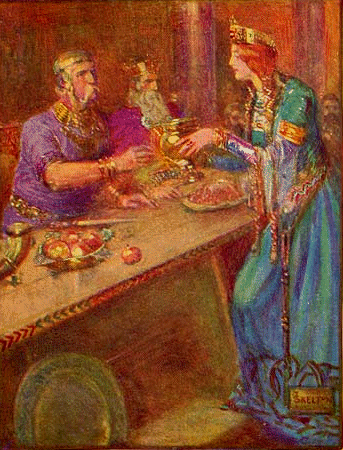
King Hrothgar and Queen Wealtheow
Illustration by J R Skelton
Many years ago, when the Dark Ages held their bleak grip over the Northern Lands, their sat a wise and courageous man on the throne of Denmark. Hrothgar was his name, and Danes far and wide spoke of his valour and glory in the many wars of his reign, and of the beauty of his Queen Wealtheow. The times were good, and Hrothgar celebrated this new golden age with a magnificent banqueting hall, where he could make merry with the boldest thanes in the kingdom. A splendid and awesome sight it was too, towering high, "foremost of all halls under Heaven" and shining with gold. The name of this most glorious hall was Heorot, a name which soon was as revered as its ruler. When Heorot was at last complete and stood proud and tall, many a night of joy and feasting transpired within. As the cold, dark nights drew in beyond its walls, the servants scurried busily through the hall, bearing the most marvellous roasted boars to the many tables in Heorot. The air was rent with the cries of revelry, and the notes struck by the bards of the court, as harp and song could be heard for miles around. This was a place where evil dwelled not, and no blood or wicked ways had yet stained its shining floors. Greatness, however, is always transitory.


Grendel
Illustration by J R Skelton
Far were the sounds of festivity carried from Heorot's lofty heights, to a distant and stormy lake. One night, within the tormented depths of the dark waters, something stirred. Within the blackened waves, an ageless evil made its grim abode. The monstrous daemon within raised a vast eyelid, awoken by the distant song. The sound of jubilation roused a long dormant hatred in the malevolent beast, who was roused to a towering rage by the thought of it. This was a creature of a damned line. A descendant of Cain, the son of Adam who slew his own brother Abel in the Garden of Eden, and was the first to stain the name of man with murder, the monster cursed God, and was cursed by God. The name of this foul hellion was Grendel, he who held man responsible for his own wicked plight, and was the sworn enemy of man. Rising from the churning waters, Grendel made his way through the freezing night, as the blackness closed in. Though gigantic in stature, the daemon made not a sound as he closed in on Heorot, vengeance burning in his fell mind. In the hall, meanwhile, intoxicated by drink and weary with food, Hrothgar and his valiant band lay in a deep sleep, oblivious to the approaching shadow. In deathly silence, Grendel did steal into Heorot, waking not a soul from its stupor. Furious, and hungry, the monster seized thirty of the mighty thanes, savagely devouring each, before striding back into the winter night to his evil lair.


                                 " Then at dawn, as day first broke,
                                    Grendel's power was at once revealed;
                                    a great lament was lifted, after the feast
                                    an anguished cry at that daylight discovery "
                                                - DAWN AFTER GRENDEL'S FIRST ATTACK        


Hrothgar and his loyal subjects awoke to a ghastly sight. The hall, and the men, were spattered with the gore from their own friends. Shattered bones and armour twisted as though of paper lay strewn across Heorot's once spotless floor. Terror and shock descended over the Danes, as not a man had been woken in the night. Helplessness too, infected each man, for none knew what abominable being could have perpetrated such base crimes. What defence was there against a silent, creeping death? The shadow of the night, however, felt no such horror, or mercy. Twice more did Grendel go about his grisly work at Heorot, and soon ninety of Denmark's finest warriors had now known gruesome deaths. After the third night of the horror, Heorot fell silent. That great hall, which so short a time ago had been witness to such joy, was now barren and devoid of life, abandoned in terror of the murderous shadow of the night.


The original manuscript of Beowulf
The 'Nowell Codex'
Twelve long years passed, and the hairs grew grey in Hrothgar's beard, for the once majestic King of the Danes was now weakened with age, and sick with melancholy. The once mighty Danes fell into dark times, crushed under a fear of the night. Then one day a stranger appeared on the Danish coast. A great warrior from Sweden, a hero of the Geats, had heard of the terror which gripped the Danes, and had made leave of his father, Ecgtheow, for Heorot. Renowned in Sweden for his colossal strength, and for slaying many great creatures which plagued the Northern Men, Beowulf rode again, compelled onward by the hand of God. Arriving at the court of King Hrothgar, the great hero bowed, and offered to conquer the beast of the fens, to honour a pact once made between the King and Ecgtheow. It was with great joy that the aged King accepted Beowulf, for word had indeed reached his ear of Beowulf's heroic exploits. That night, Heorot looked something of its old self again, as Beowulf and the Geats made merry in Hrothgar's Hall. A proud yet honorable man, Beowulf declared that since Grendel carried no weapons, so too would he fight with bare muscle, casting aside his mighty sword, a blade that had felled many a giant.


Night fell once again over Heorot, and the sounds of men reached the darkened lake. As though not a year had passed in twelve, Grendel awakened. The Geats in the hall fell slowly asleep, and soon only the great warrior himself was still awake, listening intently for any sound that pierced the night outside. The great wooden door of Heorot crumpled as though paper before the towering daemon, and in an instant, as Beowulf looked on, stunned with shock, the monster seized a poor soul who had lain nearest the gate, and tore his mortal form asunder. Shaken from his trance, Beowulf hurled himself forward, as Grendel's arm, broader than the greatest oak, darted toward another man. With all his might, Beowulf seized the creature's arm in his iron grip. In that moment, a revelation dawned upon Grendel. Never before had he encountered a man with so strong an embrace. Grendel, a fiend that had never known fear, now knew terror. With a roar, Grendel tried to break free, as the warriors in the hall were roused from their sleep. Seizing their weapons, they rushed to the aid of their hero. But no! Some cruel magic reflected each blade from Grendel's flesh:


                                 " Dread numbed the North-Danes, seized all
                                    who heard the shrieking from the wall,
                                    the enemy of God's grisly lay of terror,
                                    his song of defeat, heard hell's captive... "
                                                 - GRENDEL TRIES TO BREAK FREE


Frantic, Grendel tried to break free, in fear of the strength which he had believed impossible in a human, but Beowulf hung on. The bones in Grendel's arm began to crack, and with one almighty wrench, Grendel escaped, but at a terrible price. With a shout of pain, the muscles burst open and the sinews flew apart, as Grendel's arm was torn from its socket, still grasped in the hero's hands. The Geats cheered, as Beowulf stood still clutching his morbid trophy. Broken and weeping, Grendel staggered back to his lair, blood pouring from his mortal wound. Desperate to staunch the blood which fell in torrents, he buried his shoulder in the mud, but to no avail. Grendel, the seed of Cain, died miserably in the lake, and his soul was received in Hell. As dawn arrived, Beowulf was hailed as a hero by the Danes, and Hrothgar showered glittering gifts upon the mighty man, and joy returned once again to Heorot, and the future seemed bright.


Grendel's Mother and Beowulf
Illustration by J R Skelton
But far away, in the blackened depths, a mother clutched her dead son. The mother of Grendel, an even mightier monster than he, looked on her mutilated progeny and shouted vengeance to the coming night. Blackness fell on Heorot once again, as Grendel's Mother smashed her way into Hrothgar's Hall, seizing his most favoured retainer, Æschere, and marching off into the night. Coming to the banks of her lair, she tore the great warrior's head clean from his body, burning with rage at her lost son. Dawn arose once again over Heorot, and not for the first time to the cries of fear."Will our anguish never end?" King Hrothgar despaired to Beowulf. The Danes begged Beowulf to save them once again, gifting him a sword, Hrunting, a blade that had conquered many a foe. Worried that this time he may meet a foe beyond his means, Beowulf set forth from court, determined to vanquish the shadow over the land once and for all. Coming to the edge of the rippling lake, Beowulf and his Geats found the severed head of Æschere, and their spirits were hardened by anger. Bidding his valiant warriors to stay at the surface and watch for him, Beowulf plunged into the stormy lake, resplendent in a shining breastplate and helm, Hrunting at his side. Nigh on a whole day passed before the great hero spied the bottom of the dark lake, when suddenly a grotesque hand seized him, and pulled him to the depths. Though her grip would powder the bones of a normal man, Beowulf's cuirass deflected her crushing strength this time. Dragged into a mighty, vaulted cavern, Beowulf saw her, the monstrous mother of Grendel. As she darted towards him, her hideous face contorted with rage, Beowulf swung desperately with Hrunting, but no! The great blade clanged harmlessly from her neck, failing him in his hour of need. Furious, Beowulf hurled the sword away, as it went spinning into the darkness. Diving, he seized hold of the demonic lady, but not this time would muscle prevail. Effortlessly, she cast him away, as he stumbled and fell to the dank floor. In that moment Beowulf would have met his end, had God not deflected her lethal dagger. Fear surging through him, Beowulf lunged at the cavern wall, where stood arrayed the creature's own weapons:


                                 " Then Beowulf saw among weapons an invincible sword,
                                    wrought by the giants, massive and double-edged,
                                    the joy of many warriors; that sword was matchless,
                                    well-tempered and adorned, forged in a finer age,
                                    only it was so huge that no man but Beowulf
                                    could hope to handle it in the quick of combat..."
                                                     - BEOWULF'S LAST GAMBLE


Taking up the gargantuan blade, Beowulf swung for his life, and with a terrible crack, the monster's head soared clean from her shoulders, and her broken body fell at his feet. With a shout of triumph, Beowulf rejoiced in his victory, as the storm that churned the lake at last subsided, the shadow retreated, and the sun beat down upon the land of the Danes. At long last, after twelve long years, the evil had been cleansed, and Beowulf's name was now legend...

The poem of Beowulf is arguably the cornerstone of English literature, the first great epic poem to be written in English, over one thousand years ago. Short enough to be read in a couple of nights, yet packed with the wisdom of England's oldest poets, and as cheap as a cinema ticket, Beowulf is well worth giving a go!

United Kingdom

Penguin Classics:
Beowulf: Verse Translation (Penguin Classics)
(A version which is close to the original, yet may be a bit archaic for some)

Oxford World's Classics:
Beowulf: The Fight at Finnsburh (Oxford World's Classics)
(A poetic and easy to read version)

United States

Penguin Classics:
Beowulf: A Verse Translation (Penguin Classics)
(A version which is close to the original, yet may be a bit archaic for some)

Oxford World's Classics:
Beowulf (Oxford World's Classics)
(A poetic and easy to read version)

Wednesday, 29 September 2010

The tale of King Harald Hardrada

King Harald Hardrada (wielding battleaxe and clad in red)
Taken from 'The life of King Edward the Confessor'.

The year 1066 AD will always be associated with the Battle of Hastings, and the triumph of Duke William of Normandy over King Harold Godwinsson of England. So much so that 1066 is the most famous date in history, heralding the end of the ‘Dark Ages’ and the beginning of the Medieval Kingdom of England. Less well known however, is one of the major reasons for the English defeat at Hastings, that of the other invasion of England in the Fall of 1066. Fewer of us have heard the name Harald ‘Hardrada’, and know him simply as the Norwegian King who died at the Battle of Stamford Bridge less than three weeks before Hastings. Yet King Harald III Sigurdsson (the epithet Hardrada was given later, and is Old Norwegian for ‘hard ruler’) was a legendary figure in the Scandinavian lands, even before his fateful decision to press his claim to the English throne.

Harald was born in 1015 AD, the youngest son of the recently elected King Olaf II of Norway (who would later be canonised). His father’s rule was unstable, since these were changing times for the Scandinavian Lands. Olaf was trying to convert his subjects to Christianity, and meanwhile the Danes, losing ground in England, were looking to lands closer to home for conquest. In 1028 AD the alliance of the King of Denmark, Cnut the Great, with rebellious jarls (nobles) in Norway forced Olaf and his sons into exile. Not until 1030 did he return, making a last effort to reclaim his throne. The effort came to war, and at the Battle of Stiklestad in 1030, Olaf was killed. Harald, only a boy of barely fifteen, fought alongside his father in the battle too and was badly wounded.

The land of Sicily, where Harald distinguished himself
Photograph by the author.
Harald barely escaped with his life, and with the scattered warriors still loyal to him, he fled to the land of the Kievan Rus (what would later come to be called Russia). Harald and his retinue served the Grand Prince in his wars against Poland as hired mercenaries for several years, before their wanderings took them South, to Constantinople and the Eastern Roman Empire. The Emperor, mistrusting his own Greek bodyguards, who had felled many a ruler before him when they felt their pay was inadequate, formed a new guard composed of exiled northeners from the Viking and Saxon realms. This would later become the feared élite corps of the Roman army, the Varangian Guard. Harald and about five hundred survivors came before the Emperor Michael IV and the Empress Zoe and pledged their service. The Empress accepted immediately the pledge of so noble a man. His charisma, valour and ingenious stratagems soon won the admiration of the Varangians (and Roman chroniclers), and before long, Harald himself had risen in the Roman court to a command of the Guard. Again and again he proved his bravery, in campaigns as far away as Sicily, Italy and Bulgaria in the Emperor’s service. Soon Harald was a wealthy man, and could at last try to reclaim his righful place as King of a faraway land.

In 1042, Harald appealed to the Emperor for release from service. The Empress Zoe was angered, as she had hoped that Harald would have wed her, and tried to prevent his escape. But with the loyalty of the Varangians, Harald was not to be stopped. He stole away from Constantinople, sailed up the Bosphorus and travelled back to Scandinavia through the Eastern Kingdoms. He found Norway under the rule of his illegitimate brother, Magnus the Good. The two shared power, until in 1047, Magnus died and Harald was at last crowned King Harald III of Norway.
The next fifteen years passed with constant war with Denmark, until Harald at last gave up his claim on the Danish throne in 1062. But not long after, suddenly, a new opportunity presented itself. Arriving in Harald’s court, a man by the name of Tostig brought news of the death in England of King Edward the Confessor. Tostig revealed to Harald that he was brother to the new King Harold Godwinsson, and pledged his support and that of the majority of the chieftains of England should Harald seek the English throne. It transpired that Tostig had actually put the same offer to King Svein of Denmark, only days before, but was turned down. Harald, intially uneasy about the venture, soon gave in to Tostig’s persuasion, and agreed to once again open Norway’s claim on the throne of England.
The omens were bad. More than once did Harald have terrifying visions of impending doom, especially after the invasion was launched in the Fall of 1066. One soldier, onboard ship to the British Isles, had a vision of a troll (a fell creature and harbinger of evil news to the Northmen) who chanted:
“Norway’s warrior sea-king
Has been enticed westward
To fill England’s graveyards;
It’s all to my advantage.
Birds of carrion follow
To feast on valiant sea-men;
They know there will be plenty,
And I’ll be there to help them."
                                                - THE OMENS FORTELL HARALD'S DOOM

The portents were bad. Harald stopped in the Shetland and Orkney Islands, receiving reinforcements from both and from the Northern Scottish Isles. The fleet sailed down the East coast, and for now all went well. The Norwegians sacked Scarborough and accepted the surrender of many coastal towns. On the 20th of September 1066, Harald won a heroic victory over a large English army, under Earl Morcar and Earl Edwin, at Fulford. A sizeable portion of the elite English forces lay as food for the crows, and so badly mauled were the Earls’ forces, they were fatefully unable to come to the assistance of King Harold at Hastings three weeks later.

King Harold Godwinsson
Image taken from 'The Life of Edward
the Confessor'.
The King of Norway then marched on York with his forces, and those of Tostig, who had just joined him from Flanders. York offered its surrender, and the next day Harald chose two men of every three in his army to accompany him to formally accept the surrender. It was a hot day on the 25th of September 1066, and many of Harald’s men left their armour behind at the ships, carrying only their helmets, axes, shields and swords. Harald reached the River Derwent and the narrow bridge over it at midday, and was faced with a horrifying sight. King Harold himself had arrived with the English army, all equipped with splendid mail coats and glittering spears. Harald himself likened the sight to one of “a field of broken ice”. Harald however, was a brave man, seasoned by war. He gave the order for his flag, the Landwaster, to be unfurled.

But then, twenty horsemen rode up to the Norwegian lines. One of them spoke out, and demanded to know if Tostig was among them. Tostig shouted his reply that he was. The rider stated that King Harold was prepared to offer Tostig one third of his kingdom if the armies would withdraw. Tostig asked what the King of Norway would receive in return for his efforts. The rider uttered an immortal reply:
“King Harold has already declared how much of England he is prepared to grant him: seven feet of ground, or as much more as he is taller than other men.”

                                           - KING HAROLD GODWINSSON THREATENS THE KING OF NORWAY
The death of King Harald
Painting by Peter Nicolai Arbo.
The rider turned and galloped back to the English lines. Harald turned to Tostig and asked who this well spoken man was. “That was King Harold Godwinsson” replied Tostig, to Harald’s amazement. “What a little man that was; but he stood proudly in his stirrups”, was Harald’s reply. Battle was joined. Many fell on both sides. Indeed, on Stamford Bridge itself, one Norwegian warrior personally slew forty Englishmen. A giant of a man, given over to bloodlust, he single handedly held the bridge against England (echoing the valour of Horatius Cocles, the officer who played an outstanding role in the defence of Rome at the birth of the Republic – whose story can be found here). Not until an Englishman sailed beneath the bridge and thrust a spear through the woodwork and into the berserker’s gut were the Norwegians pushed back. The English feigned withdrawal, and in an ominous foreboding of what would transpire at Hastings three weeks later, pounced upon the pursuing Norwegians who broke the shield wall. Harald was killed by an arrow to the throat, yet still the Norwegians fought on. Norwegian reinforcements arrived from the coast, and hurled themselves to war, preferring to die with their brave King than retreat in disgrace. Yet slowly and surely, the Vikings were hewn down. So terrible were their casualties, that of the three hundred ships which bore them to England, only twenty four were needed to bear the survivors. Just three days later, a desperate messenger arrived and leaped off his horse at King Harold’s feet, frantically shouting that Duke William of Normandy had just landed at Pevensey...
The tale of Harald Hardrada is legendary in Norway, and well recorded in epic poetry and more conventional chronicles. The poem is surprisingly readable and gripping, and is available very easily and cheaply from Amazon:
United Kingdom
Penguin Classics:
King Harald's Saga: Harald Hardradi of Norway from Snorri Sturluson's Heimskringla (Classics)
(Quite short and at a very low price, poetic and epic! My recommendation.)

The Echo Library:
The Anglo-Saxon Chronicle
(More lofty in tone, containing a large history of Saxon England, including the Battle of Stamford Bridge)

United States

Penguin Classics:
King Harald's Saga: Harald Hardradi of Norway: From Snorri Sturluson's Heimskringla (Penguin Classics)
(Quite short and at a very low price, poetic and epic! My recommendation.)

The Echo Library:
The Anglo Saxon Chronicle: A History of England From Roman Times to the Norman Conquest
(More lofty in tone, containing a large history of Saxon England, including the Battle of Stamford Bridge)