Showing posts with label god. Show all posts

Friday, 11 April 2014

Cain and Abel

Though much is written, read, preached and even painted of the fall of Adam and Eve, somewhat less is their fate after their expulsion spoken of. But the trials and pains of the first Man and Woman had barely begun when their teeth first sank into the Forbidden Fruit...

Abel - Son of Adam and Eve
Painting by Theophanes the Greek
Fear and guilt their only companions now, Adam and Eve took their first steps beyond the Gates of Eden, a cherubim hovering high above, sword of piercing fire gleaming bright. Outcasts, accursed and exiled they were, but free. The whole world stretched before them, a world before the dominion of Men. For seven days and seven nights they mourned and lamented in grief. But on the eighth day, the tears stayed their fall, and the blow softened. A new emotion rose within, for in place of sadness their struck the pangs of hunger. For seven days the first Man and Wife wandered the bare land in search of food, a long time indeed for us today, longer still for the couple who once called Eden home. Far and wide they searched and still no food they found. Then at last they came to the Tigris river. Grieving at the pain of loss and pain of hunger, Eve wept by the banks of the great river. Then it was that Satan the Adversary, Lucifer of old, came down to her. With honeyed words the Fallen Archangel soothed her and led her back to Adam, but Adam, fooled once but not again, saw the truth behind the veil of beauty. "Hast thou again been ensnared by our adversary, by whose means we have been estranged from our abode in paradise and spiritual joy?"

It was then that Eve saw through it too at last, and loud was her wail, as she railed against the accursed one "Woe unto thee, thou devil. Why dost thou attack us for no cause? What hast thou to do with us? What hath we done to thee?... Why dost thou harry us, thou enemy and persecute us to the death in wickedness and envy?".

It was then at last that He the Adversary of Man, Satan was allowed the chance to vent his fury upon the two:


         " All my hostility, envy, and sorrow is for thee, since it is for thee that
           I have been expelled from my glory, which I possessed in the Heavens,
           for in the midst of the angels and for thee was I cast out in the Earth...

          ...and Michael the Archangel went out and called the angels saying:
          Worship the image of God as the Lord God hath commanded...
          and I answered, I hath no need to worship Adam..
          Why dost thou urge me? I will not worship an inferior and younger being
          that I, for I am his senior in the Creation, before he was made was I already made.
          It is his duty to worship me... "
               - THE CRAFT OF SATAN

Bided rage and wounded pride did he pour upon the first Man and Woman, his disguises cast aside, Serpent no longer, but Fallen Angel. But near his match was the anger of Adam, who saw the very source of his ruin before him now. "O Lord my God, my life is in thy hands. Banish this Adversary far from me, who seeketh to destroy my soul", spake he, and in that moment the Lord of Hell vanished from sight, the gentle breeze all that punctuated the silence. But a moment had passed when a flash of light heralded the arrival of the Archangel Michael, who bore the pity of Heaven to the first couple, and unto Adam he imparted the knowledge of the land, how to work it, and how he might grow food from it so that he might be sustained. To Eve he brought tidings of coming pain, "Prepare thee to bear", said he, and to Heaven he swiftly returned.


The Fratricide of Cain
Painting by Peter Paul Rubens
Adam beheld his wife and saw she was with child, and soon enough the progeny was born who would bring such disaster to the Line of Adam. Upon the grass the babe lay, and in his tiny hand he took a blade of grass, and eagerly gave it to Eve. To him they gave the name of Cain. It was not so long later that Eve gave birth again, to a son again. To him they gave the name of Abel. But the birth was far from easy, for a terrible nightmare afflicted Eve. A gory phantasm had emerged in the blackness of her dreams, the blood of her newborn son in the hand of Cain, and her first born was gulping it down as a ravenous beast. From whence, or whom, this ghastly vision had been sent, was a mystery, though it came when the Morning Star was at its brightest. The last time so wretched a vision had come to her, terrible indeed were the consequences...

Adam, fearful of this premonition, acted swiftly, determined to avoid further catastrophe in their lot in life. He decreed that the boys would be separated from each other, and each would live in his own dwelling. Adam raises Cain in his own ways, a tiller of the ground and tender of Earth, whilst Abel becomes a shepherd of his flock, caring for his sheep.


Adam and Eve weep over the body of Abel
Painting by William-Adolphe Bouguereau
So the sons of Adam grew strong, and under their care the earth grew bountiful in Cain's flora, and Abel's fauna. But over time, lonely Cain grew envious of his brother and the company of his flock, where he had naught but plants to share his plot with. When the time came to pass, and the first harvest rose from Earth's tilled pastures, Cain offered the bounty of the land to God. When the first lambs breathed the air of the pure skies, Abel offered the finest of his flock unto God. God looked kindly upon the offer of Abel, "but unto Cain and to his offering he had not respect. And Cain was very wroth, and his countenance fell". Feeling humiliation course through him, Cain's anger grew at with injustice. The Morning Star glowed brightly. Denied the presence of God, Cain looked upon Abel, and saw not a brother of his flesh, but one who had taken the favour of the Lord in place of him. Then it was that Cain spake with his brother, and it came to pass that together they walked in his long tamed fields. Brighter still glowed the Morning Star. The fire of injustice burned in the veins of Cain, and, seizing a bough from his own tree, the first born of Adam struck Abel upon his crown, and slew him upon the face of the Earth. His bearing regaining as he panted with the exertion, Cain looked upon the broken corpse of Abel, and an ominous feeling gripped him, as it had his father when the flesh of the apple had touched his lips.

The sky darkened, and the voice of the Lord sounded unto Cain. "Where is Abel thy brother? And Cain spake, I know not: am I my brother's keeper? To him the Lord called, What hast thou done? The voice of thy brother's blood crieth unto me from the ground". Cain fell to his knees, for he knew that nothing could be hidden from the Most High. The judgement of God thundered across the fields of the Earth, "And now thou art cursed from the Earth, which hath opened her mouth to receive thy brother's blood from thy hand; when thou tillest the ground, it shall not henceforth yield unto thee her strength; a fugitive and a vagabond shalt thou be in the Earth...". The punishment was more than Cain could bear, and he feared that any who found him would slay him now. "Therefore whosoever slayeth Cain, vengeance shall be taken on him sevenfold. And the Lord set a mark upon Cain, lest any finding him should kill him".

Banished to the Land if Nod to the east of Eden, Cain set forth upon his ageless exile, unable to face his mother and father after what he had done. So was set the curse of Cain, that would linger in his descendants, that the Great Flood would one day seek to purge. Great was the lamentation of Adam and Eve when they came upon the body of Abel, their son, and sorrow too was to be found even in the eyes of his flock, who wept for their fallen master. But the trials of the first family were far from over...
         

The story of Cain and Abel can be found in the Book of Genesis, Chapter four of the Biblical Old Testament. However, much more can be found in several of the many books rejected from the original Bible, a collection of scripts known as the Apocrypha. Cain's treachery can be found in the following excerpts:


United Kingdom

The Apocrypha
The Sacred Books and Early Literature of the East, Vol. 14 of 14: With an Historical Survey and Descriptions (Classic Reprint)
(Containing many books rejected from the Bible more than a thousand years ago, adding enormously to the stories of Genesis)

United States

The Apocrypha
The Lives Of Adam And Eve From The Old Testament Apocrypha
(Containing many books rejected from the Bible more than a thousand years ago, adding enormously to the stories of Genesis)

Wednesday, 15 January 2014

Orion

Ursa Major was not the only of the great constellations of the night sky to draw the attention of the ancients. Indeed all the major stars and their formations were well known in ancient times. All of them had their own origins and stories well recorded in lore, some in as many variants as the stars themselves. One such example is the story of the constellation Orion.


Blind Orion seeks the rising Sun
Painting by Nicolas Poussin
Long ago in Hellas, a place men now call Greece, there was a divine and regal birth. Brood of the god Poseidon, Lord of the Sea, and Euryale, daughter of King Minos of Crete, this would never be a normal child. Gigantic in stature, like his cousin the Cyclops Polyphemus, the boy towered over all of his peers, in ability as much as height. The boy was named Orion, and though good at heart, warred with the violent instincts that ran through the veins of all the Giants. As a result of his being son of the Lord of the Ocean, Orion found himself one day able to walk upon the surface of the ocean without falling through it - he could walk on water, unmolested by the horrors of the deep. As Orion grew, vaster than any mortal, though not blessed with a great mind he acquired a particular passion for hunting, a noble pursuit for a man in such days, and a way he might turn his aggression away from harming his peers. Soon his reputation was legend even as a teenager, as game fled his presence on sight, for well did they know that no being could escape Orion's hurled spear. In all things, Orion was never to be seen without his one true friend and loyal companion, his hound Sirius.


Searching for distant lands for ever more challenging game, great Orion ventured to the island of Chios, its isolation from the mainland no problem for the water walking giant, carrying faithful Sirius aloft. As Orion placed his vast foot on the sandy shore, he was welcomed to the island by King Oenopion and his entourage. Though much of the regal language was lost on simple Orion, the face of the King's daughter, Merope, was not. Intrigued by the foreign princess, and perpetually condemned to solitude, the giant desired a friend more than almost anything, save perhaps the choicest game under the Heavens. Oenopion invited his larger than life guest back to the palace, and threw a banquet in honour of him, for hospitality is a concept employed by the people of Chios with spectacular finesse. Orion, who had scarcely seen so many great things to eat, was overwhelmed. Due to his requiring more food than most simply to sustain him, the party dined well into the night. The hour grew late, and Merope retired for the night, leaving the revellers to their banquet, and Orion fell sad, though knew not why. The King, ever attentive to his guests, ordered the strongest wine brought to the table. When presented with a bucket sized goblet of shimmering red liquid, Orion knew nothing of it, having never before tasted wine of such potency, and drank as though he would water. The men of Chios laughed heartily, as the giant grew dazed and confused. The drink played its evil tricks on Orion's mind, already at war in the half human and half giant. Stumbling from the banqueting chamber, the drink lead him to Merope's quarters, sapping him of his human will. Crashing through the low threshold of the door, he fell into the princess's bedchamber, to the fright of Merope. As she ran to offer what help she could, Orion, lost to his senses, seized her with more strength than a man should. The racket caused by the door summoned the King immediately. When he saw the sight before him, the darkest suspicions reigned supreme. He at once, outraged at the abuse of his hospitality, ordered Orion condemned.


The Constellation Orion
Photograph by Rogelio Bernal Andreo
The King gave command that Orion should be blinded, so that his last vision would forever be that of the woman he longed for, and forced himself upon. Furthermore, Orion was banished from the kingdom. SO, once again, Orion set out on the road, destitute and ragged, with naught but his torn thoughts of grief and faithful Sirius to accompany him. One day, whilst on Lemnos, he encountered a stranger on the road, a stranger his eyes could not reveal as the god Hephaestus. Hephaestus took pity on the giant, and told Orion that if he sought the rays of the Sun as they were born, he would see again. His despair turned to joy, Orion eagerly asked the stranger where they could be found. Since the giant was blind, Hephaestus gave to Orion his own assistant from the forge, Cedalion. Taking up position of Orion's shoulder, Cedalion shouted directions in the giant's ear, and together they set off in search of the Land of the Sun. The vast journey, impossible for mortal feet, was swift for a giant, aided at all times by Cedalion upon his shoulder, and Sirius by his leg. At last the triad arrived at the Kingdom of the Sun, Cedalion and Sirius averting their eyes, Orion shielding them from the heat. Helios, the god of the Sun, indeed took pity on the giant, and as Orion closed his blind eyes from the heat, suddenly a slit of purest white appeared before him. He wrenched open his lids, and saw blinding light. He turned to his side, and saw a dog, and Cedalion on his shoulder, and rejoiced at his newfound sight. Thanking Helios dearly, the giant was filled with ecstasy.

For so long he had been denied the pleasure of the hunt, his great passion, and set off at once. Coming to the island of Crete, the home of his ancestors, he chased the game from sunrise to sunset. Artemis, the goddess of the hunt, was impressed by the hunter's prowess like never before in a mortal. Coming down to the Earth she offered him a unique honour, to join her in the hunt. He leapt for joy, and the games began.

Hither and thither the godly party went, and never before has so great a quarry been taken in sport. Deer, boar, bird and hare fell to the spears of Orion and arrows of Artemis. Soon near all Crete was empty of living beasts. At the moment of his pride, his giant instinct holding sway, Orion shouted to the Heavens that there was no creature on Earth that he, Orion, could not slay. But the balance of the cosmos had been tipped, that subtle yet ever levelling power which ensured no man or woman could ever be too powerful or too beautiful without disaster befalling them. Gaia, Mother Earth, was appalled at the slaughter on her body, and outraged at Orion's words. So the Titaness crafted a new beast to best the giant in his own game. Eight armoured legs she gave it, two crushing pincers and a lethal tail, brimming with fiery venom. To her new creation she gave the name of Scorpion, and thus was born the first of that race, the King of all Arachnids.


Artemis mourns the body of Orion
Painting by Daniel Seiter
At his side, Orion noticed the ground quake and churn as Mother Earth's revenge burst into the fresh air, divine fury in every inch of its chitinous hide. Orion drew back, wary of this new foe, and never was he to face such a terrible foe. He launched his spear, but alas, it span away, turned aside by the beast's armour. No arrow or blade would pierce that hide. So, across the valleys and mountains of Crete their duel raged, neither one able to best the other, Orion too swift for the creatures arms, the Scorpion impervious to Orion's blades. At last, with no more of the island left to run to, Orion, worked up to a giant's rage, hurled himself upon the monster, using his mighty strength to grapple the beast. The Scorpion writhed and injured the giant many times, but slowly, yet surely, Orion began to crush it inside its own armour. When at last victory seemed near Orion raised his head high and shouted in triumph. But alas, the momentary lapse of concentration cost him dear, for the creature's lighting flash of a move saw its stinger dart into Orion's shoulder, a lethal shot of venom upon its barb. The Scorpion died, but died avenged. Orion staggered away from the body of his conquered foe, the fiery venom robbing him of life. Lamenting his misfortune in life, he sought his last solace in the distraught eyes of Sirius, who licked his master's face one last time. So under the tears of his one true friend, Orion, the great hunter, felt the darkness close on his eyes.


Artemis, lady of the hunt, was devastated when she found his body, and appealed to Zeus the Thunderer, lord of the sky, for mercy. The god of gods was might, but could not turn the wheel of fate. Impressed by Orion's skill, yet warm human heart, he cast the giant into the skies, ever to shine in the night sky. To this day he is still there, the constellation Orion. Impressed too by the fearsome Scorpion, Zeus decided to make sure man would never forget to challenge Mother Earth, and cast it too to the skies. To this day, the constellation of Scorpio can be seen, set to rise when Orion falls. But one fellow lay not forgotten, and for his loyalty to his master and purest heart, Zeus the Thunderer placed Sirius in the skies, and the brightest of all stars he is to this day, amid the constellation of Canis Major...


United Kingdom

The Library of Mythology:
Library of Mythology
(A vast collection of the myths of old Greece, written in ancient times, and a great intro)

United States

The Library of Mythology:
Library of Mythology
(A vast collection of the myths of old Greece, written in ancient times, and a great intro)

Wednesday, 9 October 2013

The Trident and the Spear

Every city which rises to greatness does so from humble beginnings. So high can a nation rise that so mythic can her origins seem. Every great thing, be it a nation, a person, even an idea, has to start somewhere. To our ancestors of old, greatness was a sure sign of favour from on high. For the hand of a god must surely have been at work when one of the most influential cities in human history, for better or worse, was born.


Athena
2nd century AD Roman bust  from Velletri
The Olympians had fought a terrible fight for mastery of the Cosmos. Their forefathers and creators of the Universe, the Titans had not yielded their divine grip easily. After so great a struggle, the harmony of the World was worth more than anything to the gods, even to Zeus the Thunderer, King of the gods and Lord of the Sky. Now fidelity was one thing that Zeus the Thunderer knew not, and many a hero of the ancient world owed his existence to the philandering adventures of the god of gods. It was little surprise therefore, when Zeus undertook a clandestine affair with the beautiful Titaness Metis. However, when the Fates prophesied that the child of Metis would be mightier in spirit and wiser in understanding than its father, Zeus the father of gods and men was convulsed with fear. Long ago, his father Kronos had heard similar words, with dire consequences. The Heavens had groaned under the Titanomachy, and could ill afford so ruinous a war for a second time. So Zeus the Thunderer decided on a little evil for a greater good. Weaving his divine powers of transfiguration, the shape of Metis he shifted to that of a common fly, and the god swallowed her whole, so that she may never give birth to this legendary child.

Time passed, but troubles did not for the Lord of Olympus. As the days grew late, a terrible pain struck the god inside. What began as an ache inside his royal head, soon swelled to a pounding agony that would not die. Time soon came when even the Thunder himself, conqueror of Typhon and Heaven could bear the torment no more, and summoned to his side Hephaestus, the god of the forge and weaver of fire. "Take up thy hammer and rend asunder this head that pains me so, lest this torture afflict me for all the ages to come", said Zeus. The lame god of the smith stood dumbstruck by this command - split open the head of Zeus? But the father of gods and men was inexorable, and irresistible. So Hephaestus took up his hammer and tongs, and with a mighty strike, he breached the Divine Crown. A roar of thunder and a flash of light rolled over the skies. Then, in a blur of speed an apparition appeared. From the fissures in the skull of Zeus there leapt a figure, strongly built yet distinctly feminine, agile yet fully armed, wise yet ready for war, a new goddess entered the cosmos. Athena, goddess of wisdom, mistress of stratagem, lady of the spear and patron of heroes.

Around this time, far below on the mortal plain, the tribes of Attica came together under their King, Cecrops. Born of Mother Earth herself, Cecrops taught the Atticans the still young arts of reading and writing, of literature, of burial and brought the institution of marriage to the tribesmen. Civilisation as we know it, was being born. Soon, however, the simple villages of Attica groaned under the advance of the people, and a new home was needed. Under the leadership of their vibrant King, the Atticans set off through the harsh landscape of Attica, where open plains give way to beaten rock. After a time they came to a place in the West, largely flat yet punctuated by towering pinnacles of rock. The sea lay yonder, yet wise Cecrops knew that to build their new city on the shore itself was too dangerous in an era of rampant piracy on the high seas. Away from the shore then, yet near enough for trade, the people set foot upon a mount with a commanding position over the plain and the sea. Here would be founded their new city, and grandiose would it be. But every new city needed a patron god, but who?


Poseidon
The Artemision Bronze
Word reached Olympus of the gathering under Cecrops upon the Mount. Just then,  the Fates declared that the city that would be founded upon that place would rise to a greatness rivalling the best of all Greece. Glory and honour would walk hand in hand to whomsoever should become her patron. A frenzy gripped Mount Olympus, and the all the divine array wondered. Two among them immediately took the floor. Athena, ever ready with sharpened word and thought, leapt to her newborn feet. But Poseidon, god of the sea, shaker of the earth and lord of horses, bowed to few. Even Zeus himself, King of all gods kept a close eye on his ambitious younger brother, for most vexed was Poseidon when he lost the Heavens in the division of the cosmos. Torn between loyalty to his brother, however unruly, and care for his daughter, despite the danger she posed as his successor, Zeus decreed that the people should decide the patron of their city. Immediately, the two deities spirited down from Olympus and made landfall upon the mountain. With a blinding flash and a roar of thunder, the people cowered at the sight of the divine array. Fearful lest they choose one over the other, the people knew not what to do. Cecrops their King, however, decided. Turning to his gods, he declared that the patronage of the new city would belong to the one who presented the greatest gift to it. Poseidon and Athena, uncle and niece, eyed each other, and readied their contest.


The Sea of Olives, Delphi
Photograph taken by the author
Both god and goddess, stood aside the towering pinnacles of the Acropolis, poised for the prize of glory. Poseidon, shaker of the Earth, took the first move. Raising his mighty Trident high into the air, with a rush of godly strength he plunged the three blades into the mountain side. A deafening rumble rippled across the Earth, and the people were thrown to the ground, terrified. There, where the central prong penetrated the summit (a place today commemorated by the Erechtheion), the wounded rock spat forth a spring of water thick with brine. The Emperor of all Oceans granted to the people the gift of the sea itself, and the assurance that one day they would master it. A fabulous gift indeed. Next the virgin goddess stepped forth. The eyes of Athena looked into the souls of all mortals present, and she senses their hopes and fears. Confident, and unyielding, the daughter of Zeus took up her spear and flung it into the mount. The people watched, entranced, for before their eyes the lance began to shift. The wooden shaft lengthened and broadened, from the blade branches sprang forth, rich with the bounty of its dark fruit. To the people Athena gave the gift of the humble olive tree. Poseidon looked on, bemused and anxious.


Athens at her height
Painting by Leo von Klenze
The primordial Athenians looked on the lowly sprig with wonder and amazement, as the goddess instilled some of her divine wisdom in their minds. Cecrops beckoned his people round to cast their vote. Poseidon's gift was mighty indeed, as was his promise. Mastery of the Ocean? 'Tis the dream of empires! A great destiny had been given to them. But that all looked a long way off to the primitive people, as they looked to and fro, and saw naught but barren rock. One citizen splashed some of the water over his face, and recoiled at its salty taste. The people turned to the sapling, Athena's gift. One fellow took a blackened grape from its boughs, and crushed it in his hands, and oil splashed across his palm. Into his mouth he tossed the olive and pleasing was its taste. Seeing the thick and robust trunk too, he saw the greatness of Athena's gift. Poseidon had given them a taste of great nations, but Athena had given them a source of food, of wood and oil, and something they could trade with others. The people sank to their knees with joy, and hurled themselves at the foot of Athena, daughter of Zeus and maiden of Olympus. Poseidon, god of the seas, was infuriated, but his niece had won the day. Cecrops declared Athena the one true patron of their new city. He declared that this place, the Acropolis, would ever be sacred to her. He declared too, that in her honour the city would be named. To the roar of approval from the first Athenians, he named the city. Athens, the glory of Athena...


United Kingdom

The Library of Mythology:
Library of Mythology
(A vast collection of the myths of old Greece, written in ancient times, and a great intro)

United States

The Library of Mythology:
Library of Mythology
(A vast collection of the myths of old Greece, written in ancient times, and a great intro)

Wednesday, 27 February 2013

The Flute and the Flayed

Ancient lore is ripe with tales of gods and monster, heroes and heroines and their wars, affairs and voyages. Oft is fate written in the stars, virtue praised and pride punished. When mortals rise above their stations, they are punished. But the divine powers are flawed too. Sometimes even the gods could go too far...


Athena
2nd Century AD Roman copy of a Greek original
Legend says that a long time ago, in the Golden Age of the Olympians and heroes, the goddess Athena, daughter of Zeus the Thunderer, was wandering in the sunny vales of the forest of Phrygia. The goddess' chaste ears pricked up at the sound of the birdsong in the breeze, a soothing accompaniment to the percussion of the rustling leaves. Filled with a peculiar joy, she was filled with a passion to make merry in the forest. Taking from the leaf strewn earth the bones of a young doe, the goddess fashioned from them a strange instrument. Whittling a series of pipes from the matter, she lashed them together and considered her new craft. With a modest intrigue, she placed the pipes to her mouth and blew. What a fair sound it was indeed; a soft vibration, a gentle melody and hypnotising note. Spurred on, bolstered by the music of the forest, the virgin goddess could scarcely put them down. Soon her absence was noted on the snowy peaks of lofty Olympus, and gossip flew to and fro, from scheming god and intrigued goddess. All too happy to share her new art, Athena proposed to show them all the sweet sounds at a lavish banquet in Heaven's Halls.


The eve came and the resplendent array of the skies awaited, fascinated by what was to come. When the moment came, the goblets were empty, the ambrosia consumed, the goddess rose to her feet. Brimming with excitement and nerves, she began to play. In the beginning, all was well, as the dulcet tune serenaded the divine array, and seldom were such sweet tones heard in the Palace of Olympus. Zeus the father of gods and men looked merrily on, proud of his daughter's talents. Hephaestus, master of the forge, sat entranced by the music so seldom heard in the roar of the furnace. Ares, lord of war, for whom the screams of the dying were oft his cadence, could scarce hide his delight. But it was then that the eyes of Pallas Athena saw Hera and Aphrodite. Far from listening with rapture, it was with a fits of laughter they returned her song. Though fair and noble, terrible could be the warrior maiden's fury. In anger she departed, seeking solace in the wilderness. When strolling the paths of the Forest of Ida, she stopped by a great pool of glassy water, her joy poisoned by doubt. She took up the pipes once more, and for the last time did she play. In the soft ripples of the water did she see her image cast, and within was held the revelation she sought. She had not noticed until now that as she played, she puffed her cheeks out proudly, their oft white complexion soon a crimson red. Frustrated by the immaturity of her fellow goddesses, with whom she bore a ruinous rivalry, she cast her creation aside. Laying upon the pipes a curse, she vowed calamity upon whomsoever should play them again. Woe that her malediction should have found a mark.


Marsyas in the Forest
Painting by Pyotr Basin
One day, when the memory of the pipes had passed into legend, there lived a shepherd who made Forest of Ida his serene home. His name was Marsyas the son of Oeagrus, and no man was he, but a Satyr. A servant of the god Bacchus, the Satyrs lived a merry life of revelry, dancing and song, frequently spreading havoc and drunken anarchy where their cloven feet trod. Marsyas, however, possessed a gentler spirit, preferring the solitude of the forest to the chaos of the plains. There came a day, however, that neither the Satyr nor the forest would ever forget. Stumbling upon a clearing in the thick canopy of the trees, where lay a crystal pool of ice cool water, Marsyas stopped to refresh. Throwing the pleasant water over his face, he gave a sigh of satisfaction, droplets from his tangled beard breaking the mirror like reflection of the surface. Turning to dry his face, however, he spotted a strange yet curious thing cast in the bushes at the water's edge. Stained with earth and covered in moss, it seemed a relic of an ancient past. Picking the strange object up, the Satyr, acquainted as all Satyrs are with the ways of merriment, realised at once that it bore the form of an instrument. Scraping aside the grime and muck, dousing it in the clear water, he saw the simple pipes in their fresh glory.


Tentatively, the Satyr put the pipes to his lips and blew. The note was rough, but charming. He blew again. Better, but a shade of the performance of the instruments original creator. For an age did Marsyas obsess over the pipes, unable to resist the allure he could not explain, the will to keep playing. Throughout the hours when the sun drenches the Earth did the Satyr practice anew, studious and assiduous. Day by day the Satyr's prowess grew, and with his talent came music sweeter than ever before. Birds began to perch upon nearby boughs, listening intently to Marsyas' song, the notes fairer even than their own. Creatures and being from far and wide began to marvel at the Satyr's song, but before long the curse began to manifest. Pride, the ruin of the great, wove its intoxicating spell in the Satyr's mind, as his humility could deflect the shower of praise no more. Time passed, and soon Marsyas declared himself a musician beyond compare in the world. The fatal hour arrived when the Satyr challenged Apollo, the god of music himself, to a contest.


High on Olympus, Apollo heard his challenge, and the god was angered by the daring of a mortal. Soaring down from the frozen summit, Phoebus Apollo came before Marsyas, and the admiring crowds scattered in fear and awe. Shaking with rage, Apollo declared the contest begun. The Muses, the spirits of the arts, were summoned to judge, and the terms were set. Whoever showed the greater mastery of music would triumph, and the victor won the right to treat the defeated as he pleased. Alas that Marsyas was deaf to the subtle warning that lay veiled within, as the curse brandished its edge, and the proud Satyr accepted. The stage was set. Marsyas took the pipes his beloved pipes, Apollo the lyre with which he was so skilled. The god played first. What ambience the grove had never known! With each pluck of the god's fingers upon the strings, soothed was the soul of all beings present, and the Muses sighed in awe of their master. When the god finished his piece, all gathered saw the end coming for the Satyr. But Marsyas, spurred on by the curse, boldly raised the pipes to his lips. With a jolt the gathered assembly was stunned into silence. With each honey soaked note, the very forest itself seemed to sing, vibrating with raw power. All earthly woes lay distant and forgotten for all mortals there that day, and warmed were the hearts of the Muses. Incensed by fire, alas, was the heart of Apollo. Just as the Satyr neared the boundary of the grove, victory near at hand, the god called to him. If the Satyr could play as he could now, Apollo would concede defeat. Intrigued, yet proud, Marsyas agreed. Without delay did the sun god spin his lyre around, striking a haunting melody, his instrument upside down. The Muses, delighted, applauded the god's performance, before turning to Marsyas, expectant. With a glint of malice in his eye, well did Apollo know that it was impossible to play the pipes upside down. Too late did the Satyr realise this too. His mouth went dry with terror, as the judges were struck with disappointment. To the son of Zeus was triumph assigned, and to the Satyr, ignoble defeat

Marsyas Flayed
Painting by Titian
Near dumbstruck, the Satyr watched helplessly as the god approached, vengeance that only a god could muster flaming in his eyes. Poor Marsyas searched for words but none could be found, none to quench the fire before him now. Hands grabbed him from all around, and terror flooded his veins. Thus was begun a punishment terrible to behold. Strapped to a nearby oak was the quivering Satyr, and tightly bound. The servants of Apollo seized their blades and descended upon poor Marsyas.


                  " 'Why do you tear me from myself, he cries?
                     Ah cruel! Must my flesh be made the prize?
                     This for a mere pipe?' He roaring said,
                     Meanwhile the skin from off his limbs were flay'd.
                     All bare, and raw, one large continu'd wound,
                     With streams of blood his body bath'd the ground.
                     The blueish veins their trembling pulse disclos'd,
                     The stringy nerves lay naked and expos'd;
                     His guts appear'd, distinctly each express'd,
                    With ev'ry shining fibre of his breast... "
                      - THE PUNISHMENT OF MARSYAS


His muffled screams were the last song of Marsyas, raw muscle and tendon bare to the elements now. Such was the justice of Apollo, so great the price of a mortal daring to raise himself above a god.

But not all beings shared Apollo's wrath. The fauns, silvans, nymphs, naiads and spirits of the forest, once serenaded by the Satyr's song, came to his mutilated corpse. Tears flowed from their eyes at their gaping loss, the knowledge that his pure song might never woo them again. It is said that even vengeful Apollo himself was later moved to regret, and not readily did he string his lyre in ages to come, remorseful of his act. "With their tears that flow'd, a kindly moisture on the earth bestow'd, that soon, conjoin'd, and in a body rang'd, sprung from the ground, to limpid water chang'd; which, down thro' Phrygia's rocks, a mighty stream, comes tumbling to the sea, and Marsya is its name..."

Like poor Actaeon before him, Marsyas felt the terrible fate of stumbling innocently in the path of a god. It was the folly of a fool to violate the laws of Heaven, but to challenge them openly, why only those blind to all other things would dice with such death. Nevertheless, even in the ancient world there were many who questioned the magnitude of poor Marsyas' punishment...

United Kingdom

Penguin Classics
Metamorphoses: A New Verse Translation (Penguin Classics)
(A version which favours ease of understanding than high poetry)

Oxford World's Classics
Metamorphoses (Oxford World's Classics)
(A version which favours ease of understanding than high poetry)

United States

Penguin Classics
Metamorphoses (Penguin Classics)
(A version which favours ease of understanding than high poetry)

Oxford World's Classics
Metamorphoses (Oxford World's Classics)
(A version which favours ease of understanding than high poetry)

Wednesday, 20 February 2013

At the foot of the Mountain

Dante & Virgil at the foot of the Mountain
Engraving by Gustave Doré


" To course o'er more kindly waters now
   my talent's little vessel lifts her sails,
   that leaves behind a sea so cruel;

  And of that second kingdom will I sing,
   wherein the human spirit doth purge,
   becoming worthy of ascent to
   Heaven... "
      - DANTE & VIRGIL IN PURGATORY


Dante Alighieri may have endured Hell, quite literally, and all its horrors and chills, but the journey was not complete. It seemed an age since that night he had walked the dark forest path, midway through life, but adventure lay far ahead yet. The terrible retribution suffered by the souls of the damned was but a part of the hand dealt by God to man when the hour of reckoning comes...

Bursting forth from the dank and unforgiving realm of Lucifer's gaol, it was with a deep breath that Dante greeted the cool air again. Noxious fumes and at once stifling heat and piercing freeze was cast aside, replaced by a serener ambience. Stars punctuated the night sky, as both Dante and his guide and master, the mighty Virgil, found themselves at the root of a mountain more vast than any that towered over the world of still breathing men. Down and down in Inferno had they travelled, yet here in the Midworld, the only path lay up. This was Purgatory, neither damnation nor salvation, Heaven nor Hell, here nor there. Here dwell man and woman alike after death, awaiting judgement. Noble yet flawed in life, here they atone for their earthly sins, before they are welcomed in Heaven above. Abandon all hope, ye who enter here, the Gate of Hell had declared. Yet here in Purgatory, it is hope which lifts the spirits of all. For all here will one day enter Heaven, when their sentence is served.


The Death of Cato
Painting by Pierre Bouillon
With a start our pilgrim was made aware of a presence at his side. "Who are ? Ye who counter the blind river, have fled away from the eternal prison?", the stranger barked. None before had broken out of the dark abyss, since when had the damned been cast upon the root of the penitent Mount? "Who guided you?" he demanded. To Dante's rescue, silver tongued Virgil came. "A Lady from Heaven descended, at whose prayers I aided this one with my company", the poet declared. Beckoning at his companion, he argued that as he was not yet among the ranks of the dead, he was not subject to the ancient laws of the afterworld, and he sought only liberty. It was then that Virgil, spying a bloodied wound on the stranger's chest, that he recognised the man. A fellow Roman of yore, there stood before them Cato, staunch enemy of Caesar and Republican to the bitter end, who took his own life at Utica when his designs came to naught, and the Republic of the Romans breathed its last. Virgil informed Cato that Dante lived with hope to see his beloved Beatrice again, high in the Kingdom of Light. The hardened expression on their interrogator softened at once, moved with memories of the Marcia he once knew. "Marcia so pleasing was unto mine eyes whilst on the other side I dwelled...", he reminisced. "Now that she dwells beyond the evil river, she can no longer move me..." he lamented. Go forth, he commanded, and dally not under the command of the Lord. 'Do not return this way, and follow the rising Sun', his last words were. Dante looked at the path ahead. Steep indeed it was. Looking back, Cato's spirit was no more.


The Arrival of the Waiting
Engraving by Gustave Doré
Dawn had broken, and already the Sun had crested the horizon of the endless ocean. Through the haze Mars glowed a burning red, when suddenly a light flashed across the surf, heading to the base of the Mountain. A whiteness, blinding with brilliance, pierced the waves, and Virgil called to Dante "Make haste, make haste to bow the knew! Behold the Angel of God!". The radiance grew, and the craft beached upon Purgatory's shore. "In exitu Israel de Aegypto!", the Heavenly host cried, and from the boat a throng of souls emerged, recently hurled headlong from their earthly bodies. Around in incredulity and puzzlement they gazed. Spotting the two poets not far from they, the spirits rushed to embrace them. "If ye know, show us the way to go unto the mountain", one among them called out to Dante. "Ye believe perchance that we have knowledge of this place, but we are strangers even as yourselves", Virgil retorted. Downcast, one among them suddenly noticed the rising and falling of Dante's chest, and realisation dawned upon his breathless face. Pallid with amazement, they saw that he was still alive, and rejoiced. One moved forward to throw his arms around our pilgrim, but nay, it was not to be. Moved by the kind reception, Dante moved to embrace him too, but only through air did his arms pass. Three times they tried, but hope lay not there. Several among the shades recognise Dante, they were once men of Florence too. The one who would embrace revealed himself as Casella, a friend in life of our poet. Long had he dwelled in the middleworld, and into merry song he burst, flexing the mighty voice he once prized in life. A tear rolled down Dante's cheek at the memories relived, before a growling voice shattered the serenity. Cato spurred them on, urging them not to delay, for nightfall would be coming soon. So with fresh vigour did the ethereal party disband, and higher did they climb.

The path ahead seemed a gruelling one indeed, so steep was the embankment. Dante stuck close to his master, fearful that any slip would send him to the ranks of all around. The blood red rays of the Sun grew dazzling now, as the light flooded over the crags in the mountain. Marvelling at the old poet's agility, Dante suddenly noticed that Virgil cast no shadow in the blazing sun. "Dost thou not think me with thee, and that I guide thee?" Virgil remarked, noticing his anguish. All all too painful reminder it was for Dante, that his newfound friend and master was in fact dead. Since his mortal body long ago vanished, no more could his spirit cast a shadow, in Naples now are his last remains. "Marvel not at it more than at the Heavens", Virgil soothed the distraught Dante, for "insane is he who hopeth that our reason can traverse the illimitable way". Painfully aware that there would come a time when they  must part ways, Dante struggled on up, up and up the endless cliff. Scarcely, it seemed, could any being unequipped with wings ascend it, yet with determination did those two prevail.


After reaching something of a plateau, the two stopped; Dante for breath and Virgil for thought. Then, there on the left, another array of souls approached. As sheep they flocked, for those at the rear seemed oblivious to the matter around them, only following those in front. Timidly holding their heads low, they skulked forward, until the lead spirit, "modest in face and dignified in gait", spotted the shadow cast by Dante's form. With a start he jumped, and so too did his fellows behind, though they knew not why. "Without your asking, I confess to you this is a human body you see", Virgil called to them. By mandate of Heaven had they come this far, and the spirits bowed in recognition, beckoning the way forth.


King Manfred
Image take from the Chronicle
of Giovanni Villani
As they turned to move, however, a soft voice sounded behind. "Whoe'er thou art, thus going turn thine eyes, consider well if e'er thoun saw me in the other world". Intrigued, Dante spun around, to a haunting sight. A fair man stood yonder, with kindly face and blonde hair, one of his eyebrows split by some blow of war. His bearing was noble, no serf this was. Humbly, Dante admitted that he knew the man not. Smiling, the figure revealed the ghastly wound upon his chest, flecked with blood. "I am Manfred, grandson of the Empress Costanza; therefore, when thou returnest, I beseech thee, go to my daughter fair, the mother of Siciliy's honour and Aragon's, and the truth tell her, if aught else be told". Dante, who knew Manfred's tale well, was overcome with reverence. Fifty years earlier, Manfred, son of the Holy Roman Emperor Frederick II, faithfully obeyed his father's will in Southern Italy. It was a time when strife between the Empire and the Papacy was at its zenith, and the territorial extent of the Holy Roman Empire seemed well on its way to reclaiming the glory of its ancient namesake. At 18, his father died and rebellion was raised in the southern domains. Energetic and enthusiastic, Manfred crushed the rebellion in Naples. But Pope Innocent IV, spying an opportunity with the death of his nemesis, Frederick Stupor Mundi, demanded the surrender of Sicily from Imperial hands, intending to gift it to the son of King Henry III of England. Manfred, disgusted by the Vicar of Christ's earthly corruption, refused. Retribution arrived swiftly, a bull of excommunication. He was now a spiritual outlaw, shunned by the Catholic Church, and forbidden from entering Heaven. This was a sentence that made death seem trifling. The Pope deplored his daring to rule beyond papal permission, and his willingness to form alliances with Muslims, and raised arms against young Manfred. But the Imperial Prince was an able leader, and crushed the armies of the Papal States. Not long after, he was hailed by the Sicilians as their saviour and King. Triumphant, Manfred declared his candidacy for his father's throne, that of Holy Roman Emperor itself. The new Pope Alexander IV declared excommunication once again, rallying war against the precocious Prince. Charles of Anjou heard the Pope's call, and marched on Sicily. The two sides met at Benevento, and battle was joined. Outnumbered and overwhelmed, the Imperial forces were broken, but never would Manfred abandon the field. Alone did the Sicilian King hurl himself against the Angevin line, and with great honour his life did wane. Not content with his mere death, the Pope ordered the remains to be dug up and thrown out of the territory of the Papal States.

"Horrible my iniquities had been", Manfred bemoaned, "but infinite goodness hath such ample arms, that is receives whatever turns to it". In his final moments on the field of war, the Emperor's son had prayed to the Almighty for forgiveness. By divine law, those penitent at death, but outside the grace of the Church, must dwell here in Purgatory for thirty times the duration of their time of sin before they are permitted to move on. Serving this time now was Manfred, along with others excommunicated in recent times, and desperate to feel Heaven's light was he. But greater hope remained, for the Almighty had decreed that should any on the earthly plain mourn and pray for the spirit, hastened would his time in Purgatory be.


                                        " See now if thou hast power to make me happy,
                                             By making known unto my good Costanza
                                             How thou hast seen me, and this ban beside... "
                                                   - KING MANFRED'S PLEA


It was then that Dante, so moved by Manfred's tale, realised he had lost track of time, as the day was far advanced now. Something sadder than Inferno seemed at work here. Whereas in the Infernal Pit, men wicked at heart were condemned, here were ordinary, good people, robbed of Heaven's light, sadly delayed from the Judgement. Resenting the interference of the Pope in temporal affairs, and that Italy had never been right since a Caesar had sat upon his rightful throne, Dante was consumed with melancholy. With a start, a nearby soul exclaimed the discovery of the path to the Mountain above. The road grew on, and time could not be wasted. Weirder and more wonderful adventures lay beyond neither here nor there...

United Kingdom

Penguin Classics
Purgatorio (Penguin Classics)
(A translation which retains much of the poetic meter, with good illustrations and notes, as well as the original Italian alongside the English)

Oxford World's Classics
The Divine Comedy (Oxford World's Classics)
(A combined translation of all three parts of the Divine Comedy; the Inferno, the Purgatorio and the Paradisio, all in a highly accessible style)


United States

Penguin Classics
The Divine Comedy, Part 2: Purgatory (Penguin Classics) (v. 2)
(A translation which retains much of the poetic meter, with good illustrations and notes, as well as the original Italian alongside the English)

Oxford World's Classics
The Divine Comedy (Oxford World's Classics)
(A combined translation of all three parts of the Divine Comedy; the Inferno, the Purgatorio and the Paradisio, all in a highly accessible style)

Wednesday, 30 January 2013

Eden Lost

From the moment the apple's flesh touched the lips of Eve, the destiny of Man would never be the same again. Though her corrupter, the fallen angel Satan, suffered even now along his vile brethren in Hell, his evil deed was done. Hope, it seemed, was memory as lost as the Paradise in which it once dwelled...

Adam and Eve in agony
Fresco by Masaccio
As the rift between the Earth and Hell remained open, Sin and Death, the offspring of Satan, seized their chance. Soaring into the as yet still ethereal plains of Earth, Sin spread fear, doubt, envy, anger, sloth, hate, want, pride to ravage the World. Death brings down upon the land the scythe of time, undiscriminating, unbiased and even, bestowing his withering sentence upon all living things. Meanwhile, high above on the highest throne, the Almighty was made aware of this blasphemy. But it was the lot of man, his curse for his breaking the oath of God, to inhabit a lesser World now, until the day cometh when all will be purified. When that day arrives both Sin and Death will be hurled headlong to the dark pit from whence they came. "Then heav'n and earth renewed shall be made pure, to sanctity that shall receive no stain: till then the curse pronounced on both sides precedes". The host gathered sang in jubiliation, wonder at the ways of the Lord, and joyful at the promised time when the blight will be lifted and all will be free. At once the Creator set about making the new world. At his command, the blazing Sun moved, so that the Earth might feel heat and cold, from the south resplendent Summer, from the north Winter scarcely tolerable. To the Moon the Lord set in her place. To the winds he turned next, their way to blast the sea, the air and shore to the symphony of thunder.

Far below in Eden, the first man beheld the coming plight with despair. "O miserable of happy! Is this the end of this new glorious world, and me so late the glory of glory?" The curse of death weighed heavily upon his mind, as his thoughts turned to his descendants. "Who of all ages to succeed, but feeling the evil on him brought by me, will curse my head, I'll fare our ancestor impure, for this we may thank Adam". With anger he railed against the Almighty, anger at his fall for another's sin. Woe that he had been made at all, he declared:


                             " Did I request thee, Maker, from my clay
                               To mould me man, did I solicit thee
                               From darkness to promote me, or here place
                               In this delicious Garden? "
                                    - ADAM BEWAILS HIS CREATION


Adam and Eve expelled from the Garden
Engraving by John Baptist Medina
The loss of Paradise was his sentence, but to this grave retribution the Most High added endless woes. Adam considered, wondering at the ways of God. It was then that Eve, matriarch of man and companion to Adam from whose rib she once sprung, came to him. "God made thee of choice his own, and of his own to serve him; thy reward was of his grace; thy punishment then justly is at his will", she spake.  Willingly to her fate does Eve submit, filled with guilt and devouring remorse is she. Both broken hearted and dejected, lament that it is better to end all and return to the Earth from whence they came, for what left now but a life a shade of before? But Eve held one last hope:


   " Yet one doubt pursues me still,
      lest all I cannot die,
      Les that pure breath of life, the spirit of man,
      Which God inspired, cannot together perish,
      With this corporeal clod... "
                                                                       - EVE'S HOPE


How can the Almighty sentence his creation to torment without end? Adam sank deeper still:


                              " Me now your curse! Ah, why should all mankind
                                For one man's fault thus guiltless be condemned,
                                If guiltless? But from me what can proceed,
                                But all corrupt, both mind and will depraved,
                                Not to do only but to will the same
                                With me? "
                                        - THE DESTINY OF MAN?


Both ponder as to why the scythe of Death has not already struck them, but Death comes not yet. Divine justice it was which slowed her pace, as today, ordered to pronounce her foul sentence without haste. To Adam's restless state Eve sent soothing words which calmed his soul. She remembered suddenly the curse of God. The Almighty spake of a time when the progeny of the first Man and Woman will exact justice upon the Serpent, and righteous retribution will be done by their own seed. Her lowly and newfound humble words touched the anger of Adam, and some small measure of peace returned to him, not known since Eden. No longer could he find it in his heart to look upon Eve with furious eyes. He had eaten of the accursed orb so as to remain with Eve. In this some hope remained. "Eve, thy contempt of life and pleasure seems to argue in thee something more sublime and excellent...". Firm in his resolve, his will restored, Adam declares it is their duty to rid the world of the corruption which their sin brought to the fore. Terrible may be the path along the road to redemption, and long may it be, but at the end of the road redemption remained still. Hope remained. Woman had been cursed to suffer terrible pain in childbirth, but is not such agony soon recompensed by the result? With sweat, toil and grit must man now earn his bread."What harm?", Adam thought, "idleness had been worse". With terrible remorse the first man and woman accepted their fate, hoping upon hope that one day, after their sufferings and prayers, the heart of the Almighty might be moved to pity, and Paradise regained.


The Messiah intercedes
Painting by William Blake
Their repentance, and prayers of humility winged their way to Heaven more swiftly than the loudest acclamation, dampened by no gale until the throne of the Almighty they reached. But it was not God himself who was moved so at hearing their pleas, but his Son the Messiah. Turning to the Father, he spoke with heartfelt words of the pity he felt for the first man and woman. So the intercession of the Messiah was begun, and the destiny of the World set in motion. Hearing the words of Adam and Eve, he spake them anew, and with enchanting charisma, and the will of the Lord began to move. Allow me to stand for him and interpret for him, the Son said. It was then that he made his startling revelation which turned many an angelic head in Heaven:


                    " All his works on me,
                      Good or not good ingraft; my merit those
                      Shall perfect, and for these my death shall pay.
                      Accept me, and in me from these receive
                      The smell of peace toward mankind, let him live
                      Before thee reconciled, at least his days
                      Numbered, though sad, till death, his doom
                      To better life shall yield him, where with me
                      All my redeemed may dwell in joy and bliss,
                      Made one with me as I with thee am one "
                               - THE MESSIAH INTERCEDES FOR MAN


Upon deaf ears the Great Redeemer's words fell not. With calm serenity the Father relented, "All thy request for man, accepted Son". However, no longer may man dwell in the place called Eden, a Garden too pure for man corrupted now with Satan's malevolent touch. Hope remains, in the words of the Lord:


                   " I at first with two fair gifts
                     Created him endowed, with happiness,
                     And immortality: that fondly lost,
                     This other served but to eternize woe;
                     Till I provided Death; so death becomes
                     His final remedy, and after life
                     Tried in sharp tribulation, and refined
                     By faith and faithful works, to second life,
                     Waked in the renovation of the just,
                     Resigns him up with heav'n and earth renewed... "
                              - WHY MEN DIE


But now came the time for man to enter his new abode, to leave his lost Paradise, but forever no more. With a deafening blast the heralds of Heaven rallied the angelic host to the throne of the Almighty, there to await the will of the Divine...


United Kingdom

Penguin Classics
Paradise Lost (Penguin Classics)
(The raw poem in original verse with the commentary at the back)

Oxford World's Classics
Paradise Lost (Oxford World's Classics)
(The raw poem with a commentary on the same page)

United States


Penguin Classics
(The raw poem in original verse with the commentary at the back)

Oxford World's Classics
Paradise Lost (Oxford World's Classics)
The raw poem with a commentary on the same page)

Wednesday, 23 January 2013

Phaethon

Do not take on that which is not meant for you, and leave no advice or warning unheeded. That is the moral of the story of Phaethon. If your identity was suddenly revealed to you as the offspring of a deity, what would you do? Would you be humble or would you be proud?


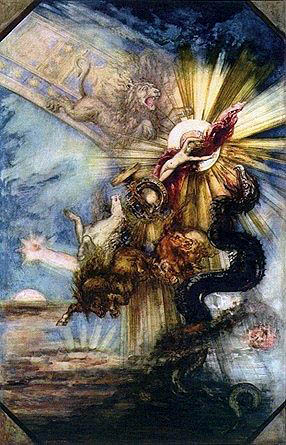
Phaethon Proud
Painting by Gustave Moreau
When Clymene, Queen of the Ethiopians, told her son Phaethon one day that he was in truth not the son of her husband, King Merops, but of the sun god himself, the boy was stunned into silence. Though he had always suspected something was not quite right, something he could never place in all the time he had spent with the King, the words which rang in his ears now still sowed the most profound shock mingled with disbelief. He, just a boy like no other, the son of a god? Not just any god, but Helios, one of the Titans, who ruled in the kingdom of the skies far over the mortal Earth, the very incarnation of the Sun. Disbelief flooded young Phaethon first, doubt close on its heels, as his mother's confession grew stronger yet. A tormented sleep did the young Prince endure, turning in the night, racked with angst. In his good friend Cygnus did Phaethon confide this revelation strange, and his bewilderment at what to do. The two boys marvelled at the possibilities if such a thing could be true. There seemed only one thing for it, and that was to travel to the Kingdom of the Sun and seek out the Titan himself to learn the truth.

Bidding farewell to his native land, to his mother and to Cygnus, Phaethon set forth on his fateful quest, his eyes upon the Eastern horizon firmly fixed. After an age it seemed, the realm of men was falling behind, the realm of the divine approaching. There, just ahead, 'the Sun's bright palace, on high columns rais'd, with burnish'd gold and flaming jewels blaz'd'. The gleam of the surface of the gate, reflected a burning light. Far had the young boy come, too far to turn back now. Upon the solar threshold a weary step the Prince did place, and never again the coolness of night touched young Phaethon's face.

Deeper and deeper into the Palace of the Sun he trod, and higher and higher the temperature soared, until at last, a blinding light of purest white heralded the throne of he, Helios the lord of the Sun. High on his blazing throne he sat, exalted and resplendent, the hours bowing at his hands. The Titan saw the proud youth loitering, "My son!" said he, "Come to thy father's arms! For Clymene has told thee true; a parent's name I own, and deem thee worthy to be called my son":


                         " 'As a sure proof, make some request, and I,
                            Whate'er it be, with that request comply;
                            By Styx I swear, whose waves are hid in night,
                            And roul impervious to my piercing sight.'
                            The youth transported, asks, without delay,
                            To guide the Sun's bright chariot for a day... "
                                     - PHAETHON'S WISH


Immediately did regret flood the Titan's mind, for the one thing of which Phaethon asked was the one thing he was not fit to bear. To steer the Chariot of the Sun was a task entrusted to none but Helios himself, for within was bound grave responsibility, and peril. The Titan, torn between his word and his care for his son, implored Phaethon to choose again. "There is not one of all the gods that dares to mount the burning axle but I, not Zeus himself, the ruler of the sky, that hurls the three forked thunder from on high...". But alas in vain, for the greater the god tried to dissuade him, the grander Phaethon's ambition grew, and his will to resist. "If downwards from the Heav'ns my head I bow, and see the Earth and Ocean hang below, ev'n I am seiz'd with horror and afright", the Titan pleaded, but alas in vain. Terrifying is the Chariot's race across the Heavens, a will of steel needed for such an undertaking as the horses tear through the sky. Helios tried and tried again to convince his son to accept a humbler prize, some kingdom or grand fortune far below in the domain of man, but unmoved was the ambitious prince.

It was beyond the point of return now, the River Styx had heard the Titan's oath. One last plea, one last turnéd ear. So with heavy heart Helios lead young Phaethon to the blazing Chariot, glimmering with gold, spoked with silver and seated with gems. With unbridled joy Phaethon surveyed his prize, his pride gorged. Helios looked up. The stars were receding, the time had come. At his command the hours brought forth the steeds, monstrous horses snorting raging fire. One last chance to save his son, the Titan anointed his body with celestial oil, to proof him against the staggering heat. A tear in his eye, he whispers one last phrase; "Take this at least, this last advice my son, keep a firm rein, and move but gently on: the courses of themselves will run too fast, your art must be to moderate their haste. Drive them not directly through the skies, but where the Zodiac' winding circle lies...". Phaethon offered his thanks, which the Titan with remorse received.

Phaethon Falls
Painting by Johann Liss
The mighty stallions neighed with restless wanton, flames roaring from their mouths, stamping upon the clouds. The time had come. Night gave way, and together they hurled forward as one, the beasts thundering forth, Phaethon soaring through clouds and breezing air. With dizzying speed they outstripped all winds. Though a little light for the Chariot, at first the Prince rode well, heeding the Titan's word. Following the course of the Zodiac, the Chariot moved with irresistible, yet steady, force. But as time passed, Phaethon grew proud of his feat, to equal the Sun god himself? The monstrous steeds sensed weakness in the hand of their master, and their unruly nature took hold. As soon as the Prince's gaze was turned, violently did they veer from the Zodiacal path. Pandaemonium reigned in the skies that day. Phaethon was cast against the Chariot's fore, and knew not which way to turn, whether to yank the reins or let them lie. The horses charged above, and the Sun veered to the stars, which retreated before its fiery heat. Far below ice with frozen hand began to throttle the land, snow fell upon the peaks and Oceanus shivered.

Far above, Phaethon looked behind, and saw the vast expanse of the Earth falling away behind him, panic stricken now. Pulling hard upon the reins, he tried to restore control. The horses, incensed, bolted to the side and careered toward the Earth:


                " The clouds disperse in fumes, the wond'ring Moon
                   Beholds her brother's steeds beneath her own;
                   The highlands smoke, cleft by the piercing rays,
                   Or, clad with woods, in their own fuel blaze.
                   Next o'er the plains, where ripen'd harvests grow,
                   The running conflagration spreads below.
                   But these are trivial ills: whole cities burn,
                   And peopled kingdoms into ashes turn... "
                           - THE EARTH SCORCHED


Down and down the Chariot plummets, and the incredible heat takes its fiery toll on the world. The high mountains buckle in the inferno, snow replaced with flames. The Ocean boils, and Poseidon the Earthshaker, god of the sea, brandishes his trident in defiance. Monstrous Typhon, deep below the Earth, grows restless in his infernal prison, and Mount Etna above explodes forth with redoubled fury. Even far off Scythia on the nomadic Steppe sees her frosts melt, and her plains burn. Verdant Africa bore the brunt, and ever after has been a mighty desert. Great Olympus, towering high above, shakes, as the rocks splinter and rend asunder, wreathed in fire. The world burns, and flames lick the Heavens. Mother Earth screams in agony, her ashes floating to the stars. Phaethon beheld the devastation before his eyes and realised the folly of his wish. The furnace heat of the world reached the sky, and the axle of the Chariot began to glow. The Euphrates fleed, the Danube too, the swollen Ganges, the Tiber, nurse to a promised Empire, too. Even the mighty Nile retreated in terror, and the seas plunged. The intense heat cracked the Earth, and fissures began to split it apart. Deep in the Underworld, pallid Hades recoiled from the light his kingdom knew not.

At last Gaia, Mother Earth, could bear no more. Denouncing the Olympians for allowing such a tragedy come to pass, she called upon her grandson to act. So did Zeus the Thunderer, King of gods and men, summon the divine array. Helios came before Zeus and tried to move his heart, but no ally did the Titan find. Taking up his burning throne, Zeus seized a bolt of thunder which glowed brighter even than the Earth. "Then, aiming at the youth, with lifted hand, full at his head he hurl'd the forky brand". The deadly dart of Heaven arced across the sky, striking Phaethon square in the head. At once from the shackles of life and the sun god's chariot was the Prince thrown. The horses charged back to the hands of their true, but weeping, master. The flaming body of Phaethon fell through the skies, gold and wheel falling too. Like a dying star he plummeted to the Earth his folly had ruined, until his ruined body struck the Po in the West.

Never again would someone dare such hubris as to emulate the Sun, and never again would a god make so bold an offer. Far below, few wept for Phaethon, cause of such ruin, except one. By the water's edge Cygnus sat, tears in his eyes for his friend. All their lives they had been partners in crime, mischievous together, now separated by Zeus's hand. The gods heard him weep, and pity moved their hearts. At their command his form was changed. Where once there were hands, now wings, where once mouth, now blunted beak, where once flesh, now pure white feathers. Ever after, the youthful swan has borne Cygnus' name...


United Kingdom

Penguin Classics
Metamorphoses: A New Verse Translation (Penguin Classics)
(A more prosaic and easier to understand version of the Roman poem)

Oxford World's Classics
Metamorphoses (Oxford World's Classics)
(A high poetical version of the Roman poem)

United States

Penguin Classics
Metamorphoses (Penguin Classics)
(A more prosaic and easier to understand version of the Roman poem)

Oxford World's Classics
Metamorphoses (Oxford World's Classics)
(A high poetical version of the Roman poem)