Showing posts with label Artemis. Show all posts

Wednesday, 15 October 2014

The White Raven

Coronis
Painting by Adam Elsheimer
Though a beautiful land of vast plains and towering mountains, Thessaly, in northern Greece, held a dread curse over her ruling house. The house of Phlegyas was damned by Olympus, as the King of the Thessalian Lapith tribe had blasphemed terribly against the most high. Both children of Phlegyas would feel the wrath of gods. The King's son, Ixion, dared vengeance upon Zeus himself, and was now condemned to be bound to a wheel of fire that roared through the vaults of Heaven until the end of times. The fate of the King's daughter, Coronis, hung in the balance...

The maiden of Larissa, the hand of Coronis was sought after far and wide, by mortal, and immortal. But far from winning the hand of any earthly prince, she won something more - the heart of the Sun god himself, Apollo the son of Zeus. While travelling with her father to the land of the Epidaurians deep in the Argolid, when alone one night, the son of Zeus came down to her from on high. Finding the Thessalian princess alone from her kin, out of sight and out of earshot, the god made his strike. Coronis, overwhelmed by the glory of an immortal god, succumbed to the allure of the son of Zeus.

Some months passed, and soon time bore witness to the swell in the belly of the Larissan maid. Apollo, son of Zeus and lord of light, rejoiced at the coming of his child. Commanding his faithful servant, a raven of purest white, he bade the bird keep watch on Coronis, and bring tidings of her to Olympus. Down to the earthly plain it flew, a glimmer of white, for in those days of old the raven was as white as the first winter snow, and 'soft as the swan'.


              " But his own bird the raven chanc'd to find
                The false one with a secret rival joyn'd
                Coronis begg'd him to suppress the tale,
                But could not with repeated pray'rs prevail "
                     - THE RAVEN UNCOVERS THE INFIDELITY OF CORONIS


Grim were the tidings indeed, for it seemed the absence of Apollo had hit Coronis hard. The Thessalian princess had since fallen for Ischys, a Thessalian boy, and it was her meeting with the lad that the snowy raven caught sight of now. Cold dread flooded him icier than the snows like which he seemed. The raven agonised over what to do, should he defend his master's honour, and furiously peck the stranger away? Should he chastise Coronis for dishonouring the father of her unborn child? Should he do nothing? At length, the mischievous nature of the raven took flight, and the snowbird soared to the skies, hurtling to the Kingdom of the Sun.


            " The raven to her injur'd patron flew,
               And found him out, and told the fatal truth
              Of false Coronis and the favour'd youth "
                   - THE RAVEN REVEALS CORONIS

Terrible was the fury of the god, cuckolded by a mere mortal, and worse, when the lady was with his child. All colour drained the Sun god's ever youthful complexion bar the red of rage. Madness of jealous anger flooded him, banishing afar reason and good sense. His radiant hand as a flash of his father's lightning darted toward his bow, the dread of giants and all creatures of darkness. With a scream, he wrenched the string back, feathered arrow nocked, and released. Sure and true, the golden dart raced through the Heavens and Earth, and transfixed itself in the breast of Coronis. Where once the sun god had touched in life, he now struck in death. To her knees fell the maiden of Thessaly, gentle groans, and no words, as her life-force trickled out from the burning wound. Apollo's fire grew not cooler, but hotter still, as he found no release from grief at his fell deed. As her soul leaked from her wound, Coronis cried with her last breath:


          " Ah cruel god! Tho' I have justly dy'd,
            What has, alas! my unborn infant done,
            That he should fall, and two expire in one? "
                    - CORONIS' PLEA

The Argolid
Photograph taken by the author
With that, her noblest words, she departed life, as the fires of the sun god's dart consumed her mortal form. Her words pierced both fire and sky, and reached Apollo's ears. A thundering remorse pulsed through him, as he was seized with grief and regret. So great was the heat that emanated from within him the snowy raven was scorched, his magnificent plumage, once pure as hope, now blackened with grief. Charred deeply, from that day the raven and all his descendants would bear the mark of that day, and that is why the raven has black feathers. Soaring down to her body, the sun god heard the cries of a baby, and resolved to protect the child. The son of an immortal god, the child could not die, alas her mother bore not the same shield against Death. From amongst the embers, the screaming child was ripped, a ray of the sun god's hope. To him was given the name of Asclepius, who would one day be the god of healing and rejuvenation. Apollo set him in the land which conceived him, the land of the Epidaurians in the Argolid, there to be raised by the finest tutor of the age, the centaur, Chiron, who had taught Achilles himself. For the god of healing, it was the beginning....


United Kingdom

Penguin Classics
Metamorphoses: A New Verse Translation (Penguin Classics)
(A version which favours ease of understanding than high poetry)

Oxford World's Classics
Metamorphoses (Oxford World's Classics)
(A version which favours ease of understanding than high poetry)

United States

Penguin Classics
Metamorphoses (Penguin Classics)
(A version which favours ease of understanding than high poetry)

Oxford World's Classics
Metamorphoses (Oxford World's Classics)
(A version which favours ease of understanding than high poetry)

Wednesday, 23 July 2014

The Lycian Peasants


Leto in the Wilderness
Artist Unknown
Mother to two of the greatest of the deities of Olympus, the Titaness Leto was a force to be reckoned with. Niobe had felt her dread wrath, and that of her brood. The daughter of the Titans Coeus and Phoebe, much of her origins were shrouded in the mysteries of Asia. Though when at last a maiden of Heaven she became, and the eyes of Zeus the Thunderer met her gaze, revealed at last was she. Hera, Queen of the gods, ever paranoid of the wandering affections of her consort, hounded Leto across the face of the Earth. Heavy with the seed of Zeus, Leto grew weary of the chase. Enraged, Hera ordered the Fates to forbid Leto to give birth on terra firma under the Sun. When at last the pains of labour struck, with nowhere else to turn, turned away by the vile words of Hera, the Titaness came to the island of Delos. Finding a measure of peace at last under the weeping boughs of a forgotten glade, the goddess fought that ungodly pain. First came forth Artemis, the lady of the moon and hunt. Nine days and nights the Titaness laboured still, until with the help of her daughter, a twin was brought into the world -  Apollo, god of light, healing and truth. Sympathetic nymphs, naiads and dryads had shielded Leto from the servants of Hera, but when the screams of the newborn deities pierced the skies, the lady of Olympus was made aware of them, and seethed with rage once more. Vowing never to give Leto rest, She sent forth all manner of dark creatures to hound her and her brood. Far and wide she fled, desperate for respite.


Leto Fountain, Palace of Versailles
Photograph taken by Daniel Gaudry
"At last, outwearied with the toil, and parched with thirst", the exhausted matriarch came to the arid and harsh land of Lycia, where once the fearsome Chimaera had once tread. A blasted land, with little verdance in its hills, the eyes of Leto spied a rare pool of crystal water. Parched with thirst, it played on her mind as the mirage does on the desert traveller. Shimmering in the light, the parched Titaness could resist no longer, and sped with all haste to its banks. Some of the rustic folk of Lycia were there at the lake's shores, reaping the bending osiers, the dank bulrushes and fragrant weeds. The Lycian folk, a people not known for their warmth of hospitality with strangers, eyed the stranger with deepest suspicion. A threatening buzz arose from within their wretched ranks, as Leto came in her approach. Wearied and near broken with toil, she eyed the peasants with more than a dash of humility. They angrily called out to her to stay away, and come not near the crystal waters, so wickedly opposing her primal need. Leto called out to them:


                   " Water I only ask, and sure 'tis hard
                      From Nature's common rights to be debarr'd,
                      This, as the genial sun, and vital air,
                      Should flow alike to ev'ry creature's share.
                      Yet still I ask, and as a favour crave,
                      That which, a public bounty, Nature gave... "
                             - LETO'S PLEA


Leto desperately invoked the pity of her newborn twins, yet still the fiendish folk would not desist, nor with vulgar words restrain. Young Apollo stretched out his arm in supplication, a mere baby, yet no more than his mother's word to the hearts of the Lycian peasants could it reach.

Feeling the pains of dehydration now, Leto moved to cup the crystalled water in her hands, but the dastardly folk spoiled her relief. Foul, abusive words they hurled, and worse still "with spiteful feet the villains trod, over the soft bottom of the marshy flood, and blacken'd all the lake with clouds of rising mud". A once crystal lake was now a murky depth, its purity defiled by the evil whims of a hostile crowd.

The Transfiguration of the Peasants
Painting by Johann Georg Platzer
Now the desperation of a Titaness turned to rage, as "her thirst by indignation was suppress'd". Vengeance coursed through her godly veins, all worries of hydration cast aside as the serpent sheds his skin. The frustrations of long chase, the pains of twin labour and the pangs of thirst mingled as Leto cast her gaze to the Heavens. "May you live, she passionately cry'd, doom'd in that pool for ever to abide". No sooner had her words of wrath left her parched lips, than the wretched folk dived into the pool, void of all shame. To the murky depths they plunged, and as swiftly as they fell, their last vestiges of humanity were gone. When next they pierced the crystal surface, no shouts of insults would come forth, but instead a hoarse croak. Wrenched wide by their bawling, their mouths grew cavernous; a mottled green, their backs. Seldom to see the light, their bellies grew a pale white, their eyes wide and alert. Men and women no more were they, but frogs, condemned forever to dwell within the mud...


United Kingdom

Penguin Classics
Metamorphoses: A New Verse Translation (Penguin Classics)
(A version which favours ease of understanding than high poetry)

Oxford World's Classics
Metamorphoses (Oxford World's Classics)
(A version which favours ease of understanding than high poetry)

United States

Penguin Classics
Metamorphoses (Penguin Classics)
(A version which favours ease of understanding than high poetry)

Oxford World's Classics
Metamorphoses (Oxford World's Classics)
(A version which favours ease of understanding than high poetry)

Wednesday, 11 June 2014

The Children of Niobe


The Children of Niobe
Painting by Jacques Louis-David
Cursed indeed was the House of Tantalus. A divine and royal line descended from Zeus the Thunderer, polluted by murder and betrayal. For Tantalus, the King of Phrygia, had dared to deceive the gods, had slain his own son and now lay condemned for eternity in the dark unyielding night of unholy Tartarus. Yet far above the blackened plain the accursed king left a daughter, Niobe, a sister to Pelops. Alas that the sole heiress to the line inherited her father's pride! For oft did Niobe dare to think, that she and she alone stood high as the gods, oblivious to Arachne's fate.


There came a day in that Phrygian city, as all years, when the folk gathered from across the land to honour Leto, the Titaness upon whom the eyes of Zeus had once lingered. Hither and thither the Phyrgians strayed, all the land caught up in the hustle and bustle of festival & ceremony, song and dance.  But one among their kind was far from awash with joy, as among the royal guard there appeared proud Niobe bedecked in state., "and mad with rage, yet lovely to behold". Never forgetting her father's fate, a wrathful contempt had she for the Olympians high above. Why do these fools worship the reckless gods above, said she, with a house as mighty as hers within plain sight. Her line, who had dined with gods, held Phyrgia within her grasp, knew the Titan Atlas as an ancestor who bears the Heavens above, and groaned beneath the riches of Asia? Why look to the distant gods beyond, when all this lay here and near? But of no thing was Niobe more proud than the children she bore:

                   " Seven are my daughters, of a form divine,
                     With seven fair sons, an indefective line...
                     There Leto a mother was, of two at most,
                     Only the seventh part of what I boast.
                     My joys are all beyond suspicion fix'd,
                     With no pollutions of misfortune mix'd,
                     Safe on the Basis of my pow'r I stand,
                     Above the reach of Fortune's fickle hand... "
                            - THE HUBRIS OF NIOBE

Far beyond and high above, atop the shady Mount Cynthus the goddess lurked, and clear as daylight did she hear the wicked words. A godly anger rippled through her form, Niobe's offence driven deep to her heart. To her two great children, Apollo and Artemis, she turned. "Nay more, the imp of Tantalus has flung reflections with her vile paternal tongue; has dared prefer her mortal breed to mine, and call'd me childless; which, just fate, may she repine!". In haste golden Apollo set about his vengeful mission, hearkening to his mother's will. Swift behind soared Artemis the lady of the hunt, whose deadly wrath mortals had come to fear.

The Dying Niobid
Sculpture by James Pradier
Beyond the walls of the Phrygian city there was a boy riding on the plain. The first of Niobe's brood, Ismenos, sighed deeply, when Apollo's dart speared his breast, and from his towering steed his body crashed. Sipylus next met deadly fate, when upon seeing his brother's end, he dared to flee. As the stormy winds he flew, but Apollo's aim was true. Transfixed in the neck, paralysed he stood, life force leaking where it could. At youthful Phaedimus the sun god took aim, and his brother Tantalus who bore his grandsire's name. Both brothers were wrestling on the plain, straining every nerve and muscle in their game. With a mighty shot Apollo pierced them both, their life turned black as coal, as from their mortal forms fled their soul. Grieving Alphenor saw their plight, beating his chest with sorrow, he moved to embrace the fallen boys, before by keen aimed dart he fell. Pierced through the heart, for Apollo had aimed for no other part. Damasichthon next, beardless and young, cried out for mercy, but alas the god heard him late. Two arrows sheared his form, one the knee one somewhere warm.

Swiftly did the news reach Niobe's ear, grief and anger mingled into one. But humility she knew not, as towering was her pride still. Poor Amphion her husband, stricken with the darkest thought, had sheathed a dagger and driven into into his breast. Tears streaming from her eyes, Niobe roared in defiance "Tho' seve'n are slain, superior in number I remain". Her daughters looked upon her, seeing the doom their mother had brought on them now. Far above Leto screamed, and to her call deadly Artemis soared. The bow's thunderous twang echoed through the vale, as in terror all wondered what it would hail.

Around the pyres of their seven brothers they stood, seven daughters who need not have suffered, clad in garments of mourning black. From the eyes of one and the eyes of all fell a tear of purest grief. When that one was stung a sudden by more than emotion, the others tried in vain to remove the lethal dart. "But to grim death her blooming youth resigns, and o'er her brother's corpse her dying head reclines". A silent arrow, winged death, arcs through the skies, more cries silenced. The deadly huntress of the moon, so skilled in tracking game, found no challenge in her dark work, as one by one the seven fell, each pierced by a different death.


The Weeping Mountain
Image taken from the Wikimedia Commons
How lamentable now was Niobe's state, hardened with woe, and dying with grief, for my her own word had she condemned herself, and fourteen lives otherwise pure. Her hair moved to no rippling wind, her eyes faded and fixed within her head. Her deadly tongue called no more, within her veins the blood began to stall. Transfixed in stone her body was, atop Mount Sipylus, the Weeping Mountain. Unafflicted by stormy winds, yet pierced by grief and wounded pride, there she stands even today, a warning of unearthly pride, for no rest can she find...


United Kingdom

Penguin Classics
Metamorphoses: A New Verse Translation (Penguin Classics)
(A version which favours ease of understanding than high poetry)

Oxford World's Classics
Metamorphoses (Oxford World's Classics)
(A version which favours ease of understanding than high poetry)

United States

Penguin Classics
Metamorphoses (Penguin Classics)
(A version which favours ease of understanding than high poetry)

Oxford World's Classics
Metamorphoses (Oxford World's Classics)
(A version which favours ease of understanding than high poetry)

Wednesday, 12 February 2014

Atalanta

Strength, wisdom, charisma and valour - all virtues of a heroic persona. But contrary to popular belief, heroism was not a male monopoly in the ancient world, even in Greece. Sometimes a heroine could beat a hero at his own game. No finer an example of this was there than Atalanta.


Orchomenos of fair Arcadia
Photograph taken by Heinz Schmitz
In the idyllic pastures of Arcadia, there was once born a princess to King Iasus. But the King, who desired above all other things a son to continue his Royal House, was greatly dismayed. So the King ordered the baby to be left to die in the mountains, as was custom in Greece at the time for the unwanted (a practice frequently used by the Spartans to deal with deformed children who were believed to be incapable of growing into active citizens - for more on this, read here). But, like the shepherd who was ordered to do the same with young Oedipus, the man tasked with the grisly labour found himself, at the last moment, unable to condemn a child to such a fate. Taking pity on the wailing child, he carried her deep into the Arcadian mountains. Upon the slopes of Mount Partheneon, he struggled up the escarpment, coming to rest near a mountain spring. Reasoning here a better place than many others, the man lay the baby down in the grass, and took his leave. But what the herder had failed to spot was the mouth of the cave beyond the clearing, in the dense scrub.  From deep within the darkness, a furry muzzle emerged. Swift behind it the form of a great bear, a mother who had recently lost her cubs to hunters. Staying her savage instinct, the bear took pity on the feeble child before her, and suckled the child. Taking the child as her own, bear and girl lived together in the mountains.


Over time, Atalanta grew, and learned to hunt and fight as the bear, and became hardened to the world. Slowly, she began to grow into a woman, and a striking one at that. The match of any Arcadian girl in beauty, and surpassing them all in strength, endurance and sheer will. Years of exposure to the Sun had reddened her cheeks, so that she seemed to be perpetually blushing. This was one of her most formidable qualities - the other, was that any man who looked upon her would be at once charmed and stricken with fear, for a reason they would never know. She grew into a truly exceptional hunter, such that the goddess of the hunt herself, Artemis, favoured her greatly. Atalanta valued her solitude in the mountains, and committed herself, like her great patron, to a lifetime of chastity.


Meleager presents the head of 
the Calydonian Boar to Atalanta
Painting by Peter Paul Rubens
There came a time, however, in the kingdom of Calydonia, when a great blasphemy was committed. King Oineus one day gave thanks to the Olympian gods, but became distracted, and forgot to honour the lady Artemis. The fierce huntress was consumed with rage, and to the Calydonian lands she sent a monstrous boar, berserk fury in its mind, to curse the realm of men. Livestock was devastated, crops were destroyed and men sent to slay the beast were gored to death. Soon the whole kingdom was thrown into disarray. King Oineus grieved, and the king's son, Prince Meleager, issued a summons across the Greek world, for the greatest hunter of each kingdom to join him in the hunt. Meleager did not fear the creature, for he had heard a prophecy that his end would only come when a brand that burned in the family hearth would be consumed by fire. What risk lay there in the hunt? Legends had spread to Calydonia of the fierce maiden of the peaks, raised by beasts, and Meleager sent heralds to Atalanta to aid them. Her bear indued hunter's instinct fired, Atalanta agreed to help, and for the first time she descended from the mountains. Meleager, from the moment he saw her, was smitten, and invited her to his hunting party.


With a blast of Meleager's horn, the hunt began. The Calydonian Boar was outlandishly fast, however, and the hunters from far and wide tried in vain to gain on the creature. With all the world's great hunters left in the dust, it was young Atalanta who bore down upon the forbidden quarry now. On the sprint, she wrenched back her bowstring, and loosed a lethal barb ahead. The dart struck the boar and drew blood, the first time any weapon had pierced its hide. Slowed by its wounds, the boar stumbled, and Meleager pounced, slaying it with his spear. Awed by Atalanta, Meleager skinned the beast and offered its hide to the huntress, for it had been she who had first drawn blood. Plexippus and Toxeus, the uncles of Meleager, infuriated that the prize had been granted to a woman, tried to seize it from her. Blinded by passion and shame for the conduct of his family, Meleager struck them down where they stood. It was then that Althaea, Meleager's mother, distraught with grief and anger for her son's deeds, cast a log upon the fire. The ancient prophecy fulfilled, the brand was wreathed in flames, and when the wood burned out, the lifeforce of Meleager waned...


It was then that the legend of Atalanta spread across the land, admiration of her prowess that had shamed the greatest men of Greece. King Iasus heard the tale, and came to her. At once, he saw in her his own line, and rejoiced to see her, grateful now of the daughter he had in place of a son. Yet hopes of continuing his line had not died, and he asked Atalanta to be wed. Atalanta, oblivious to her father's former sentence of certain death against her, and feeling little loyalty to the man, having known only a bear as a parent, said bluntly "I will not be won, till I am conquered first in speed". Having bested the might of Greece in the hunt, Atalanta saw little in the men of the world now. The king proposed a contest among the bachelors of Greece, that they might come from far and wide and win the hand of the greatest huntress of them all. Atalanta half heartedly agreed, but only under lethal terms. The bear's wrath and a hunter's endurance waxed strong that day, for she decreed that any would be suitor would be subject to a grueling ordeal. The course was laid, and the suitor would begin the foot race, unarmed. After a set time, Atalanta would enter the field, and if she caught the suitor before the course bound was met, he would be immediately slain. Should she fail to catch him, that man would be her groom.


Hippomenes casts the Golden Apples
Painting by Nicolas Colombel
Suitors came from kingdoms far and kingdoms wide, drawn by the grisly allure of the prize. From the furthest reaches of the known world, they came in droves, all eager for the huntress' hand, the favoured of forest. Many set forth from the starting line, none ever passed the finish. Many a hope was dashed on the point of Atalanta's spear, as her frustration grew at the lack of true competition. Then one day came the charming and wise Hippomenes, a humble fellow Arcadian. Hippomenes, seeing the dead litter the path to the glade, and pure of heart, prayed to on high for guidance. The goddess Aphrodite, lady of passion, took pity on him, and could not bear to see a pure soul transfixed like so many before him on Atalanta's spear. Just before the race, the goddess gave to Hippomenes three apples of the brightest gold, as alluring to the female eye as the face of Atalanta was to the male. Atalanta saw her new challenger approaching, and fought the instinct within when she looked fondly upon him. Her wild nature took flight once more, and the red descended over her eyes. So the lines were drawn, and the race was begun, and quite literally did bold Hippomenes run for his life. A good start it was, as under the watchful eyes of Aphrodite did the eager boy compete. Then, the blast of the horn, and Hippomenes heard the sound of death begin her march. The heart rending sound of approaching, running, footfalls would have struck cold the hearts of any other man, but not Hippomenes. Fighting fear, and keeping his head clear, he took the first of the blessed apples, and cast it upon the ground behind him.

Atalanta, death in her eyes, caught sight of a glint of gold on the earth ahead, and was intrigued. She came to the source of the light, and bent down to pick it up. She saw that it was an apple, but the most luxurious she had ever seen, and was consumed with desire. Shaking her head, she recalled her task. Stowing the blessed fruit in her tunic, she set off at a sprint once more. But precious time had the huntress squandered in her distraction, for now bold Hippomenes had taken the lead.

Soon, the huntress was hot on the Arcadian's heels once more. Trusting in Aphrodite, with a prayer, he cast the second apple. For a second time, Infatuation conquered Atalanta, and for a second time, Hippomenes widened the lead. Then, the end of the course in sight, Hippomenes rejoiced. His euphoria nearly deafening him, Atalanta was now barely a spear thrust behind him. Trusting the gift for a third time, he released the last of his gilded fruit. Aphrodite blessed the last with the most potent incantation of all, and in the moment of her victory, Atalanta was irresistably drawn to the flash of gold. The split second cost her the last thrill of the hunt, and the foot of Hippomenes fell upon the finishing line. A shout went up from the crowd. A bewilderment came over Atalanta, joy over Hippomenes and admiration over the king. Impressed by the boy's ingenuity, he declared the Arcadian the winner. At last, a king, a huntress, and a farm boy had found peace...


United Kingdom

The Library of Mythology:
Library of Mythology
(A vast collection of the myths of old Greece, written in ancient times, and a great intro)

Aelianus:
Historical Miscellany (Loeb Classical Library)
(A 3rd century AD collection of all manner of weird and wonderful stories, including the most detailed account of Atalanta that survives from Antiquity)

United States

The Library of Mythology:
Library of Mythology
(A vast collection of the myths of old Greece, written in ancient times, and a great intro)

Aelianus:
Aelian: Historical Miscellany (Loeb Classical Library No. 486)
(A 3rd century AD collection of all manner of weird and wonderful stories, including the most detailed account of Atalanta that survives from Antiquity)

Wednesday, 15 January 2014

Orion

Ursa Major was not the only of the great constellations of the night sky to draw the attention of the ancients. Indeed all the major stars and their formations were well known in ancient times. All of them had their own origins and stories well recorded in lore, some in as many variants as the stars themselves. One such example is the story of the constellation Orion.


Blind Orion seeks the rising Sun
Painting by Nicolas Poussin
Long ago in Hellas, a place men now call Greece, there was a divine and regal birth. Brood of the god Poseidon, Lord of the Sea, and Euryale, daughter of King Minos of Crete, this would never be a normal child. Gigantic in stature, like his cousin the Cyclops Polyphemus, the boy towered over all of his peers, in ability as much as height. The boy was named Orion, and though good at heart, warred with the violent instincts that ran through the veins of all the Giants. As a result of his being son of the Lord of the Ocean, Orion found himself one day able to walk upon the surface of the ocean without falling through it - he could walk on water, unmolested by the horrors of the deep. As Orion grew, vaster than any mortal, though not blessed with a great mind he acquired a particular passion for hunting, a noble pursuit for a man in such days, and a way he might turn his aggression away from harming his peers. Soon his reputation was legend even as a teenager, as game fled his presence on sight, for well did they know that no being could escape Orion's hurled spear. In all things, Orion was never to be seen without his one true friend and loyal companion, his hound Sirius.


Searching for distant lands for ever more challenging game, great Orion ventured to the island of Chios, its isolation from the mainland no problem for the water walking giant, carrying faithful Sirius aloft. As Orion placed his vast foot on the sandy shore, he was welcomed to the island by King Oenopion and his entourage. Though much of the regal language was lost on simple Orion, the face of the King's daughter, Merope, was not. Intrigued by the foreign princess, and perpetually condemned to solitude, the giant desired a friend more than almost anything, save perhaps the choicest game under the Heavens. Oenopion invited his larger than life guest back to the palace, and threw a banquet in honour of him, for hospitality is a concept employed by the people of Chios with spectacular finesse. Orion, who had scarcely seen so many great things to eat, was overwhelmed. Due to his requiring more food than most simply to sustain him, the party dined well into the night. The hour grew late, and Merope retired for the night, leaving the revellers to their banquet, and Orion fell sad, though knew not why. The King, ever attentive to his guests, ordered the strongest wine brought to the table. When presented with a bucket sized goblet of shimmering red liquid, Orion knew nothing of it, having never before tasted wine of such potency, and drank as though he would water. The men of Chios laughed heartily, as the giant grew dazed and confused. The drink played its evil tricks on Orion's mind, already at war in the half human and half giant. Stumbling from the banqueting chamber, the drink lead him to Merope's quarters, sapping him of his human will. Crashing through the low threshold of the door, he fell into the princess's bedchamber, to the fright of Merope. As she ran to offer what help she could, Orion, lost to his senses, seized her with more strength than a man should. The racket caused by the door summoned the King immediately. When he saw the sight before him, the darkest suspicions reigned supreme. He at once, outraged at the abuse of his hospitality, ordered Orion condemned.


The Constellation Orion
Photograph by Rogelio Bernal Andreo
The King gave command that Orion should be blinded, so that his last vision would forever be that of the woman he longed for, and forced himself upon. Furthermore, Orion was banished from the kingdom. SO, once again, Orion set out on the road, destitute and ragged, with naught but his torn thoughts of grief and faithful Sirius to accompany him. One day, whilst on Lemnos, he encountered a stranger on the road, a stranger his eyes could not reveal as the god Hephaestus. Hephaestus took pity on the giant, and told Orion that if he sought the rays of the Sun as they were born, he would see again. His despair turned to joy, Orion eagerly asked the stranger where they could be found. Since the giant was blind, Hephaestus gave to Orion his own assistant from the forge, Cedalion. Taking up position of Orion's shoulder, Cedalion shouted directions in the giant's ear, and together they set off in search of the Land of the Sun. The vast journey, impossible for mortal feet, was swift for a giant, aided at all times by Cedalion upon his shoulder, and Sirius by his leg. At last the triad arrived at the Kingdom of the Sun, Cedalion and Sirius averting their eyes, Orion shielding them from the heat. Helios, the god of the Sun, indeed took pity on the giant, and as Orion closed his blind eyes from the heat, suddenly a slit of purest white appeared before him. He wrenched open his lids, and saw blinding light. He turned to his side, and saw a dog, and Cedalion on his shoulder, and rejoiced at his newfound sight. Thanking Helios dearly, the giant was filled with ecstasy.

For so long he had been denied the pleasure of the hunt, his great passion, and set off at once. Coming to the island of Crete, the home of his ancestors, he chased the game from sunrise to sunset. Artemis, the goddess of the hunt, was impressed by the hunter's prowess like never before in a mortal. Coming down to the Earth she offered him a unique honour, to join her in the hunt. He leapt for joy, and the games began.

Hither and thither the godly party went, and never before has so great a quarry been taken in sport. Deer, boar, bird and hare fell to the spears of Orion and arrows of Artemis. Soon near all Crete was empty of living beasts. At the moment of his pride, his giant instinct holding sway, Orion shouted to the Heavens that there was no creature on Earth that he, Orion, could not slay. But the balance of the cosmos had been tipped, that subtle yet ever levelling power which ensured no man or woman could ever be too powerful or too beautiful without disaster befalling them. Gaia, Mother Earth, was appalled at the slaughter on her body, and outraged at Orion's words. So the Titaness crafted a new beast to best the giant in his own game. Eight armoured legs she gave it, two crushing pincers and a lethal tail, brimming with fiery venom. To her new creation she gave the name of Scorpion, and thus was born the first of that race, the King of all Arachnids.


Artemis mourns the body of Orion
Painting by Daniel Seiter
At his side, Orion noticed the ground quake and churn as Mother Earth's revenge burst into the fresh air, divine fury in every inch of its chitinous hide. Orion drew back, wary of this new foe, and never was he to face such a terrible foe. He launched his spear, but alas, it span away, turned aside by the beast's armour. No arrow or blade would pierce that hide. So, across the valleys and mountains of Crete their duel raged, neither one able to best the other, Orion too swift for the creatures arms, the Scorpion impervious to Orion's blades. At last, with no more of the island left to run to, Orion, worked up to a giant's rage, hurled himself upon the monster, using his mighty strength to grapple the beast. The Scorpion writhed and injured the giant many times, but slowly, yet surely, Orion began to crush it inside its own armour. When at last victory seemed near Orion raised his head high and shouted in triumph. But alas, the momentary lapse of concentration cost him dear, for the creature's lighting flash of a move saw its stinger dart into Orion's shoulder, a lethal shot of venom upon its barb. The Scorpion died, but died avenged. Orion staggered away from the body of his conquered foe, the fiery venom robbing him of life. Lamenting his misfortune in life, he sought his last solace in the distraught eyes of Sirius, who licked his master's face one last time. So under the tears of his one true friend, Orion, the great hunter, felt the darkness close on his eyes.


Artemis, lady of the hunt, was devastated when she found his body, and appealed to Zeus the Thunderer, lord of the sky, for mercy. The god of gods was might, but could not turn the wheel of fate. Impressed by Orion's skill, yet warm human heart, he cast the giant into the skies, ever to shine in the night sky. To this day he is still there, the constellation Orion. Impressed too by the fearsome Scorpion, Zeus decided to make sure man would never forget to challenge Mother Earth, and cast it too to the skies. To this day, the constellation of Scorpio can be seen, set to rise when Orion falls. But one fellow lay not forgotten, and for his loyalty to his master and purest heart, Zeus the Thunderer placed Sirius in the skies, and the brightest of all stars he is to this day, amid the constellation of Canis Major...


United Kingdom

The Library of Mythology:
Library of Mythology
(A vast collection of the myths of old Greece, written in ancient times, and a great intro)

United States

The Library of Mythology:
Library of Mythology
(A vast collection of the myths of old Greece, written in ancient times, and a great intro)

Wednesday, 13 November 2013

The Great Bear

To the curious and logical human mind, all things must have reason, some purpose and indeed some explanation for existence. It is the inquisitive nature of man to seek the answers to these. Where Science fails, Mythology steps in to take up the slack. Few things were, are, and will continue to be more mysterious than the very stars themselves...


Zeus Disguided and Callisto
Painting by François Boucher
When one day the World was settled upon its course, wide around its celestial dome trod Zeus the Thunderer, Lord of the Sky and god of gods. Across the Earth far below he raked his omniscient eyes, across mountains tall, oceans deep and plains vast. Over the fair, unspoiled meadows of Arcadia he oft enjoyed to cast his gaze, for there was no more idyllic land in all Greece. Just then, in the shade of some Arcadian grove, the Son of Kronos saw her, and he was afire. A nymph, reclining upon a tree, though no ordinary spirit of the forest. Simply clad, dressed for the hunt, hair tied, quiver slung and spear ready. Daughter of accursed Lycaon, her name was Callisto, and she was a loyal and chaste follower of Diana, the lady of the hunt and goddess of the moon.

The Sun far above the mortal plain waxed strong now, burning heat pounding Arcadian fields.  The young nymph had been sent panting to the grove, and flung herself now upon the cool grass. Far above, Zeus spied 'the charming huntress unprepar'd, stretch'd on the verdant turf, without a guard'. Wary of Hera's prying gaze, Zeus cast an anxious glance to and fro before his move he made.
Sensing that this one would no easy catch be, his form he shifted. King of all gods no more, he took the shape of the lady Diana herself, softening his regal features and relaxing his dread visage. In the huntress' voice he spoke "How fares my girl? How went the morning chase?" to whom chaste Callisto replied "All hail, bright deity, whom I prefer to Zeus himself". Closer by far was the Thunderer than she thought, to her soon to come regret. With warm words and embrace Zeus worked his charm until the form of Diana could no longer hold the god of all gods, and the truth at last was bared. But when has a mortal ever had the power, or the will to resist the master of the Heavens? "Possess'd at last of what his heart desir'd, Back to his Heav'ns, th' exulting God retir'd". Fair Callisto, poor Callisto, rising from the grass that failed as her respite, with cast down eyes awash with shame as much as tears, flew from the guilty place, almost leaving her bow behind, such her haste.


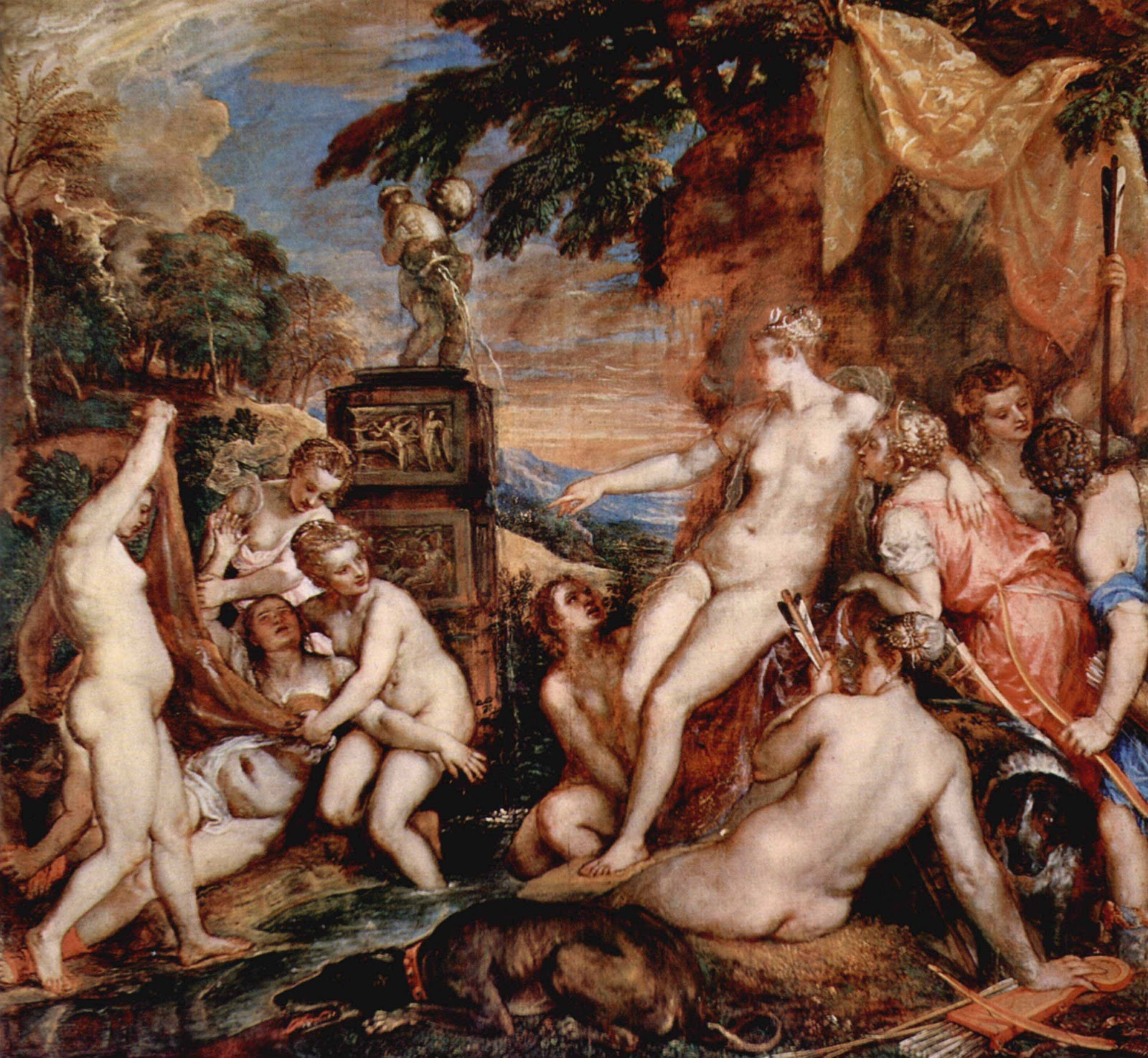
Diana and Callisto unveiled
Painting by Titian
But now Diana, the fiercely virgin goddess, returned to the glade, close in tow her hunter's train. The oblivious goddess called to Callisto, who when she saw her mistress, quaked with fear. Suspecting some other fraud, some deception of the flesh, she trod carefully, flushed in her face. Terror cursing her every step, she joined the parade, her defilement to all others yet concealed.

Nine months in the world of men passed, until a warm day once more came to pass. Diana wiped the sweat from her heavenly brow, and commanded her maids to join her in the bathe, the sentinel careful to see that no prying eye might look upon them in their modesty. All maids comply, all joyful but one. For when they as one cast their tunics aside, the plight of Callisto was revealed, her form swollen with child. The eyes of Diana flashed dangerously. Wrath burned through her veins, and in that moment, Tartarus had no fury more terrible than hers. "Begone!" the goddes cried with outrage, "Begone! nor dare the hallow'd stream to strain". Tears streaming from her eyes, writhing with injustice, Callisto fled for her life, forever banished from Diana's presence.

Far above Hera, Queen of the gods, heard the commotion, and the nymph's cries. Long had she bided her time, awaiting the moment when she might punish her husband for his infidelities, and her rage she now directed upon the nymph with whom he had lain. To fire her more, the pains of labour struck Callisto now, as the fruit of Zeus' advance was born. A flash of lightning and Hera's wrath was vented upon the nymph. Sensing some dark craft, Callisto raised her hands in mercy, but before her eyes, her arms grew thick and shaggy with hair, her nails warped and stretched into evil claws:


               'Her hands bear half her weight, and turn to paws;
                her lips that once cou'd tempt a god,
                begin to grow distorted in an ugly grin .
                And, lest the supplicating brute might reach
                The ears of Jove, she was depriv'd of speech:
                Her surly voice thro' a hoarse passage came
                In savage sounds...'
                   - CALLISTO CURSED


Her form twisted to that of a towering and ferocious bear, but her mind remaining, she begged of Zeus for aid, desperate now, but all that came forth was an echoing roar that caused birds to flee the canopies in fear. How such fear flew within her now, with such dread she though of roaming the meadows she once called her own, with blinding terror from her own hounds she fled, thinking to avoid poor Actaeon's fate. How she felt for her father Lycaon now, their forms both horribly mutated now, one by Zeus, one by the deeds of Zeus.

Fifteen long summers passed on the earthly plain, and the son of Callisto was growing into a mighty boy. Like his mother before him he was skilled at the hunt, and from her he had taken fine reflexes and a deadly aim. Conqueror of the plains vast and mountains high, to the depths of the forest he stalked in search of prey. By chance he came across his mother where she lay, broken hearted and overflowing with sorrow. One eyelid flickered, and she caught sight of the hunter. Fondly she gazed, 'she knew her son, and kept him in her sight'. She moved to approach, eager to embrace the boy she long thought lost. But a cruel hand had Hera dealt, for only fright rippled through the boy, as a rampaging bear he saw toward him bound. He nocked an arrow on his bow and pulled it tight, aiming at his own mother's heart...

But it was then that Zeus the Thunderer, hidden from Callisto for so many years by Hera, saw at last the scene below. Fifteen years of guilt and pity boiled to their head, and anger at Hera's callous spite. The string of the bow strained, and the boy's grip began to loose. A lone tear welled in the eye of the bear. But Zeus forbade this crime, and with all godly haste he flashed down to the earth, taking both mother and son into his grasp. Looking to his own domain, the son of Kronos fixed them both in the vault of the sky to watch forever over the cosmos, forever united side by side. The mother, the Great Bear, came over time to be called by the Latin race Ursa Major, the son Ursa Minor, and still today can both be seen clearly in the night sky. But Hera looked above too, and saw her rival glowing among the stars, and burned with rage anew. To Oceanus, the Titan of the seas, she turned. Oceanus welcomed the Queen of the gods, and begged of her the reason for her unusual visit. Hera commanded Oceanus to never grant Callisto or her kin the simple pleasure of water, that they might never meet the surface of his domain. That is why Ursa Major and Ursa Minor never sink below the horizon...

Ursa Major - The Great Bear

United Kingdom

Penguin Classics
Metamorphoses: A New Verse Translation (Penguin Classics)
(A version which favours ease of understanding than high poetry)

Oxford World's Classics
Metamorphoses (Oxford World's Classics)
(A version which favours ease of understanding than high poetry)

United States

Penguin Classics
Metamorphoses (Penguin Classics)
(A version which favours ease of understanding than high poetry)

Oxford World's Classics
Metamorphoses (Oxford World's Classics)
(A version which favours ease of understanding than high poetry)

Wednesday, 28 March 2012

The Hounds of Actaeon

There were times, in the lore of the ancient world, when the gods and goddesses rewarded the benevolent, humbled the proud, cursed the wicked and blessed the pure. Yet the gods could succumb just as readily to the passions and impulses of nature as the mortals they ruled over. In the order of the Cosmos, there were and will always be casualties of imbalance, and pure misfortune. One such man, who tragically suffered so, was Actaeon.


Diana - the Lady of the Hunt
Painting by Titian
King Cadmus, founder of the great city of Thebes and hero of his people, had enjoyed a wondrous life. Now in his old age, he watched his grandsons mature to adulthood, and nothing gave him more joy, especially when it came to his favourite - Actaeon. But alas, that ancient maxim cannot be forgotten, "Call no man happy until he is dead" (for the story behind this saying, please click here). For such a tragedy there scarcely was when the grandson of Cadmus fell afoul of chance. Actaeon had grown into a strong young man, handsome, and skilled in the pursuits of men. Indeed, more than anything else, he was impressively skilled as a hunter. His fellow men marvelled at the vast array of game he could bring back in one ride, many times more than any of them. Though he triumphed so often through his immense prowess, it was the strong bond that Actaeon shared with his beloved dogs which set him apart. He knew each of their names, and each of their talents. First there was Blackfoot, always the first to sound out their quarry. Then there was Tracker, bred on Crete, who never missed a scent. Of Wingdog too, no there was no swifter hound than he. White as the snow on the high mountains was the coat of Sheen, and black as night was the body of Soot. Such a din there was when Yelper let out his bark, verily did one's eardrums shake! Poor Sylvan, a valiant beast but limping now, a savage boar had gored his flank. Then came Harpy with her puppies, eager to serve. Blacklock too, first to maul their chosen quarry, followed by Beast-Killer and Mountain-Boy, who never desisted from their prey. Never before has man and beast bonded so closely as Actaeon and his dogs. As one, they were a match for the lady Diana herself, chaste goddess of the hunt.


One day, as the chariot of the Sun god rode high in the Heavens, far below in the wooded glades rode Actaeon and his gathered friends. The morning had been kind. The hunters' party had an impressive array of game, though of course, none eclipsed Actaeon's. The day grew late and soon the mighty Actaeon called a halt to the day's chase. The nets were soaked and their spears wet with blood. His faithful dogs, delighted to have caught so many for their master, wagged their tails eagerly, keen for a morsel when they returned home. Actaeon's friends laughed merrily at the thought of the magnificent feast that was sure to come that night, and bent down to pack away the panoply of the hunt.


Actaeon stumbles upon Diana
Painting by Titian
But the towering man himself decided to take a stroll in the pleasant late-afternoon sun. The falling sun was just bursting through the trees, its golden touch cast on the dappled forest floor. It all seemed so quiet, so tranquil, that Actaeon kept walking on. Soon, the serene silence was weakened. A strange, ethereal sound drifted through the trees. It was a little while before Actaeon recognised it as the sound of song, the sound of women singing not far ahead. He could not explain why he followed it, there was just something about it, so beautiful and pure, that he felt compelled to follow. Imagine, if you can, a secret valley, alive with bushy pine and towering cypress, holding a tranquil lake in their leafy embrace. No man had ever come here; all was as Gaia had first made it, pure from the mightiest trunk to the smallest droplets of water on the tips of the leaves. It was here that the lady Artemis and her maids came to bathe. Diana, the goddess of the moon, childbirth and the hunt, was fiercely chaste. Many a god had sought her hand in marriage, such was the beauty of the daughter of Zeus and the Titaness Leto, but she scorned them all. It was here, in the shade of the forest, that the goddess, weary from the hunt, would come to rest her weary limbs. Handing her bow and quiver to her maidens, she stepped into the perfectly calm water, while others unrobed her. Taking her golden hair in her hands, her nymphs gently poured urns of water over her head. This was the scene which the grandson of Cadmus stumbled upon.


Actaeon's tragic end
Painting by Titian
Unsure of where he was, this was unfamiliar forest to him, Actaeon rounded the clearing and then, he saw it all. For a moment he could not move, so stunned by the sight was he. Never before had he seen such beauty, and no matter how great he tried, he could not turn his eyes from this forbidden scene. For just a moment, there was blissful peace. But then, aware of the presence of a man, a terrible scream rent the air. The nymphs bounded forward, frantically reaching for their mistress' clothes. They surrounded her, shielding her from view, but the daughter of Zeus, alas was taller by far than they. Her blushing cheeks red as the setting sun, shock and fury mingled in her immortal form. Fury that her bow was not to hand, fury that she could not slay the intruder with a murderous arrow. Desperate now, Actaeon tried to find something to say, to express his sincere sorrow, for truly he was, but the great huntress gave him not a chance. Words cannot describe the terror poor Actaeon felt as he gazed into those merciless eyes, but worse was yet to come. In a flash, the unstoppable goddess took up a handful of water from the peaceful pool, and hurled it in Actaeon's face:


                          " Now you may tell the story of seeing Diana naked -
                             if storytelling is in your power! "
                                                  - THE CURSE OF DIANA


Panic flooded over Actaeon as a towering wave, as his body convulsed violently. A stabbing pain, and as he placed his sorry head in his hands, he felt to his horror two stumps growing rapidly out of his head. His neck began to stretch itself outward painfully, and his ears lurched into points. In his humility he looked down, and saw his once powerful feet harden and shrink before his eyes, now cloven to a point. Coarse fur rent its way through his flesh, until soon all his body was enveloped in a mighty coat. Then the huntress filled his mind with thoughts only of flight, and verily did Actaeon run. With a speed most extraordinary, the grandson of Cadmus bounded to a nearby pool, and gazed within its glassy waters. Gone was the handsome face of Actaeon, instead, the head of a mighty stag. The terrible realisation dropped like a stone. The vengeful goddess had made him into a beast. Tears streaming from his eyes, poor Actaeon moaned "Oh, dear god!", but no words came from within,  strange sounds and deep grunts instead.


Diana and Actaeon
Painting by Francesco Albani
Frantically, Actaeon thought of what to do, but each plan seemed helpless. Go back to the palace? But he could not speak, how would tell them what had transpired in that wretched glade? Or hide in the woodland? But to live forever as a beast, and know only melancholy forever more? "He wavered in fearful doubt". It was then that Actaeon knew the meaning of terror. For the silence of the wood was broken once again. This time, however, it was not a beautiful sound. Barking. Dogs barking. Hunting dogs barking. His dogs barking. Actaeon recognised at once the cry of Yelper, and it was the cry that betrayed that Tracker had caught a scent. The scent of prey. Frantically, Actaeon took to flight from his dearest friends, his friends who now spelled his doom. "Stop! It is I, Actaeon, your master. Do you not know me?", he cried in vain. But all that was heard was his desperate baying, drowned under the roar of the hunt. As he sprinted for his very life, he felt it. Sharp teeth sank into his neck, as Blacklock was first onto his prey. Then came Beast-Killer and Mountain-Boy. Moaning with agony under his wounds, his majestic body crashed into the ground, as the hounds pinned their own master. Just then, human voices. His breath giving away, Actaeon called out in vain hope, pleading to his friends. It was his friends, shouting in exultation at the magnificent stag they had caught. "Actaeon! Actaeon!... Why aren't you here, you indolent man, to enjoy the sight of this heaven-sent prize?" With that, his spirit broken at last, so passed Actaeon grandson of Cadmus, as his beloved hounds tore at his mortal form, eager to bring back another catch for their beloved master...

United Kingdom

Penguin Classics:
Metamorphoses: A New Verse Translation (Penguin Classics)
(A classic Roman epic poem, which has a good blend of readability and poetic meter)

Oxford World's Classics:
Metamorphoses (Oxford World's Classics)
(A classic Roman epic poem, which is charmingly archaic, but possibly too much so for some - choose if you like poetry of the 'old ways')

United States

Penguin Classics:
Metamorphoses (Penguin Classics)
(A classic Roman epic poem, which has a good blend of readability and poetic meter)

Oxford World's Classics:
Metamorphoses (Oxford World's Classics)
(A classic Roman epic poem, which is charmingly archaic, but possibly too much so for some - choose of you like poetry of the 'old ways')

Wednesday, 20 July 2011

The Labours Continue

Today we return to the story of Heracles, who, desperate for salvation, embarked on a grueling series of tasks to prove himself worthy of immortality - the Labours of Heracles. King Eurystheus, acting by the will of Hera, determined that Heracles should never complete his task, and concocted the Labours as impossible for a mortal man to achieve (for the beginning of this sage, please click here). But, defying belief, Heracles had slain the Lion of Nemea, and the Hydra of Lernaea, both fearsome monsters descended from Typhon himself.


Heracles captures the Ceryneian Hind
Painting in the New Museum, Berlin.
Returned to the mighty walled city of Tiryns, Heracles shouted with frustration when Eurystheus declared the slaying of the Hydra void, since Heracles had achieved it with help. Secretly, the King was afraid that Heracles might prove successful in the tasks he had planned, and crafted ever more daring ones to come. Having conquered two of Typhon's brood (for more about Typhon, the greatest monster in Greek Mythology, please click here), Heracles had proved himself as a warrior, but now it was to be his endurance which would undergo trial. For his Third Labour, Eurystheus commanded Heracles to trap and bring to him the Hind of Ceryneia, without inflicting any injury on the creature. This was no ordinary deer however. The Hind was sacred to the goddess Artemis, Lady of the Hunt. It was said that the Hind bore horns of purest gold, and was as swift as the winds, able to outrun even an arrow in flight. Heracles accepted the challenge, and set forth from strong walled Tiryns, entering the forests of Greece in search of the creature. Awoken one morning by a strong reflection in the forest, Heracles peered through the bushes and saw the magnificent beast. Light shining off its gilded antlers, the Hind charged off through the scrub, as the hero looked on in dismay at the cloud of dust left behind. Undeterred nonetheless, Heracles set off in pursuit. Another sighting, another failed attempt, the Hind bounded off once more. Again, and again, Heracles got only a glimpse of a flash of gold, and the creature was gone. This would not be an easy, or quick, affair. For a whole year man and beast played cat and mouse through the forests of Greece. What Heracles lacked in speed, however, he made up for in sheer endurance. The Hind, exhausted, came close to Mount Artemision, beginning to falter. As it approached the River Ladon, Heracles took a desperate shot with his bow. The arrow struck the ground just before the Hind, and the creature's forelegs stumbled. Sprinting over before it could recover, Heracles heaved the Hind over his shoulders, triumphant. On his return journey, an angered Artemis appeared before Heracles, chastising him for his desecration of her sacred property. Pleading that he caught the Hind not for himself, but for another, however, allayed the goddess' anger. Eurystheus, knowing that the Hind was the goddess' property, secretly hoped Artemis would strike Heracles down, but was foiled again.


Heracles and the Erymanthian Boar
Sculpture in the Lützowplatz, Berlin.
Carrying the majestic Hind back to Tiryns, Heracles proudly displayed his quarry to Eurystheus. Impressed that Heracles had chased - on foot - the swiftest creature that lived on the Earth, the King ordered the hero to acquire another beast of game. Rumours had reached Tiryns that the land of the city of Psophis was being devastated by a monstrous Boar, whose lair lay high on Mount Erymanthos. Eurystheus ordered Heracles to capture the Boar alive and bring it before him. Whereas the Ceryneian Hind was renowned for its speed, the Erymanthian Boar was notoriously ill tempered, having gored to death the last man who was unfortunate enough to cross its path. Setting forth once again, Heracles went on the hunt. Coming across his old friend, the Centaur Pholos, Heracles asked the wise and kindly being his advice. Brute strength and endurance alone would not prevail, came the reply, but wits would conquer the beast. Feasting together, Heracles asked his host for wine, and reluctantly, Pholos opened a jar. The intoxicating smell wafted out of the cave, and filled the nostrils of the other Centaurs. Centaurs, usually docile (and descendants of the condemned Ixion, see here), were particularly susceptible to savagery when inebriated, and the smell alone was enough to achieve this. Mad and drunk, the Centaurs stormed the cave, but Heracles fended them off with burning branches, and arrows. Emerging from the cave, Pholos saw the bodies of so many of his kin and pondered how Heracles could have slain so many. Picking up one of the arrows from a body, he marvelled at how something so small could bring down so large a beast. Distracted by his musings, however, the arrow slipped from his grip and grazed his foot, killing him instantly. What Pholos had not realised was that Heracles' arrows were coated in the lethal poison of the Hydra, which spelled instant death for any mortal. Grieving at his friend's demise, Heracles buried the Centaur, and set off alone in pursuit of the Boar, conscious that he could not use arrows to stop it, as his orders were to capture it alive. High in the mountains, the snows began to fall, as Heracles stalked the Boar. Approaching near from behind a bush, Heracles let out a great shout, and the Boar, startled, fled into the peaks. In its eagerness to flee, the Boar charged straight into a vast snowdrift, and became stranded in its icy prison. Seizing his chance, Heracles bound the exhausted beast in strong chains of iron, and bore it back to Tiryns.


Heracles diverts the rivers
Mosaic in the National Archaeological Museum of Spain, Madrid.
Entering the palace of Eurystheus, Heracles carried the Boar upon his shoulders, hurrying to show the King his catch. The King, however, terrified by the beast, hid inside a jar, and assured Heracles he would accept the task as complete if he just got rid of it. This Heracles obediently did. Humiliated by Heracles glorious achievements, Eurystheus decided that for his next task, Heracles would embark upon something much less glamorous. The King ordered the hero, for his next Labour, that he must clean the stables of Augeias, King of Elis, in a single day without assistance. This was a far more grim prospect than it sounds. The largest stables in Greece, Augeias owned over a thousand cattle, and his stables had never been cleaned. The cattle were no ordinary livestock either. Divinely blessed with good health, they produced exceptional amounts of dung. The squalor and stench of the stables was legendary. Undaunted, Heracles set forth once again from mighty Tiryns. Coming to Elis, Heracles proudly came before Aegeias and his son Phyleus, and vowed to clean the stables in a single day, in return for a tenth of the cattle (cattle, then as much as today, were extremely valuable). Disbelieving, Augeias agreed. Seeing before him the unholy and nauseating sight of the stables, and loathe to perform such a mundane task as cleaning it by hand, Heracles once again turned to wit over weapons. Walking to the boundaries of the stables, the hero made a breach in the outer wall surrounding the cattle herds. Seeing the Alpheios and Peneios rivers flowing nearby, Heracles dug a fresh channel and diverted both rivers through the stables. The roaring torrents of the river carried off over thirty year's worth of filth, and the stables were sparkling. Returning proudly to Augeias, Heracles found the King irate. Never believing it possible, Augeias denied the deal had ever existed, and offered to submit to arbitration. In the court, the casting vote was won when Phyleus, an honourable man, testified to the deal having been made before the King. Furious, Augeias watched as Heracles departed triumphant, with a tenth of his cattle.

Back in Tiryns, King Eurystheus, too, was furious. Seeing Heracles untainted by the filth of the stables, and marching with pristine cattle, the King declared the Labour void, on the grounds that Heracles had undertaken it for payment. Enraged, Heracles for the second time witnessed all his hard work go to waste, bound as he was to Eurystheus word, at the command of the Oracle. But more was yet to come...

United Kingdom

The Library of Mythology:
The Library of Greek Mythology (Oxford World's Classics)
(A vast collection of stories of old Greece, written and compiled in ancient times)

United States

The Library of Mythology:
The Library of Greek Mythology (Oxford World's Classics)
(A vast collection of stories of old Greece, written and compiled in ancient times)