Showing posts with label Hesperides. Show all posts

Wednesday, 6 June 2012

The Judgement of Paris

It is a curious thing how great the influence of one person can be on the course of history. Though they may not know it at the time, one person truly can make all the difference. The Trojan War, the most iconic of its kind in history, which forever bound the great civilisations of the West, and whose heroes are spoken of in awe even today, began because of one such person. But the War (whose story begins here) found its origins in the most unlikely of places...


The Marriage of Thetis and Peleus
Painting by Hendrick de Clerck
One day, far distant in the mists of time, high on the peaks of Mount Ida, there was great jubilation. It was a joyful day, for it saw the wedding of the nymph Thetis to Peleus, a marriage which held the blessings of the gods of Olympus. Great would be their progeny indeed, for one day their union would give birth to the mightiest of champions - Achilles, whose name the world would ever after speak of in reverence. Men, nymphs, gods, goddesses and all manner of magical creatures came from far and wide to celebrate, bearing a dazzling array of gifts to honour the happy day. Even Ares, lord of war, and Artemis, chaste maiden of the hunt, were to be seen in the great ensemble. All were euphoric, the skies rang to the sound of music, and not a sad face was to be seen amid the revelry. All, that was, except for one. For, skulking in the shadows, was the only being who had not received an invitation. Looking on in cold fury at her rejection, Eris, the goddess of discord, whose evil ways had ever left her shunned amid the spirits of the world, conspired to take her revenge, and bring cruel chaos down upon the scene before her now. As she circled in the shade of the trees, she cast her thoughts to how she could bring her malevolent influence to bear. Perhaps she could spread foul rumours amongst the guests? Poison the minds of the many against their gracious hosts? Openly denounce the bridal pair? There was a dark moment, when her rage waxed grave indeed, when she considered, for one brief moment, going to the very depths of the world, to the deepest part of the Underworld, and breaking asunder the Gates of Tartarus, and so releasing the Titans from their infernal bonds, to be unleashed once more upon the world. It was a fortunate thing indeed, that her fear was too great to carry out this dark deed. Instead, her thoughts turned to discord, that thing at which she was adept at spreading above all others.

Taking a Golden Apple from the Garden of the Hesperides (of the very same tree which Heracles had once ventured to, for the story, please click here), the vengeful goddess inscribed upon it "For the fairest". Never before or again would one sentence bring such ruinous calamity upon the world. Eris, proud of her stratagem, took careful aim, hurling the fruit into the midst of the dancing goddesses. All were amazed at the shining seed now before them, but none more so than three of the greatest goddesses - Hera, Queen of the gods, Athena, goddess of wisdom and war and Aphrodite, goddess of lust. From the moment they set eyes upon it, each goddess claimed the Apple for their own. As discord and argument soon spread as to who should rightfully bear the fruit, the three goddesses turned to Zeus, King of all the gods, to judge himself. Knowing well the undying wrath he would earn from the two he did not choose, the Thunderer wisely refused. To a mortal man should fall this mighty burden, the god ruled, as he thought to himself who this soul could be.

There was, not far away on the slopes of Mount Ida, a young man tending his flocks as a faithful shepherd. But this man was no ordinary shepherd. Named Paris, he was an exile of royal blood, cast out of his homeland whilst still a baby. For long ago, the boy's mother, Queen Hecuba of the royal house of Troy, had experienced a terrible nightmare. Just before her son's birth, she saw a vision that she would give birth to a flaming torch. When she awoke with a start, she confided in her husband, King Priam. Priam decided to consult an Oracle as to what this strange portent could mean. The seer Aesacus, when the royal couple retold their worries to him, was gripped with anguish. The child that the Queen would soon bear, the prophet declared, would be the ruin of Troy. The seer urged them to kill the child as soon as it was born, and save Troy from her doom. The day came, however, when Paris entered the world, and from the moment Hecuba and Priam looked upon him, they could bring no harm upon their own flesh and blood. Despairing, Priam handed the child over to Agelaus, his chief herdsmen, to take him away. The shepherd took the young Paris far from Troy's towering heights, but as a he too looked upon the baby, he found that he could not bring himself to slay a child. Vowing to raise the child as his own, he took Paris into his care, where the two lived happily, with a simple life upon the slopes of Mount Ida. It was to Paris that the goddesses of Olympus came now, forever to change his destiny, and that of the world.


The Judgement of Paris
Painting by Rubens
It was with great fear that Paris beheld the sight of Hermes, messenger of the gods, bearing down upon him on that fateful day. " Fling away thy milking-pail and leave thy fair flocks and come hither and give decision as judge of the goddesses of heaven. Come hither and decide which is the more excellent beauty of face, and to the fairer give this apple’s lovely fruit ", the swift footed god declared. Paris stood, transfixed, hardly daring to question, even less refuse the command of Olympus. In a flash of blazing glory, the three goddesses appeared suddenly before him, in all their divine majesty. One by one, the goddesses approached, Athena, lady of war and wisdom first:

          " Come hither, son of Priam! leave the spouse of Zeus and heed not Aphrodite,
            queen of the bridal bower, but praise thou Athena who aids the prowess of men.
            They say that thou art a king and keepest the city of Troy. Come hither,
            and I will make thee the saviour of their city to men hard pressed:
            lest ever Enyo of grievous wrath weigh heavily upon thee.
            Hearken to me and I will teach thee war and prowess! "

Then came Hera, regal mistress of Olympus:

         " If thou wilt elect me and bestow on me the fruit of the fairer,
           I will make thee lord of all mine Asia. Scorn thou the works of battle.
           What has a king to do with war? A prince gives command both to the valiant
           and to the unwarlike. Not always are the squires of Athena foremost.
           Swift is the doom and death of the servants of Enyo! "

Finally, there stood Aphrodite, folly of all men, who simply looked Paris in the eyes, smiling, as she began to speak:

      " Accept me and forget wars: take my beauty and leave the sceptre
         and the land of Asia. I know not the works of battle.
         What has Aphrodite to do with shields? By beauty much more do women excel.
         In place of manly prowess I will give thee a lovely bride, and, instead of kingship,
         enter thou the bed of Helen. Lacedaemon, after Troy, shall see thee a bridegroom! "


Helen
Painting by Evelyn de Morgan
Little did Paris, or the other deities assembled know, that Aphrodite wore a girdle infused with a powerful enchantment. No man which looked upon its wearer could resist base temptation. Still did the words flow from Aphrodite as the son of Priam already offered the Apple to her. Triumphant, Aphrodite raised her glittering prize, mocking her competitors mercilessly. Athena was angered, but it was nothing compared with the fury of Hera. For from this moment the House of Troy and all her descendants had made an eternal enemy of the goddess, and her curse would plague the destiny of the Trojan race. Aphrodite turned to Paris, placing her blessing upon him, declaring that he had the heart of the most beautiful woman in the world. Her name was Helen. With this promise, the goddesses departed, leaving Paris severely shaken. All he could think of now was Helen, far away in the distant lands of Greece. Unable to turn his thoughts anywhere but to her, he resolved to seek her out. Little could he know now the whole world of pain that this decision would unleash...


United Kingdom

Colluthus:
Oppian. Colluthus. Tryphiodorus (Loeb Classical Library)
(The most poetic, and best preserved form of the story)

Colluthus:
http://www.theoi.com/Text/Colluthus.html
(A sample available to read online)

United States

Colluthus:
Oppian, Colluthus, Tryphiodorus (Loeb Classical Library No. 219)
(The most poetic, and best preserved form of the story)

Colluthus:
http://www.theoi.com/Text/Colluthus.html
(A sample available to read online)

Wednesday, 24 August 2011

Girdle, Giant and Garden

Having conquered some of the mightiest beasts to walk the earth, and weary from years of toil, it was with bewilderment that Heracles pondered what could possibly come next, on his long journey to immortality. Slaying the Lion of Nemea, the Hydra of Lernaea, the Birds of Stymphalos, capturing the Hind of Cerynaia, the Boar of Erymanthos, the Bull of Crete and the carnivorous Mares of Diomedes, and cleaning the vile stables of King Augeias, the list of Heracles' achievements was already impressive (for the previous episode in this sage, please click here). Eight down, just four more tasks stood between the son of Zeus and his place on Mount Olympus itself.


The Amazons
Painting by Theodor Baierl.
Free of the diabolical horses that had slain his friend, Heracles came before King Eurystheus once again in his strong walled citadel of Tiryns. Growing desperate, Eurystheus agonised to discover some feat that would beyond even the son of Zeus. Deciding to begin sending the hero far beyond the borderlands of Greece, the King began to grow ever more ambitious in his schemes. For his next Labour, Eurystheus charged Heracles to seek out the Girdle of Hippolyta, and bring it to him. But neither Girdle nor lady was ordinary. For Hippolyta was the Queen of the Amazons, a feared race from the distant steppes of Sarmatia. The Amazons, a tribe of entirely women, could not have been more different from the women of Greece. Largely hidden from public view, and guardians of the household, the women of Greece contrasted violently with the fierce warrior women that were the Amazons. Training constantly in the arts of war, women of the Amazon tribe were forbidden to marry until they had slain a man in war. It was even rumoured that Amazon women ritually severed their right breast so as not to hinder their use of the javelin and the bow. Hippolyta had been presented with her magic Girdle by Ares, the war god himself. It was with a large company of armed men that Heracles set forth from mighty Tiryns this time. After a long voyage across the Oceans, sailing beyond the Aegean to the farthest reaches of the Black Sea, the son of Zeus made landfall upon the beaches of Themiscyra. The Amazons were already there, along with their Queen. The legend of Heracles defeat of so many beasts however, appeared to have spread. Respectful of the hero's prowess, Hippolyta received Heracles kindly, approaching him directly on the beach. Charmed by his might, Hippolyta even agreed to hand over her Girdle, much to Heracles delight. The rest of the Amazons, however, further up the beach, watched intently, unsure of what was transpiring. Far away, on the heights of Mount Olympus, Hera, Queen of the Gods, looked on in fury that Heracles had succeeded so easily. Soaring down to the Earth, the goddess took the form of an Amazon maiden. Walking amongst the fierce women, she suddenly cried out that Heracles had come to abduct their Queen, and brought only death. Confusion rippled through both sides. The Amazons remembered all too well how another Greek hero had once abducted their Queen, and seized their arms and hurled themselves upon Heracles and his kin. Heracles, utterly confused, believed Hippolyta's approach to have been a ruse all along, violently turned upon the Queen. Delighted at the chaos she had caused, Hera returned to the Heavens to watch events unfold. Taken aback by the ferocity of the Amazons, Greeks began to fall one by one. In his rage, Heracles turned his arms upon the Amazon Queen, brutally slaying her, and tearing the Girdle from her lifeless form. Raising his war cry, the son of Zeus slammed into the Amazon ranks. Cowed by such a formidable opponent, the Amazons fled before his rampage. Seizing their chance, the battered and bloodied surviving Greeks desperately pushed away from the shore.


Heracles and Geryon
Image from a 6th century BC Etruscan vase.
Limping back to Tiryns, the Greek party returned to Eurystheus, and Heracles handed over the Girdle. Relieved to see that the hero was not completely invincible yet, the King at once issued forth a new challenge. Eurystheus commanded Heracles to bring to him the cattle of Geryon from the island of Erytheia. Far away at the mouth of edges of the Ocean, Erytheia lay off the coast of the Southern tip of Iberia. Travelling across Europe, and crossing to Africa, Heracles began the long journey through the deserts of Libya. Beaten down by the burning heat of the Sun, in frustration, the son of Zeus fired an arrow at the Sun itself. So impressed at his audacity, the Sun god himself came before Heracles and offered to speed him on his way, granting him a special vessel. Eventually reaching the boundaries of the known world, Heracles marked this achievement by raising two monumental pillars, one on the most southerly plateau in Iberia, and the other on the most northerly plateau in Africa. The 'Pillars of Hercules' still stand today, guarding the pass from the Mediterranean to the Atlantic. Coming to Geryon's domain, the hero's presence was at once detected by Orthus, the guardian of Geryon's cattle. Being a monstrous, two headed dog, and one of the dread offspring of Typhon and Echidna (for more on these, the most fearsome monsters on Greek Mythology, please click here), Orthus was no ordinary shepherding dog. A demonic hound, Orthus charged Heracles down on sight. Drawing his mighty club, Heracles managed to bring Orthus down with a mighty strike to the beast's two skulls. More herdsmen came, attracted by the din of fighting. Slaying them all, Heracles found the cattle and seized them, herding them towards his ship. Distracted by the cattle, Heracles was unaware that he had been spotted by Geryon himself. Hearing a shout of rage from behind him that would break the spirit of lesser men, the hero turned at the last moment to a terrifying sight. Geryon was no normal, mortal man. A monster, triple bodied and triple headed, and fully armed and armoured, Geryon was a formidable opponent. With three spears and three shields flurrying, Geryon engaged Heracles in a fierce struggle. Unable to land a blow upon the monster, Heracles struggled to defend himself. Casting aside his club in desperation, Heracles took out his bow. As Geryon charged forward, Heracles ripped back his bowstring with all the strength his divine sinews could muster, and loosed an arrow. Flying with overpowering momentum, Heracles fired the arrow with such force that the tip bore straight through the metal, skin, bone and brain of one of Geryon's three heads. Even this alone would not have brought mighty Geryon down, but the lethal venom of the Hydra which impregnated the iron tip of Heracles' arrow coursed through Geryon's body, strangling the life out of him. Shaken by his ever closer brush with death, Heracles embarked upon the long voyage back to Tiryns.


The Garden of the Hesperides
Painting by Frederic Leighton.
Handing the cattle over to Eurystheus, the son of Zeus stood eagerly to hear his penultimate task. Having served Eurystheus for eight long years now, the end was in sight. Ten incredible tasks had been completed, but Eurystheus had rendered the slaying of the Hydra and the cleaning of the Augeian stables void, and as punishment, had conceived two special tasks as the final tests of the hero. It was time for the son of Zeus to rise above the tasks of mortals now, and prove himself in the immortal plain. For the first of these two Labours, King Eurystheus ordered Heracles to bring him the Golden Apples of the Hesperides. The tree on which the Apples grew lay far away in the Garden of the Hesperides, a tranquil land ruled over by the Hesperides, nymphs who were the daughters of the Atlas, one of the Titans who had fought against Zeus in the War of the Titans (for this climactic struggle, please click here).The Golden Apples had been presented by Gaia, Mother Earth herself, at the marriage of Zeus and Hera untold milennia ago. To pick the Apples would truly demonstrate immortal favour. Venturing forth from Tiryns, Heracles travelled far and wide, yearning for the knowledge of the Garden's whereabouts. Guided by the nymphs, Heracles came across Nereus, the Old Man of the Sea, a shapeshifting Titan, and a son of Gaia. Seizing Nereus, Heracles held on tight whilst the Titan changed forms repeatedly, becoming all manner of nightmarish creatures. Binding him tightly, Heracles refused to release him until he revealed the Garden's location. Impressed at Heracles endurance, Nereus revealed that the daughters of Atlas tended the Garden of the Hesperides in the far West (Hence the name of the mountain range in North West Africa). Eventually coming to the garden, Heracles saw the magnificent tree in the distance of the serene paradise. However, tightly coiled around the trunk was a large and monstrous dragon, Ladon, immortal, invulnerable, never sleeping and always watchful from each of its one hundred heads. Ladon, another of the vile brood of Typhon and Echidna, had been placed in the Garden by Hera to ensure that none could ever steal the Apples. Realising for the first time that he had encountered a creature he could not stand against, Heracles began a long search for some other way.

In his frustrated wanderings, Heracles came to a great mountain, upon which was bound one of the Titans, one tortured by an eagle which gnawed at his liver - Prometheus (for his story, please click here). Pitying towering Prometheus, Heracles slew the eagle with one of his poisoned arrows, and released the Titan from his shackles. The greatful Titan, ever striving to assist mankind, advised Heracles to seek out his brother Atlas to obtain the Apples for him. Journeying into the very boundaries of existence, Heracles came before Atlas. The Titan, who had sided against Zeus in the war for the mastery of the Heavens, was punished to bear the weight of Heaven upon his shoulders for all eternity. Heracles asked Atlas permission to take the Apples from his daughters' Garden. The Titan agreed, and offered to pick them himself, in return for Heracles taking the weight of the Heavens for a short time. This he did, and towering Atlas set forth, whilst Heracles struggled under the mighty weight of Heaven upon his shoulders. Atlas soon returned with the Apples. Having no intention of enduring his punishment any longer, Atlas declared he would take the Apples to Eurystheus himself. Panicking, Heracles quickly conceived a desperate plan. Pretending to agree, Heracles asked if Atlas would take the weight briefly so as to allow him to prepare a pad to ease his shoulder when he took it back again. This seemed reasonable to the Titan, and he agreed. As the mighty Titan took up his colossal burden once more, Heracles quickly seized the Apples and made his escape, to the fury of Atlas.

Returning all the way to the powerful citadel of Tiryns, Heracles presented the shining Apples to Eurystheus. The King was overwhelmed by the sight of the gift, returning them to Heracles, worthy of the prize was he. No sooner had he done so, however, than Athena came down from Olympus, and retrieved the Apples, for they were too pure to reside anywhere than in the tranquil Garden. His resentment turning to reverence, Eurystheus turned to his final request, the last and most dangerous Labour of Hercules. If the hero completed this, then he would fulfil his ultimate desire, and earn his place among the gods...


United Kingdom

The Library of Greek Mythology:
The Library of Greek Mythology (Oxford World's Classics)
(A vast collection of stories from old Greece, written and compiled in ancient times)

United States

The Library of Greek Mythology:
The Library of Greek Mythology (Oxford World's Classics)
(A vast collection of stories from old Greece, written and compiled in ancient times)

Wednesday, 8 September 2010

Perseus and Medusa

Even today the monstrous Medusa, whose gaze spelled doom for all who looked upon her dread visage, is an iconic figure in our shared psyche, featured in Greek verse, Roman poetry, Renaissance painting, Baroque sculpture and modern cinema alike. But how many know the story behind the serpents? How many know for example, that Medusa was once a normal, mortal woman, who became a hideous creature cursed by the gods? Where is this stuff written? - The story, one of the earliest stories of heroes and monsters, can be found in many places; the two most prominent places being in a poem called The Metamorphoses and in one of the many stories which make up the Library of Greek Mythology.

Perseus
Sculpture by Benvenuto Cellini.
The story begins one day when King Acrisius of Argos (a powerful city on the eastern shores of Greece) heard from the Oracle of Delphi that should his daughter, Danaë, give birth to a son, he would die at his hands. So as to prevent the prophecy from ever coming to pass, Acrisius imprisoned Danaë in a high tower, forbidding her any visitors. The machinations of man were mere playthings to gods however, and the barred windows of the lady’s cell were no barrier to the King of the Gods. Zeus took the form of a shower of gold and cascaded through the bars and gave Danaë a son – Perseus. Acrisius was furious and bound Danaë and the demigod in a chest and hurled them into the sea.

Danaë prayed desperately to the gods, and the Thunderer heard her prayers. The chest washed up on the shore of the isle of Seriphos, where it was found by the fisherman Dictys. Dictys raised Perseus in the humble life of the fisherman until he was a man. Dictys’ brother Polydectes was a cruel and scheming man however, and the King of Seriphos. He desired to take Danaë for himself, and destroy the young Perseus. One day Polydectes summoned all his friends to him, and told them he was collecting contributions in order to be wed to the lady Hippodameia. Many gave horses as a gift to the king, but Perseus had no horse to give, and so asked the king to name anything and he would bring it. Polydectes seized his chance and ordered Perseus to bring him the head of the Gorgon.

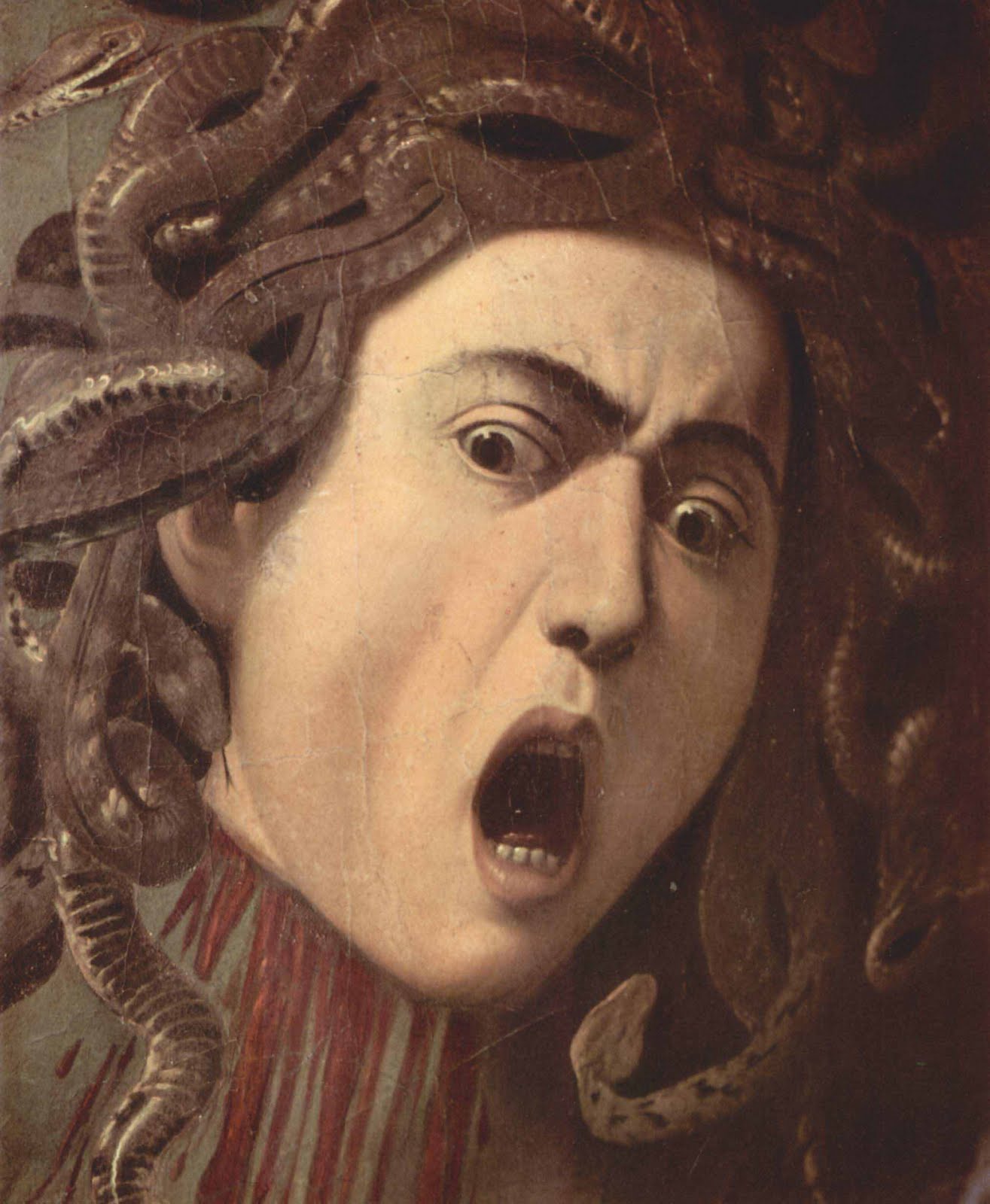
The Gorgons were three sisters by the names of Stheno, Euryale and Medusa. They were grotesque beings with snakes for hair, tusks like those of a boar, hands of bronze, wings of gold and their glance was death to man. Of the three, only Medusa was mortal and vulnerable, having once been a woman:


Medusa
Painting by Caravaggio.
“Medusa was once an exceedingly beautiful maiden,

Whose hand in marriage was jealously sought by an army of suitors,

According to someone who told me he’d seen it, her marvellous hair

Was her crowning glory. The story goes that Poseidon the sea god

Defiled this glorious creature inside the shrine of Athena.

The daughter of Zeus screened her virginal eyes with her aegis in horror,

And punished the sin, by transforming the Gorgon’s beautiful hair

Into horrible snakes.”
                        - PERSEUS RECOUNTS THE TALE OF MEDUSA


So Perseus set out to vanquish the blasphemous monster. Athena came to his aid, and told him to seek the nymphs known as the Hesperides, who possessed weapons which could conquer the Gorgon. Perseus sought out the old witches, and asked where he might find these nymphs. The witches were the sisters of the Gorgons, old women from birth who shared but a single eye and a single tooth between them. At first the witches taunted and mocked Perseus, and refused to reveal the nymph’s whereabouts. Through cunning and trickery, Perseus seized the eye and tooth, and offered them back only if they gave him what he needed. Reluctantly, the witches told him all they knew.

Perseus came to the Hesperides, where the nymphs gave Perseus a magnificent set of gifts to aid him against Medusa. The nymphs gave him a magical wallet to contain the Gorgon’s head and then the enchanted helm of Hades, which had been forged by the Cyclopes during the War of the Titans, which rendered the wearer invisible. The gods themselves also gave, and Hermes lent to Perseus his winged sandals so as to grant him the gift of flight, as well as an adamantine blade to pierce Medusa’s reptilian hide. Athena gave a fine shield, whose polished bronze surface rendered the perfect reflection. Armed with his divine tools, Perseus took flight across the vast Ocean, to the ends of the Earth and arrived at the Gorgon’s cave. Over to the sleeping beasts he crept, eyes fixed on their ghastly reflection of in his shield, and with a mighty strike he severed Medusa’s head. From her bleeding neck sprung the winged horse Pegasus. Out too came Chrysaor – the result of her and Poseidon’s violation in Athena’s sanctuary. Medusa’s fellow Gorgons awoke with a start and gave chase, but Perseus quickly slipped the foul head into the wallet and made good his escape, shielded under Hades’ helm.

On his return to Polydectes, Perseus stopped in the land of Ethiopia, kingdom of Cepheus and his queen Cassiepeia. Cassiepeia proudly declared herself to be more beautiful than the Nereids (The sea nymphs) themselves, bringing down upon her kingdom the wrath of Poseidon, who unleashed a terrible Leviathan upon the people. An Oracle told the people that the land could be saved only by sacrificing the Princess Andromeda to the monster, and so King Cepheus mournfully gave the order to chain her to the rocks. Perseus offered to slay the creature if he could take Andromeda as his wife. The King eagerly agreed, and Perseus flew to the princess’ rescue:

Perseus rescues Andromeda
Painting by Paolo Veronese.
“Poised on his swift wings, Perseus eluded his ravening enemys’ jaws

And went for his weak points, hacking away with his hooked sword,

Now at its barnacled back and then at the ribs, then again

At the narrowest point of the tail where it tapered into a fish.

The monster spewed forth seawater mingled with crimson blood...”
                                               - PERSEUS SLAYS THE LEVIATHAN

Perseus was hailed as a hero, and was given Andromeda as his bride. However the brother of Cepheus, Phineus, demanded Andromeda for himself and confronted the hero. Perseus revealed the Gorgon’s head and turned Phineus and his fellow conspirators to stone.

Perseus shows the Gorgon's head to Phineus
Painting by Luca Giordano.
Returning home to Seriphos triumphant, he found his mother and the fisherman Dictys in hiding from cruel Polydectes, who now received his wish – the Gorgon’s head. Indeed he even got to look the evil thing in the eye, and was transfixed in bloodless stone. Perseus gave the throne to the fisherman Dictys and set off to confront the man behind all of this – Acrisius, who had fled Argos when he heard of the hero’s coming. Perseus competed in the pentathlon at the athletic games in the land of the Pelasgians (northern Greece), whereupon he hurled his discus. The gods made the wind blow suddenly strong, carrying the disc into the head of Acrisius, sending him to the Underworld in a single blow. The prophecy at last fulfilled, Perseus buried Acrisius outside the walls of Argos, as he himself became King of Tiryns and founded Mycenae. Andromeda gave birth to many sons and daughters, the first son taking the name of Perses – from whom the Persian race claimed origin. Perseus and Andromeda lived long lives and became the progenitors of the Danaan race, to whom many great dynasties of Greece would claim descent, even to the day they had all been trodden under the iron shod boot of the Roman legions. To be descended from the Thunder god himself was to have powerful blood flowing through your very veins. To trace your lineage through one the god’s most illustrious sons was to add even greater lustre to the sheen.

The story of Perseus is one of the most famous in Greek mythology, and both Perseus and Medusa are famous cultural icons across the West. The stories are as enchanting in the original poetry as they were read aloud. The story can be found easily and at a discounted price at Amazon:

United Kingdom

Penguin Classics:
Metamorphoses: A New Verse Translation (Penguin Classics)
(The famous poem of Publius Ovidius Naso, a joy to read and 'the poetic account')

Oxford World's Classics:
The Library of Greek Mythology (Oxford World's Classics)
(A library of mythology, less poetic but contains the whole story of Perseus)

United States

Penguin Classics:
Metamorphoses (Penguin Classics)
(The famous poem of Publius Ovidius Naso, a joy to read and 'the poetic account')

Oxford World's Classics
The Library of Greek Mythology (Oxford World's Classics)
(A library of mythology, less poetic but contains the whole story of Perseus)