Showing posts with label Hermes. Show all posts

Wednesday, 10 April 2013

Orpheus and Eurydice

The son of the Thracian King Oeagrus, Prince Orpheus, seemed to many who met him an unremarkable man, neither tall of stature like Hercules, nor divinely handsome as Adonis. He was not a renowned warrior, as Achilles, or even notably silver tongued as Odysseus. The son of a King, and the Muse Calliope, Orpheus did however possess two qualities so rare in the great men of his time. For the Thracian Prince was blessed with a heart of gold, and was gifted lyre player, a trait handed down from his mother and grandfather - the god Apollo. Both of these things would be his greatest asset, and his ultimate ruin...


Orpheus serenades the Nymphs of the Forest
Painting by Charles Jalabert
While the lyre was the creation of the god Hermes, it was Orpheus who perfected it. As a young child Apollo gifted his favoured grandson with a lyre of burnished gold, and his mother, the patron of lofty poetry, taught him many a verse of heroic lore, and the Prince set it all to heart-warming music. Any doubts old King Oeagrus may have had at his son's disinterest in military pursuits were at once silenced the moment young Orpheus began to play, for the hearts of the King and all his court were moved by the heavenly notes. Many a summer's afternoon would young Orpheus spend in the wild forests of Thrace, his refuge of body, his music, his sanctuary of mind. Oblivious he was too, to the enchanting power of his tunes. The nymphs of the forest lay all around, entranced by the Prince's songs, as they had been for his brother Marsyas. The beasts of the glades, boars, wolves and the like all stood alert and spellbound. Even the stones of the forest floor lent their attention to the sound that soothed the air, such was the power of the music that Orpheus created. The Prince's quiet life, however, did not endure for long. As a young man, Orpheus volunteered to join Jason and his fellow Argonauts on their arduous quest to the ends of the Earth for the Golden Fleece (a story which shall be told in the future on this site). The crew of heroes, including mighty Hercules himself, grew to respect and admire Orpheus, whose humble demeanour and beautiful compositions came to their rescue on many an occasion when morale was low, saving the lives of the whole crew when faced with the deadly Sirens.


When at last the voyage was over, Orpheus returned a grown man to his native Thrace, desiring a quiet life as of old. He soon grew to care for a nymph, Eurydice, a spirit who once admired his songs deep in the forest. Over time both Orpheus and Eurydice became deeply attached to one another, and the Prince was overjoyed when she agreed to wed him. The day arrived, and it was wondrous to behold, such was the array of beings present. Apollo made the rays of the Sun touch all the fields and faces that day, his grandson's wedding day. In their tens and hundreds the dryads and naiads marched forth from their abodes, bedecked in garlands and fine robes. It was a happy day, and even high on Olympus the joy was felt. Alas that such calamity would strike utopia that day. In the commotion and revelry, a drunken Satyr chased the bride through the party. Eurydice, surprised, fled into the fields, but ruinous was her fortune. Into the long grass of the meadow she fled. She turned to try and catch a glimpse of her pursuer, but in that moment she felt a lethal pain in her foot. She screamed and looked for the source of her doom. There at her feet, a viper. A glance she stole at Orpheus, face white with raw terror, before death moved to claim her on her wedding day.


The River Styx
Painting by Joachim Patinir
Devastation was the mere beginning of feeling which struck Orpheus now. Holding her close to him, he grieved terribly, and the whole world grieved with him. Shattered as a man, for an age after, a new song pierced the air, but it was not the tune of joy which touched the soul, it was a lament, a tearful mourning indeed. The spirits of the forest could restrain their pity no more. His heart afire with longing and despair, Orpheus refused to accept his loss of Heaven. At the urging of the nymphs, he decided to take the dark road to Hades himself and plead for mercy. So the Prince set off on his morbid journey, one fraught with danger. Seldom had a mortal ventured into the land of the dead and ever seen the light of day again. But even the hearts of the gods on high were with him that day. At his approach, fearsome Cerberus skulked away in the darkness at the gates of death. Eerie silence fell on the Prince's ears. Such a heavy silence the greatest musician in the world had never before heard, and it saddened him. Taking out his lyre, he did the only thing he knew, he played. Even the monstrous guardian of Hell was soothed by the song, and allowed his passage. Charon, the ferryman of the dead, taking pity too, granted him a journey across the River Styx, the true boundary between the Overworld and Hades. The smell of decay grew overwhelming, and at last, to the throne room of the god of the dead himself he came in humility. Hades and his Queen Persephone were astonished at the sight of the broken man, his robes defiled with filth and tears, and heard his call.


Orpheus came forth and spake his mind, "I come not curious to explore thy domain, nor come to boast... My wife alone I seek, for her sake these terrors I support, this journey take". The gods high on Olympus, powerless in the abode of death, wept for Orpheus. The Prince, wavering at the fearsome gaze of Hades, continued:


             " A hope within my heart prevails...
               Let me again Eurydice receive,
               Let Fate her quick spun thread of life re-weave...
               She, when ripen'd years she shall attain,
               Must, of avoidless right, be yours again:
               I but the transient use of that require,
               Which soon, too soon, I must resign entire... "
                  - ORPHEUS' PLEA TO HADES


Orpheus leads Eurydice
Painting by Jacopo Vignali
The Prince's fingers moved toward his lyre, he couldn't help it, it was his only solace now. He began to play, and even the bloodless shades of the dead turned to see. Far in Tartarus,  Sisyphus laid down his mighty burden to listen, far above Ixion squirmed for a glance, and away in the pool Tantalus forgot his hunger and thirst. Even the vengeful Furies relaxed their snarls, tears stinging their ferocius cheeks. The hand of Queen Persephone tensed. Too well did she know what it was like to be torn from a dear one. To her husband, the lord of death did she intercede, asking pity this one time. Not even the cold heart of Hades remained unmoved that day. To the grieving Prince the son of Kronos turned, and declared that he would grant his wish, and restore Eurydice to life, but upon one condition. The rules of the cosmos were absolute - Hades commanded Orpheus to return to the Overworld, but until both he and Eurydice had crossed the threshold of the land of the living, he was forbidden to look behind him into the deadlands. If he did, the pact would be forfeit, and he would lose Eurydice forever. The Thracian Prince nodded gently, and Hades snapped his fingers. A troop of deathly shades approached from the darkness, bearing in their midst the shadowy form of the his beloved. Wincing slightly from the deadly bite, she stopped perfectly still at the sight of her Prince, joy spreading through her body, reviving now with breath, though as yet unable to speak. It was as though her wretched misfortune had never befallen her, as Orpheus, crying with joy, moved to embrace her. Alas they passed through her, for the ritual was not yet complete. Thanking the dead god and his Queen from the deepest chamber of his heart, Orpheus bid Eurydice come with him quick before the Sun set that day, so they might enjoy anew an evening upon the Earth. Leading the way Orpheus put his first foot upon the deathly stairs, rising high above the Halls of Hell.


Immediately his resolve was tested to breaking point, such was his desire and the temptation to look behind. Lost and again found, alas that he was forbidden to look back at his beloved and that he must lead the way!

   
                     " Now thro' the noiseless throng their way they bend,
                       And both with pain the rugged road ascend;
                       Dark was the path, and difficult, and steep... "
                              - ORPHEUS' ESCAPE


Orpheus found the dread silence agony to bear, unbroken by song. For the laws of the cosmos decreed it easy for a man to enter the realm of the dead, but far harder to leave, and both hands did the Prince require on the ascent. As the sweat poured from his brow, he fought his urge to turn and assist, terrified of breaking his oath. He called to her, naught but heavy silence replied. Not until restored fully to life would breath pass her lips again. Trying desperately to cast his thoughts away from horrid visions of his beloved lost far below in the darkness, Orpheus continued his climb.


Eurydice lost
Painting by Christian Gottlieb Kratzenstein
At last, after what seemed days of silent struggle, the black shroud seemed to ease all around. Colour could be seen again, and the harsh, jagged rocks around the tunnel. They seemed as teeth of the jaws of some infernal beast, binding the dead within that realm, never to leave. Orpheus' excitement grew - at last, redemption lay just over the crest! For hours and hours he toiled against the rock, alone to his ears. As the light grew, hand in hand with it walked his paranoia. Was Eurydice still there? Had Hades deceived him? The desire to look grew painful to resist. With every reserve of will, Orpheus forced his head forward. Up and over the last precipice, the rays of the late afternoon Sun struck his forehead, embracing him with their reassuring heat. Ecstatic, he hauled himself up and over, and rushed into the cool air, blazing with light. In that moment his happiness was absolute, unbroken and willed to live for ever. Puzzled he was, however, when the cry of freedom at his side he could not hear. Doubt racked his mind again - was she there? He wheeled around, seeking Eurydice. There she stood after all, she had followed him all the way from the root of the Earth, but something was amiss. He glimpsed her fair face, near full again, but the expression upon it he would never forget. White as snow, a look of terror on her face, a visage to freeze the soul. The joy of Orpheus stopped dead in its tracks. Cold dread flooded every inch of him, as he saw too late his folly. A mere footstep it was from the mouth of the Underworld his beloved stood. Behind it. His legs and arms began to shake, a soft no all he could utter, and his eyes welled up. The word of Hades rang in his ear, and for the second time Death claimed Eurydice, this time for good. One last look of hopeless longing she gave him, before the darkness took her spirit, as Orpheus fell to his knees...


United Kingdom

Penguin Classics
Metamorphoses: A New Verse Translation (Penguin Classics)
(A version which favours ease of understanding than high poetry)

Oxford World's Classics
Metamorphoses (Oxford World's Classics)
(A version which favours ease of understanding than high poetry)

United States

Penguin Classics
Metamorphoses (Penguin Classics)
(A version which favours ease of understanding than high poetry)

Oxford World's Classics
Metamorphoses (Oxford World's Classics)
(A version which favours ease of understanding than high poetry)

Wednesday, 6 June 2012

The Judgement of Paris

It is a curious thing how great the influence of one person can be on the course of history. Though they may not know it at the time, one person truly can make all the difference. The Trojan War, the most iconic of its kind in history, which forever bound the great civilisations of the West, and whose heroes are spoken of in awe even today, began because of one such person. But the War (whose story begins here) found its origins in the most unlikely of places...


The Marriage of Thetis and Peleus
Painting by Hendrick de Clerck
One day, far distant in the mists of time, high on the peaks of Mount Ida, there was great jubilation. It was a joyful day, for it saw the wedding of the nymph Thetis to Peleus, a marriage which held the blessings of the gods of Olympus. Great would be their progeny indeed, for one day their union would give birth to the mightiest of champions - Achilles, whose name the world would ever after speak of in reverence. Men, nymphs, gods, goddesses and all manner of magical creatures came from far and wide to celebrate, bearing a dazzling array of gifts to honour the happy day. Even Ares, lord of war, and Artemis, chaste maiden of the hunt, were to be seen in the great ensemble. All were euphoric, the skies rang to the sound of music, and not a sad face was to be seen amid the revelry. All, that was, except for one. For, skulking in the shadows, was the only being who had not received an invitation. Looking on in cold fury at her rejection, Eris, the goddess of discord, whose evil ways had ever left her shunned amid the spirits of the world, conspired to take her revenge, and bring cruel chaos down upon the scene before her now. As she circled in the shade of the trees, she cast her thoughts to how she could bring her malevolent influence to bear. Perhaps she could spread foul rumours amongst the guests? Poison the minds of the many against their gracious hosts? Openly denounce the bridal pair? There was a dark moment, when her rage waxed grave indeed, when she considered, for one brief moment, going to the very depths of the world, to the deepest part of the Underworld, and breaking asunder the Gates of Tartarus, and so releasing the Titans from their infernal bonds, to be unleashed once more upon the world. It was a fortunate thing indeed, that her fear was too great to carry out this dark deed. Instead, her thoughts turned to discord, that thing at which she was adept at spreading above all others.

Taking a Golden Apple from the Garden of the Hesperides (of the very same tree which Heracles had once ventured to, for the story, please click here), the vengeful goddess inscribed upon it "For the fairest". Never before or again would one sentence bring such ruinous calamity upon the world. Eris, proud of her stratagem, took careful aim, hurling the fruit into the midst of the dancing goddesses. All were amazed at the shining seed now before them, but none more so than three of the greatest goddesses - Hera, Queen of the gods, Athena, goddess of wisdom and war and Aphrodite, goddess of lust. From the moment they set eyes upon it, each goddess claimed the Apple for their own. As discord and argument soon spread as to who should rightfully bear the fruit, the three goddesses turned to Zeus, King of all the gods, to judge himself. Knowing well the undying wrath he would earn from the two he did not choose, the Thunderer wisely refused. To a mortal man should fall this mighty burden, the god ruled, as he thought to himself who this soul could be.

There was, not far away on the slopes of Mount Ida, a young man tending his flocks as a faithful shepherd. But this man was no ordinary shepherd. Named Paris, he was an exile of royal blood, cast out of his homeland whilst still a baby. For long ago, the boy's mother, Queen Hecuba of the royal house of Troy, had experienced a terrible nightmare. Just before her son's birth, she saw a vision that she would give birth to a flaming torch. When she awoke with a start, she confided in her husband, King Priam. Priam decided to consult an Oracle as to what this strange portent could mean. The seer Aesacus, when the royal couple retold their worries to him, was gripped with anguish. The child that the Queen would soon bear, the prophet declared, would be the ruin of Troy. The seer urged them to kill the child as soon as it was born, and save Troy from her doom. The day came, however, when Paris entered the world, and from the moment Hecuba and Priam looked upon him, they could bring no harm upon their own flesh and blood. Despairing, Priam handed the child over to Agelaus, his chief herdsmen, to take him away. The shepherd took the young Paris far from Troy's towering heights, but as a he too looked upon the baby, he found that he could not bring himself to slay a child. Vowing to raise the child as his own, he took Paris into his care, where the two lived happily, with a simple life upon the slopes of Mount Ida. It was to Paris that the goddesses of Olympus came now, forever to change his destiny, and that of the world.


The Judgement of Paris
Painting by Rubens
It was with great fear that Paris beheld the sight of Hermes, messenger of the gods, bearing down upon him on that fateful day. " Fling away thy milking-pail and leave thy fair flocks and come hither and give decision as judge of the goddesses of heaven. Come hither and decide which is the more excellent beauty of face, and to the fairer give this apple’s lovely fruit ", the swift footed god declared. Paris stood, transfixed, hardly daring to question, even less refuse the command of Olympus. In a flash of blazing glory, the three goddesses appeared suddenly before him, in all their divine majesty. One by one, the goddesses approached, Athena, lady of war and wisdom first:

          " Come hither, son of Priam! leave the spouse of Zeus and heed not Aphrodite,
            queen of the bridal bower, but praise thou Athena who aids the prowess of men.
            They say that thou art a king and keepest the city of Troy. Come hither,
            and I will make thee the saviour of their city to men hard pressed:
            lest ever Enyo of grievous wrath weigh heavily upon thee.
            Hearken to me and I will teach thee war and prowess! "

Then came Hera, regal mistress of Olympus:

         " If thou wilt elect me and bestow on me the fruit of the fairer,
           I will make thee lord of all mine Asia. Scorn thou the works of battle.
           What has a king to do with war? A prince gives command both to the valiant
           and to the unwarlike. Not always are the squires of Athena foremost.
           Swift is the doom and death of the servants of Enyo! "

Finally, there stood Aphrodite, folly of all men, who simply looked Paris in the eyes, smiling, as she began to speak:

      " Accept me and forget wars: take my beauty and leave the sceptre
         and the land of Asia. I know not the works of battle.
         What has Aphrodite to do with shields? By beauty much more do women excel.
         In place of manly prowess I will give thee a lovely bride, and, instead of kingship,
         enter thou the bed of Helen. Lacedaemon, after Troy, shall see thee a bridegroom! "


Helen
Painting by Evelyn de Morgan
Little did Paris, or the other deities assembled know, that Aphrodite wore a girdle infused with a powerful enchantment. No man which looked upon its wearer could resist base temptation. Still did the words flow from Aphrodite as the son of Priam already offered the Apple to her. Triumphant, Aphrodite raised her glittering prize, mocking her competitors mercilessly. Athena was angered, but it was nothing compared with the fury of Hera. For from this moment the House of Troy and all her descendants had made an eternal enemy of the goddess, and her curse would plague the destiny of the Trojan race. Aphrodite turned to Paris, placing her blessing upon him, declaring that he had the heart of the most beautiful woman in the world. Her name was Helen. With this promise, the goddesses departed, leaving Paris severely shaken. All he could think of now was Helen, far away in the distant lands of Greece. Unable to turn his thoughts anywhere but to her, he resolved to seek her out. Little could he know now the whole world of pain that this decision would unleash...


United Kingdom

Colluthus:
Oppian. Colluthus. Tryphiodorus (Loeb Classical Library)
(The most poetic, and best preserved form of the story)

Colluthus:
http://www.theoi.com/Text/Colluthus.html
(A sample available to read online)

United States

Colluthus:
Oppian, Colluthus, Tryphiodorus (Loeb Classical Library No. 219)
(The most poetic, and best preserved form of the story)

Colluthus:
http://www.theoi.com/Text/Colluthus.html
(A sample available to read online)

Wednesday, 8 June 2011

The First Labours of Heracles

Standing high amongst all the heroes of Classical lore, and possessed of one of the most famous names in civilisation, is Heracles. Son of Zeus, slayer of countless fierce monsters, towering of stature, founder of cities and raised to godhood, the answer to why his name has emerged from the ravages of time unscathed is not easily forgotten. The name of Heracles will always be associated with the famous Twelve Labours, daunting and formidable tasks worthy of testing the potential of a man to become a god. Let us then look to the beginnings of the adventures, and the first labours of Heracles.


Heracles strangles the Serpents
Sculpture in the Capitoline Museums, Rome.
There was once a mortal man named Amphitryon, who lived with his wife Alcmene in the grand city of Thebes (the kingdom of Oedipus, for more please click here). But the King of gods and men, Zeus the Thunderer, was ever the ceaseless philanderer, and his eyes had found Alcmene. One time, when Amphitryon went away to war, the god came down to Earth, slowing the passage of time, so that the night grew long and the slumber of mortals endured. Assuming the shape of Amphitryon, Zeus entered the house and deceived Alcmene into believing her husband had returned from the war at last, as the two embraced. The following day, Amphitryon himself returned to Thebes. Yet his wife did not greet him with the enthusiasm he expected. Upon questioning her, she revealed in utter confusion that he had of course returned last night and that she had conceived by him. Suspecting divine play at hand, Amphitryon consulted the blind seer Tiresias, who revealed that Alcmene bore twins, one the son of Amphitryon, the other the seed of Zeus. Furious at her husband's repeated affairs, Hera, Queen of the gods, planned a torturous future for his extramarital offspring. When the boys were born, the son of Amphitryon was named Iphicles, and the son of Zeus, so that Hera might be appeased, was named Heracles, a name which means 'The Glory of Hera'. Far from being sated, the goddess raged at the insult. Hera sent forth from Olympus two serpents to the cot of Heracles, commanding them to strangle the infant. Shrieking at the sight, Alcmene cried out for Amphitryon to help, but upon looking back at the infant's cot, saw Heracles playing with the lifeless bodies of the snakes, whose lifeforce he had crushed with his bare hands.

Raised as one of their own by Amphitryon and Alcmene, Heracles learned the ways of the bow, the sword and the lyre, and soon surpassed all peers in his size and near boundless strength:


                 " The mere sight of him was enough to show that he was a son of Zeus:
                    for his body measured four cubits, a fiery gleam shone in his eyes,
                    and he never missed his mark with his arrows or javelins... "
                                                                      - THE STATURE OF HERACLES


Serving his adoptive father loyally in the fields, tending to the cattle in the mountain pastures, one day two nymphs came to the son of Zeus. They were Pleasure and Virtue, and they prophysied a momentous choice that lay before Heracles. Either he could lead a simple and easy life, or one of toil but boundless glory. A proud son of the greatest of gods, the hero chose the latter. Not long after, the Minyans, another Greek people, marched upon Thebes in arms, resolved to destroy the great city in war. Amphitryon fell in the battle, and in a rage, Heracles lead the Thebans to a fresh assault, unleashing his fury upon the Minyans, slaying many and putting them to flight. Men looked on in awe at the feats of Heracles.

As a prize for his valour, King Creon of Thebes presented to Heracles his own eldest daughter, Megara, and his younger to Iphicles. Megara gave to Heracles three sons; Therimachos, Creontides and Deicoon. The gods, too, gave gifts to the hero. The sun god Apollo gave to him a bow and quiver, such that he would never miss a target.  Hermes gave a sword, Athena a robe and Hephaestus forged a breastplate of gold for the glory of Hera. But the wrath of Hera would not be so easily abated. The vengeful goddess sent a madness to descend over Heracles' eyes. The hero writhed in the agony of his mind, blind to those all around. In his writhings, Heracles murdered his own children and two of Iphicles' too. Coming to his senses, deepest shame welled up inside Heracles at what he had done. Tormented by his unholy crime, Heracles went into exile from Thebes, coming to the Oracle of Delphi for purification. Little did he know that the words of the Oracle could be influenced by Hera. The Oracle spoke, and pious Heracles listened. She commanded the hero to journey to the court of King Eurystheus (who was the grandson of Perseus, for more about him please click here) in the mighty walled city of Tiryns, and serve the King for ten years, and complete any task that may be assigned to him, and upon completion of his service, he would be granted immortality.


Heracles slays the Lion of Nemea
Painting by Rubens.
Journeying to the city of Tiryns, Heracles came before Eurystheus. Under the sway of Hera, the King crafted a series of impossible tasks, such that no ordinary man could ever accomplish. For his first task, Eurystheus ordered, Heracles was to bring to him the skin of the Lion of Nemea. This monster was no ordinary lion. One of the dread offspring of Typhon and Echidna (for more about them, please click here), the Nemean Lion was invulnerable to the weapons of man. Its hide was impervious to spear, sword and arrow. Heracles arrived in Nemea, and soon found the creature, which terrorised the local people. Taking up Apollo's bow, Heracles loosed an arrow at the Lion, hoping for an easy victory. The arrow however, simply bounced off the monster's hide. Fashioning a club from a nearby tree, the hero tried to strike the monster, but it too was in vain. The Lion retreated to a cave in the mountains, so Heracles walled up one exit, leaving one cave mouth open. Venturing inside, the two powerful beings launched themselves at each other, the Lion's roar shaking the plains as Heracles grappled with the beast. Heracles throttled the Nemean Lion, using his own Titan strength to crush the beast's neck. Finding his knife unable to flay the body of it even in death, Heracles could only cut the monster's hide with its own claws. Wearing the hide around him as a cloak, Heracles journeyed back to Tiryns.

Heracles slays the Lernaean Hydra
Painting by Antonio del Pollaiolo.
Shocked by Heracles' prowess, Eurystheus hid inside the walls, forbidding Heracles entry to the city, fearing his might. Angered by the hero's success, Eurystheus decreed a second task, sure to prove too great this time. The King ordered Heracles to slay the infamous Hydra of Lernaea, a hideous monster which emerged from the swamps of Lerna to devastate the plains, slaughtering cattle and humans alike. Another of the fearsome brood of Typhon and Echidna, the Hydra was a vast creature, crowned with nine heads, each dribbling toxic poison. Eight of the beast's heads were mortal, but the ninth was invulnerable. Treading cautiously, Heracles, along with his nephew Iolaos, discovered the monster's lair near the springs of Amymone, hurling flaming brands to make the creature emerge. Emerge it did, and the hero hurled himself at it, grasping hold of the monster's trunk. The Hydra slithered its tails around his leg and began to squeeze, as Heracles drew forth his mighty club and swung down with all his might, striking with such force that one of the beast's many heads flew through the air, severed from its giant body. To the hero's despair, however, two new heads sprouted forth from the scaly stump. Retreating to rethink, Heracles called upon Iolaos to help. Attacking once more, as Heracles struck off the monster's heads, he ordered Iolaos to burn the stumps with a torch to prevent the creature regenerating. With one last almighty strike, Heracles severed the final head. But the head could not die, for it was blessed with immortality. So Heracles used his mighty strength to lift a huge boulder high, burying the monstrous head beneath it, so that it might never strike out again. Moving over the huge body, Heracles dipped his arrows in the creature's blood, which ran with lethal venom, sure that more fierce beings were yet to come on his adventures. Taking himself back to Eurystheus, Heracles was enraged to hear the King refuse to accept the validity of his task. Secretly furious that Heracles still lived, the King decreed that the slaying of the Hydra did not count, since the Hero had required the help of Iolaos to slay the beast. More labours were yet to come, but now Heracles was truly alone...

Revered by the Greeks, worshipped in the West and imitated by more than one Roman Emperor, the stories of the toils and hardships endured by Heracles have been told for not just centuries, but millennia. In coming posts we shall return to the adventures of Heracles, ever relentless in his quest for immortality and redemption. The stories of this great hero are scattered wide through the literature of Greece and Rome, but a good narrative may be found in the work of Apollodorus, a tome easily available from Amazon:

United Kingdom

The Library of Mythology:
The Library of Greek Mythology (Oxford World's Classics)
(A vast collection of stories of old Greece, written and compiled in ancient times)

United States

The Library of Mythology:
The Library of Greek Mythology (Oxford World's Classics)
(A vast collection of stories of old Greece, written and compiled in ancient times)


Wednesday, 30 March 2011

Ixion

The fates of those condemned to punishment are often revealing windows into the psyche of another culture. Through a dramatic example, they show us at once what qualities are deplored and which are admired. It bears little wonder therefore, why criminals gain such infamy in the popular mindset. Particularly where sympathy may stain a reputation of atrocity. The men and women condemned to the depths of Tartarus in Roman and Greek lore are no different, and their stories no less remembered for it (for a story of another such man, please click here). One such man was Ixion, whose tale merges ignominy and tragedy in equal measure.


The Anguish of Ixion
Painting by Jules-Élie Delaunay.
Ixion, like the hero Bellerophon (for more about him, please click here), was of a cursed line. His father, whose name was Phlegyas, was also tormented in the Underworld, as was his sister, Coronis. One day the god Apollo, enamoured of Coronis, had ordered a white raven to guard her when his divine presence was required elsewhere. She was pregnant with the Sun god's own son, and was not to be touched by another. With Apollo's absence however, Coronis soon became infatuated with a local Lapith chieftain, a man named Ischys. The day came when Apollo returned, and the god asked the white raven if Coronis had been kept safe in his absence. The bird, fearful of its master, told him of the affair it had witnessed. Filled with fury that the raven had not pecked out the eyes of Ischys for daring to even look upon Coronis, Apollo unleashed a curse upon the bird so powerful the feathers on its body were badly scorched. Ever since this time, the plumage borne by all ravens has been black, a living reminder of their progenitor's fate. Appalled, the god of the sun pierced her with an arrow, slaying her instantly. The soul of the girl was borne to Tartarus, where it was ever after punished, yet upon her funeral pyre, her unborn son was saved by Apollo, overcome as he was by remorse. Her son was named Asclepius, and would become the god of medicine and healing, patron god of doctors. Phlegyas however, was driven mad with anger at the killing of his daughter. In retaliation, Phlegyas torched the sacred temple of Apollo at Delphi itself, committing the ultimate act of blasphemy, such that his name came to mean 'the fiery one' in the Greek tongue. Inevitably, Apollo struck the man down.


Mount Olympus
Photograph taken by Aline Zienowicz.
Such was the legacy left to Ixion, who had seen both his own father and sister slain by a god. Thirsting for vengeance, Ixion would ever after pit himself against Olympus, even the father of gods himself. One day, Ixion, like his sister, fell foul of dangerous passion. Wishing to be wed to the maiden Dia, daughter of Deioneus, but unable to afford the steep bride price (the opposite of the dowry) required, Ixion despaired. Driven to desperation, Ixion turned to deceit. Telling Deioneus that he would present a valuable gift to him in return for Dia, the two were wed, and soon ran away. In revenge, Deioneus seized Ixion's horses as compensation for the crime. Angered in turn, Ixion tried his hand at deception once more. Inviting Deioneus to a great feast, ostensibly to settle matters rationally, Ixion prepared his trap. Deioneus arrived and moved to embrace his son-in-law, but reconciliation was far from the mind of Ixion. Approaching slowly, Ixion suddenly and violently pushed Deioneus into the fire, and so 'he was the hero who, not without guile, was the first to stain mortal men with kindred blood'. The relationship between guest and host was a holy one in ancient times.  A host was supposed to treat a guest with charity, respect and kindness, and a guest should honour his host suitably. It was a bond so sacred that it's patron was the Thunderer himself. Yet Ixion had not only disrespected his guest, he had murdered him, polluting himself with the most savage of crimes.


Ixion is bound to the Wheel of Fire
Engraving by Bernard Picart.
Slowly falling into insanity, Ixion wandered the plains, spurned by all men, so horrified were they at his crime. Seeing the outlaw living so wretchedly, and recalling the tragedy of Ixion's family, Zeus offered the hand of redemption to this polluted man. The king of the gods even brought him to the banqueting table on Olympus itself, inviting Ixion to dine with the gods. However, at his moment of forgiveness, Ixion did not forget, nor forgive. Just as the gods had treated his father and sister so lamentably, Ixion resolved to punish even Zeus himself. Just as Apollo had made sport of Coronis, now Ixion turned his attention upon Hera, queen of the gods and the wife of Zeus. Plotting in his mind, Ixion resolved to abduct the goddess, once again violating the bond of guest to host, this time violating it in the name of its very patron. Zeus however, was omniscient. Seeing the dark thoughts brewing in his mind, Zeus could not believe that Ixion would dare do such a thing, but prepared a test nonetheless. Crafting an image of his wife from the clouds, Zeus created the cloud woman, Nephele, who resembled Hera perfectly. To Zeus' dismay, Ixion seized Nephele and stole away to his quarters on Olympus. Ixion even begot a son by Nephele, named Centaurus, a man so deranged he would one day take one of the mares which lived on Mount Pelion as his wife, and thus sire the race of Centaurs, creatures who would ever after cause great strife in the kingdoms of men.

The Thunder god was stricken with fury. Not content with violating the bonds between men, Ixion had violated the bonds between the gods themselves. Zeus hurled a thunderbolt at Ixion, blasting him from the summit of Mount Olympus. Furthermore, Zeus ordered Hermes to bind Ixion to a wheel made of fire, a wheel decreed to spin across through the skies for eternity, as Ixion looked on alone at the world he had polluted, victim of the terrible agony of his fiery bonds...

United Kingdom

The Odes of Pindar
The Complete Odes (Oxford World's Classics)
(The story of Ixion and his punishment in poetry) 

The Library of Greek Mythology
The Library of Greek Mythology (Oxford World's Classics)
(A less poetic account, but includes a wealth of information from across Greek Mythology)

United States

The Odes of Pindar
The Complete Odes (Oxford World's Classics)
(The story of Ixion and his punishment in poetry) 

The Library of Greek Mythology
The Library of Greek Mythology (Oxford World's Classics)
(A less poetic account, but includes a wealth of information from across Greek Mythology)

Wednesday, 2 March 2011

The Rage of Achilles

“ Down from the high skies the father of men and gods let loose tremendous thunder,
   from down below Poseidon shook the boundless earth and towering heads of mountains.
   The whole world quaked, the slopes of Ida with all her springs and all her peaks
   and the walls of Troy and Achaea’s ships... ”

                              - ZEUS UNLEASHES WAR UPON THE FIELDS OF TROY


Thetis presents the arms to Achilles
Painting by Giulio Romano.
Newly furnished with a magnificent gift of arms from the forge of Hephaestus himself, with a roar of fury Achilles vowed bloody vengeance upon the sons of Troy, and death to Prince Hector, whose hand had felled his cousin Patroclus (for the immediate lead up to these events, please click here). As the rage pounding through Achilles reached even lofty Olympus, the gods above met in council to lay out the brutal final act of the siege of Troy. But Achilles, one of the greatest warriors ever born, was unleashed upon the field of war, the only place ever his true home.

Seeing the unstoppable power of Achilles gathering its strength, Zeus the Thunderer is worried. The Fates have decreed that Priam’s citadel will indeed fall, but also that Achilles will not be the one to take it, that he must die at Troy. Fearing that Achilles will dare to raze the walls of Troy himself if unopposed, Zeus commands the gods to take their sides and journey down to the field of war, granting aid to whoever their desire drives them. With a flash of lightning, the gods descend from on high, their spirits going one way or another. Hera, Queen of the gods, races to the Achaean ships, followed closely by Poseidon, the god of the sea and Lord of Earthquakes, Athena, the lady of war and wisdom, as well as Hermes the god of messengers and luck and Hephaestus, the god of fire and the forge. But murderous Ares, the god of war himself, swept to the Trojan ranks, flanked by Apollo, the god of the sun and the archer, Artemis his twin sister and Aphrodite of the golden hair.

As gods waged war upon gods, so too down on the plain did man against man. Spying his first foe, Achilles charged upon Aeneas, the son of Aphrodite and cousin of Hector. Breathing strength into the Trojan warrior, Apollo turned to face the wrathful Achilles. Taunting his audacity to face him alone, Achilles sprinted toward Aeneas. Facing his foe honourably, Aeneas hurls his heavy lance at the golden clad Achilles. His aim is true, and surely it would smite the life from Achilles, but no, the glittering gifts of the gods guarded the favoured Achilles. Five plies thick was the Shield of Achilles, the outer two forged of bronze, the inner two of tin and between them one of purest gold. The mighty ashen spear of Aeneas bores through two plies and held fast in the gold. Now Achilles’ turn. Taking up his spear of strong Pelian ash, the son of Peleus hurled with all his might. Straight through Aeneas’ shield the spear punched, but the Trojan crouched low, and the spear soared inches from his head and embedded firmly in the ground behind. Anguish rising in him, Aeneas fears that his time has come, as do the gods above. Drawing his sword, Achilles lunges to strike down the prince, but his blade passes only air, for Poseidon rushes to the field and bears Aeneas away to safety. The Fates have a plan for Aeneas, a magnificent destiny ahead in a distant land, it is not his time.


The Fury of Achilles
Painting by Charles-Antoine Coypel.
Furious at his humbled glory, Achilles charges into the massed ranks of the Trojans. Iphition is the first to fall, as Achilles deals him so violent a blow with his spear that the Trojan’s skull splits in half. His rage growing, Achilles rounds on Demoleon next and, with a shout, spears him in the temple, the bronze helmet buckling before the great warrior, Demoleon’s brains and gore showering his comrades. The carnage rising, Polydorus, the Prince of Troy and brother to Hector, falls to Achilles’ hands, the blood of yet another of Priam’s sons staining the fields of Troy. Then he sees him. Hector himself is close at hand. Gaze fixed upon the man who is the cause of his grief, Achilles speeds toward him as Death to a man. Apollo, seeing the danger, whisks Hector away from the battle. Roaring in defiance at the Heavens, the godlike Achilles hurls himself once again into the thick of war, rage tempered by grief for his fallen cousin. His blade hot with the blood of Trojan sons, and his anger hotter still, Achilles gives chase to his fleeing foe.


Achilles fights the River
Painting by Auguste Couder.
Coming to the banks of the Scamander River, many Trojans, looking upon the golden clad Achilles in terror, hurl themselves into its foaming waters, desperate to escape his spear. But nothing will break the lust for slaughter in Achaea’s greatest champion. Casting aside his great spear, he dives in, relentless in pursuit, hurling countless heroes to the House of Death. But Scamander is angered by the desecration of his waters. Rising from a whirlpool, the shape of a man, the god of the river begs Achilles to stop his rampage, as his channels are already choked with corpses. Scorning the god’s plea, Achilles advances, as Scamander swirls his waters to protect the fleeing Trojans, calling to Apollo for aid. His rage fired once more, Achilles charges the god himself. Bellowing as a bull, Scamander, his white rapids churning in fury, hurls his thunderous currents upon the hero. The powerful torrents batter that mighty shield, forcing Achilles on one knee. Cursing the river’s power, Achilles moves for the bank, eager to return to the battlefield. But the river refuses to let up, crashing upon the furious hero again and again:

                  “ Again and again the brilliant swift Achilles whirled...

                     Again and again the mighty crest of the river fed by the rains of Zeus

                     Came battering down on his shoulders, down from high above

                     But Achilles kept on leaping, higher, desperate now... ”

                                                 - SCAMANDER FIGHTS ACHILLES

Bemoaning that it is better to die under the spear of Hector than broken by the river, the lamentations of Achilles are heard throughout the Heavens. Rushing to his aid, the god Hephaestus, whose mighty hands made the shining armour now protecting Achilles, moves against the river. Conjuring up his divine power, the god of fire unleashes a maelstrom of fiery rage upon Scamander. The elms, willows and tamarisks upon its banks roar with flame, the lotus plants amongst its waters blacken with heat and the creatures within its waves writhe in agony as the blazing inferno takes hold. Hera sends the West and South Winds forth, and a searing gale blasts the Trojan troops, as the whole arena now erupts with fire. His waters bubbling and boiling with agony, Scamader cries in cruel pain, crippled under the onslaught. Relenting at last, the river releases its hold on Achilles, surrendering the great hero to his fate. Hephaestus quenches his flame, and makes his peace with Scamander. Fury pounding through his veins, Achilles leaps from the river and sprints toward the towering walls of Troy, focusing on one thing alone – Hector. The gods above will not interfere this time. This time, there will be no escape for the Prince of Troy, as total war descends upon the vast plains...

United Kingdom

Penguin Classics:
The Iliad (Penguin Classics)
(A translation which retains much of the poetic meter, my personal recommendation)

Oxford World's Classics:
The Iliad (Oxford World's Classics)
(A translation which omits some of the epithets in favour of 'easier' reading for the casual reader)

United States

Penguin Classics:
The Iliad (Penguin Classics)
(A translation which retains much of the poetic meter, my personal recommendation)

Oxford World's Classics:
The Iliad (Oxford World's Classics)
(A translation which omits some of the epithets in favour of 'easier' reading for the casual reader)


Wednesday, 8 September 2010

Perseus and Medusa

Even today the monstrous Medusa, whose gaze spelled doom for all who looked upon her dread visage, is an iconic figure in our shared psyche, featured in Greek verse, Roman poetry, Renaissance painting, Baroque sculpture and modern cinema alike. But how many know the story behind the serpents? How many know for example, that Medusa was once a normal, mortal woman, who became a hideous creature cursed by the gods? Where is this stuff written? - The story, one of the earliest stories of heroes and monsters, can be found in many places; the two most prominent places being in a poem called The Metamorphoses and in one of the many stories which make up the Library of Greek Mythology.

Perseus
Sculpture by Benvenuto Cellini.
The story begins one day when King Acrisius of Argos (a powerful city on the eastern shores of Greece) heard from the Oracle of Delphi that should his daughter, Danaë, give birth to a son, he would die at his hands. So as to prevent the prophecy from ever coming to pass, Acrisius imprisoned Danaë in a high tower, forbidding her any visitors. The machinations of man were mere playthings to gods however, and the barred windows of the lady’s cell were no barrier to the King of the Gods. Zeus took the form of a shower of gold and cascaded through the bars and gave Danaë a son – Perseus. Acrisius was furious and bound Danaë and the demigod in a chest and hurled them into the sea.

Danaë prayed desperately to the gods, and the Thunderer heard her prayers. The chest washed up on the shore of the isle of Seriphos, where it was found by the fisherman Dictys. Dictys raised Perseus in the humble life of the fisherman until he was a man. Dictys’ brother Polydectes was a cruel and scheming man however, and the King of Seriphos. He desired to take Danaë for himself, and destroy the young Perseus. One day Polydectes summoned all his friends to him, and told them he was collecting contributions in order to be wed to the lady Hippodameia. Many gave horses as a gift to the king, but Perseus had no horse to give, and so asked the king to name anything and he would bring it. Polydectes seized his chance and ordered Perseus to bring him the head of the Gorgon.

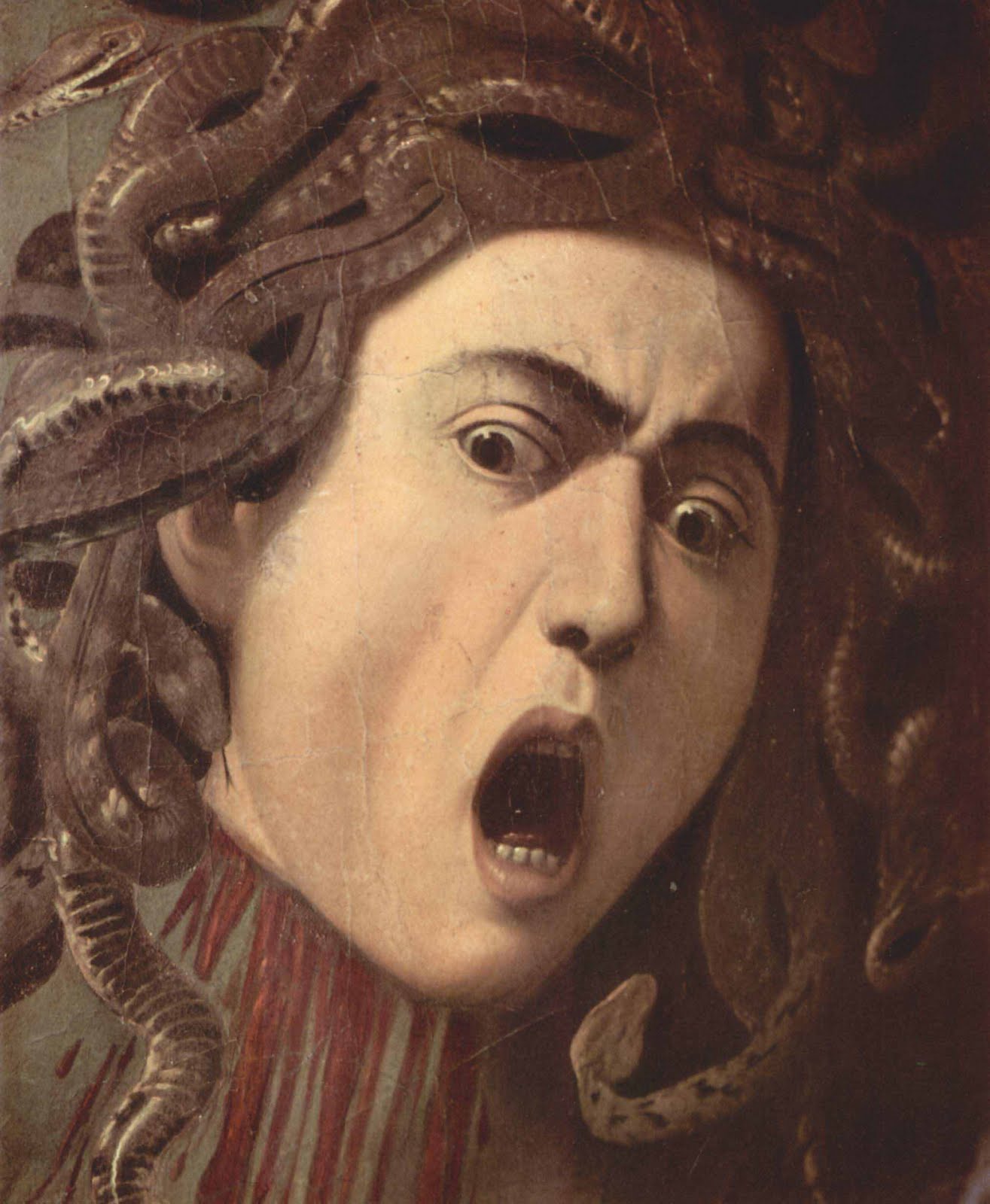
The Gorgons were three sisters by the names of Stheno, Euryale and Medusa. They were grotesque beings with snakes for hair, tusks like those of a boar, hands of bronze, wings of gold and their glance was death to man. Of the three, only Medusa was mortal and vulnerable, having once been a woman:


Medusa
Painting by Caravaggio.
“Medusa was once an exceedingly beautiful maiden,

Whose hand in marriage was jealously sought by an army of suitors,

According to someone who told me he’d seen it, her marvellous hair

Was her crowning glory. The story goes that Poseidon the sea god

Defiled this glorious creature inside the shrine of Athena.

The daughter of Zeus screened her virginal eyes with her aegis in horror,

And punished the sin, by transforming the Gorgon’s beautiful hair

Into horrible snakes.”
                        - PERSEUS RECOUNTS THE TALE OF MEDUSA


So Perseus set out to vanquish the blasphemous monster. Athena came to his aid, and told him to seek the nymphs known as the Hesperides, who possessed weapons which could conquer the Gorgon. Perseus sought out the old witches, and asked where he might find these nymphs. The witches were the sisters of the Gorgons, old women from birth who shared but a single eye and a single tooth between them. At first the witches taunted and mocked Perseus, and refused to reveal the nymph’s whereabouts. Through cunning and trickery, Perseus seized the eye and tooth, and offered them back only if they gave him what he needed. Reluctantly, the witches told him all they knew.

Perseus came to the Hesperides, where the nymphs gave Perseus a magnificent set of gifts to aid him against Medusa. The nymphs gave him a magical wallet to contain the Gorgon’s head and then the enchanted helm of Hades, which had been forged by the Cyclopes during the War of the Titans, which rendered the wearer invisible. The gods themselves also gave, and Hermes lent to Perseus his winged sandals so as to grant him the gift of flight, as well as an adamantine blade to pierce Medusa’s reptilian hide. Athena gave a fine shield, whose polished bronze surface rendered the perfect reflection. Armed with his divine tools, Perseus took flight across the vast Ocean, to the ends of the Earth and arrived at the Gorgon’s cave. Over to the sleeping beasts he crept, eyes fixed on their ghastly reflection of in his shield, and with a mighty strike he severed Medusa’s head. From her bleeding neck sprung the winged horse Pegasus. Out too came Chrysaor – the result of her and Poseidon’s violation in Athena’s sanctuary. Medusa’s fellow Gorgons awoke with a start and gave chase, but Perseus quickly slipped the foul head into the wallet and made good his escape, shielded under Hades’ helm.

On his return to Polydectes, Perseus stopped in the land of Ethiopia, kingdom of Cepheus and his queen Cassiepeia. Cassiepeia proudly declared herself to be more beautiful than the Nereids (The sea nymphs) themselves, bringing down upon her kingdom the wrath of Poseidon, who unleashed a terrible Leviathan upon the people. An Oracle told the people that the land could be saved only by sacrificing the Princess Andromeda to the monster, and so King Cepheus mournfully gave the order to chain her to the rocks. Perseus offered to slay the creature if he could take Andromeda as his wife. The King eagerly agreed, and Perseus flew to the princess’ rescue:

Perseus rescues Andromeda
Painting by Paolo Veronese.
“Poised on his swift wings, Perseus eluded his ravening enemys’ jaws

And went for his weak points, hacking away with his hooked sword,

Now at its barnacled back and then at the ribs, then again

At the narrowest point of the tail where it tapered into a fish.

The monster spewed forth seawater mingled with crimson blood...”
                                               - PERSEUS SLAYS THE LEVIATHAN

Perseus was hailed as a hero, and was given Andromeda as his bride. However the brother of Cepheus, Phineus, demanded Andromeda for himself and confronted the hero. Perseus revealed the Gorgon’s head and turned Phineus and his fellow conspirators to stone.

Perseus shows the Gorgon's head to Phineus
Painting by Luca Giordano.
Returning home to Seriphos triumphant, he found his mother and the fisherman Dictys in hiding from cruel Polydectes, who now received his wish – the Gorgon’s head. Indeed he even got to look the evil thing in the eye, and was transfixed in bloodless stone. Perseus gave the throne to the fisherman Dictys and set off to confront the man behind all of this – Acrisius, who had fled Argos when he heard of the hero’s coming. Perseus competed in the pentathlon at the athletic games in the land of the Pelasgians (northern Greece), whereupon he hurled his discus. The gods made the wind blow suddenly strong, carrying the disc into the head of Acrisius, sending him to the Underworld in a single blow. The prophecy at last fulfilled, Perseus buried Acrisius outside the walls of Argos, as he himself became King of Tiryns and founded Mycenae. Andromeda gave birth to many sons and daughters, the first son taking the name of Perses – from whom the Persian race claimed origin. Perseus and Andromeda lived long lives and became the progenitors of the Danaan race, to whom many great dynasties of Greece would claim descent, even to the day they had all been trodden under the iron shod boot of the Roman legions. To be descended from the Thunder god himself was to have powerful blood flowing through your very veins. To trace your lineage through one the god’s most illustrious sons was to add even greater lustre to the sheen.

The story of Perseus is one of the most famous in Greek mythology, and both Perseus and Medusa are famous cultural icons across the West. The stories are as enchanting in the original poetry as they were read aloud. The story can be found easily and at a discounted price at Amazon:

United Kingdom

Penguin Classics:
Metamorphoses: A New Verse Translation (Penguin Classics)
(The famous poem of Publius Ovidius Naso, a joy to read and 'the poetic account')

Oxford World's Classics:
The Library of Greek Mythology (Oxford World's Classics)
(A library of mythology, less poetic but contains the whole story of Perseus)

United States

Penguin Classics:
Metamorphoses (Penguin Classics)
(The famous poem of Publius Ovidius Naso, a joy to read and 'the poetic account')

Oxford World's Classics
The Library of Greek Mythology (Oxford World's Classics)
(A library of mythology, less poetic but contains the whole story of Perseus)