Do not take on that which is not meant for you, and leave no advice or warning unheeded. That is the moral of the story of Phaethon. If your identity was suddenly revealed to you as the offspring of a deity, what would you do? Would you be humble or would you be proud?
When Clymene, Queen of the Ethiopians, told her son Phaethon one day that he was in truth not the son of her husband, King Merops, but of the sun god himself, the boy was stunned into silence. Though he had always suspected something was not quite right, something he could never place in all the time he had spent with the King, the words which rang in his ears now still sowed the most profound shock mingled with disbelief. He, just a boy like no other, the son of a god? Not just any god, but Helios, one of the Titans, who ruled in the kingdom of the skies far over the mortal Earth, the very incarnation of the Sun. Disbelief flooded young Phaethon first, doubt close on its heels, as his mother's confession grew stronger yet. A tormented sleep did the young Prince endure, turning in the night, racked with angst. In his good friend Cygnus did Phaethon confide this revelation strange, and his bewilderment at what to do. The two boys marvelled at the possibilities if such a thing could be true. There seemed only one thing for it, and that was to travel to the Kingdom of the Sun and seek out the Titan himself to learn the truth.
Bidding farewell to his native land, to his mother and to Cygnus, Phaethon set forth on his fateful quest, his eyes upon the Eastern horizon firmly fixed. After an age it seemed, the realm of men was falling behind, the realm of the divine approaching. There, just ahead, 'the Sun's bright palace, on high columns rais'd, with burnish'd gold and flaming jewels blaz'd'. The gleam of the surface of the gate, reflected a burning light. Far had the young boy come, too far to turn back now. Upon the solar threshold a weary step the Prince did place, and never again the coolness of night touched young Phaethon's face.
Deeper and deeper into the Palace of the Sun he trod, and higher and higher the temperature soared, until at last, a blinding light of purest white heralded the throne of he, Helios the lord of the Sun. High on his blazing throne he sat, exalted and resplendent, the hours bowing at his hands. The Titan saw the proud youth loitering, "My son!" said he, "Come to thy father's arms! For Clymene has told thee true; a parent's name I own, and deem thee worthy to be called my son":
" 'As a sure proof, make some request, and I,
Whate'er it be, with that request comply;
By Styx I swear, whose waves are hid in night,
And roul impervious to my piercing sight.'
The youth transported, asks, without delay,
To guide the Sun's bright chariot for a day... "
- PHAETHON'S WISH
Immediately did regret flood the Titan's mind, for the one thing of which Phaethon asked was the one thing he was not fit to bear. To steer the Chariot of the Sun was a task entrusted to none but Helios himself, for within was bound grave responsibility, and peril. The Titan, torn between his word and his care for his son, implored Phaethon to choose again. "There is not one of all the gods that dares to mount the burning axle but I, not Zeus himself, the ruler of the sky, that hurls the three forked thunder from on high...". But alas in vain, for the greater the god tried to dissuade him, the grander Phaethon's ambition grew, and his will to resist. "If downwards from the Heav'ns my head I bow, and see the Earth and Ocean hang below, ev'n I am seiz'd with horror and afright", the Titan pleaded, but alas in vain. Terrifying is the Chariot's race across the Heavens, a will of steel needed for such an undertaking as the horses tear through the sky. Helios tried and tried again to convince his son to accept a humbler prize, some kingdom or grand fortune far below in the domain of man, but unmoved was the ambitious prince.
It was beyond the point of return now, the River Styx had heard the Titan's oath. One last plea, one last turnéd ear. So with heavy heart Helios lead young Phaethon to the blazing Chariot, glimmering with gold, spoked with silver and seated with gems. With unbridled joy Phaethon surveyed his prize, his pride gorged. Helios looked up. The stars were receding, the time had come. At his command the hours brought forth the steeds, monstrous horses snorting raging fire. One last chance to save his son, the Titan anointed his body with celestial oil, to proof him against the staggering heat. A tear in his eye, he whispers one last phrase; "Take this at least, this last advice my son, keep a firm rein, and move but gently on: the courses of themselves will run too fast, your art must be to moderate their haste. Drive them not directly through the skies, but where the Zodiac' winding circle lies...". Phaethon offered his thanks, which the Titan with remorse received.
The mighty stallions neighed with restless wanton, flames roaring from their mouths, stamping upon the clouds. The time had come. Night gave way, and together they hurled forward as one, the beasts thundering forth, Phaethon soaring through clouds and breezing air. With dizzying speed they outstripped all winds. Though a little light for the Chariot, at first the Prince rode well, heeding the Titan's word. Following the course of the Zodiac, the Chariot moved with irresistible, yet steady, force. But as time passed, Phaethon grew proud of his feat, to equal the Sun god himself? The monstrous steeds sensed weakness in the hand of their master, and their unruly nature took hold. As soon as the Prince's gaze was turned, violently did they veer from the Zodiacal path. Pandaemonium reigned in the skies that day. Phaethon was cast against the Chariot's fore, and knew not which way to turn, whether to yank the reins or let them lie. The horses charged above, and the Sun veered to the stars, which retreated before its fiery heat. Far below ice with frozen hand began to throttle the land, snow fell upon the peaks and Oceanus shivered.
Far above, Phaethon looked behind, and saw the vast expanse of the Earth falling away behind him, panic stricken now. Pulling hard upon the reins, he tried to restore control. The horses, incensed, bolted to the side and careered toward the Earth:
" The clouds disperse in fumes, the wond'ring Moon
Beholds her brother's steeds beneath her own;
The highlands smoke, cleft by the piercing rays,
Or, clad with woods, in their own fuel blaze.
Next o'er the plains, where ripen'd harvests grow,
The running conflagration spreads below.
But these are trivial ills: whole cities burn,
And peopled kingdoms into ashes turn... "
- THE EARTH SCORCHED
Down and down the Chariot plummets, and the incredible heat takes its fiery toll on the world. The high mountains buckle in the inferno, snow replaced with flames. The Ocean boils, and Poseidon the Earthshaker, god of the sea, brandishes his trident in defiance. Monstrous Typhon, deep below the Earth, grows restless in his infernal prison, and Mount Etna above explodes forth with redoubled fury. Even far off Scythia on the nomadic Steppe sees her frosts melt, and her plains burn. Verdant Africa bore the brunt, and ever after has been a mighty desert. Great Olympus, towering high above, shakes, as the rocks splinter and rend asunder, wreathed in fire. The world burns, and flames lick the Heavens. Mother Earth screams in agony, her ashes floating to the stars. Phaethon beheld the devastation before his eyes and realised the folly of his wish. The furnace heat of the world reached the sky, and the axle of the Chariot began to glow. The Euphrates fleed, the Danube too, the swollen Ganges, the Tiber, nurse to a promised Empire, too. Even the mighty Nile retreated in terror, and the seas plunged. The intense heat cracked the Earth, and fissures began to split it apart. Deep in the Underworld, pallid Hades recoiled from the light his kingdom knew not.
At last Gaia, Mother Earth, could bear no more. Denouncing the Olympians for allowing such a tragedy come to pass, she called upon her grandson to act. So did Zeus the Thunderer, King of gods and men, summon the divine array. Helios came before Zeus and tried to move his heart, but no ally did the Titan find. Taking up his burning throne, Zeus seized a bolt of thunder which glowed brighter even than the Earth. "Then, aiming at the youth, with lifted hand, full at his head he hurl'd the forky brand". The deadly dart of Heaven arced across the sky, striking Phaethon square in the head. At once from the shackles of life and the sun god's chariot was the Prince thrown. The horses charged back to the hands of their true, but weeping, master. The flaming body of Phaethon fell through the skies, gold and wheel falling too. Like a dying star he plummeted to the Earth his folly had ruined, until his ruined body struck the Po in the West.
Never again would someone dare such hubris as to emulate the Sun, and never again would a god make so bold an offer. Far below, few wept for Phaethon, cause of such ruin, except one. By the water's edge Cygnus sat, tears in his eyes for his friend. All their lives they had been partners in crime, mischievous together, now separated by Zeus's hand. The gods heard him weep, and pity moved their hearts. At their command his form was changed. Where once there were hands, now wings, where once mouth, now blunted beak, where once flesh, now pure white feathers. Ever after, the youthful swan has borne Cygnus' name...
United Kingdom
Penguin Classics
Metamorphoses: A New Verse Translation (Penguin Classics)
(A more prosaic and easier to understand version of the Roman poem)
Oxford World's Classics
Metamorphoses (Oxford World's Classics)
(A high poetical version of the Roman poem)
United States
Penguin Classics
Metamorphoses (Penguin Classics)
(A more prosaic and easier to understand version of the Roman poem)
Oxford World's Classics
Metamorphoses (Oxford World's Classics)
(A high poetical version of the Roman poem)
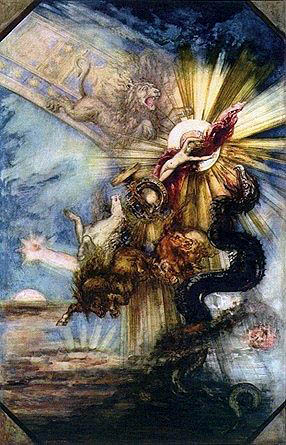 |
| Phaethon Proud Painting by Gustave Moreau |
Bidding farewell to his native land, to his mother and to Cygnus, Phaethon set forth on his fateful quest, his eyes upon the Eastern horizon firmly fixed. After an age it seemed, the realm of men was falling behind, the realm of the divine approaching. There, just ahead, 'the Sun's bright palace, on high columns rais'd, with burnish'd gold and flaming jewels blaz'd'. The gleam of the surface of the gate, reflected a burning light. Far had the young boy come, too far to turn back now. Upon the solar threshold a weary step the Prince did place, and never again the coolness of night touched young Phaethon's face.
Deeper and deeper into the Palace of the Sun he trod, and higher and higher the temperature soared, until at last, a blinding light of purest white heralded the throne of he, Helios the lord of the Sun. High on his blazing throne he sat, exalted and resplendent, the hours bowing at his hands. The Titan saw the proud youth loitering, "My son!" said he, "Come to thy father's arms! For Clymene has told thee true; a parent's name I own, and deem thee worthy to be called my son":
" 'As a sure proof, make some request, and I,
Whate'er it be, with that request comply;
By Styx I swear, whose waves are hid in night,
And roul impervious to my piercing sight.'
The youth transported, asks, without delay,
To guide the Sun's bright chariot for a day... "
- PHAETHON'S WISH
Immediately did regret flood the Titan's mind, for the one thing of which Phaethon asked was the one thing he was not fit to bear. To steer the Chariot of the Sun was a task entrusted to none but Helios himself, for within was bound grave responsibility, and peril. The Titan, torn between his word and his care for his son, implored Phaethon to choose again. "There is not one of all the gods that dares to mount the burning axle but I, not Zeus himself, the ruler of the sky, that hurls the three forked thunder from on high...". But alas in vain, for the greater the god tried to dissuade him, the grander Phaethon's ambition grew, and his will to resist. "If downwards from the Heav'ns my head I bow, and see the Earth and Ocean hang below, ev'n I am seiz'd with horror and afright", the Titan pleaded, but alas in vain. Terrifying is the Chariot's race across the Heavens, a will of steel needed for such an undertaking as the horses tear through the sky. Helios tried and tried again to convince his son to accept a humbler prize, some kingdom or grand fortune far below in the domain of man, but unmoved was the ambitious prince.
It was beyond the point of return now, the River Styx had heard the Titan's oath. One last plea, one last turnéd ear. So with heavy heart Helios lead young Phaethon to the blazing Chariot, glimmering with gold, spoked with silver and seated with gems. With unbridled joy Phaethon surveyed his prize, his pride gorged. Helios looked up. The stars were receding, the time had come. At his command the hours brought forth the steeds, monstrous horses snorting raging fire. One last chance to save his son, the Titan anointed his body with celestial oil, to proof him against the staggering heat. A tear in his eye, he whispers one last phrase; "Take this at least, this last advice my son, keep a firm rein, and move but gently on: the courses of themselves will run too fast, your art must be to moderate their haste. Drive them not directly through the skies, but where the Zodiac' winding circle lies...". Phaethon offered his thanks, which the Titan with remorse received.
 |
| Phaethon Falls Painting by Johann Liss |
Far above, Phaethon looked behind, and saw the vast expanse of the Earth falling away behind him, panic stricken now. Pulling hard upon the reins, he tried to restore control. The horses, incensed, bolted to the side and careered toward the Earth:
" The clouds disperse in fumes, the wond'ring Moon
Beholds her brother's steeds beneath her own;
The highlands smoke, cleft by the piercing rays,
Or, clad with woods, in their own fuel blaze.
Next o'er the plains, where ripen'd harvests grow,
The running conflagration spreads below.
But these are trivial ills: whole cities burn,
And peopled kingdoms into ashes turn... "
- THE EARTH SCORCHED
Down and down the Chariot plummets, and the incredible heat takes its fiery toll on the world. The high mountains buckle in the inferno, snow replaced with flames. The Ocean boils, and Poseidon the Earthshaker, god of the sea, brandishes his trident in defiance. Monstrous Typhon, deep below the Earth, grows restless in his infernal prison, and Mount Etna above explodes forth with redoubled fury. Even far off Scythia on the nomadic Steppe sees her frosts melt, and her plains burn. Verdant Africa bore the brunt, and ever after has been a mighty desert. Great Olympus, towering high above, shakes, as the rocks splinter and rend asunder, wreathed in fire. The world burns, and flames lick the Heavens. Mother Earth screams in agony, her ashes floating to the stars. Phaethon beheld the devastation before his eyes and realised the folly of his wish. The furnace heat of the world reached the sky, and the axle of the Chariot began to glow. The Euphrates fleed, the Danube too, the swollen Ganges, the Tiber, nurse to a promised Empire, too. Even the mighty Nile retreated in terror, and the seas plunged. The intense heat cracked the Earth, and fissures began to split it apart. Deep in the Underworld, pallid Hades recoiled from the light his kingdom knew not.
At last Gaia, Mother Earth, could bear no more. Denouncing the Olympians for allowing such a tragedy come to pass, she called upon her grandson to act. So did Zeus the Thunderer, King of gods and men, summon the divine array. Helios came before Zeus and tried to move his heart, but no ally did the Titan find. Taking up his burning throne, Zeus seized a bolt of thunder which glowed brighter even than the Earth. "Then, aiming at the youth, with lifted hand, full at his head he hurl'd the forky brand". The deadly dart of Heaven arced across the sky, striking Phaethon square in the head. At once from the shackles of life and the sun god's chariot was the Prince thrown. The horses charged back to the hands of their true, but weeping, master. The flaming body of Phaethon fell through the skies, gold and wheel falling too. Like a dying star he plummeted to the Earth his folly had ruined, until his ruined body struck the Po in the West.
Never again would someone dare such hubris as to emulate the Sun, and never again would a god make so bold an offer. Far below, few wept for Phaethon, cause of such ruin, except one. By the water's edge Cygnus sat, tears in his eyes for his friend. All their lives they had been partners in crime, mischievous together, now separated by Zeus's hand. The gods heard him weep, and pity moved their hearts. At their command his form was changed. Where once there were hands, now wings, where once mouth, now blunted beak, where once flesh, now pure white feathers. Ever after, the youthful swan has borne Cygnus' name...
United Kingdom
Penguin Classics
Metamorphoses: A New Verse Translation (Penguin Classics)
(A more prosaic and easier to understand version of the Roman poem)
Oxford World's Classics
Metamorphoses (Oxford World's Classics)
(A high poetical version of the Roman poem)
United States
Penguin Classics
Metamorphoses (Penguin Classics)
(A more prosaic and easier to understand version of the Roman poem)
Oxford World's Classics
Metamorphoses (Oxford World's Classics)
(A high poetical version of the Roman poem)


