Showing posts with label Poseidon. Show all posts

Wednesday, 12 March 2014

Theseus and the Minotaur

The legend of the hero Theseus is matched only by the infamy of the beast he slew - the Minotaur. When the city's hour of need was at its greatest, the hero came forth to face the threat beyond the sea...


Theseus discovers the sword
Painting by Antonion Balestra
Long ago, before the days of Hellenic greatness, before even the Trojan War, there sat Aegeus on the throne of Athens, eighth in line since great Cecrops had received the olive from the goddess Athena and founded the city which forever honours her name. As a young man, Aegeus had sought a Queen to secure the still fragile Athenian dynasty, and came to the city of Troezen, a power in the nearby Eastern Peloponnese. Smitten with Aethra, daughter to King Pittheus, the humble Aegeus pledged himself to her. When the night of their betrothal came, and the wedding was consummated, a god's will compelled Aethra out of the Palace and into the night. Drawn far from the walls, her foot touched the glassy waters of the ocean, as she waded to the island of Sphairia. There, embraced in Poseidon's realm, she was embraced too by the god of the watery realm. Thus was her son to have two fathers, one a mortal man, the other a god, a son of Kronos. When Dawn arrived, and the enchantment lifted, Aethra was racked with guilt, and confessed to Aegeus. Distraught, the Athenian King resolved to return to Athens. But before he did, he left a trial for his yet unborn son. Taking his own sword and sandals, he dug a ditch just wide enough, and concealed the regalia within, and sealed them in their earthen tomb below a mighty boulder such that no man who lacked royal or divine blood could lift. Aegeus told Aethra that when the time came, the boy might come to him bearing the sword and sandals, and his birthright would then be his.

Thus was the infant boy, who was gifted the name of Theseus, raised in the land of his mother. With royal blood of both mortal and immortal kind flowing in his veins, a strong young lad he became, the envy of all in his company. Then one day he asked his mother of his father, for rumours had he heard of his mystical parentage. Aethra told the boy of the boulder, and that he should take what he found beneath it to King Aegeus of Athens, and follow his path there. Finding the great stone, in the grip of vines and of moss, Theseus placed his strong hands on either side, and heaved. Royal blood and divine sinew strained, and the pinnacle was torn from the ground. A flash of sunlight shone from below, and there no more tarnished than the day they were lain there, the sword glinted, and the sandals too. Taking them, a warmth in his fingers, Theseus set out on the long road to Athens.

When at last the Acropolis appeared on the horizon, Theseus arrived in a city of misery, for Athens was submit to the will of the wrathful King of Crete - Minos. Long ago, enraged by the assassination of his son at the hands of jealous Athenians, Minos had warred down Athens to the point of capitulation. In desperation, the Athenians begged the Oracle of Delphi for advice. Her words were unsually unambiguous - submit to Minos' wish. The ambassadors of Athens came before the Cretan King, and offered surrender, if he would spare their city. Minos offered them peace, but on one terrible condition. Every nine years, Athens must send to Crete the seven most promising young boys, and the seven most beautiful young girls, where they were to be thrown deep into the labryinthine dungeons of Knossos. Rumours abounded in the courts of the world, terrible stories of unspeakable horror. Long ago, the great architect Daedalus had designed the Labyrinth for one grisly purpose, to contain the monstrous brood of Queen Pasiphae and the Cretan Bull, a creature both man in body and beast in head, the bloodthirsty Minotaur. The Ambassadors balked. The choice that lay between King Aegeus now, either humiliation or destruction. Resigned to his fate, a grieving Aegeus had accepted the cruel tribute that was demanded of him, to sacrifice the few for the survival of the many. The day Theseus arrived in Athens was the third time the emissary of Crete had arrived to exact the tribute, and Athens mourned her third loss.

Theseus, alone happy in a sea of mourning, approached the broken King ahead, holding high the shining sword, and clad in the fine sandals of the House of Erechtheus. A glint of sunlight, the King raises his head. He sees the blade he cast beneath the earth so long ago, and for the first time in many long years,a  ray of happiness pierced his life, for well did he know that there was but one person who could have claimed them. A rare smile breaks his face, as he runs to give his child his first embrace, just as many others around wail as they give their last. Tomorrow will be the day when the ships sail for Crete's dark domain, and the last victims are yet to be chosen to meet their fate. Aegeus welcomed Theseus to the city, and honoured him as a citizen of Athens, and the people cheered, momentarily distracted from the dark day ahead.

Long ago King Aegeus had decreed that there was only one way to decide fairly, and that was a lottery of all the citizens of Athens, with no exceptions. Evening came, and the lottery of death could be delayed no more. Athenian fathers and mothers wept as their children placed their tokens in the vessel. Woe that the King should see his son return on this day, for Theseus too honoured the pact, and placed his own mark within. Tense was the atmosphere, and grievous the anticipation. All men felt as though the gallows awaited, the base dread of every parent incarnate, present, and inevitable. Seven stones were chosen from the girl's ballot box, seven families broken, and the palace groaned beneath their cries. The screams had barely abated when seven more were chosen from the boy's box. Six rolled out, and six mothers screamed, yet when the seventh rolled out, it was the King himself who joined them, for there, unambiguously, was the stone that poor Theseus had cast within. Never had a father known such joy and such terror in one day. Aegeus embraced the prodigal son, but his rules were absolute, and Aegeus was a just ruler. Theseus would be joining his thirteen fellow citizens on their final voyage. But Theseus, no stranger to danger, filled with valour and bravado in equal measure, vowed to slay the monster that lurked below the King's Palace. With such longing, anything to distract him from clear logic, Aegeus dared to trust in him.

Dawn arrived, Light and impending doom both carried in her wake. The ferrymen readied black sails upon the ships, for it seemed a funeral sail. But it was then that Theseus, son of two fathers, who boldly commanded the black be cast aside in favour of white. He vowed before the men and women of Athens that he would conquer the Minotaur, and that the dark days would soon be at an end. Fresh hope filled the hearts of the Athenians, and people dared to wonder. Aegeus took the boy aside and asked him one thing, that should he succeed against the odds, to fly the white sail on his return, so that Athens may know in advance of his fate. Theseus agreed, and father and son embraced for what all around believed the last time. Sails white as the snow on Olympus' lofty heights billowed, and the voyage was begun. Twice before the ferrymen had made this journey, twice before had they steeled themselves against the soft weeping of yore. This time however, a different atmosphere prevailed. Buoyed by the limitless reserve of fortitude that Theseus seemed to possess, the thirteen clung to the one thing Pandora had saved so long ago - hope.


Dolphin Fresco
Image taken from the Queen's Megaron, Palace of Knossos
When at last the ferrymen hurled their ropes on Cretan docks, fear lanced through the Athenians more terrible than ever, for no mere emissary stood to await them, but Minos himself and his daughter, Ariadne. Now Minos was no simpleton nor ignorant fool. News reached his ears from far and wide. Least of all could Crete escape the stories of the twice fathered son. Yet there was one part of the legend the King, himself a son of Zeus and Europa, longed to know. Thus he cried:


                     " You, if Troezenian Aethra bore you to Poseidon the earth shaker,
                      bring this splendid gold ornament on my hand back from the depths
                      of the sea, casting your body boldy down to your father's home... "
                                - KING MINOS CHALLENGES THESEUS

From his finger the King took his sovereign's ring, and cast it into the azure sea, a tiny flash of gold against the ripples of blue. The spirit of Theseus within held no fear, as without a moment's fear, he dived from the Athenian prow into the waves. Out of the murky blackness of the deep a dolphin soared, and beckoned Theseus to follow. Down and down into the foot of the ocean they went, until the halls of Poseidon they reached, bright with the spirit of gods. Shining Nereids played hither and thither, hippocampi wallowing in the surf. There ahead sat enthroned Amphitrite, the consort of the god himself upon the coral throne. There at the foot of it all sat the ring, an insignificant band before the lady of the ocean herself.

High above the Cretans and Athenians sat anxiously, the Minoans smiling, the Athenians tense. But then, the surface of the Ocean was rent asunder, as a powerful hand burst forth from the azure waves, clasping a sovereign's ring. Behind it came the body of Theseus, the twice fathered son if Poseidon. The Athenians shouted with joy, hope sprang anew. Even the Cretans were struck dumb. But Minos, himself heaven born, was not swayed. He saw now a mere equal, yet Theseus was son to the god of the sea, whereas he was son to the god of gods himself. To him he summoned his guards, and bade them cast the Athenians into gaol.


Ariadne gifts the twine to Theseus
Painting by Niccolo Bambini
In the dungeons of Knossos, a city whose beauty concealed a secret spattered with blood, the Athenians were sealed for their final night, one last night Minos granted them before they gazed upon the face of death. But it was not only Minos who had noticed something about Theseus, for in the moment she first saw him, Ariadne, struck by the barb of Cupid, had been drawn to the young prince. Well did she know of the horror with the Labyrinth's walls, and great was her pity for the young Prince. Coming to his cell, she bore a gift, a simple gift which no guard would question. A simple ball of string. Through the bars she passed the invaluable twine, instructing Theseus to tie one end at the entrance to the unconquerable maze, and hold the other at all times, so that he might see the light of day again should he prevail against the odds. She gave to him one further thing, a piece of knowledge great Daedalus himself had once told her. "Go forwards, always down and never left nor right". Theseus, overwhelmed, gave thanks to Ariadne, and swore to come for her if he triumphed. With a smile she withdrew into the night.

Dawn arrived to a blood red sky over the idyllic island of Crete, as the jailer arrived to unlock the cells. Black were the omens, grieving the moods. Just one among the Athenian party looked straight ahead. Theseus, heart pounding, gazed into the dark entrance of the Labyrinth. A torch burned in a bracket in the dark tunnel ahead. Fumbling, his hand found the ball of twine, and wisely did he fix one end upon the bracket. The thirteen followed close behind him, daring not to be without him in the house of death. Bold Theseus led the way, and faithful was he to Ariadne's word, for onward he strode, never a branch in the dark path did he take.


Theseus victorious
Painting by Charles-Edouard Chaise
For an age, or so it seemed, this strange procession took place, the presence of the twice fathered heir to the throne the only thing preventing the thirteen falling into ruinous panic. A shattered human bone came into view from the darkness, a race of pulses. Further in and further down they went, when soon a most nauseating stench rose to their nostrils. The stink of death, and rotting cadavers. The pounding hearts dared to shake the walls, matched only by the unearthly sound of snoring in the darkness beyond, as Theseus bade his kin remain silent, lest their presence be revealed. Further in and further down, as though down the throat of Hell they went now, until a clearing suddenly opened up before them. There, in the heart of the great Labyrinth atop a mound of mangled bones spattered with blood, lay the dealer of so many Athenian deaths. "A mingled form and hybrid birth of monstrous shape... two different natures, man and bull, were joined in him...". The monstrous brood of the Cretan Queen and the Cretan Bull lay stretched out, snoring loudly as it slept, gorged on human flesh. Then the courage of one of them failed, the sight of so many of their kin cruelly slaughtered, and a scream. A heavily lidded taurian eye wrenched open, and snores turned to roars. Theseus moved quick as a flash, and leaped onto the creature's back, swift as an arrow, before it found its feet. Nerves racing, Poseidon and Aegeus' son summoned all his might, divine and royal blood thundering through his veins, and flung his arms around Asterion's mighty neck. More than once the Minotaur's lethal horns near pierced his chest, as the crew of Athens gasped, their own lives on the line now. Tighter was the hero's iron grip, fiercer the monster's rage, wakened from its nine year slumber. Slammed against the great Labyrinth's walls, no other man could have held on, but no other man was Theseus. Seeing the terror on the faces of his kin, he had all the motivation he needed, and Theseus wrenched one last time with all his strength, forcing the creatures on one knee. The Minotaur snorted loudly, and breath left its body. With a loud crunch, the massive form fell upon the bones of its victims, cast down to the Inferno, never again to rise and trouble the realm of men. Blood still pounding in his ears, Theseus did not at first hear the screams all around, but no screams of fear were they, but sheer relief mingled with joy...


United Kingdom

The Life of Theseus:
Plutarch's Lives: Theseus and Romulus, Lycurgus and Numa, Solon and Publicola (Loeb Classical Library): Vol 1
(A series of well written biographies of great men of ancient Greece and Rome, including Theseus, and the most complete and in depth source for him. Fun to read and not at all academic or dull!)

United States

The Life of Theseus:
Plutarch Lives, I, Theseus and Romulus. Lycurgus and Numa. Solon and Publicola (Loeb Classical Library®) (Volume I)
(A series of well written biographies of great men of ancient Greece and Rome, including Theseus, and the most complete and in depth source for him. Fun to read and not at all academic or dull!)

Wednesday, 15 January 2014

Orion

Ursa Major was not the only of the great constellations of the night sky to draw the attention of the ancients. Indeed all the major stars and their formations were well known in ancient times. All of them had their own origins and stories well recorded in lore, some in as many variants as the stars themselves. One such example is the story of the constellation Orion.


Blind Orion seeks the rising Sun
Painting by Nicolas Poussin
Long ago in Hellas, a place men now call Greece, there was a divine and regal birth. Brood of the god Poseidon, Lord of the Sea, and Euryale, daughter of King Minos of Crete, this would never be a normal child. Gigantic in stature, like his cousin the Cyclops Polyphemus, the boy towered over all of his peers, in ability as much as height. The boy was named Orion, and though good at heart, warred with the violent instincts that ran through the veins of all the Giants. As a result of his being son of the Lord of the Ocean, Orion found himself one day able to walk upon the surface of the ocean without falling through it - he could walk on water, unmolested by the horrors of the deep. As Orion grew, vaster than any mortal, though not blessed with a great mind he acquired a particular passion for hunting, a noble pursuit for a man in such days, and a way he might turn his aggression away from harming his peers. Soon his reputation was legend even as a teenager, as game fled his presence on sight, for well did they know that no being could escape Orion's hurled spear. In all things, Orion was never to be seen without his one true friend and loyal companion, his hound Sirius.


Searching for distant lands for ever more challenging game, great Orion ventured to the island of Chios, its isolation from the mainland no problem for the water walking giant, carrying faithful Sirius aloft. As Orion placed his vast foot on the sandy shore, he was welcomed to the island by King Oenopion and his entourage. Though much of the regal language was lost on simple Orion, the face of the King's daughter, Merope, was not. Intrigued by the foreign princess, and perpetually condemned to solitude, the giant desired a friend more than almost anything, save perhaps the choicest game under the Heavens. Oenopion invited his larger than life guest back to the palace, and threw a banquet in honour of him, for hospitality is a concept employed by the people of Chios with spectacular finesse. Orion, who had scarcely seen so many great things to eat, was overwhelmed. Due to his requiring more food than most simply to sustain him, the party dined well into the night. The hour grew late, and Merope retired for the night, leaving the revellers to their banquet, and Orion fell sad, though knew not why. The King, ever attentive to his guests, ordered the strongest wine brought to the table. When presented with a bucket sized goblet of shimmering red liquid, Orion knew nothing of it, having never before tasted wine of such potency, and drank as though he would water. The men of Chios laughed heartily, as the giant grew dazed and confused. The drink played its evil tricks on Orion's mind, already at war in the half human and half giant. Stumbling from the banqueting chamber, the drink lead him to Merope's quarters, sapping him of his human will. Crashing through the low threshold of the door, he fell into the princess's bedchamber, to the fright of Merope. As she ran to offer what help she could, Orion, lost to his senses, seized her with more strength than a man should. The racket caused by the door summoned the King immediately. When he saw the sight before him, the darkest suspicions reigned supreme. He at once, outraged at the abuse of his hospitality, ordered Orion condemned.


The Constellation Orion
Photograph by Rogelio Bernal Andreo
The King gave command that Orion should be blinded, so that his last vision would forever be that of the woman he longed for, and forced himself upon. Furthermore, Orion was banished from the kingdom. SO, once again, Orion set out on the road, destitute and ragged, with naught but his torn thoughts of grief and faithful Sirius to accompany him. One day, whilst on Lemnos, he encountered a stranger on the road, a stranger his eyes could not reveal as the god Hephaestus. Hephaestus took pity on the giant, and told Orion that if he sought the rays of the Sun as they were born, he would see again. His despair turned to joy, Orion eagerly asked the stranger where they could be found. Since the giant was blind, Hephaestus gave to Orion his own assistant from the forge, Cedalion. Taking up position of Orion's shoulder, Cedalion shouted directions in the giant's ear, and together they set off in search of the Land of the Sun. The vast journey, impossible for mortal feet, was swift for a giant, aided at all times by Cedalion upon his shoulder, and Sirius by his leg. At last the triad arrived at the Kingdom of the Sun, Cedalion and Sirius averting their eyes, Orion shielding them from the heat. Helios, the god of the Sun, indeed took pity on the giant, and as Orion closed his blind eyes from the heat, suddenly a slit of purest white appeared before him. He wrenched open his lids, and saw blinding light. He turned to his side, and saw a dog, and Cedalion on his shoulder, and rejoiced at his newfound sight. Thanking Helios dearly, the giant was filled with ecstasy.

For so long he had been denied the pleasure of the hunt, his great passion, and set off at once. Coming to the island of Crete, the home of his ancestors, he chased the game from sunrise to sunset. Artemis, the goddess of the hunt, was impressed by the hunter's prowess like never before in a mortal. Coming down to the Earth she offered him a unique honour, to join her in the hunt. He leapt for joy, and the games began.

Hither and thither the godly party went, and never before has so great a quarry been taken in sport. Deer, boar, bird and hare fell to the spears of Orion and arrows of Artemis. Soon near all Crete was empty of living beasts. At the moment of his pride, his giant instinct holding sway, Orion shouted to the Heavens that there was no creature on Earth that he, Orion, could not slay. But the balance of the cosmos had been tipped, that subtle yet ever levelling power which ensured no man or woman could ever be too powerful or too beautiful without disaster befalling them. Gaia, Mother Earth, was appalled at the slaughter on her body, and outraged at Orion's words. So the Titaness crafted a new beast to best the giant in his own game. Eight armoured legs she gave it, two crushing pincers and a lethal tail, brimming with fiery venom. To her new creation she gave the name of Scorpion, and thus was born the first of that race, the King of all Arachnids.


Artemis mourns the body of Orion
Painting by Daniel Seiter
At his side, Orion noticed the ground quake and churn as Mother Earth's revenge burst into the fresh air, divine fury in every inch of its chitinous hide. Orion drew back, wary of this new foe, and never was he to face such a terrible foe. He launched his spear, but alas, it span away, turned aside by the beast's armour. No arrow or blade would pierce that hide. So, across the valleys and mountains of Crete their duel raged, neither one able to best the other, Orion too swift for the creatures arms, the Scorpion impervious to Orion's blades. At last, with no more of the island left to run to, Orion, worked up to a giant's rage, hurled himself upon the monster, using his mighty strength to grapple the beast. The Scorpion writhed and injured the giant many times, but slowly, yet surely, Orion began to crush it inside its own armour. When at last victory seemed near Orion raised his head high and shouted in triumph. But alas, the momentary lapse of concentration cost him dear, for the creature's lighting flash of a move saw its stinger dart into Orion's shoulder, a lethal shot of venom upon its barb. The Scorpion died, but died avenged. Orion staggered away from the body of his conquered foe, the fiery venom robbing him of life. Lamenting his misfortune in life, he sought his last solace in the distraught eyes of Sirius, who licked his master's face one last time. So under the tears of his one true friend, Orion, the great hunter, felt the darkness close on his eyes.


Artemis, lady of the hunt, was devastated when she found his body, and appealed to Zeus the Thunderer, lord of the sky, for mercy. The god of gods was might, but could not turn the wheel of fate. Impressed by Orion's skill, yet warm human heart, he cast the giant into the skies, ever to shine in the night sky. To this day he is still there, the constellation Orion. Impressed too by the fearsome Scorpion, Zeus decided to make sure man would never forget to challenge Mother Earth, and cast it too to the skies. To this day, the constellation of Scorpio can be seen, set to rise when Orion falls. But one fellow lay not forgotten, and for his loyalty to his master and purest heart, Zeus the Thunderer placed Sirius in the skies, and the brightest of all stars he is to this day, amid the constellation of Canis Major...


United Kingdom

The Library of Mythology:
Library of Mythology
(A vast collection of the myths of old Greece, written in ancient times, and a great intro)

United States

The Library of Mythology:
Library of Mythology
(A vast collection of the myths of old Greece, written in ancient times, and a great intro)

Wednesday, 9 October 2013

The Trident and the Spear

Every city which rises to greatness does so from humble beginnings. So high can a nation rise that so mythic can her origins seem. Every great thing, be it a nation, a person, even an idea, has to start somewhere. To our ancestors of old, greatness was a sure sign of favour from on high. For the hand of a god must surely have been at work when one of the most influential cities in human history, for better or worse, was born.


Athena
2nd century AD Roman bust  from Velletri
The Olympians had fought a terrible fight for mastery of the Cosmos. Their forefathers and creators of the Universe, the Titans had not yielded their divine grip easily. After so great a struggle, the harmony of the World was worth more than anything to the gods, even to Zeus the Thunderer, King of the gods and Lord of the Sky. Now fidelity was one thing that Zeus the Thunderer knew not, and many a hero of the ancient world owed his existence to the philandering adventures of the god of gods. It was little surprise therefore, when Zeus undertook a clandestine affair with the beautiful Titaness Metis. However, when the Fates prophesied that the child of Metis would be mightier in spirit and wiser in understanding than its father, Zeus the father of gods and men was convulsed with fear. Long ago, his father Kronos had heard similar words, with dire consequences. The Heavens had groaned under the Titanomachy, and could ill afford so ruinous a war for a second time. So Zeus the Thunderer decided on a little evil for a greater good. Weaving his divine powers of transfiguration, the shape of Metis he shifted to that of a common fly, and the god swallowed her whole, so that she may never give birth to this legendary child.

Time passed, but troubles did not for the Lord of Olympus. As the days grew late, a terrible pain struck the god inside. What began as an ache inside his royal head, soon swelled to a pounding agony that would not die. Time soon came when even the Thunder himself, conqueror of Typhon and Heaven could bear the torment no more, and summoned to his side Hephaestus, the god of the forge and weaver of fire. "Take up thy hammer and rend asunder this head that pains me so, lest this torture afflict me for all the ages to come", said Zeus. The lame god of the smith stood dumbstruck by this command - split open the head of Zeus? But the father of gods and men was inexorable, and irresistible. So Hephaestus took up his hammer and tongs, and with a mighty strike, he breached the Divine Crown. A roar of thunder and a flash of light rolled over the skies. Then, in a blur of speed an apparition appeared. From the fissures in the skull of Zeus there leapt a figure, strongly built yet distinctly feminine, agile yet fully armed, wise yet ready for war, a new goddess entered the cosmos. Athena, goddess of wisdom, mistress of stratagem, lady of the spear and patron of heroes.

Around this time, far below on the mortal plain, the tribes of Attica came together under their King, Cecrops. Born of Mother Earth herself, Cecrops taught the Atticans the still young arts of reading and writing, of literature, of burial and brought the institution of marriage to the tribesmen. Civilisation as we know it, was being born. Soon, however, the simple villages of Attica groaned under the advance of the people, and a new home was needed. Under the leadership of their vibrant King, the Atticans set off through the harsh landscape of Attica, where open plains give way to beaten rock. After a time they came to a place in the West, largely flat yet punctuated by towering pinnacles of rock. The sea lay yonder, yet wise Cecrops knew that to build their new city on the shore itself was too dangerous in an era of rampant piracy on the high seas. Away from the shore then, yet near enough for trade, the people set foot upon a mount with a commanding position over the plain and the sea. Here would be founded their new city, and grandiose would it be. But every new city needed a patron god, but who?


Poseidon
The Artemision Bronze
Word reached Olympus of the gathering under Cecrops upon the Mount. Just then,  the Fates declared that the city that would be founded upon that place would rise to a greatness rivalling the best of all Greece. Glory and honour would walk hand in hand to whomsoever should become her patron. A frenzy gripped Mount Olympus, and the all the divine array wondered. Two among them immediately took the floor. Athena, ever ready with sharpened word and thought, leapt to her newborn feet. But Poseidon, god of the sea, shaker of the earth and lord of horses, bowed to few. Even Zeus himself, King of all gods kept a close eye on his ambitious younger brother, for most vexed was Poseidon when he lost the Heavens in the division of the cosmos. Torn between loyalty to his brother, however unruly, and care for his daughter, despite the danger she posed as his successor, Zeus decreed that the people should decide the patron of their city. Immediately, the two deities spirited down from Olympus and made landfall upon the mountain. With a blinding flash and a roar of thunder, the people cowered at the sight of the divine array. Fearful lest they choose one over the other, the people knew not what to do. Cecrops their King, however, decided. Turning to his gods, he declared that the patronage of the new city would belong to the one who presented the greatest gift to it. Poseidon and Athena, uncle and niece, eyed each other, and readied their contest.


The Sea of Olives, Delphi
Photograph taken by the author
Both god and goddess, stood aside the towering pinnacles of the Acropolis, poised for the prize of glory. Poseidon, shaker of the Earth, took the first move. Raising his mighty Trident high into the air, with a rush of godly strength he plunged the three blades into the mountain side. A deafening rumble rippled across the Earth, and the people were thrown to the ground, terrified. There, where the central prong penetrated the summit (a place today commemorated by the Erechtheion), the wounded rock spat forth a spring of water thick with brine. The Emperor of all Oceans granted to the people the gift of the sea itself, and the assurance that one day they would master it. A fabulous gift indeed. Next the virgin goddess stepped forth. The eyes of Athena looked into the souls of all mortals present, and she senses their hopes and fears. Confident, and unyielding, the daughter of Zeus took up her spear and flung it into the mount. The people watched, entranced, for before their eyes the lance began to shift. The wooden shaft lengthened and broadened, from the blade branches sprang forth, rich with the bounty of its dark fruit. To the people Athena gave the gift of the humble olive tree. Poseidon looked on, bemused and anxious.


Athens at her height
Painting by Leo von Klenze
The primordial Athenians looked on the lowly sprig with wonder and amazement, as the goddess instilled some of her divine wisdom in their minds. Cecrops beckoned his people round to cast their vote. Poseidon's gift was mighty indeed, as was his promise. Mastery of the Ocean? 'Tis the dream of empires! A great destiny had been given to them. But that all looked a long way off to the primitive people, as they looked to and fro, and saw naught but barren rock. One citizen splashed some of the water over his face, and recoiled at its salty taste. The people turned to the sapling, Athena's gift. One fellow took a blackened grape from its boughs, and crushed it in his hands, and oil splashed across his palm. Into his mouth he tossed the olive and pleasing was its taste. Seeing the thick and robust trunk too, he saw the greatness of Athena's gift. Poseidon had given them a taste of great nations, but Athena had given them a source of food, of wood and oil, and something they could trade with others. The people sank to their knees with joy, and hurled themselves at the foot of Athena, daughter of Zeus and maiden of Olympus. Poseidon, god of the seas, was infuriated, but his niece had won the day. Cecrops declared Athena the one true patron of their new city. He declared that this place, the Acropolis, would ever be sacred to her. He declared too, that in her honour the city would be named. To the roar of approval from the first Athenians, he named the city. Athens, the glory of Athena...


United Kingdom

The Library of Mythology:
Library of Mythology
(A vast collection of the myths of old Greece, written in ancient times, and a great intro)

United States

The Library of Mythology:
Library of Mythology
(A vast collection of the myths of old Greece, written in ancient times, and a great intro)

Wednesday, 23 January 2013

Phaethon

Do not take on that which is not meant for you, and leave no advice or warning unheeded. That is the moral of the story of Phaethon. If your identity was suddenly revealed to you as the offspring of a deity, what would you do? Would you be humble or would you be proud?


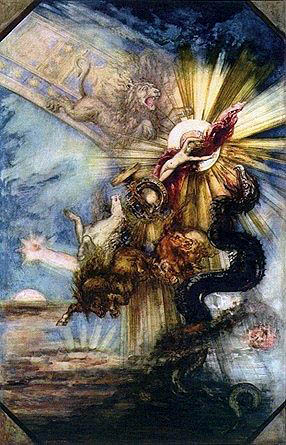
Phaethon Proud
Painting by Gustave Moreau
When Clymene, Queen of the Ethiopians, told her son Phaethon one day that he was in truth not the son of her husband, King Merops, but of the sun god himself, the boy was stunned into silence. Though he had always suspected something was not quite right, something he could never place in all the time he had spent with the King, the words which rang in his ears now still sowed the most profound shock mingled with disbelief. He, just a boy like no other, the son of a god? Not just any god, but Helios, one of the Titans, who ruled in the kingdom of the skies far over the mortal Earth, the very incarnation of the Sun. Disbelief flooded young Phaethon first, doubt close on its heels, as his mother's confession grew stronger yet. A tormented sleep did the young Prince endure, turning in the night, racked with angst. In his good friend Cygnus did Phaethon confide this revelation strange, and his bewilderment at what to do. The two boys marvelled at the possibilities if such a thing could be true. There seemed only one thing for it, and that was to travel to the Kingdom of the Sun and seek out the Titan himself to learn the truth.

Bidding farewell to his native land, to his mother and to Cygnus, Phaethon set forth on his fateful quest, his eyes upon the Eastern horizon firmly fixed. After an age it seemed, the realm of men was falling behind, the realm of the divine approaching. There, just ahead, 'the Sun's bright palace, on high columns rais'd, with burnish'd gold and flaming jewels blaz'd'. The gleam of the surface of the gate, reflected a burning light. Far had the young boy come, too far to turn back now. Upon the solar threshold a weary step the Prince did place, and never again the coolness of night touched young Phaethon's face.

Deeper and deeper into the Palace of the Sun he trod, and higher and higher the temperature soared, until at last, a blinding light of purest white heralded the throne of he, Helios the lord of the Sun. High on his blazing throne he sat, exalted and resplendent, the hours bowing at his hands. The Titan saw the proud youth loitering, "My son!" said he, "Come to thy father's arms! For Clymene has told thee true; a parent's name I own, and deem thee worthy to be called my son":


                         " 'As a sure proof, make some request, and I,
                            Whate'er it be, with that request comply;
                            By Styx I swear, whose waves are hid in night,
                            And roul impervious to my piercing sight.'
                            The youth transported, asks, without delay,
                            To guide the Sun's bright chariot for a day... "
                                     - PHAETHON'S WISH


Immediately did regret flood the Titan's mind, for the one thing of which Phaethon asked was the one thing he was not fit to bear. To steer the Chariot of the Sun was a task entrusted to none but Helios himself, for within was bound grave responsibility, and peril. The Titan, torn between his word and his care for his son, implored Phaethon to choose again. "There is not one of all the gods that dares to mount the burning axle but I, not Zeus himself, the ruler of the sky, that hurls the three forked thunder from on high...". But alas in vain, for the greater the god tried to dissuade him, the grander Phaethon's ambition grew, and his will to resist. "If downwards from the Heav'ns my head I bow, and see the Earth and Ocean hang below, ev'n I am seiz'd with horror and afright", the Titan pleaded, but alas in vain. Terrifying is the Chariot's race across the Heavens, a will of steel needed for such an undertaking as the horses tear through the sky. Helios tried and tried again to convince his son to accept a humbler prize, some kingdom or grand fortune far below in the domain of man, but unmoved was the ambitious prince.

It was beyond the point of return now, the River Styx had heard the Titan's oath. One last plea, one last turnéd ear. So with heavy heart Helios lead young Phaethon to the blazing Chariot, glimmering with gold, spoked with silver and seated with gems. With unbridled joy Phaethon surveyed his prize, his pride gorged. Helios looked up. The stars were receding, the time had come. At his command the hours brought forth the steeds, monstrous horses snorting raging fire. One last chance to save his son, the Titan anointed his body with celestial oil, to proof him against the staggering heat. A tear in his eye, he whispers one last phrase; "Take this at least, this last advice my son, keep a firm rein, and move but gently on: the courses of themselves will run too fast, your art must be to moderate their haste. Drive them not directly through the skies, but where the Zodiac' winding circle lies...". Phaethon offered his thanks, which the Titan with remorse received.

Phaethon Falls
Painting by Johann Liss
The mighty stallions neighed with restless wanton, flames roaring from their mouths, stamping upon the clouds. The time had come. Night gave way, and together they hurled forward as one, the beasts thundering forth, Phaethon soaring through clouds and breezing air. With dizzying speed they outstripped all winds. Though a little light for the Chariot, at first the Prince rode well, heeding the Titan's word. Following the course of the Zodiac, the Chariot moved with irresistible, yet steady, force. But as time passed, Phaethon grew proud of his feat, to equal the Sun god himself? The monstrous steeds sensed weakness in the hand of their master, and their unruly nature took hold. As soon as the Prince's gaze was turned, violently did they veer from the Zodiacal path. Pandaemonium reigned in the skies that day. Phaethon was cast against the Chariot's fore, and knew not which way to turn, whether to yank the reins or let them lie. The horses charged above, and the Sun veered to the stars, which retreated before its fiery heat. Far below ice with frozen hand began to throttle the land, snow fell upon the peaks and Oceanus shivered.

Far above, Phaethon looked behind, and saw the vast expanse of the Earth falling away behind him, panic stricken now. Pulling hard upon the reins, he tried to restore control. The horses, incensed, bolted to the side and careered toward the Earth:


                " The clouds disperse in fumes, the wond'ring Moon
                   Beholds her brother's steeds beneath her own;
                   The highlands smoke, cleft by the piercing rays,
                   Or, clad with woods, in their own fuel blaze.
                   Next o'er the plains, where ripen'd harvests grow,
                   The running conflagration spreads below.
                   But these are trivial ills: whole cities burn,
                   And peopled kingdoms into ashes turn... "
                           - THE EARTH SCORCHED


Down and down the Chariot plummets, and the incredible heat takes its fiery toll on the world. The high mountains buckle in the inferno, snow replaced with flames. The Ocean boils, and Poseidon the Earthshaker, god of the sea, brandishes his trident in defiance. Monstrous Typhon, deep below the Earth, grows restless in his infernal prison, and Mount Etna above explodes forth with redoubled fury. Even far off Scythia on the nomadic Steppe sees her frosts melt, and her plains burn. Verdant Africa bore the brunt, and ever after has been a mighty desert. Great Olympus, towering high above, shakes, as the rocks splinter and rend asunder, wreathed in fire. The world burns, and flames lick the Heavens. Mother Earth screams in agony, her ashes floating to the stars. Phaethon beheld the devastation before his eyes and realised the folly of his wish. The furnace heat of the world reached the sky, and the axle of the Chariot began to glow. The Euphrates fleed, the Danube too, the swollen Ganges, the Tiber, nurse to a promised Empire, too. Even the mighty Nile retreated in terror, and the seas plunged. The intense heat cracked the Earth, and fissures began to split it apart. Deep in the Underworld, pallid Hades recoiled from the light his kingdom knew not.

At last Gaia, Mother Earth, could bear no more. Denouncing the Olympians for allowing such a tragedy come to pass, she called upon her grandson to act. So did Zeus the Thunderer, King of gods and men, summon the divine array. Helios came before Zeus and tried to move his heart, but no ally did the Titan find. Taking up his burning throne, Zeus seized a bolt of thunder which glowed brighter even than the Earth. "Then, aiming at the youth, with lifted hand, full at his head he hurl'd the forky brand". The deadly dart of Heaven arced across the sky, striking Phaethon square in the head. At once from the shackles of life and the sun god's chariot was the Prince thrown. The horses charged back to the hands of their true, but weeping, master. The flaming body of Phaethon fell through the skies, gold and wheel falling too. Like a dying star he plummeted to the Earth his folly had ruined, until his ruined body struck the Po in the West.

Never again would someone dare such hubris as to emulate the Sun, and never again would a god make so bold an offer. Far below, few wept for Phaethon, cause of such ruin, except one. By the water's edge Cygnus sat, tears in his eyes for his friend. All their lives they had been partners in crime, mischievous together, now separated by Zeus's hand. The gods heard him weep, and pity moved their hearts. At their command his form was changed. Where once there were hands, now wings, where once mouth, now blunted beak, where once flesh, now pure white feathers. Ever after, the youthful swan has borne Cygnus' name...


United Kingdom

Penguin Classics
Metamorphoses: A New Verse Translation (Penguin Classics)
(A more prosaic and easier to understand version of the Roman poem)

Oxford World's Classics
Metamorphoses (Oxford World's Classics)
(A high poetical version of the Roman poem)

United States

Penguin Classics
Metamorphoses (Penguin Classics)
(A more prosaic and easier to understand version of the Roman poem)

Oxford World's Classics
Metamorphoses (Oxford World's Classics)
(A high poetical version of the Roman poem)

Wednesday, 22 February 2012

The Cyclops

After the most grueling siege in history, after ten long years Troy fell to the Greek armies. Some of the greatest heroes ever born had fought and died on both sides, Olympus was divided and the world would never be the same again. But the ordeal of many of the Greek heroes was far from over. Indeed for one man above all others, it had only just begun...


Odysseus
Second Century Greek Sculpture, housed
in the Villa of the Roman Emperor Tiberius
at Sperlonga
Cunning Odysseus, King of Ithaca and sacker of cities, was the man who won the Trojan War. Renowned the world over for his sagacity and brilliant mind, it had been he who had masterminded the stratagem of the Wooden Horse, a deception famous the world over even today. But now, nearly ten years after the Trojan citadel burned, a weary and despairing man sat before King Alcinous of Phaeacia. The Phaeacians had been most intrigued when a strange and ragged looking man had been washed up on their shores, but Alcinous was a kindly man, and entertained the stranger in his palace. That night, at the banquet, the court bard struck up a song, a song which rang with the deeds of those famous men at Troy so long ago now. The gathered crowd cheered as the song turned to the valiant heroism of those who fought inside Troy's walls as the city fell to its knees, most of all proud Odysseus, blessed by Athena. At the sound of the bard's song, the memories welled up afresh in the stranger's mind, and choked with emotion, tears fell from his eyes. Seeing his distress, Alcinous bade the bard fall silent, and prayed the stranger to reveal his as yet unknown name, and what force had brought him here. Realising he could remain anonymous no longer, the stranger replied "Where shall I begin, where end, my tale? For the list of woes which the gods in Heaven have sent me is a long one... I am Odysseus, Laertes' son. The whole world talks of my stratagems, and my fame has reached the Heavens...". The room fell silent. All were entranced by the hero's words, stunned and saddened at his melancholy. So, with a heavy heart, Odysseus began his mighty tale.

Ten long years ago, Odysseus and his men departed Trojan shores, desperate to see beloved Ithaca again. The journey should have been quick and easy, but little could they have known that it would be as arduous and perilous as the War had ever been. For the gathered Greek Kings had made sacrifices to the gods on the shores of Troy, giving praise for their triumph. But the rituals were in vain. For the Greek soldiers had desecrated the holy places within Troy when they stormed the city, burning her temples and slaughtering her priests. In their rage, the gods decreed a terrible retribution upon the Greeks...


Odysseus rescues his men from the Lotus Eaters
Engraver unknown
Odysseus' ships made landfall in the land of the Cicones, a vicious and warlike tribe who despised all foreign men. The Ithacans sacked their citadels, eager for plunder to take home for their families as they were. But the Cicones struck back, and many were killed in the ensuing slaughter. Rallying his men, Odysseus sounded their retreat, as they continued South on their journey home. Zeus the Thunderer, however, gathered the storm clouds and unleashed a tempest upon the sea, and for nine days the Greek ships were blasted across the Mediterranean, coming to the strange land. Odysseus sent two men to investigate the local tribe, and determine if they were hostile. The locals, however, were not violent at all, on the contrary they gave Odysseus' men lotus fruit to eat. As soon as the sweet, luscious fruit touched their lips, however, the men lost all thought of home and the worries of the world. All they desired was to remain here and feast on the Lotus flower for ever more. With a great struggle did Odysseus drag his men back to the ships, urgently making for distant shores, lest his whole crew fall victim to the dangerous fruit.

Home seemed more distant than ever when, sometime later, the ships chanced upon a dense fog which descended upon them, shrouding the moonlight. So dark was the night that the ships ran aground upon a peculiar island, not a large land, but a bountiful one. Lush and verdant, this island was teeming with life, and the weary crew dined well on the plentiful goat population of the island. For the first time in many long months, Odysseus and his men enjoyed a peaceful sleep. When Dawn arrived, and the light hit Odysseus' eyes, he awoke to the beauty of the island. Across the strait, however, there was a land that night had veiled. A wild and mountainous sight it was too, in the shadow of a towering volcano - Mount Etna. When the ships were filled to bursting with supplies, curious Odysseus picked his best ship's crew, and together they set sail across the strait, inquisitive as to the local peoples and their ways. Odysseus ordered gifts to be brought, in the form of wine taken from the groves sacred to Apollo, a wine fit for Olympus itself, such was the floral aroma that rose from it. A fitting present for the local leader who, Odysseus hoped, might grant hospitality to his men in return. How very wrong he would be.


The Sack of Troy
Painting by Johan Georg Trautmann
Making landfall upon the beach, Odysseus noticed high up on the slopes an enormous cavern. Fighting an ominous sense of foreboding, the King and his twelve finest warriors scaled the cliff and gazed within the towering entrance. The sight that waited there so amazed them that all thoughts of doubt left their minds. Baskets of the most luxurious cheeses towered high, pails full to the brim with milk and pens laden with the finest lambs all stretched before them. His comrades begged him to let them take some and swiftly make their flight. How much better if would have been for them all if they had, Odysseus mournfully confessed to the Phaeacian King, but alas that hindsight was not theirs, as the hero continued his tale. Odysseus forbade his men to steal from the cave, and was at any rate keen to meet the owner of these splendid things.  Lighting a fire, the Greeks settled down, guessing the owner to be out tending his flocks during the day, as they wondered what gifts their host might present them with. Some hours later, the herds came into their cave, their shepherd close behind. At last, the owner had come. But it was no native tribesman or leader of men. With a titanic crash the Greeks awoke with a start, some might have thought that they had been roused to a nightmare. An enormous pile of logs and fallen to the cavern floor, and the being who had dropped them stood not far behind. A towering giant, mightier in stature than any building raised by the hands of men, stood framed by the mouth of the cave. So feeble were they aside such a vast being, the Greeks had avoided the gaze of the giant's single and enormous eye. With a ripple of terror, Odysseus and his men shrank into the shadows, making not a sound. The Cyclops rolled an enormous boulder into the cave's entrance as some crude door, before turning to drive his flock deeper into the cave. After methodically milking his ewes, the Cyclops lit his fire, and with the orange glow, Odysseus' cover was blown. "Strangers!" the giant roared, "and who are you!"


            " Our hearts sank. The booming voice and the very sight
              of the monster filled us with panic..."
                                          - ODYSSEUS RECOUNTS MEETING THE CYCLOPS


Their courage faltering, the Greeks turned to their King, who boldly replied that they were Achaeans, returning from Troy, once proud subjects of King Agamemnon. Some god had lead them astray on their path home, and they were now suppliants before him. Odysseus reminded the Cyclops of his duty towards guests, for Zeus decreed the honour that bound a host to his guest. The pitiless Cyclops replied that the Cyclopes were no god fearing people, and that he cared nothing for Zeus or the Olympians, since his own strength was a match for they. Nevertheless, the giant demanded to know where Odysseus had moored his ship. Sensing danger for his men still down on the ships, cunning Odysseus replied that Poseidon had smashed up his ships and that they were stranded here. The cruel Cyclops made no reply, but triumphantly dived upon them. Seizing two of Odysseus' men, he dashed their heads against the cold, stone floor. Tearing them limb from limb, he devoured them, as the Greeks shouted in terror, weeping as they raised their hands to Heaven, begging Zeus for help. Taking a gulp of milk to wash down his ghastly meal, the Cyclops settled down into a sleep.


Odysseus blinds Polyphemus
Painting by Pellegrino Tibaldi
Odysseus's first impulse was to draw his blade and slay the giant there and then, but wisdom prevailed. No man could move the vast boulder at the cave's door, and simply kill him would seal all their fates. Stricken groans came from his men, but Odysseus soothed them with his words, as they braced for morning. Dawn came once more, as the giant awoke. After slowly milking his ewes once more, he grabbed two more brave Greeks. Odysseus looked helplessly on at their grisly fate, crying with frustration. As the Cyclops left for the day to tend his flocks, however, Odysseus noticed that he had left his staff behind. If a staff it was, for to human eyes it was more like the mast of some great ship, such was its size. Forming a plan, he drew his sword and began to whittle the staff, sharpening it to a point. Thrusting the point into the fire, so as to harden it in the flames, the men drew lots to see who would have the brave task of helping Odysseus wield it. Just then the goats returned to the cave. With seconds to spare, Odysseus hid the point under a pile of dung, of which there was a great deal in the cave. Evening fell, and after milking his ewes once more, the Cyclops snatched two more of Odysseus' comrades and gobbled them down. Steeling his nerves for not the first, or the last, time, Odysseus beckoned to his men to pass him the wine he had brought. Approaching the fierce giant, Odysseus flattered him, offering him a gift of wine in the hope of pity. The Cyclops took the wine and drank deeply from it, as the intoxicating perfumes from it rose to his nostrils. The wine gave him such joy that he immediately demanded more, and the Odysseus' name, promising him a gift in return. Three times Odysseus refilled the bowl, and three times the Cyclops drained it to the last. Seeing the wine do its work on the giant's wits, Odysseus addressed him once more, "My name is Nobody. That is what I am called by my mother and father and by all my friends". Looking hopefully for his gift, Odysseus looked the giant in his monstrous eye. The heartless being answered, "of all his company I will eat Nobody last, and the rest before him. That shall be your gift". Barely had the word "gift" been uttered, when the Cyclops keeled over into a drunken stupor, vomiting forth a stream of wine and torn human flesh from his gullet.


Odysseus' Escape
Painting by Jacob Jordaens
Seizing their chance, Odysseus and his men thrust the staff into the glowing fire, and soon the tip was burning hot. Whispering encouragements to his men, Odysseus drove the stake into the Cyclops eye, twisting it with all his might. The heat singed the giant's brow, and the blood bubbled around the wound as his eye hissed furiously. The Cyclops let out a deafening shriek of agony, a shout which rang across the mountains, as the Greeks recoiled again, their nerve buckling. Such was the din, other Cyclopes soon crowded around the sealed entrance to the cave, demanding to know the cause for this disturbance. "What on earth is wrong with you Polyphemus?" they called from the night. "O my friends, it is Nobody's treachery that is doing me to death", Polyphemus shouted back. Confused, the Cyclopes replied "well, if you are alone and nobody is assaulting you, you must be sick", and off they went. Odysseus laughed to himself at the brilliance of his plan, but they had little time to waste. Groaning in pain, Polyphemus rolled aside the boulder at the door of the cave, and groped feebly, hoping to catch Odysseus or his comrades as they fled. Thinking quickly, Odysseus ordered his men to lash together the sheep in threes, using willow twigs from Polyphemus' enormous bed. For himself, Odysseus chose the most robust ram and, clinging tightly on, swung underneath it. As soon as Dawn arrived, the flock made for the pastures on the mountainside. Their master, however, still in blinding pain, ran his fingers along to tops of their fleeces as they passed through the mouth of the cave, for it did not occur to the Cyclops that men would hang beneath. Soon only the great ram remained. As the giant's hands recognised his favourite of the flock, he moaned "Sweet ram, why are you the last of the flock to pass out og the cave like this? You have never before lagged behind the others..." Odysseus felt a sudden pang of fear. "You must be grieved for your master's eye", Polyphemus mournfully concluded, and Odysseus breathed a sigh of relief. Releasing the ram, Polyphemus sat as the flock stepped into the fresh air once more. With many backward glances, Odysseus and his crew detached themselves and sprinted for the shore.


The Rage of Polyphemus
Painting by Annibale Carracci
Reaching the ship as fast as they could, Odysseus and his men were greeted with cries of joy, soon followed by lamentations at those lost. With urgent gestures, Odysseus beckoned them to silently load the flock on board and make their escape. As the oar blades struck the surf, Odysseus could not resist. Shouting in defiance, he taunted Polyphemus, "Cyclops! So he was not such a weakling after all, the man whose friends you meant to overpower and eat in your hollow cave! And your crimes were bound to catch up with you, you brute, who did not shrink from devouring your guests. Now Zeus and the other gods have paid you out!" Polyphemus felt a stab of rage. With a roar he tore off the pinnacle of the mountains and hurled it in the direction of Odysseus' voice. Soaring through the air, the rock struck the sea just ahead of the ship, but the resulting wave drove the Greeks back to shore. Seizing a pole, Odysseus pushed them off, frantically urging the crew to row for their lives. The will to shout more abuse took hold once again, as his men tried to restrain him. But anger and frustration was welling up in Odysseus too, frustration that home was no closer, frustration at his helplessness to save the lives of his men. His men begged him to stop, lest they all die. But Odysseus was not to be restrained, and shouted something he would later rue.


            "Cyclops, if anyone ever asks you how you came by your blindness, tell him
              your eye was put out by Odysseus, sacker of cities,
              the son of Laertes, who lives in Ithaca!"
                                       - ODYSSEUS TAUNTS POLYPHEMUS

Polyphemus stopped. He remembered an ancient prophecy told amongst the Cyclopes, a prophecy that foretold that he would be robbed of his sight by a man called Odysseus. In return, the Cyclops called to Odysseus, bidding him return, so that he might present him with gifts to speed him on his journey, for his father was none other than Poseidon, the god of the sea himself. Fatally disbelieving, Odysseus angrily retorted "I only wish I could make as sure of robbing you of life and breath and sending you to Hell, as I certain that not even the Earthshaker will ever heal your eye!" As this, Polyphemus kneeled in prayer. Beseeching the skies, he called to his father, laying a curse on Odysseus and his men:


        "Grant that Odysseus, sacker of cities and son of Laertes, may never reach his home
          in Ithaca. But if he is destined to see his friends again, to come once more
          to his own house and reach his native land, let him come late, in wretched plight,
          having lost all his comrades, in a foreign ship, and let him find trouble in his home"
                                        - THE CYCLOP'S CURSE


Polyphemus prayed, and Lord Poseidon heard his prayer. Rising to his feet, with all his might, Polyphemus seized a boulder, mightier by far than the first, and with a roar hurled it towards Odysseus' proud words. Falling through the sky, the rock scraped the rear of the ship, but missed, though the resulting tidal wave propelled the Greeks to foreign shores. Odysseus and his men were overjoyed. Little did they know, as Odysseus later told King Alcinous in Phaeacia, what a world of pain the Cyclops had now unleashed upon them. For in his lair they had had a giant as a foe. Now they had a long ocean voyage home, and now they had the god of the sea himself as a foe...

United Kingdom

Penguin Classics:
The Odyssey (Penguin Classics)
(A version which keeps a dash of the original poetry, good if you like a balance between high poetry and readability)

Oxford World's Classics:
The Odyssey (Oxford World's Classics)
(An excellent choice if you want to read the Odyssey for it's story over it's poetry)

United States

Penguin Classics:
The Odyssey (Penguin Classics)
(A version which keeps a dash of the original poetry, good if you like a balance between high poetry and readability)

Oxford World's Classics:
The Odyssey (Oxford World's Classics)
(An excellent choice if you want to read the Odyssey for it's story over it's poetry)  

Wednesday, 28 September 2011

The Son of Tantalus

The struggles between men and gods often bring out the very best, and the very worst in both in the legends of the ancient world. The lowliest peasant could be raised to the divine, and the mightiest king could fall to the most humiliating ruin. For there existed a delicate balance between the mortal world and the immortal plain, a balance which held bound within it dire consequences for those who sought to violate the laws of nature. For every man blessed with Paradise in the golden, sun drenched Elysian fields, many more were cursed to hideous retribution in the fires of Tartarus. One such malign soul was Tantalus.


The Tantalisation of Tantalus
Painting by Giocchano Assereto
The son of Zeus, the thunder god himself, and the sea nymph Plouto, Tantalus was of an exalted line. King of the mighty realm of Phrygia too, he was a powerful man indeed. The bounty of the Earth, the reverence of man and the lineage of gods, however, had made Tantalus a proud man. Soon, he began to to question the omnipotence of the Olympians. However, his cruel leanings as yet unknown, one day Tantalus was invited to the dine at a banquet with the gods themselves, high on Mount Olympus (just as Ixion had been too, for this story, please click here). Far from being honoured at this request from on high, Tantalus decided to use this opportunity to put the gods to the test. Legend spoke of a magical substance that was the food of gods, a divine material borne to Olympus by doves shining white as the burning sun. This substance was ambrosia, which sustained the ageless life of the immortals, and granted invulnerability to whomsoever should seek sustenance from it. At the table of Olympus, the gods honoured Tantalus by allowing him to taste Ambrosia, and nectar, the drink which sustained the immortals. Through sleight of hand, Tantalus slipped a portion below the table, with an eye to sharing this majestic food with mortal men, out of spite for the gods. The King of gods and men was unmoved, though he saw Tantalus' ploy, such envy was to be expected from mortals, who so frequently believed their own plight to be greater than that of all others. The worst, however, was yet to come.


The Fall of Tantalus
Engraving by Hendrick Goltzius
Tantalus invited the gods to try a dish of his own making, as gratitude for the warm hospitality they had granted him. Happily, they agreed. Resolved to testing their so called omiscience, Tantalus decided upon a grisly trial. Cruel and heartless to the bone, Tantalus murdered his own son, Pelops, and boiled his flesh. Slicing the corpse up, Tantalus crafted a fine dish, one which veiled its gruesome secret from mortal eyes. Returning to the banquet hall, Tantalus served up the evil dish to the assembled gods. At once, the enraged gods were made aware of Tantalus' fell designs, as all things are laid bare before their eyes. All that is, except for Demeter, the goddess of the harvest, who absent mindedly began to chew on one of Pelop's shoulders, distracted by grief as she was at the loss of her daughter Persephone (whose story will be told in a future post). The fury of the Thunderer was a terror to behold, for the slaughter of one's own kin was the gravest of crimes, the most vile of corruptions and most heinous of sins a man could commit. Zeus banished Tantalus to Tartarus, the deepest, darkest and most grim depths of the Underworld. In this cruel land, the most evil men and women met their fates, and it was here too that the Titans were bound in their infernal prison (for this story, please click here). Like Sisyphus before him, Tantalus was doomed to an eternity of vain struggling (for the damnation of Sisyphus, please click here). Tantalus was ordered to stand in a pool of water, deep in unholy Tartarus. Zeus imbued within him an agonising thirst, yet whenever Tantalus should try to drink from the pool, the Thunderer commanded the waters to recede before his very eyes, so that his thirst should never be quenched. Furthermore, Zeus imposed another ordeal:


           " Trees spread their foliage high over the pool and dangled fruits above
              his head - pear trees and pomegranates, apple trees with their glossy
              burden, sweet figs and luxuriant olives. But whenever the old man made
              to grasp them in his hands, the wind would toss them up towards the clouds "
                                                           - THE PUNISHMENT OF TANTALUS


The Peloponnese
Photograph taken by Ulrich Tichy
Condemned to an eternal fate of thirst and hunger, the fate of Tantalus was sealed, bound in the abyss. Stunned by Tantalus inhumanity, Zeus ordered Clotho, one of the Three Fates, to restore Pelops to life. Realising that Pelops had a peculiar stance due to his mangled shoulder, Hephaestus, the god of the forge, crafted a new shoulder from the finest ivory, and granted it to the young prince. Aphrodite, goddess of sensuality bestowed the gift of extraordinary beauty upon Pelops, taking pity upon the prince too. Poseidon, the god of the oceans and the Lord of Horses, gave Pelops a winged chariot which could ride the surface of the seas. Setting forth from Olympus lofty heights, Pelops travelled the lands of Greece, the legends of his grace and prowess spreading before him. Even the lands he travelled through took their name from him, and it is indeed after Pelops that the Peloponnese is named.

Word soon spread throughout the lands of Greece however, of the proclamation of King Oinomaos of Elis, that to the best of men he would give the hand of his daughter, Hippodaemia, in marriage. Any man was welcome to try, but should he fail, he would die. For the challenge was a chariot race, whereby the suitor would attempt to reach the Isthmus of Corinth. Oinomaos would set off in immediate pursuit, in full armour, and if he caught up, he would slay the man. Twelve men had so far accepted the King's deadly challenge, and twelve lay slain, their heads now hanging from the Royal Palace. For the King, unbeknownst to the suitors, possessed the horses and arms of Ares, the god of war, and no human mercy. The stakes were high indeed, when Pelops arrived at the court of Oinomaos.


The Land of Elis
Photograph taken by the author
Entering the throne room, Pelops came before the King to accept the lethal challenge. Lurking nearby, however, was Hippodameia herself, and she was immediately struck by the dart of Eros, stunned by the handsome form of Pelops, blessed by the gods as he was. That night, before the race began, Hippodameia made a secret visit to the quarters of Myrtilos, the King's charioteer. Begging him to help her and come to Pelops' aid in the race, she won Myrtilos over, who agreed, harbouring secret desires for the princess himself. Dawn arrived and rose into the sky, as the line was set and the chariots were made ready. Careful to avoid being seen, however, Myrtilos approached the King's chariot and removed the axle pin from the wheels, replacing it with one made of wax. Pelops soared off the line, racing along the coast of the land which bore his name. With a shout, King Oinomaos set off in pursuit, spear raised and primed for blood once more. However, the sun beat down, and the stresses of the race soon took their course, and the wax began to melt. The King's chariot began to fall apart, and Oinomaos, entangled in the reins was thrown to the sand, dragging helplessly through the ground. Battered, broken and dying, Oinomaos realised Myrtilos' treachery, and with his last words cursed the charioteer to die by Pelops' hand.

Triumphant with victory, Pelops returned to claim Hippodameia's hand, stopping on the road to collect some water. On his return to his new princess he saw Myrtilos attempting to steal away with his new bride, maddened as the charioteer was with passion. Enraged, Pelops seized Myrtilos and hurled him from Cape Geraistos, fulfilling the prophecy of King Oinomaos. Myrtilos however, seething with injustice, proclaimed a terrible curse upon the House of Pelops and his progeny, that it should be forever hounded by strife, and afflicted by death, its descendants doomed to die before their time...

The tale of the treachery of Tantalus, and the adventures of Pelops, is a legendary one in the lore of the ancient Greeks. The cursed line of Pelops would continue to shape the course of history for generations, and the curse would inflict its terrible price for years to come. Not even mighty Agamemnon, King of Mycenae, and grandson of Pelops through his father Atreus, would escape it. But the legacy of Pelops that lives on today is the land of Southern Greece, a land of magnificent beauty, among whose illustrious sons can be counted the formidable Spartans, the greatest warriors ever born. What of Tantalus? Well, his legacy is found within our very language. For even today in English, if a person is tantalised, they are victim to temptation...


United Kingdom

The Library of Greek Mythology:
The Library of Greek Mythology (Oxford World's Classics)
(A vast collection of stories from old Greece, written and compiled in ancient times)

The Odyssey:
The Odyssey (Penguin Classics)
(One of the greatest pieces of world literature, which recounts the punishment of Tantalus)

The Metamorphoses:
Metamorphoses: A New Verse Translation (Penguin Classics)
(A Roman epic poem, which recounts the plight of Pelops, and many other heroes)

United States

The Library of Greek Mythology:
The Library of Greek Mythology (Oxford World's Classics)
(A vast collection of stories from old Greece, written and compiled in ancient times)

The Odyssey:
The Odyssey (Penguin Classics)
(One of the greatest pieces of world literature, which recounts the punishment of Tantalus)

The Metamorphoses:
Metamorphoses (Penguin Classics)
(A Roman epic poem, which recounts the plight of Pelops, and many other heroes)