Showing posts with label Titan. Show all posts

Wednesday, 23 July 2014

The Lycian Peasants


Leto in the Wilderness
Artist Unknown
Mother to two of the greatest of the deities of Olympus, the Titaness Leto was a force to be reckoned with. Niobe had felt her dread wrath, and that of her brood. The daughter of the Titans Coeus and Phoebe, much of her origins were shrouded in the mysteries of Asia. Though when at last a maiden of Heaven she became, and the eyes of Zeus the Thunderer met her gaze, revealed at last was she. Hera, Queen of the gods, ever paranoid of the wandering affections of her consort, hounded Leto across the face of the Earth. Heavy with the seed of Zeus, Leto grew weary of the chase. Enraged, Hera ordered the Fates to forbid Leto to give birth on terra firma under the Sun. When at last the pains of labour struck, with nowhere else to turn, turned away by the vile words of Hera, the Titaness came to the island of Delos. Finding a measure of peace at last under the weeping boughs of a forgotten glade, the goddess fought that ungodly pain. First came forth Artemis, the lady of the moon and hunt. Nine days and nights the Titaness laboured still, until with the help of her daughter, a twin was brought into the world -  Apollo, god of light, healing and truth. Sympathetic nymphs, naiads and dryads had shielded Leto from the servants of Hera, but when the screams of the newborn deities pierced the skies, the lady of Olympus was made aware of them, and seethed with rage once more. Vowing never to give Leto rest, She sent forth all manner of dark creatures to hound her and her brood. Far and wide she fled, desperate for respite.


Leto Fountain, Palace of Versailles
Photograph taken by Daniel Gaudry
"At last, outwearied with the toil, and parched with thirst", the exhausted matriarch came to the arid and harsh land of Lycia, where once the fearsome Chimaera had once tread. A blasted land, with little verdance in its hills, the eyes of Leto spied a rare pool of crystal water. Parched with thirst, it played on her mind as the mirage does on the desert traveller. Shimmering in the light, the parched Titaness could resist no longer, and sped with all haste to its banks. Some of the rustic folk of Lycia were there at the lake's shores, reaping the bending osiers, the dank bulrushes and fragrant weeds. The Lycian folk, a people not known for their warmth of hospitality with strangers, eyed the stranger with deepest suspicion. A threatening buzz arose from within their wretched ranks, as Leto came in her approach. Wearied and near broken with toil, she eyed the peasants with more than a dash of humility. They angrily called out to her to stay away, and come not near the crystal waters, so wickedly opposing her primal need. Leto called out to them:


                   " Water I only ask, and sure 'tis hard
                      From Nature's common rights to be debarr'd,
                      This, as the genial sun, and vital air,
                      Should flow alike to ev'ry creature's share.
                      Yet still I ask, and as a favour crave,
                      That which, a public bounty, Nature gave... "
                             - LETO'S PLEA


Leto desperately invoked the pity of her newborn twins, yet still the fiendish folk would not desist, nor with vulgar words restrain. Young Apollo stretched out his arm in supplication, a mere baby, yet no more than his mother's word to the hearts of the Lycian peasants could it reach.

Feeling the pains of dehydration now, Leto moved to cup the crystalled water in her hands, but the dastardly folk spoiled her relief. Foul, abusive words they hurled, and worse still "with spiteful feet the villains trod, over the soft bottom of the marshy flood, and blacken'd all the lake with clouds of rising mud". A once crystal lake was now a murky depth, its purity defiled by the evil whims of a hostile crowd.

The Transfiguration of the Peasants
Painting by Johann Georg Platzer
Now the desperation of a Titaness turned to rage, as "her thirst by indignation was suppress'd". Vengeance coursed through her godly veins, all worries of hydration cast aside as the serpent sheds his skin. The frustrations of long chase, the pains of twin labour and the pangs of thirst mingled as Leto cast her gaze to the Heavens. "May you live, she passionately cry'd, doom'd in that pool for ever to abide". No sooner had her words of wrath left her parched lips, than the wretched folk dived into the pool, void of all shame. To the murky depths they plunged, and as swiftly as they fell, their last vestiges of humanity were gone. When next they pierced the crystal surface, no shouts of insults would come forth, but instead a hoarse croak. Wrenched wide by their bawling, their mouths grew cavernous; a mottled green, their backs. Seldom to see the light, their bellies grew a pale white, their eyes wide and alert. Men and women no more were they, but frogs, condemned forever to dwell within the mud...


United Kingdom

Penguin Classics
Metamorphoses: A New Verse Translation (Penguin Classics)
(A version which favours ease of understanding than high poetry)

Oxford World's Classics
Metamorphoses (Oxford World's Classics)
(A version which favours ease of understanding than high poetry)

United States

Penguin Classics
Metamorphoses (Penguin Classics)
(A version which favours ease of understanding than high poetry)

Oxford World's Classics
Metamorphoses (Oxford World's Classics)
(A version which favours ease of understanding than high poetry)

Wednesday, 23 January 2013

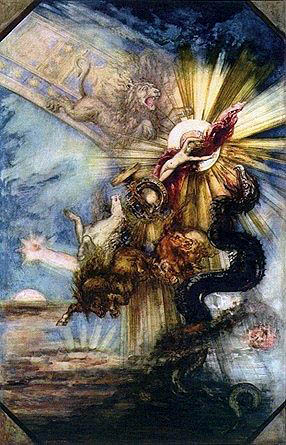
Phaethon

Do not take on that which is not meant for you, and leave no advice or warning unheeded. That is the moral of the story of Phaethon. If your identity was suddenly revealed to you as the offspring of a deity, what would you do? Would you be humble or would you be proud?


Phaethon Proud
Painting by Gustave Moreau
When Clymene, Queen of the Ethiopians, told her son Phaethon one day that he was in truth not the son of her husband, King Merops, but of the sun god himself, the boy was stunned into silence. Though he had always suspected something was not quite right, something he could never place in all the time he had spent with the King, the words which rang in his ears now still sowed the most profound shock mingled with disbelief. He, just a boy like no other, the son of a god? Not just any god, but Helios, one of the Titans, who ruled in the kingdom of the skies far over the mortal Earth, the very incarnation of the Sun. Disbelief flooded young Phaethon first, doubt close on its heels, as his mother's confession grew stronger yet. A tormented sleep did the young Prince endure, turning in the night, racked with angst. In his good friend Cygnus did Phaethon confide this revelation strange, and his bewilderment at what to do. The two boys marvelled at the possibilities if such a thing could be true. There seemed only one thing for it, and that was to travel to the Kingdom of the Sun and seek out the Titan himself to learn the truth.

Bidding farewell to his native land, to his mother and to Cygnus, Phaethon set forth on his fateful quest, his eyes upon the Eastern horizon firmly fixed. After an age it seemed, the realm of men was falling behind, the realm of the divine approaching. There, just ahead, 'the Sun's bright palace, on high columns rais'd, with burnish'd gold and flaming jewels blaz'd'. The gleam of the surface of the gate, reflected a burning light. Far had the young boy come, too far to turn back now. Upon the solar threshold a weary step the Prince did place, and never again the coolness of night touched young Phaethon's face.

Deeper and deeper into the Palace of the Sun he trod, and higher and higher the temperature soared, until at last, a blinding light of purest white heralded the throne of he, Helios the lord of the Sun. High on his blazing throne he sat, exalted and resplendent, the hours bowing at his hands. The Titan saw the proud youth loitering, "My son!" said he, "Come to thy father's arms! For Clymene has told thee true; a parent's name I own, and deem thee worthy to be called my son":


                         " 'As a sure proof, make some request, and I,
                            Whate'er it be, with that request comply;
                            By Styx I swear, whose waves are hid in night,
                            And roul impervious to my piercing sight.'
                            The youth transported, asks, without delay,
                            To guide the Sun's bright chariot for a day... "
                                     - PHAETHON'S WISH


Immediately did regret flood the Titan's mind, for the one thing of which Phaethon asked was the one thing he was not fit to bear. To steer the Chariot of the Sun was a task entrusted to none but Helios himself, for within was bound grave responsibility, and peril. The Titan, torn between his word and his care for his son, implored Phaethon to choose again. "There is not one of all the gods that dares to mount the burning axle but I, not Zeus himself, the ruler of the sky, that hurls the three forked thunder from on high...". But alas in vain, for the greater the god tried to dissuade him, the grander Phaethon's ambition grew, and his will to resist. "If downwards from the Heav'ns my head I bow, and see the Earth and Ocean hang below, ev'n I am seiz'd with horror and afright", the Titan pleaded, but alas in vain. Terrifying is the Chariot's race across the Heavens, a will of steel needed for such an undertaking as the horses tear through the sky. Helios tried and tried again to convince his son to accept a humbler prize, some kingdom or grand fortune far below in the domain of man, but unmoved was the ambitious prince.

It was beyond the point of return now, the River Styx had heard the Titan's oath. One last plea, one last turnéd ear. So with heavy heart Helios lead young Phaethon to the blazing Chariot, glimmering with gold, spoked with silver and seated with gems. With unbridled joy Phaethon surveyed his prize, his pride gorged. Helios looked up. The stars were receding, the time had come. At his command the hours brought forth the steeds, monstrous horses snorting raging fire. One last chance to save his son, the Titan anointed his body with celestial oil, to proof him against the staggering heat. A tear in his eye, he whispers one last phrase; "Take this at least, this last advice my son, keep a firm rein, and move but gently on: the courses of themselves will run too fast, your art must be to moderate their haste. Drive them not directly through the skies, but where the Zodiac' winding circle lies...". Phaethon offered his thanks, which the Titan with remorse received.

Phaethon Falls
Painting by Johann Liss
The mighty stallions neighed with restless wanton, flames roaring from their mouths, stamping upon the clouds. The time had come. Night gave way, and together they hurled forward as one, the beasts thundering forth, Phaethon soaring through clouds and breezing air. With dizzying speed they outstripped all winds. Though a little light for the Chariot, at first the Prince rode well, heeding the Titan's word. Following the course of the Zodiac, the Chariot moved with irresistible, yet steady, force. But as time passed, Phaethon grew proud of his feat, to equal the Sun god himself? The monstrous steeds sensed weakness in the hand of their master, and their unruly nature took hold. As soon as the Prince's gaze was turned, violently did they veer from the Zodiacal path. Pandaemonium reigned in the skies that day. Phaethon was cast against the Chariot's fore, and knew not which way to turn, whether to yank the reins or let them lie. The horses charged above, and the Sun veered to the stars, which retreated before its fiery heat. Far below ice with frozen hand began to throttle the land, snow fell upon the peaks and Oceanus shivered.

Far above, Phaethon looked behind, and saw the vast expanse of the Earth falling away behind him, panic stricken now. Pulling hard upon the reins, he tried to restore control. The horses, incensed, bolted to the side and careered toward the Earth:


                " The clouds disperse in fumes, the wond'ring Moon
                   Beholds her brother's steeds beneath her own;
                   The highlands smoke, cleft by the piercing rays,
                   Or, clad with woods, in their own fuel blaze.
                   Next o'er the plains, where ripen'd harvests grow,
                   The running conflagration spreads below.
                   But these are trivial ills: whole cities burn,
                   And peopled kingdoms into ashes turn... "
                           - THE EARTH SCORCHED


Down and down the Chariot plummets, and the incredible heat takes its fiery toll on the world. The high mountains buckle in the inferno, snow replaced with flames. The Ocean boils, and Poseidon the Earthshaker, god of the sea, brandishes his trident in defiance. Monstrous Typhon, deep below the Earth, grows restless in his infernal prison, and Mount Etna above explodes forth with redoubled fury. Even far off Scythia on the nomadic Steppe sees her frosts melt, and her plains burn. Verdant Africa bore the brunt, and ever after has been a mighty desert. Great Olympus, towering high above, shakes, as the rocks splinter and rend asunder, wreathed in fire. The world burns, and flames lick the Heavens. Mother Earth screams in agony, her ashes floating to the stars. Phaethon beheld the devastation before his eyes and realised the folly of his wish. The furnace heat of the world reached the sky, and the axle of the Chariot began to glow. The Euphrates fleed, the Danube too, the swollen Ganges, the Tiber, nurse to a promised Empire, too. Even the mighty Nile retreated in terror, and the seas plunged. The intense heat cracked the Earth, and fissures began to split it apart. Deep in the Underworld, pallid Hades recoiled from the light his kingdom knew not.

At last Gaia, Mother Earth, could bear no more. Denouncing the Olympians for allowing such a tragedy come to pass, she called upon her grandson to act. So did Zeus the Thunderer, King of gods and men, summon the divine array. Helios came before Zeus and tried to move his heart, but no ally did the Titan find. Taking up his burning throne, Zeus seized a bolt of thunder which glowed brighter even than the Earth. "Then, aiming at the youth, with lifted hand, full at his head he hurl'd the forky brand". The deadly dart of Heaven arced across the sky, striking Phaethon square in the head. At once from the shackles of life and the sun god's chariot was the Prince thrown. The horses charged back to the hands of their true, but weeping, master. The flaming body of Phaethon fell through the skies, gold and wheel falling too. Like a dying star he plummeted to the Earth his folly had ruined, until his ruined body struck the Po in the West.

Never again would someone dare such hubris as to emulate the Sun, and never again would a god make so bold an offer. Far below, few wept for Phaethon, cause of such ruin, except one. By the water's edge Cygnus sat, tears in his eyes for his friend. All their lives they had been partners in crime, mischievous together, now separated by Zeus's hand. The gods heard him weep, and pity moved their hearts. At their command his form was changed. Where once there were hands, now wings, where once mouth, now blunted beak, where once flesh, now pure white feathers. Ever after, the youthful swan has borne Cygnus' name...


United Kingdom

Penguin Classics
Metamorphoses: A New Verse Translation (Penguin Classics)
(A more prosaic and easier to understand version of the Roman poem)

Oxford World's Classics
Metamorphoses (Oxford World's Classics)
(A high poetical version of the Roman poem)

United States

Penguin Classics
Metamorphoses (Penguin Classics)
(A more prosaic and easier to understand version of the Roman poem)

Oxford World's Classics
Metamorphoses (Oxford World's Classics)
(A high poetical version of the Roman poem)

Wednesday, 6 June 2012

The Judgement of Paris

It is a curious thing how great the influence of one person can be on the course of history. Though they may not know it at the time, one person truly can make all the difference. The Trojan War, the most iconic of its kind in history, which forever bound the great civilisations of the West, and whose heroes are spoken of in awe even today, began because of one such person. But the War (whose story begins here) found its origins in the most unlikely of places...


The Marriage of Thetis and Peleus
Painting by Hendrick de Clerck
One day, far distant in the mists of time, high on the peaks of Mount Ida, there was great jubilation. It was a joyful day, for it saw the wedding of the nymph Thetis to Peleus, a marriage which held the blessings of the gods of Olympus. Great would be their progeny indeed, for one day their union would give birth to the mightiest of champions - Achilles, whose name the world would ever after speak of in reverence. Men, nymphs, gods, goddesses and all manner of magical creatures came from far and wide to celebrate, bearing a dazzling array of gifts to honour the happy day. Even Ares, lord of war, and Artemis, chaste maiden of the hunt, were to be seen in the great ensemble. All were euphoric, the skies rang to the sound of music, and not a sad face was to be seen amid the revelry. All, that was, except for one. For, skulking in the shadows, was the only being who had not received an invitation. Looking on in cold fury at her rejection, Eris, the goddess of discord, whose evil ways had ever left her shunned amid the spirits of the world, conspired to take her revenge, and bring cruel chaos down upon the scene before her now. As she circled in the shade of the trees, she cast her thoughts to how she could bring her malevolent influence to bear. Perhaps she could spread foul rumours amongst the guests? Poison the minds of the many against their gracious hosts? Openly denounce the bridal pair? There was a dark moment, when her rage waxed grave indeed, when she considered, for one brief moment, going to the very depths of the world, to the deepest part of the Underworld, and breaking asunder the Gates of Tartarus, and so releasing the Titans from their infernal bonds, to be unleashed once more upon the world. It was a fortunate thing indeed, that her fear was too great to carry out this dark deed. Instead, her thoughts turned to discord, that thing at which she was adept at spreading above all others.

Taking a Golden Apple from the Garden of the Hesperides (of the very same tree which Heracles had once ventured to, for the story, please click here), the vengeful goddess inscribed upon it "For the fairest". Never before or again would one sentence bring such ruinous calamity upon the world. Eris, proud of her stratagem, took careful aim, hurling the fruit into the midst of the dancing goddesses. All were amazed at the shining seed now before them, but none more so than three of the greatest goddesses - Hera, Queen of the gods, Athena, goddess of wisdom and war and Aphrodite, goddess of lust. From the moment they set eyes upon it, each goddess claimed the Apple for their own. As discord and argument soon spread as to who should rightfully bear the fruit, the three goddesses turned to Zeus, King of all the gods, to judge himself. Knowing well the undying wrath he would earn from the two he did not choose, the Thunderer wisely refused. To a mortal man should fall this mighty burden, the god ruled, as he thought to himself who this soul could be.

There was, not far away on the slopes of Mount Ida, a young man tending his flocks as a faithful shepherd. But this man was no ordinary shepherd. Named Paris, he was an exile of royal blood, cast out of his homeland whilst still a baby. For long ago, the boy's mother, Queen Hecuba of the royal house of Troy, had experienced a terrible nightmare. Just before her son's birth, she saw a vision that she would give birth to a flaming torch. When she awoke with a start, she confided in her husband, King Priam. Priam decided to consult an Oracle as to what this strange portent could mean. The seer Aesacus, when the royal couple retold their worries to him, was gripped with anguish. The child that the Queen would soon bear, the prophet declared, would be the ruin of Troy. The seer urged them to kill the child as soon as it was born, and save Troy from her doom. The day came, however, when Paris entered the world, and from the moment Hecuba and Priam looked upon him, they could bring no harm upon their own flesh and blood. Despairing, Priam handed the child over to Agelaus, his chief herdsmen, to take him away. The shepherd took the young Paris far from Troy's towering heights, but as a he too looked upon the baby, he found that he could not bring himself to slay a child. Vowing to raise the child as his own, he took Paris into his care, where the two lived happily, with a simple life upon the slopes of Mount Ida. It was to Paris that the goddesses of Olympus came now, forever to change his destiny, and that of the world.


The Judgement of Paris
Painting by Rubens
It was with great fear that Paris beheld the sight of Hermes, messenger of the gods, bearing down upon him on that fateful day. " Fling away thy milking-pail and leave thy fair flocks and come hither and give decision as judge of the goddesses of heaven. Come hither and decide which is the more excellent beauty of face, and to the fairer give this apple’s lovely fruit ", the swift footed god declared. Paris stood, transfixed, hardly daring to question, even less refuse the command of Olympus. In a flash of blazing glory, the three goddesses appeared suddenly before him, in all their divine majesty. One by one, the goddesses approached, Athena, lady of war and wisdom first:

          " Come hither, son of Priam! leave the spouse of Zeus and heed not Aphrodite,
            queen of the bridal bower, but praise thou Athena who aids the prowess of men.
            They say that thou art a king and keepest the city of Troy. Come hither,
            and I will make thee the saviour of their city to men hard pressed:
            lest ever Enyo of grievous wrath weigh heavily upon thee.
            Hearken to me and I will teach thee war and prowess! "

Then came Hera, regal mistress of Olympus:

         " If thou wilt elect me and bestow on me the fruit of the fairer,
           I will make thee lord of all mine Asia. Scorn thou the works of battle.
           What has a king to do with war? A prince gives command both to the valiant
           and to the unwarlike. Not always are the squires of Athena foremost.
           Swift is the doom and death of the servants of Enyo! "

Finally, there stood Aphrodite, folly of all men, who simply looked Paris in the eyes, smiling, as she began to speak:

      " Accept me and forget wars: take my beauty and leave the sceptre
         and the land of Asia. I know not the works of battle.
         What has Aphrodite to do with shields? By beauty much more do women excel.
         In place of manly prowess I will give thee a lovely bride, and, instead of kingship,
         enter thou the bed of Helen. Lacedaemon, after Troy, shall see thee a bridegroom! "


Helen
Painting by Evelyn de Morgan
Little did Paris, or the other deities assembled know, that Aphrodite wore a girdle infused with a powerful enchantment. No man which looked upon its wearer could resist base temptation. Still did the words flow from Aphrodite as the son of Priam already offered the Apple to her. Triumphant, Aphrodite raised her glittering prize, mocking her competitors mercilessly. Athena was angered, but it was nothing compared with the fury of Hera. For from this moment the House of Troy and all her descendants had made an eternal enemy of the goddess, and her curse would plague the destiny of the Trojan race. Aphrodite turned to Paris, placing her blessing upon him, declaring that he had the heart of the most beautiful woman in the world. Her name was Helen. With this promise, the goddesses departed, leaving Paris severely shaken. All he could think of now was Helen, far away in the distant lands of Greece. Unable to turn his thoughts anywhere but to her, he resolved to seek her out. Little could he know now the whole world of pain that this decision would unleash...


United Kingdom

Colluthus:
Oppian. Colluthus. Tryphiodorus (Loeb Classical Library)
(The most poetic, and best preserved form of the story)

Colluthus:
http://www.theoi.com/Text/Colluthus.html
(A sample available to read online)

United States

Colluthus:
Oppian, Colluthus, Tryphiodorus (Loeb Classical Library No. 219)
(The most poetic, and best preserved form of the story)

Colluthus:
http://www.theoi.com/Text/Colluthus.html
(A sample available to read online)

Wednesday, 1 February 2012

Glaucus and Scylla

One of the most timeless aspects of the myths of the ancient world is the sheer humanity of the gods they worshipped. Powerful and wise though they were, they were susceptible to very familiar faults and emotions, and envy is a potent force indeed. Here is the story of one man who discovered the terrible consequences of the envy of a goddess...


Glaucus
Detail of a painting
by Bartholomäus Spranger
There was once a strange cove on the eastern coast of Greece called Anthedon. It was a place men avoided, fearful of a strange power which seemed to radiate from its shores. Isolated it remained, until one day a fisherman happened upon the sheltered beach, weary from a long, exhausting day on the ocean waves. Sweating under the blazing sun, Glaucus hauled his bountiful catch ashore, dragging his nets across the springy grass of a wild meadow. Though a little untamed, and perhaps rather quiet, there was nothing to suggest that the meadow was more special than any other. Soon tired out, Glaucus came to rest in the long grass by the waves, and laid out his nets to dry, as he surveyed the day's catch. It was an impressive sight, a splendid array of the choicest specimens of the high seas. Even more impressive was what followed. For in the moment the fish touched the soft grass, they suddenly quivered. Glaucus stared. Barely a moment later, the nearest fish flopped right over. The fisherman looked on, utterly perplexed. These fish had been in his boat for hours and must have been dead for some time. Glaucus blinked. There was no denying it now, for the whole shoal of his catch was now defiantly leaping its way back to the sea, invigorated by some unseen force. Glaucus looked around for the sign of some god who might be behind this miracle. But there was no other on that isolated cove.


Oceanus
Sculpture by Pietro Bracci, centrepiece
of the Trevi Fountain, Rome
Glaucus looked down, wondering whether there was more to this strange grass than met the eye. Tearing a handful of blades from the swaying meadow, the fisherman chewed them, and the sap flowed into his mouth. Glaucus had barely swallowed a mouthful when a strange feeling overcame him. The burning rays of the sun suddenly seemed to sear his skin. The gentle tide nearby seemed more inviting than ever. A strange shudder within his heart, and Glaucus knew what to do. It seemed so strange to live on land, now he thought of it, especially when the cool waves appeared to almost call out to him. So, bidding a swift farewell to the Earth, Glaucus dived into the azure ocean. What a feeling it was, to glide through the water, with the freedom of a bird in the sky! Deep below the surface, Glaucus was welcomed to his new home by the Titan Oceanus and his consort Tethys, who both ruled over this domain, having escaped the wrath of Zeus by remaining neutral in the War of the Titans (for this story, please click here). Oceanus greeted Glaucus joyfully, and at the Titan's command, the former fisherman was purged of his mortality, embracing the eternal life of a sea god. Nine times the Titan chanted, and in a hundred streams Glaucus was purified. As the thundering torrents rushed over his head in a deluge, Glaucus felt his body begin to change. Where once there was an auburn beard, now there was green, as though seaweed. His shoulders, broader now than ever they had been before, were host to strong new arms, blue as the sea. Glaucus kicked his legs. But there were legs there no more, for in their place was a poweful tail, studded with fins. With a single flick of his new tail, Glaucus could soar through the depths, surrounded with fish more beautiful than any he had seen on his days as a fisherman.


Glaucus beseeches Scylla
Painting by Painting by Laurent de la Hyre
Glaucus rejoiced in the freedom of his new life, revelling in the company of gods. One day, however, whilst powering through the waves where the shores of Sicily and Italy are all but one, Glaucus caught sight of a young maiden reclining in a small rock pool by the ocean's edge. Her name was Scylla, one of the nymphs who came to the aid of those who lose their way at sea. From the moment his eyes saw her, Glaucus was utterly transfixed. Overcome in the heat of the moment, Glaucus came to her, surfacing suddenly. Though he tried to placate her with words which he prayed would make her stay, it was to no avail. Horrified by the creature she saw, Scylla fled in terror to a high crag of rock hanging over the Strait. The nymph eyed him suspiciously, unaware if Glaucus were god or monster. Relentless, Glaucus called out to her, telling the story of how he had once been a humble fisherman, how the Titan of the Ocean had granted him immortality and new life. Glaucus was, however, still recanting his tale when Scylla fled once more. Distraught at her harsh rejection, desperate Glaucus remembered stories he had once heard of a powerful witch who called nearby her home, and set off without delay, praying that she might help him in his plight.


Circe
Painting by John William Waterhouse
Making straight for Aeaea, the island where dwelled the daughter of the Sun god, the Titan Helios, Glaucus found it impossible to cast his thoughts to anything but Scylla and her cruel retreat. Soaring through the Tyrrhenian Sea, Glaucus soon arrived on the island of Aeaea, and made his way to the halls of Circe, whose skills with magic were known the world over. Throwing himself at the witch's feet, Glaucus begged for her pity, releasing his pent up emotions:

" Oh Circe, if spells can hold any sway,
   now open those holy lips to utter a spell! "
               - GLAUCUS PRAYS TO CIRCE


Circe was startled by this impassioned plea, and could not fail to be impressed by Glaucus' devotion. The witch responded by urging Glaucus to forget Scylla, and turn to her instead. Glaucus, horrified, declared that as long as Scylla lived and until the day grass grew on the ocean floor and seaweed rested on the mountaintops, he would always be loyal to Scylla. Circe was wracked by envy that she, a goddess, would be refused, but could not bear to harm Glaucus. Instead she turned her wrath upon innocent Scylla. She assured Glaucus that she would create a potion that would cool Scylla's fire and make her fall for him. Elated, Glaucus thanked the witch and dived back into the sea, eager to see Scylla again.

Circe, however, had cold fury in her heart. She too, could think of nothing but Scylla, but with feelings all too different. Taking the most noxious herbs from the woods, Circe ground the poisons into a drug, laying upon it both curse and malice. Her dark work complete, Circe soared through the Heavens, coming to the pool where Scylla liked to bathe. The nymph herself was on her way, and Circe was swift, pouring  her fell concoction into the calm waters. Where the poison touched the glassy tide, it hissed and bubbled, but soon was tranquil, hiding its evil purpose. Her work done, Circe withdrew just as Scylla arrived on the scene. Gently lowering herself in the water, Scylla found the water pleasantly warm, and soon fell asleep, as Glaucus relentlessly approached.


The Metamorphosis of Scylla
Painting by Rubens
It was a strange, growling noise which awoke Scylla. Still drowsy, she opened one eyelid. With a pang of terror, she saw a monstrous hound snapping near her waist. Almost paralysed with fright, slowly she edged away. But the creature followed her every move. Soon snarling surrounded her, and soon the terrible truth dawned on her - they were her. Circe's magic had fused the monsters to her waist, yet the beasts knew no mind or master other than their own. Circe had transformed Scylla into a ravenous monster, who could not control the six pairs of jaws bound to her. Six pairs of jaws which had a taste for human flesh. After a frantic journey back to be at Scylla's side, the former fisherman was thrown into a pit of despair at what he saw. Realising Circe's treachery, with tears in his eyes, he hurled himself back into the waves, shouting in deranged frustration. What of Scylla? As she lay in her lair, torn with grief, she cursed Circe's name, thinking only of vengeance. Until that day, however, sailors seeking to cross the treacherous Straits of Messina did so at their own peril, for fear of finding more than rapids there...

United Kingdom

Penguin Classics:
Metamorphoses: A New Verse Translation (Penguin Classics)
(A lyrical Roman poem which tells the stories of many myths, including Glaucus and Scylla)

Oxford World's Classics:
Metamorphoses (Oxford World's Classics)
(A more accessible version of the Roman poem, which tells the story of many myths, including Glaucus and Scylla)

United States

Penguin Classics:
Metamorphoses (Penguin Classics)
(A lyrical Roman poem which tells the stories of many myths, including Glaucus and Scylla)

Oxford World's Classics:
Metamorphoses (Oxford World's Classics)
(A more accessible version of the Roman poem, which tells the story of many myths, including Glaucus and Scylla) 

Wednesday, 25 January 2012

Into the Abyss

His thoughts still wracked by the gruesome sights of cleaved souls, it was with a profound sense of foreboding that Dante ventured onward, deeper and deeper into the Inferno on his dark journey (for the previous episode in this story, please click here). After a rebuke from his guide, Virgil, for his sympathy for the damned souls, the two poets arrive at the edge of a rickety bridge, with the final of the Rotten Pockets of the Eighth Circle of Hell stretching far below on the valley floor...


The Falsifiers
Painting by Giovanni di Paolo
" Wierd shrieks of lamentation
   pierced through me,
   like arrow shafts whose tips
   are barbed with pity,
   so that my hands were
   covering my ears "
          - THE CRIES OF THE FALSIFIERS

It was as all the plague hospitals in marshy, malaria ridden Tuscany had been crammed together into one fetid ditch, Dante thought. The screams of agony rang through his ears, and the grotesque stench of decay rose to his nostrils. Covering their noses with their drapes, the two poets descended to the foot of the mountains, as the din grew louder yet. Fighting back a wave of nausea, Dante looked on, as the rocky floor was strewn with the bodies of men and women struck with the most terrible afflictions. His eyes noticed two men, writhing in pain, frantically slashing at the sores on their flesh with their own nails, desperate to relief the itching that would not cease. For here in the last Rotten Pocket are punished the falsifiers, those who through their lies and perjury in life were a disease upon society. So now their bodies are corrupted by disease in death. Among the many Italians condemned to this plight, Dante spies two souls history knows well. The first, the wife of Potiphar, who through her false accusation incriminated Joseph, the second, Sinon, the Greek spy who persuaded the men of Troy to take the Horse within their walls. Many too, are afflicted with insanity, and frantically cavort around, acting more as beast than men, snapping and biting at any that approach. They see the lady Myrrha too, who through the malicious designs of the gods, seduced her own father whilst disguised (and who, incidentally, that myrrh is named after). Shuddering with disgust, our pilgrims turn their back on the rotten trench, and move on into the darkness.


Antaeus lowers Dante and Virgil
to the Ninth Circle of Hell
Painting by William Blake
Feeling his way through the impenetrable blackness, not for the first time Dante's ears nearly bled with a thunderous noise that blasted throughout Hell. The sound of a horn trumpeting not far ahead roused both men to their senses. As the darkness rolled aside, a city of many, gargantuan, towers seemed to appear. Blinking, with a start Dante realised that they were no towers. Giants! The most colossal beings the cosmos had ever seen. For here, straddling the chasm of the Ninth Circle were the Titans themselves, supreme beings whom the Olympian Gods had fought that devastating war for the mastery of the Heavens (a story which is told here). There too was the race of Giants who had followed them, and tried in vain to overthrow Jupiter himself. With a face greater in form than the mightiest cathedrals in Christendom, the giant Nimrod, who had blown the horn, looked down upon them. Dante's courage began to buckle in fear as he gazed back at the being who, in his pride, had dared to raise the Tower of Babel to God's throne, and was responsible for the fact that man no more speaks a common language. Approaching closer, Dante saw Ephialtes too, the Giant who dared to raise the mountains high to Olympus' lofty heights and seize the Heavenly Halls by force. Terrifying though they were, the Giants were tightly bound in chains, and could not move, but only leer in deathly silence. All that is, except for the Giant Antaeus, whom Heracles had once slain in ancient times. At Virgil's stern command, however, Antaeus obliged, knowing as he did the folly of violating the divine mandate which protected both pilgrims. Opening his titanic hand, Antaeus gently lowered Dante and Virgil into the Ninth and final Circle of Hell, as Virgil expressed relief to Dante that they had not been forced to venture further within the Giants, for deeper within was bound the most fearsome monster that ever lived - Typhon, a terrible abomination who struck fear into the hearts of mortals and gods alike (whose story is also told here).


Lake Cocytus
Engraving by Gustave Doré
As the Giant released them, Dante felt a strange new sensation. Their journey throughout Hell had been a long and torturous one, through Eight Circles they had descended; now just one remained, the final bastion of Sin where those who have committed the most heinous crimes of all are bound. For it is within this Circle that the greatest sinner of them all, Satan himself, is shackled in an eternity of torment. Here was the very Pit of the Universe itself, and the weight of all the cosmos, and all Hell, pressed down upon those bound within the Final Circle. Edging forwards, Dante felt a sudden, piercing cold at his feet. They were walking atop the surface of a vast lake, frozen solid by the sheer cold, an ethereal icy wind blasting over its surface from a distant source. This was the Lake Cocytus, in which were imprisoned forever those beings guilty of that gravest of crimes - Treachery. No lake or river on Earth bore ice so thick, Dante thought, no mountain which crashed upon it would so much as crack its sheets of clear crystal. To his horror, our pilgrim noticed the souls of men and women, encased in the ice below and all around him, frozen solid, yet all too aware, eyes wide in blind terror. The souls frozen in Cocytus in the Ninth Circle are ordered into five Rounds, according to the seriousness of their betrayal  Here, in the First Round, known as CaĂ¯na, are tortured those who betrayed their own kin. The souls here, Dante notices, are frozen to the face in the ice, their heads alone, blue with the deathly chill, are free. Among the many Dante knew in life, there are those legendary in history here too. For Cain himself, the Son of Adam and Eve who murdered his own brother Abel in the Book of Genesis, is held here as the Round's namesake. Near Cain's side writhes Sir Mordred, the Knight of the Round Table who betrayed and slew King Arthur himself, his own father, in battle during a climactic duel (whose story will be told in a future post).


Count Ugolino
Illustration by Giovanni Stradano
Shaken, but resolute, Dante and Virgil made their way deeper into Cocytus' icy grip, closer to the heart of the Universe. Starting to shiver uncontrollably, Dante covered his face with his robes, desperate to shield his eyes from the frigid wind. Suddenly a scream pierced through the roaring gale, and Dante realised he had accidentally kicked a poor soul in the face. After a plethora of wrathful words from the man, nearby souls identified him as Bocca degli Abati. Dante recoiled in unveiled fury, for this was the man who betrayed his native Florence, siding with Siena in the crushing Florentine defeat that was the Battle of Montaperti. For here was Round Two of the Final Circle, named Antenora, where those who betrayed their city, party or nation suffer the eternal price. Held here is the Round's namesake, Antenor, the counsellor to King Priam of Troy, who treacherously opened the Gates of the great city to the Greek hordes. Proceeding further in, Dante stops by two souls, one gnawing on the head of another. The man looks up and introduces himself as Count Ugolino, and his companion as Archbishop Ruggieri. Ugolino had conspired to overthrow the Ghibelline (pro-Imperial party in medieval Italy) and replace it with a Guelph (pro-Papacy party in medieval Italy) regime in his native Pisa. Ruggieri, his co-conspirator, later turned on Ugolino, imprisoning him and his family in a tower until they starved to death. Now in Hell both men are punished for their treachery. Time draws in, and both poets continue along Cocytus' icy sheets. The blasting winds grow unbearable, and Dante turns to his guide, "What causes such  a wind, my master? I thought no heat could reach into these depths". Virgil turned, with a dark look, and replied "Before long you will be where your own eyes can answer for themselves...", as both men walked on, and the very heart of Hell opened up before them...


United Kingdom

Penguin Classics:
Dante: Inferno (Penguin Classics)
(A good version with both English and Italian text, as well as illustrations)

Oxford World's Classics:
The Divine Comedy (Oxford World's Classics)
(A readily accessible and well annotated version which also contains Purgatorio and Paradisio)

United States

Penguin Classics:
The Divine Comedy: Volume 1: Inferno (Penguin Classics) (Pt. 1)
(A good version with both English and Italian text, as well as illustrations)

Oxford World's Classics:
The Divine Comedy (Oxford World's Classics)
(A readily accessible and well annotated version which also contains Purgatorio and Paradisio)

Wednesday, 14 December 2011

The Seeds of the Pomegranate

Myths have, in so many civilisations, sought to explain what science could not. As science evolves, so too do myths. For man today ever seeks to understand the world in which he lives, no less than the man of three thousand years ago. One such phenomenon in nature was the changing of the seasons, a thing so critical to man's bond with the land. Here is one such story of how the seasons came into being.


Demeter
Photograph taken by Marie-Lan Nguyen
Sculpture in the Vatican Museums
One of the quieter goddesses, Demeter yet held a honoured position on Mount Olympus. She remained, after all, the sister of Zeus himself, and a daughter of Kronos, greatest of the Titans (for the story of their birth, please click here). Whilst her illustrious brothers reigned at the forefront, diligently watching over the affairs of man and the deeds of heroes, Demeter took a quieter role in the cosmos. For she was the lady of the harvest, to whom all men prayed to grant abundance to their crops. In these most ancient times, the bounty of the Earth was great all year round, as bushels of corn burst forth from the fields each day. There was, however, one thing Demeter treasured above all else. Persephone, her daughter, was renowned throughout the world as a paragon of beauty. Where mother and daughter walked, the sun shone brightly, flowers bloomed, the grasses rippled in the gentle breeze and the maize swelled at their fertile touch. Many gods had sought her favour, but Demeter had refused all suitors to Persephone. One god, more than any other, grazed by Cupid's arrow, was transfixed by her. His cold and dark demeanour could not have been further away from the sun drenched world above. For he was Hades, the god of death and lord of the Underworld, who rued the grisly world gifted to him at the Creation. His divine flesh was tinged with a sickly pallor, deprived of sunlight far below the surface of the Earth, and the light of life was far distant from his eyes. But longingly did he look upon Persephone.


Enna
Photograph taken by Massimiliano Canale
One day, Hades could endure the torment no longer, and came before Zeus, high on Mount Olympus. The Thunderer, surprised to see his brother in the Overworld, was stunned to see the anguish upon Hades' face. The god of the dead bowed before Zeus, and implored him to grant Persephone to him so that she could be his wife. The King of the gods was troubled by this request. For Persephone was also his daughter (incest being an alas regular occurrence in Greek Mythology), and she would never forgive her father for sending her to the dank depths of the Underworld. What was more, Demeter would never allow it, having spurned so many other deities before. Yet Hades was his brother, and he had no wish to offend him. What then, was the King of the gods to do? Torn by his duties, Zeus resigned to neutrality, neither granting Hades' wish, nor denying it, sending his brother away while he deliberated. Time passed, and the lord of the dead grew restless in his black abode. If Zeus had not forbidden it, then he must be allowed to, he thought. His patience gone at last, Hades resolved to take Persephone himself.


Hades seizes Persephone
Painting by NicolĂ² dell'Abate
Meanwhile, far above on the golden meadows of Sicily, Persephone and her handmaidens were dancing in the rolling fields. Revelling in the summer bloom, the goddesses were picking flowers near Enna, for a magnificent garland. Just then, Persephone noticed the particularly vibrant petals of a narcissus. Leaning over, she clasped the flower. As her soft fingers closed around the stem, a deafening roar shook the Earth. The goddesses screamed and jumped back in fear, for before them a vast fissure had torn the Earth asunder, a pit to the black abyss. Bursting forth from within came the god of the dead himself, in all his deathly glory, on a mighty chariot pulled by four towering black steeds. With a strength belying his ghostly complexion, Hades seized Persephone by the waist and took her into his chariot. With a crack of the whip, the god made haste, and hurtled back to the blackness of the abyss, as the handmaidens looked on, paralysed with shock and terror. The gaping maw of the chasm pulled shut with a roar, and the gateway between this world and the nether world sealed. Where once there was song, only silence prevailed.


Demeter, as yet unaware of Persephone's fate, called out to her daughter. When no reply came, she called again and again. Confused, and worried, the lady of the harvest looked, but did not find. Soon her worry turned to fear, as she could find her nowhere. Across the land she frantically searched, but no trace of her was to be found. For nine days the goddess searched, oblivious to hunger and fatigue. Distraught, soon Demeter found Persephone's belt, lying where she had been seized.


  " When she saw the gate-keepers fled, the house unguarded,
     the rusted hinges, the overthrown doorposts, and the miserable state
     of the silent halls, pausing not to look again at the disaster,
     she rent her garment and tore away the shattered corn-ears along with her hair.
     She could not weep nor speak nor breathe and a trembling
     shook the very marrow of her bones; her faltering steps tottered... "
                              - THE GRIEF OF DEMETER


Weeping, and angry, soon she neglected her duties as goddess of the harvest. Crops failed throughout the land. The grass withered and dried, green became brown, and maize became empty husks.  Wherever she trod, desert spread. Soon cattle, stricken with famine, collapsed in the barren fields. Mankind began to suffer too. Starving, soon people felt death's stricken hand drag them down to the House of Hades. The other gods came to Demeter and begged her to release the world from the deadly grip it was now locked in. But their pleas fell upon deaf ears, for Demeter thought only of  finding Persephone. Crying with frustration, Zeus ordered Hermes, the messenger of the gods, to travel down to Hades' realm, and release Persephone from the dark god's grip.


The Abduction of Persephone
Photograph taken by Steffen Heilfort
Meanwhile, deep in the depths of the Underworld, Persephone lay, a sad and melancholic shadow of her former self. Hades tried in vain to bring her round, and reconcile her with her new life, showing her the wealth that lay below the ground. The god of the dead held a large banquet to celebrate their wedding. Just as Persephone, resigned to her torment, placed her hand upon a pomegranate before her, a blinding light flashed throughout the darkness. Hermes appeared, in all his divine glory, commanding Hades to release his new bride. The dark god dared not disobey a direct order from Olympus, and reluctantly set her free, but with an odd indifference. Puzzled by the ease with which Hades handed her over, Hermes nevertheless took flight upon his winged sandals, bearing the new Queen of the Dead high to Olympus' lofty heights.


The Return of Persephone
Painting by Frederic Leighton
A storm of cheers raised the heights of the Divine Mountain as Persephone tentatively stepped into the banqueting hall, with the array of gods enthroned before her. With a cry of exultation, Demeter threw herself forward and embraced her daughter, tears of joy rolling down her fair cheek. All seemed well at last. The rains came, the drought subsided, and the crops grew plentiful once more. But then, at the moment of triumph, came forth the god Ascalaphus. A servant of Hades, who yearned for favour from his dark master, Ascalaphus, with a look of savage pleasure on his face, informed the assembled crowd that since Persephone had eaten the food of the Underworld, she was forbidden to leave it. The joy broke to silence. Jolted to the very core, Zeus realised he was right. The laws of the Fates were absolute, for it was indeed the law that any who took the food or drink of the Underworld was condemned to spend an eternity there. Persephone broke down in tears, for in her absent minded grief, she had eaten four seeds from the pomegranate at Hades' table. Demeter rounded on Ascalaphus in fury, and in her anger turned him into an owl, and he was forever banished from the domain of the gods. Pleading at the feet of Zeus, she begged the Thunderer for help. The gods debated long into the night. If the Fates were defied, the cosmos would be overturned in Chaos. But if Persephone could not be free, man would, for a second time, be hurled headlong into the grasp of death.

Dawn arrived. Demeter came before Zeus, awaiting his verdict with terror. Torn by inner conflict, the Thunderer decreed that since Persephone had eaten four seeds of the pomegranate, for four months of the year she would dwell with Hades in the Underworld. For the remaining eight, however, she was free to return to the Earth. So ever after, for much of the year the world was bathed in light and burdened under the fruits of the trees. As Persephone's time in Hades approached, Demeter grew sad again, and the land turned a shade of brown, and leaves began to fall from the trees, bringing Autumn. When Persephone descended to the Underworld, Demeter's grief was absolute, and the world was shrouded in white, and ice spread her glittering sheets across the land, bearing Winter. So the comings and goings of the seasons were born...

 United Kingdom

The Library of Mythology:
Apollodorus - The Library of Greek Mythology
(A vast collection of the myths of old Greece, written in ancient times, and a great intro)

The Theogony:
Hesiod - Theogony and Works and Days
(A tale of the beginning of the world, and the creation of the gods, briefly mentioning this story)

The Rape of Proserpina:
Claudian - The Rape of Proserpina
(Here is a link to a poetic retelling of the story, for the adventurous!)


United States

The Library of Mythology:
Apollodorus - The Library of Greek Mythology
(A vast collection of the myths of old Greece, written in ancient times, and a great intro)

The Theogony:
Hesiod - Theogony and Works and Days
(A tale of the beginning of the world, and the creation of the gods, briefly mentioning this story)

The Rape of Proserpina:
Claudian - The Rape of Proserpina
(Here is a link to a poetic retelling of the story, for the adventurous!)

Wednesday, 24 August 2011

Girdle, Giant and Garden

Having conquered some of the mightiest beasts to walk the earth, and weary from years of toil, it was with bewilderment that Heracles pondered what could possibly come next, on his long journey to immortality. Slaying the Lion of Nemea, the Hydra of Lernaea, the Birds of Stymphalos, capturing the Hind of Cerynaia, the Boar of Erymanthos, the Bull of Crete and the carnivorous Mares of Diomedes, and cleaning the vile stables of King Augeias, the list of Heracles' achievements was already impressive (for the previous episode in this sage, please click here). Eight down, just four more tasks stood between the son of Zeus and his place on Mount Olympus itself.


The Amazons
Painting by Theodor Baierl.
Free of the diabolical horses that had slain his friend, Heracles came before King Eurystheus once again in his strong walled citadel of Tiryns. Growing desperate, Eurystheus agonised to discover some feat that would beyond even the son of Zeus. Deciding to begin sending the hero far beyond the borderlands of Greece, the King began to grow ever more ambitious in his schemes. For his next Labour, Eurystheus charged Heracles to seek out the Girdle of Hippolyta, and bring it to him. But neither Girdle nor lady was ordinary. For Hippolyta was the Queen of the Amazons, a feared race from the distant steppes of Sarmatia. The Amazons, a tribe of entirely women, could not have been more different from the women of Greece. Largely hidden from public view, and guardians of the household, the women of Greece contrasted violently with the fierce warrior women that were the Amazons. Training constantly in the arts of war, women of the Amazon tribe were forbidden to marry until they had slain a man in war. It was even rumoured that Amazon women ritually severed their right breast so as not to hinder their use of the javelin and the bow. Hippolyta had been presented with her magic Girdle by Ares, the war god himself. It was with a large company of armed men that Heracles set forth from mighty Tiryns this time. After a long voyage across the Oceans, sailing beyond the Aegean to the farthest reaches of the Black Sea, the son of Zeus made landfall upon the beaches of Themiscyra. The Amazons were already there, along with their Queen. The legend of Heracles defeat of so many beasts however, appeared to have spread. Respectful of the hero's prowess, Hippolyta received Heracles kindly, approaching him directly on the beach. Charmed by his might, Hippolyta even agreed to hand over her Girdle, much to Heracles delight. The rest of the Amazons, however, further up the beach, watched intently, unsure of what was transpiring. Far away, on the heights of Mount Olympus, Hera, Queen of the Gods, looked on in fury that Heracles had succeeded so easily. Soaring down to the Earth, the goddess took the form of an Amazon maiden. Walking amongst the fierce women, she suddenly cried out that Heracles had come to abduct their Queen, and brought only death. Confusion rippled through both sides. The Amazons remembered all too well how another Greek hero had once abducted their Queen, and seized their arms and hurled themselves upon Heracles and his kin. Heracles, utterly confused, believed Hippolyta's approach to have been a ruse all along, violently turned upon the Queen. Delighted at the chaos she had caused, Hera returned to the Heavens to watch events unfold. Taken aback by the ferocity of the Amazons, Greeks began to fall one by one. In his rage, Heracles turned his arms upon the Amazon Queen, brutally slaying her, and tearing the Girdle from her lifeless form. Raising his war cry, the son of Zeus slammed into the Amazon ranks. Cowed by such a formidable opponent, the Amazons fled before his rampage. Seizing their chance, the battered and bloodied surviving Greeks desperately pushed away from the shore.


Heracles and Geryon
Image from a 6th century BC Etruscan vase.
Limping back to Tiryns, the Greek party returned to Eurystheus, and Heracles handed over the Girdle. Relieved to see that the hero was not completely invincible yet, the King at once issued forth a new challenge. Eurystheus commanded Heracles to bring to him the cattle of Geryon from the island of Erytheia. Far away at the mouth of edges of the Ocean, Erytheia lay off the coast of the Southern tip of Iberia. Travelling across Europe, and crossing to Africa, Heracles began the long journey through the deserts of Libya. Beaten down by the burning heat of the Sun, in frustration, the son of Zeus fired an arrow at the Sun itself. So impressed at his audacity, the Sun god himself came before Heracles and offered to speed him on his way, granting him a special vessel. Eventually reaching the boundaries of the known world, Heracles marked this achievement by raising two monumental pillars, one on the most southerly plateau in Iberia, and the other on the most northerly plateau in Africa. The 'Pillars of Hercules' still stand today, guarding the pass from the Mediterranean to the Atlantic. Coming to Geryon's domain, the hero's presence was at once detected by Orthus, the guardian of Geryon's cattle. Being a monstrous, two headed dog, and one of the dread offspring of Typhon and Echidna (for more on these, the most fearsome monsters on Greek Mythology, please click here), Orthus was no ordinary shepherding dog. A demonic hound, Orthus charged Heracles down on sight. Drawing his mighty club, Heracles managed to bring Orthus down with a mighty strike to the beast's two skulls. More herdsmen came, attracted by the din of fighting. Slaying them all, Heracles found the cattle and seized them, herding them towards his ship. Distracted by the cattle, Heracles was unaware that he had been spotted by Geryon himself. Hearing a shout of rage from behind him that would break the spirit of lesser men, the hero turned at the last moment to a terrifying sight. Geryon was no normal, mortal man. A monster, triple bodied and triple headed, and fully armed and armoured, Geryon was a formidable opponent. With three spears and three shields flurrying, Geryon engaged Heracles in a fierce struggle. Unable to land a blow upon the monster, Heracles struggled to defend himself. Casting aside his club in desperation, Heracles took out his bow. As Geryon charged forward, Heracles ripped back his bowstring with all the strength his divine sinews could muster, and loosed an arrow. Flying with overpowering momentum, Heracles fired the arrow with such force that the tip bore straight through the metal, skin, bone and brain of one of Geryon's three heads. Even this alone would not have brought mighty Geryon down, but the lethal venom of the Hydra which impregnated the iron tip of Heracles' arrow coursed through Geryon's body, strangling the life out of him. Shaken by his ever closer brush with death, Heracles embarked upon the long voyage back to Tiryns.


The Garden of the Hesperides
Painting by Frederic Leighton.
Handing the cattle over to Eurystheus, the son of Zeus stood eagerly to hear his penultimate task. Having served Eurystheus for eight long years now, the end was in sight. Ten incredible tasks had been completed, but Eurystheus had rendered the slaying of the Hydra and the cleaning of the Augeian stables void, and as punishment, had conceived two special tasks as the final tests of the hero. It was time for the son of Zeus to rise above the tasks of mortals now, and prove himself in the immortal plain. For the first of these two Labours, King Eurystheus ordered Heracles to bring him the Golden Apples of the Hesperides. The tree on which the Apples grew lay far away in the Garden of the Hesperides, a tranquil land ruled over by the Hesperides, nymphs who were the daughters of the Atlas, one of the Titans who had fought against Zeus in the War of the Titans (for this climactic struggle, please click here).The Golden Apples had been presented by Gaia, Mother Earth herself, at the marriage of Zeus and Hera untold milennia ago. To pick the Apples would truly demonstrate immortal favour. Venturing forth from Tiryns, Heracles travelled far and wide, yearning for the knowledge of the Garden's whereabouts. Guided by the nymphs, Heracles came across Nereus, the Old Man of the Sea, a shapeshifting Titan, and a son of Gaia. Seizing Nereus, Heracles held on tight whilst the Titan changed forms repeatedly, becoming all manner of nightmarish creatures. Binding him tightly, Heracles refused to release him until he revealed the Garden's location. Impressed at Heracles endurance, Nereus revealed that the daughters of Atlas tended the Garden of the Hesperides in the far West (Hence the name of the mountain range in North West Africa). Eventually coming to the garden, Heracles saw the magnificent tree in the distance of the serene paradise. However, tightly coiled around the trunk was a large and monstrous dragon, Ladon, immortal, invulnerable, never sleeping and always watchful from each of its one hundred heads. Ladon, another of the vile brood of Typhon and Echidna, had been placed in the Garden by Hera to ensure that none could ever steal the Apples. Realising for the first time that he had encountered a creature he could not stand against, Heracles began a long search for some other way.

In his frustrated wanderings, Heracles came to a great mountain, upon which was bound one of the Titans, one tortured by an eagle which gnawed at his liver - Prometheus (for his story, please click here). Pitying towering Prometheus, Heracles slew the eagle with one of his poisoned arrows, and released the Titan from his shackles. The greatful Titan, ever striving to assist mankind, advised Heracles to seek out his brother Atlas to obtain the Apples for him. Journeying into the very boundaries of existence, Heracles came before Atlas. The Titan, who had sided against Zeus in the war for the mastery of the Heavens, was punished to bear the weight of Heaven upon his shoulders for all eternity. Heracles asked Atlas permission to take the Apples from his daughters' Garden. The Titan agreed, and offered to pick them himself, in return for Heracles taking the weight of the Heavens for a short time. This he did, and towering Atlas set forth, whilst Heracles struggled under the mighty weight of Heaven upon his shoulders. Atlas soon returned with the Apples. Having no intention of enduring his punishment any longer, Atlas declared he would take the Apples to Eurystheus himself. Panicking, Heracles quickly conceived a desperate plan. Pretending to agree, Heracles asked if Atlas would take the weight briefly so as to allow him to prepare a pad to ease his shoulder when he took it back again. This seemed reasonable to the Titan, and he agreed. As the mighty Titan took up his colossal burden once more, Heracles quickly seized the Apples and made his escape, to the fury of Atlas.

Returning all the way to the powerful citadel of Tiryns, Heracles presented the shining Apples to Eurystheus. The King was overwhelmed by the sight of the gift, returning them to Heracles, worthy of the prize was he. No sooner had he done so, however, than Athena came down from Olympus, and retrieved the Apples, for they were too pure to reside anywhere than in the tranquil Garden. His resentment turning to reverence, Eurystheus turned to his final request, the last and most dangerous Labour of Hercules. If the hero completed this, then he would fulfil his ultimate desire, and earn his place among the gods...


United Kingdom

The Library of Greek Mythology:
The Library of Greek Mythology (Oxford World's Classics)
(A vast collection of stories from old Greece, written and compiled in ancient times)

United States

The Library of Greek Mythology:
The Library of Greek Mythology (Oxford World's Classics)
(A vast collection of stories from old Greece, written and compiled in ancient times)