Showing posts with label Helios. Show all posts

Wednesday, 15 January 2014

Orion

Ursa Major was not the only of the great constellations of the night sky to draw the attention of the ancients. Indeed all the major stars and their formations were well known in ancient times. All of them had their own origins and stories well recorded in lore, some in as many variants as the stars themselves. One such example is the story of the constellation Orion.


Blind Orion seeks the rising Sun
Painting by Nicolas Poussin
Long ago in Hellas, a place men now call Greece, there was a divine and regal birth. Brood of the god Poseidon, Lord of the Sea, and Euryale, daughter of King Minos of Crete, this would never be a normal child. Gigantic in stature, like his cousin the Cyclops Polyphemus, the boy towered over all of his peers, in ability as much as height. The boy was named Orion, and though good at heart, warred with the violent instincts that ran through the veins of all the Giants. As a result of his being son of the Lord of the Ocean, Orion found himself one day able to walk upon the surface of the ocean without falling through it - he could walk on water, unmolested by the horrors of the deep. As Orion grew, vaster than any mortal, though not blessed with a great mind he acquired a particular passion for hunting, a noble pursuit for a man in such days, and a way he might turn his aggression away from harming his peers. Soon his reputation was legend even as a teenager, as game fled his presence on sight, for well did they know that no being could escape Orion's hurled spear. In all things, Orion was never to be seen without his one true friend and loyal companion, his hound Sirius.


Searching for distant lands for ever more challenging game, great Orion ventured to the island of Chios, its isolation from the mainland no problem for the water walking giant, carrying faithful Sirius aloft. As Orion placed his vast foot on the sandy shore, he was welcomed to the island by King Oenopion and his entourage. Though much of the regal language was lost on simple Orion, the face of the King's daughter, Merope, was not. Intrigued by the foreign princess, and perpetually condemned to solitude, the giant desired a friend more than almost anything, save perhaps the choicest game under the Heavens. Oenopion invited his larger than life guest back to the palace, and threw a banquet in honour of him, for hospitality is a concept employed by the people of Chios with spectacular finesse. Orion, who had scarcely seen so many great things to eat, was overwhelmed. Due to his requiring more food than most simply to sustain him, the party dined well into the night. The hour grew late, and Merope retired for the night, leaving the revellers to their banquet, and Orion fell sad, though knew not why. The King, ever attentive to his guests, ordered the strongest wine brought to the table. When presented with a bucket sized goblet of shimmering red liquid, Orion knew nothing of it, having never before tasted wine of such potency, and drank as though he would water. The men of Chios laughed heartily, as the giant grew dazed and confused. The drink played its evil tricks on Orion's mind, already at war in the half human and half giant. Stumbling from the banqueting chamber, the drink lead him to Merope's quarters, sapping him of his human will. Crashing through the low threshold of the door, he fell into the princess's bedchamber, to the fright of Merope. As she ran to offer what help she could, Orion, lost to his senses, seized her with more strength than a man should. The racket caused by the door summoned the King immediately. When he saw the sight before him, the darkest suspicions reigned supreme. He at once, outraged at the abuse of his hospitality, ordered Orion condemned.


The Constellation Orion
Photograph by Rogelio Bernal Andreo
The King gave command that Orion should be blinded, so that his last vision would forever be that of the woman he longed for, and forced himself upon. Furthermore, Orion was banished from the kingdom. SO, once again, Orion set out on the road, destitute and ragged, with naught but his torn thoughts of grief and faithful Sirius to accompany him. One day, whilst on Lemnos, he encountered a stranger on the road, a stranger his eyes could not reveal as the god Hephaestus. Hephaestus took pity on the giant, and told Orion that if he sought the rays of the Sun as they were born, he would see again. His despair turned to joy, Orion eagerly asked the stranger where they could be found. Since the giant was blind, Hephaestus gave to Orion his own assistant from the forge, Cedalion. Taking up position of Orion's shoulder, Cedalion shouted directions in the giant's ear, and together they set off in search of the Land of the Sun. The vast journey, impossible for mortal feet, was swift for a giant, aided at all times by Cedalion upon his shoulder, and Sirius by his leg. At last the triad arrived at the Kingdom of the Sun, Cedalion and Sirius averting their eyes, Orion shielding them from the heat. Helios, the god of the Sun, indeed took pity on the giant, and as Orion closed his blind eyes from the heat, suddenly a slit of purest white appeared before him. He wrenched open his lids, and saw blinding light. He turned to his side, and saw a dog, and Cedalion on his shoulder, and rejoiced at his newfound sight. Thanking Helios dearly, the giant was filled with ecstasy.

For so long he had been denied the pleasure of the hunt, his great passion, and set off at once. Coming to the island of Crete, the home of his ancestors, he chased the game from sunrise to sunset. Artemis, the goddess of the hunt, was impressed by the hunter's prowess like never before in a mortal. Coming down to the Earth she offered him a unique honour, to join her in the hunt. He leapt for joy, and the games began.

Hither and thither the godly party went, and never before has so great a quarry been taken in sport. Deer, boar, bird and hare fell to the spears of Orion and arrows of Artemis. Soon near all Crete was empty of living beasts. At the moment of his pride, his giant instinct holding sway, Orion shouted to the Heavens that there was no creature on Earth that he, Orion, could not slay. But the balance of the cosmos had been tipped, that subtle yet ever levelling power which ensured no man or woman could ever be too powerful or too beautiful without disaster befalling them. Gaia, Mother Earth, was appalled at the slaughter on her body, and outraged at Orion's words. So the Titaness crafted a new beast to best the giant in his own game. Eight armoured legs she gave it, two crushing pincers and a lethal tail, brimming with fiery venom. To her new creation she gave the name of Scorpion, and thus was born the first of that race, the King of all Arachnids.


Artemis mourns the body of Orion
Painting by Daniel Seiter
At his side, Orion noticed the ground quake and churn as Mother Earth's revenge burst into the fresh air, divine fury in every inch of its chitinous hide. Orion drew back, wary of this new foe, and never was he to face such a terrible foe. He launched his spear, but alas, it span away, turned aside by the beast's armour. No arrow or blade would pierce that hide. So, across the valleys and mountains of Crete their duel raged, neither one able to best the other, Orion too swift for the creatures arms, the Scorpion impervious to Orion's blades. At last, with no more of the island left to run to, Orion, worked up to a giant's rage, hurled himself upon the monster, using his mighty strength to grapple the beast. The Scorpion writhed and injured the giant many times, but slowly, yet surely, Orion began to crush it inside its own armour. When at last victory seemed near Orion raised his head high and shouted in triumph. But alas, the momentary lapse of concentration cost him dear, for the creature's lighting flash of a move saw its stinger dart into Orion's shoulder, a lethal shot of venom upon its barb. The Scorpion died, but died avenged. Orion staggered away from the body of his conquered foe, the fiery venom robbing him of life. Lamenting his misfortune in life, he sought his last solace in the distraught eyes of Sirius, who licked his master's face one last time. So under the tears of his one true friend, Orion, the great hunter, felt the darkness close on his eyes.


Artemis, lady of the hunt, was devastated when she found his body, and appealed to Zeus the Thunderer, lord of the sky, for mercy. The god of gods was might, but could not turn the wheel of fate. Impressed by Orion's skill, yet warm human heart, he cast the giant into the skies, ever to shine in the night sky. To this day he is still there, the constellation Orion. Impressed too by the fearsome Scorpion, Zeus decided to make sure man would never forget to challenge Mother Earth, and cast it too to the skies. To this day, the constellation of Scorpio can be seen, set to rise when Orion falls. But one fellow lay not forgotten, and for his loyalty to his master and purest heart, Zeus the Thunderer placed Sirius in the skies, and the brightest of all stars he is to this day, amid the constellation of Canis Major...


United Kingdom

The Library of Mythology:
Library of Mythology
(A vast collection of the myths of old Greece, written in ancient times, and a great intro)

United States

The Library of Mythology:
Library of Mythology
(A vast collection of the myths of old Greece, written in ancient times, and a great intro)

Wednesday, 23 January 2013

Phaethon

Do not take on that which is not meant for you, and leave no advice or warning unheeded. That is the moral of the story of Phaethon. If your identity was suddenly revealed to you as the offspring of a deity, what would you do? Would you be humble or would you be proud?


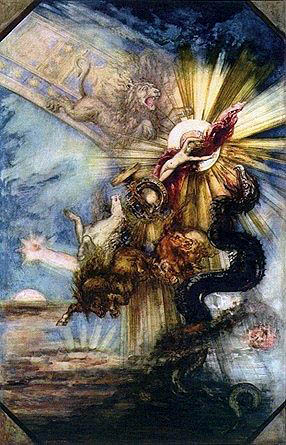
Phaethon Proud
Painting by Gustave Moreau
When Clymene, Queen of the Ethiopians, told her son Phaethon one day that he was in truth not the son of her husband, King Merops, but of the sun god himself, the boy was stunned into silence. Though he had always suspected something was not quite right, something he could never place in all the time he had spent with the King, the words which rang in his ears now still sowed the most profound shock mingled with disbelief. He, just a boy like no other, the son of a god? Not just any god, but Helios, one of the Titans, who ruled in the kingdom of the skies far over the mortal Earth, the very incarnation of the Sun. Disbelief flooded young Phaethon first, doubt close on its heels, as his mother's confession grew stronger yet. A tormented sleep did the young Prince endure, turning in the night, racked with angst. In his good friend Cygnus did Phaethon confide this revelation strange, and his bewilderment at what to do. The two boys marvelled at the possibilities if such a thing could be true. There seemed only one thing for it, and that was to travel to the Kingdom of the Sun and seek out the Titan himself to learn the truth.

Bidding farewell to his native land, to his mother and to Cygnus, Phaethon set forth on his fateful quest, his eyes upon the Eastern horizon firmly fixed. After an age it seemed, the realm of men was falling behind, the realm of the divine approaching. There, just ahead, 'the Sun's bright palace, on high columns rais'd, with burnish'd gold and flaming jewels blaz'd'. The gleam of the surface of the gate, reflected a burning light. Far had the young boy come, too far to turn back now. Upon the solar threshold a weary step the Prince did place, and never again the coolness of night touched young Phaethon's face.

Deeper and deeper into the Palace of the Sun he trod, and higher and higher the temperature soared, until at last, a blinding light of purest white heralded the throne of he, Helios the lord of the Sun. High on his blazing throne he sat, exalted and resplendent, the hours bowing at his hands. The Titan saw the proud youth loitering, "My son!" said he, "Come to thy father's arms! For Clymene has told thee true; a parent's name I own, and deem thee worthy to be called my son":


                         " 'As a sure proof, make some request, and I,
                            Whate'er it be, with that request comply;
                            By Styx I swear, whose waves are hid in night,
                            And roul impervious to my piercing sight.'
                            The youth transported, asks, without delay,
                            To guide the Sun's bright chariot for a day... "
                                     - PHAETHON'S WISH


Immediately did regret flood the Titan's mind, for the one thing of which Phaethon asked was the one thing he was not fit to bear. To steer the Chariot of the Sun was a task entrusted to none but Helios himself, for within was bound grave responsibility, and peril. The Titan, torn between his word and his care for his son, implored Phaethon to choose again. "There is not one of all the gods that dares to mount the burning axle but I, not Zeus himself, the ruler of the sky, that hurls the three forked thunder from on high...". But alas in vain, for the greater the god tried to dissuade him, the grander Phaethon's ambition grew, and his will to resist. "If downwards from the Heav'ns my head I bow, and see the Earth and Ocean hang below, ev'n I am seiz'd with horror and afright", the Titan pleaded, but alas in vain. Terrifying is the Chariot's race across the Heavens, a will of steel needed for such an undertaking as the horses tear through the sky. Helios tried and tried again to convince his son to accept a humbler prize, some kingdom or grand fortune far below in the domain of man, but unmoved was the ambitious prince.

It was beyond the point of return now, the River Styx had heard the Titan's oath. One last plea, one last turnéd ear. So with heavy heart Helios lead young Phaethon to the blazing Chariot, glimmering with gold, spoked with silver and seated with gems. With unbridled joy Phaethon surveyed his prize, his pride gorged. Helios looked up. The stars were receding, the time had come. At his command the hours brought forth the steeds, monstrous horses snorting raging fire. One last chance to save his son, the Titan anointed his body with celestial oil, to proof him against the staggering heat. A tear in his eye, he whispers one last phrase; "Take this at least, this last advice my son, keep a firm rein, and move but gently on: the courses of themselves will run too fast, your art must be to moderate their haste. Drive them not directly through the skies, but where the Zodiac' winding circle lies...". Phaethon offered his thanks, which the Titan with remorse received.

Phaethon Falls
Painting by Johann Liss
The mighty stallions neighed with restless wanton, flames roaring from their mouths, stamping upon the clouds. The time had come. Night gave way, and together they hurled forward as one, the beasts thundering forth, Phaethon soaring through clouds and breezing air. With dizzying speed they outstripped all winds. Though a little light for the Chariot, at first the Prince rode well, heeding the Titan's word. Following the course of the Zodiac, the Chariot moved with irresistible, yet steady, force. But as time passed, Phaethon grew proud of his feat, to equal the Sun god himself? The monstrous steeds sensed weakness in the hand of their master, and their unruly nature took hold. As soon as the Prince's gaze was turned, violently did they veer from the Zodiacal path. Pandaemonium reigned in the skies that day. Phaethon was cast against the Chariot's fore, and knew not which way to turn, whether to yank the reins or let them lie. The horses charged above, and the Sun veered to the stars, which retreated before its fiery heat. Far below ice with frozen hand began to throttle the land, snow fell upon the peaks and Oceanus shivered.

Far above, Phaethon looked behind, and saw the vast expanse of the Earth falling away behind him, panic stricken now. Pulling hard upon the reins, he tried to restore control. The horses, incensed, bolted to the side and careered toward the Earth:


                " The clouds disperse in fumes, the wond'ring Moon
                   Beholds her brother's steeds beneath her own;
                   The highlands smoke, cleft by the piercing rays,
                   Or, clad with woods, in their own fuel blaze.
                   Next o'er the plains, where ripen'd harvests grow,
                   The running conflagration spreads below.
                   But these are trivial ills: whole cities burn,
                   And peopled kingdoms into ashes turn... "
                           - THE EARTH SCORCHED


Down and down the Chariot plummets, and the incredible heat takes its fiery toll on the world. The high mountains buckle in the inferno, snow replaced with flames. The Ocean boils, and Poseidon the Earthshaker, god of the sea, brandishes his trident in defiance. Monstrous Typhon, deep below the Earth, grows restless in his infernal prison, and Mount Etna above explodes forth with redoubled fury. Even far off Scythia on the nomadic Steppe sees her frosts melt, and her plains burn. Verdant Africa bore the brunt, and ever after has been a mighty desert. Great Olympus, towering high above, shakes, as the rocks splinter and rend asunder, wreathed in fire. The world burns, and flames lick the Heavens. Mother Earth screams in agony, her ashes floating to the stars. Phaethon beheld the devastation before his eyes and realised the folly of his wish. The furnace heat of the world reached the sky, and the axle of the Chariot began to glow. The Euphrates fleed, the Danube too, the swollen Ganges, the Tiber, nurse to a promised Empire, too. Even the mighty Nile retreated in terror, and the seas plunged. The intense heat cracked the Earth, and fissures began to split it apart. Deep in the Underworld, pallid Hades recoiled from the light his kingdom knew not.

At last Gaia, Mother Earth, could bear no more. Denouncing the Olympians for allowing such a tragedy come to pass, she called upon her grandson to act. So did Zeus the Thunderer, King of gods and men, summon the divine array. Helios came before Zeus and tried to move his heart, but no ally did the Titan find. Taking up his burning throne, Zeus seized a bolt of thunder which glowed brighter even than the Earth. "Then, aiming at the youth, with lifted hand, full at his head he hurl'd the forky brand". The deadly dart of Heaven arced across the sky, striking Phaethon square in the head. At once from the shackles of life and the sun god's chariot was the Prince thrown. The horses charged back to the hands of their true, but weeping, master. The flaming body of Phaethon fell through the skies, gold and wheel falling too. Like a dying star he plummeted to the Earth his folly had ruined, until his ruined body struck the Po in the West.

Never again would someone dare such hubris as to emulate the Sun, and never again would a god make so bold an offer. Far below, few wept for Phaethon, cause of such ruin, except one. By the water's edge Cygnus sat, tears in his eyes for his friend. All their lives they had been partners in crime, mischievous together, now separated by Zeus's hand. The gods heard him weep, and pity moved their hearts. At their command his form was changed. Where once there were hands, now wings, where once mouth, now blunted beak, where once flesh, now pure white feathers. Ever after, the youthful swan has borne Cygnus' name...


United Kingdom

Penguin Classics
Metamorphoses: A New Verse Translation (Penguin Classics)
(A more prosaic and easier to understand version of the Roman poem)

Oxford World's Classics
Metamorphoses (Oxford World's Classics)
(A high poetical version of the Roman poem)

United States

Penguin Classics
Metamorphoses (Penguin Classics)
(A more prosaic and easier to understand version of the Roman poem)

Oxford World's Classics
Metamorphoses (Oxford World's Classics)
(A high poetical version of the Roman poem)

Wednesday, 1 February 2012

Glaucus and Scylla

One of the most timeless aspects of the myths of the ancient world is the sheer humanity of the gods they worshipped. Powerful and wise though they were, they were susceptible to very familiar faults and emotions, and envy is a potent force indeed. Here is the story of one man who discovered the terrible consequences of the envy of a goddess...


Glaucus
Detail of a painting
by Bartholomäus Spranger
There was once a strange cove on the eastern coast of Greece called Anthedon. It was a place men avoided, fearful of a strange power which seemed to radiate from its shores. Isolated it remained, until one day a fisherman happened upon the sheltered beach, weary from a long, exhausting day on the ocean waves. Sweating under the blazing sun, Glaucus hauled his bountiful catch ashore, dragging his nets across the springy grass of a wild meadow. Though a little untamed, and perhaps rather quiet, there was nothing to suggest that the meadow was more special than any other. Soon tired out, Glaucus came to rest in the long grass by the waves, and laid out his nets to dry, as he surveyed the day's catch. It was an impressive sight, a splendid array of the choicest specimens of the high seas. Even more impressive was what followed. For in the moment the fish touched the soft grass, they suddenly quivered. Glaucus stared. Barely a moment later, the nearest fish flopped right over. The fisherman looked on, utterly perplexed. These fish had been in his boat for hours and must have been dead for some time. Glaucus blinked. There was no denying it now, for the whole shoal of his catch was now defiantly leaping its way back to the sea, invigorated by some unseen force. Glaucus looked around for the sign of some god who might be behind this miracle. But there was no other on that isolated cove.


Oceanus
Sculpture by Pietro Bracci, centrepiece
of the Trevi Fountain, Rome
Glaucus looked down, wondering whether there was more to this strange grass than met the eye. Tearing a handful of blades from the swaying meadow, the fisherman chewed them, and the sap flowed into his mouth. Glaucus had barely swallowed a mouthful when a strange feeling overcame him. The burning rays of the sun suddenly seemed to sear his skin. The gentle tide nearby seemed more inviting than ever. A strange shudder within his heart, and Glaucus knew what to do. It seemed so strange to live on land, now he thought of it, especially when the cool waves appeared to almost call out to him. So, bidding a swift farewell to the Earth, Glaucus dived into the azure ocean. What a feeling it was, to glide through the water, with the freedom of a bird in the sky! Deep below the surface, Glaucus was welcomed to his new home by the Titan Oceanus and his consort Tethys, who both ruled over this domain, having escaped the wrath of Zeus by remaining neutral in the War of the Titans (for this story, please click here). Oceanus greeted Glaucus joyfully, and at the Titan's command, the former fisherman was purged of his mortality, embracing the eternal life of a sea god. Nine times the Titan chanted, and in a hundred streams Glaucus was purified. As the thundering torrents rushed over his head in a deluge, Glaucus felt his body begin to change. Where once there was an auburn beard, now there was green, as though seaweed. His shoulders, broader now than ever they had been before, were host to strong new arms, blue as the sea. Glaucus kicked his legs. But there were legs there no more, for in their place was a poweful tail, studded with fins. With a single flick of his new tail, Glaucus could soar through the depths, surrounded with fish more beautiful than any he had seen on his days as a fisherman.


Glaucus beseeches Scylla
Painting by Painting by Laurent de la Hyre
Glaucus rejoiced in the freedom of his new life, revelling in the company of gods. One day, however, whilst powering through the waves where the shores of Sicily and Italy are all but one, Glaucus caught sight of a young maiden reclining in a small rock pool by the ocean's edge. Her name was Scylla, one of the nymphs who came to the aid of those who lose their way at sea. From the moment his eyes saw her, Glaucus was utterly transfixed. Overcome in the heat of the moment, Glaucus came to her, surfacing suddenly. Though he tried to placate her with words which he prayed would make her stay, it was to no avail. Horrified by the creature she saw, Scylla fled in terror to a high crag of rock hanging over the Strait. The nymph eyed him suspiciously, unaware if Glaucus were god or monster. Relentless, Glaucus called out to her, telling the story of how he had once been a humble fisherman, how the Titan of the Ocean had granted him immortality and new life. Glaucus was, however, still recanting his tale when Scylla fled once more. Distraught at her harsh rejection, desperate Glaucus remembered stories he had once heard of a powerful witch who called nearby her home, and set off without delay, praying that she might help him in his plight.


Circe
Painting by John William Waterhouse
Making straight for Aeaea, the island where dwelled the daughter of the Sun god, the Titan Helios, Glaucus found it impossible to cast his thoughts to anything but Scylla and her cruel retreat. Soaring through the Tyrrhenian Sea, Glaucus soon arrived on the island of Aeaea, and made his way to the halls of Circe, whose skills with magic were known the world over. Throwing himself at the witch's feet, Glaucus begged for her pity, releasing his pent up emotions:

" Oh Circe, if spells can hold any sway,
   now open those holy lips to utter a spell! "
               - GLAUCUS PRAYS TO CIRCE


Circe was startled by this impassioned plea, and could not fail to be impressed by Glaucus' devotion. The witch responded by urging Glaucus to forget Scylla, and turn to her instead. Glaucus, horrified, declared that as long as Scylla lived and until the day grass grew on the ocean floor and seaweed rested on the mountaintops, he would always be loyal to Scylla. Circe was wracked by envy that she, a goddess, would be refused, but could not bear to harm Glaucus. Instead she turned her wrath upon innocent Scylla. She assured Glaucus that she would create a potion that would cool Scylla's fire and make her fall for him. Elated, Glaucus thanked the witch and dived back into the sea, eager to see Scylla again.

Circe, however, had cold fury in her heart. She too, could think of nothing but Scylla, but with feelings all too different. Taking the most noxious herbs from the woods, Circe ground the poisons into a drug, laying upon it both curse and malice. Her dark work complete, Circe soared through the Heavens, coming to the pool where Scylla liked to bathe. The nymph herself was on her way, and Circe was swift, pouring  her fell concoction into the calm waters. Where the poison touched the glassy tide, it hissed and bubbled, but soon was tranquil, hiding its evil purpose. Her work done, Circe withdrew just as Scylla arrived on the scene. Gently lowering herself in the water, Scylla found the water pleasantly warm, and soon fell asleep, as Glaucus relentlessly approached.


The Metamorphosis of Scylla
Painting by Rubens
It was a strange, growling noise which awoke Scylla. Still drowsy, she opened one eyelid. With a pang of terror, she saw a monstrous hound snapping near her waist. Almost paralysed with fright, slowly she edged away. But the creature followed her every move. Soon snarling surrounded her, and soon the terrible truth dawned on her - they were her. Circe's magic had fused the monsters to her waist, yet the beasts knew no mind or master other than their own. Circe had transformed Scylla into a ravenous monster, who could not control the six pairs of jaws bound to her. Six pairs of jaws which had a taste for human flesh. After a frantic journey back to be at Scylla's side, the former fisherman was thrown into a pit of despair at what he saw. Realising Circe's treachery, with tears in his eyes, he hurled himself back into the waves, shouting in deranged frustration. What of Scylla? As she lay in her lair, torn with grief, she cursed Circe's name, thinking only of vengeance. Until that day, however, sailors seeking to cross the treacherous Straits of Messina did so at their own peril, for fear of finding more than rapids there...

United Kingdom

Penguin Classics:
Metamorphoses: A New Verse Translation (Penguin Classics)
(A lyrical Roman poem which tells the stories of many myths, including Glaucus and Scylla)

Oxford World's Classics:
Metamorphoses (Oxford World's Classics)
(A more accessible version of the Roman poem, which tells the story of many myths, including Glaucus and Scylla)

United States

Penguin Classics:
Metamorphoses (Penguin Classics)
(A lyrical Roman poem which tells the stories of many myths, including Glaucus and Scylla)

Oxford World's Classics:
Metamorphoses (Oxford World's Classics)
(A more accessible version of the Roman poem, which tells the story of many myths, including Glaucus and Scylla)