Showing posts with label goddess. Show all posts

Wednesday, 15 January 2014

Orion

Ursa Major was not the only of the great constellations of the night sky to draw the attention of the ancients. Indeed all the major stars and their formations were well known in ancient times. All of them had their own origins and stories well recorded in lore, some in as many variants as the stars themselves. One such example is the story of the constellation Orion.


Blind Orion seeks the rising Sun
Painting by Nicolas Poussin
Long ago in Hellas, a place men now call Greece, there was a divine and regal birth. Brood of the god Poseidon, Lord of the Sea, and Euryale, daughter of King Minos of Crete, this would never be a normal child. Gigantic in stature, like his cousin the Cyclops Polyphemus, the boy towered over all of his peers, in ability as much as height. The boy was named Orion, and though good at heart, warred with the violent instincts that ran through the veins of all the Giants. As a result of his being son of the Lord of the Ocean, Orion found himself one day able to walk upon the surface of the ocean without falling through it - he could walk on water, unmolested by the horrors of the deep. As Orion grew, vaster than any mortal, though not blessed with a great mind he acquired a particular passion for hunting, a noble pursuit for a man in such days, and a way he might turn his aggression away from harming his peers. Soon his reputation was legend even as a teenager, as game fled his presence on sight, for well did they know that no being could escape Orion's hurled spear. In all things, Orion was never to be seen without his one true friend and loyal companion, his hound Sirius.


Searching for distant lands for ever more challenging game, great Orion ventured to the island of Chios, its isolation from the mainland no problem for the water walking giant, carrying faithful Sirius aloft. As Orion placed his vast foot on the sandy shore, he was welcomed to the island by King Oenopion and his entourage. Though much of the regal language was lost on simple Orion, the face of the King's daughter, Merope, was not. Intrigued by the foreign princess, and perpetually condemned to solitude, the giant desired a friend more than almost anything, save perhaps the choicest game under the Heavens. Oenopion invited his larger than life guest back to the palace, and threw a banquet in honour of him, for hospitality is a concept employed by the people of Chios with spectacular finesse. Orion, who had scarcely seen so many great things to eat, was overwhelmed. Due to his requiring more food than most simply to sustain him, the party dined well into the night. The hour grew late, and Merope retired for the night, leaving the revellers to their banquet, and Orion fell sad, though knew not why. The King, ever attentive to his guests, ordered the strongest wine brought to the table. When presented with a bucket sized goblet of shimmering red liquid, Orion knew nothing of it, having never before tasted wine of such potency, and drank as though he would water. The men of Chios laughed heartily, as the giant grew dazed and confused. The drink played its evil tricks on Orion's mind, already at war in the half human and half giant. Stumbling from the banqueting chamber, the drink lead him to Merope's quarters, sapping him of his human will. Crashing through the low threshold of the door, he fell into the princess's bedchamber, to the fright of Merope. As she ran to offer what help she could, Orion, lost to his senses, seized her with more strength than a man should. The racket caused by the door summoned the King immediately. When he saw the sight before him, the darkest suspicions reigned supreme. He at once, outraged at the abuse of his hospitality, ordered Orion condemned.


The Constellation Orion
Photograph by Rogelio Bernal Andreo
The King gave command that Orion should be blinded, so that his last vision would forever be that of the woman he longed for, and forced himself upon. Furthermore, Orion was banished from the kingdom. SO, once again, Orion set out on the road, destitute and ragged, with naught but his torn thoughts of grief and faithful Sirius to accompany him. One day, whilst on Lemnos, he encountered a stranger on the road, a stranger his eyes could not reveal as the god Hephaestus. Hephaestus took pity on the giant, and told Orion that if he sought the rays of the Sun as they were born, he would see again. His despair turned to joy, Orion eagerly asked the stranger where they could be found. Since the giant was blind, Hephaestus gave to Orion his own assistant from the forge, Cedalion. Taking up position of Orion's shoulder, Cedalion shouted directions in the giant's ear, and together they set off in search of the Land of the Sun. The vast journey, impossible for mortal feet, was swift for a giant, aided at all times by Cedalion upon his shoulder, and Sirius by his leg. At last the triad arrived at the Kingdom of the Sun, Cedalion and Sirius averting their eyes, Orion shielding them from the heat. Helios, the god of the Sun, indeed took pity on the giant, and as Orion closed his blind eyes from the heat, suddenly a slit of purest white appeared before him. He wrenched open his lids, and saw blinding light. He turned to his side, and saw a dog, and Cedalion on his shoulder, and rejoiced at his newfound sight. Thanking Helios dearly, the giant was filled with ecstasy.

For so long he had been denied the pleasure of the hunt, his great passion, and set off at once. Coming to the island of Crete, the home of his ancestors, he chased the game from sunrise to sunset. Artemis, the goddess of the hunt, was impressed by the hunter's prowess like never before in a mortal. Coming down to the Earth she offered him a unique honour, to join her in the hunt. He leapt for joy, and the games began.

Hither and thither the godly party went, and never before has so great a quarry been taken in sport. Deer, boar, bird and hare fell to the spears of Orion and arrows of Artemis. Soon near all Crete was empty of living beasts. At the moment of his pride, his giant instinct holding sway, Orion shouted to the Heavens that there was no creature on Earth that he, Orion, could not slay. But the balance of the cosmos had been tipped, that subtle yet ever levelling power which ensured no man or woman could ever be too powerful or too beautiful without disaster befalling them. Gaia, Mother Earth, was appalled at the slaughter on her body, and outraged at Orion's words. So the Titaness crafted a new beast to best the giant in his own game. Eight armoured legs she gave it, two crushing pincers and a lethal tail, brimming with fiery venom. To her new creation she gave the name of Scorpion, and thus was born the first of that race, the King of all Arachnids.


Artemis mourns the body of Orion
Painting by Daniel Seiter
At his side, Orion noticed the ground quake and churn as Mother Earth's revenge burst into the fresh air, divine fury in every inch of its chitinous hide. Orion drew back, wary of this new foe, and never was he to face such a terrible foe. He launched his spear, but alas, it span away, turned aside by the beast's armour. No arrow or blade would pierce that hide. So, across the valleys and mountains of Crete their duel raged, neither one able to best the other, Orion too swift for the creatures arms, the Scorpion impervious to Orion's blades. At last, with no more of the island left to run to, Orion, worked up to a giant's rage, hurled himself upon the monster, using his mighty strength to grapple the beast. The Scorpion writhed and injured the giant many times, but slowly, yet surely, Orion began to crush it inside its own armour. When at last victory seemed near Orion raised his head high and shouted in triumph. But alas, the momentary lapse of concentration cost him dear, for the creature's lighting flash of a move saw its stinger dart into Orion's shoulder, a lethal shot of venom upon its barb. The Scorpion died, but died avenged. Orion staggered away from the body of his conquered foe, the fiery venom robbing him of life. Lamenting his misfortune in life, he sought his last solace in the distraught eyes of Sirius, who licked his master's face one last time. So under the tears of his one true friend, Orion, the great hunter, felt the darkness close on his eyes.


Artemis, lady of the hunt, was devastated when she found his body, and appealed to Zeus the Thunderer, lord of the sky, for mercy. The god of gods was might, but could not turn the wheel of fate. Impressed by Orion's skill, yet warm human heart, he cast the giant into the skies, ever to shine in the night sky. To this day he is still there, the constellation Orion. Impressed too by the fearsome Scorpion, Zeus decided to make sure man would never forget to challenge Mother Earth, and cast it too to the skies. To this day, the constellation of Scorpio can be seen, set to rise when Orion falls. But one fellow lay not forgotten, and for his loyalty to his master and purest heart, Zeus the Thunderer placed Sirius in the skies, and the brightest of all stars he is to this day, amid the constellation of Canis Major...


United Kingdom

The Library of Mythology:
Library of Mythology
(A vast collection of the myths of old Greece, written in ancient times, and a great intro)

United States

The Library of Mythology:
Library of Mythology
(A vast collection of the myths of old Greece, written in ancient times, and a great intro)

Wednesday, 9 October 2013

The Trident and the Spear

Every city which rises to greatness does so from humble beginnings. So high can a nation rise that so mythic can her origins seem. Every great thing, be it a nation, a person, even an idea, has to start somewhere. To our ancestors of old, greatness was a sure sign of favour from on high. For the hand of a god must surely have been at work when one of the most influential cities in human history, for better or worse, was born.


Athena
2nd century AD Roman bust  from Velletri
The Olympians had fought a terrible fight for mastery of the Cosmos. Their forefathers and creators of the Universe, the Titans had not yielded their divine grip easily. After so great a struggle, the harmony of the World was worth more than anything to the gods, even to Zeus the Thunderer, King of the gods and Lord of the Sky. Now fidelity was one thing that Zeus the Thunderer knew not, and many a hero of the ancient world owed his existence to the philandering adventures of the god of gods. It was little surprise therefore, when Zeus undertook a clandestine affair with the beautiful Titaness Metis. However, when the Fates prophesied that the child of Metis would be mightier in spirit and wiser in understanding than its father, Zeus the father of gods and men was convulsed with fear. Long ago, his father Kronos had heard similar words, with dire consequences. The Heavens had groaned under the Titanomachy, and could ill afford so ruinous a war for a second time. So Zeus the Thunderer decided on a little evil for a greater good. Weaving his divine powers of transfiguration, the shape of Metis he shifted to that of a common fly, and the god swallowed her whole, so that she may never give birth to this legendary child.

Time passed, but troubles did not for the Lord of Olympus. As the days grew late, a terrible pain struck the god inside. What began as an ache inside his royal head, soon swelled to a pounding agony that would not die. Time soon came when even the Thunder himself, conqueror of Typhon and Heaven could bear the torment no more, and summoned to his side Hephaestus, the god of the forge and weaver of fire. "Take up thy hammer and rend asunder this head that pains me so, lest this torture afflict me for all the ages to come", said Zeus. The lame god of the smith stood dumbstruck by this command - split open the head of Zeus? But the father of gods and men was inexorable, and irresistible. So Hephaestus took up his hammer and tongs, and with a mighty strike, he breached the Divine Crown. A roar of thunder and a flash of light rolled over the skies. Then, in a blur of speed an apparition appeared. From the fissures in the skull of Zeus there leapt a figure, strongly built yet distinctly feminine, agile yet fully armed, wise yet ready for war, a new goddess entered the cosmos. Athena, goddess of wisdom, mistress of stratagem, lady of the spear and patron of heroes.

Around this time, far below on the mortal plain, the tribes of Attica came together under their King, Cecrops. Born of Mother Earth herself, Cecrops taught the Atticans the still young arts of reading and writing, of literature, of burial and brought the institution of marriage to the tribesmen. Civilisation as we know it, was being born. Soon, however, the simple villages of Attica groaned under the advance of the people, and a new home was needed. Under the leadership of their vibrant King, the Atticans set off through the harsh landscape of Attica, where open plains give way to beaten rock. After a time they came to a place in the West, largely flat yet punctuated by towering pinnacles of rock. The sea lay yonder, yet wise Cecrops knew that to build their new city on the shore itself was too dangerous in an era of rampant piracy on the high seas. Away from the shore then, yet near enough for trade, the people set foot upon a mount with a commanding position over the plain and the sea. Here would be founded their new city, and grandiose would it be. But every new city needed a patron god, but who?


Poseidon
The Artemision Bronze
Word reached Olympus of the gathering under Cecrops upon the Mount. Just then,  the Fates declared that the city that would be founded upon that place would rise to a greatness rivalling the best of all Greece. Glory and honour would walk hand in hand to whomsoever should become her patron. A frenzy gripped Mount Olympus, and the all the divine array wondered. Two among them immediately took the floor. Athena, ever ready with sharpened word and thought, leapt to her newborn feet. But Poseidon, god of the sea, shaker of the earth and lord of horses, bowed to few. Even Zeus himself, King of all gods kept a close eye on his ambitious younger brother, for most vexed was Poseidon when he lost the Heavens in the division of the cosmos. Torn between loyalty to his brother, however unruly, and care for his daughter, despite the danger she posed as his successor, Zeus decreed that the people should decide the patron of their city. Immediately, the two deities spirited down from Olympus and made landfall upon the mountain. With a blinding flash and a roar of thunder, the people cowered at the sight of the divine array. Fearful lest they choose one over the other, the people knew not what to do. Cecrops their King, however, decided. Turning to his gods, he declared that the patronage of the new city would belong to the one who presented the greatest gift to it. Poseidon and Athena, uncle and niece, eyed each other, and readied their contest.


The Sea of Olives, Delphi
Photograph taken by the author
Both god and goddess, stood aside the towering pinnacles of the Acropolis, poised for the prize of glory. Poseidon, shaker of the Earth, took the first move. Raising his mighty Trident high into the air, with a rush of godly strength he plunged the three blades into the mountain side. A deafening rumble rippled across the Earth, and the people were thrown to the ground, terrified. There, where the central prong penetrated the summit (a place today commemorated by the Erechtheion), the wounded rock spat forth a spring of water thick with brine. The Emperor of all Oceans granted to the people the gift of the sea itself, and the assurance that one day they would master it. A fabulous gift indeed. Next the virgin goddess stepped forth. The eyes of Athena looked into the souls of all mortals present, and she senses their hopes and fears. Confident, and unyielding, the daughter of Zeus took up her spear and flung it into the mount. The people watched, entranced, for before their eyes the lance began to shift. The wooden shaft lengthened and broadened, from the blade branches sprang forth, rich with the bounty of its dark fruit. To the people Athena gave the gift of the humble olive tree. Poseidon looked on, bemused and anxious.


Athens at her height
Painting by Leo von Klenze
The primordial Athenians looked on the lowly sprig with wonder and amazement, as the goddess instilled some of her divine wisdom in their minds. Cecrops beckoned his people round to cast their vote. Poseidon's gift was mighty indeed, as was his promise. Mastery of the Ocean? 'Tis the dream of empires! A great destiny had been given to them. But that all looked a long way off to the primitive people, as they looked to and fro, and saw naught but barren rock. One citizen splashed some of the water over his face, and recoiled at its salty taste. The people turned to the sapling, Athena's gift. One fellow took a blackened grape from its boughs, and crushed it in his hands, and oil splashed across his palm. Into his mouth he tossed the olive and pleasing was its taste. Seeing the thick and robust trunk too, he saw the greatness of Athena's gift. Poseidon had given them a taste of great nations, but Athena had given them a source of food, of wood and oil, and something they could trade with others. The people sank to their knees with joy, and hurled themselves at the foot of Athena, daughter of Zeus and maiden of Olympus. Poseidon, god of the seas, was infuriated, but his niece had won the day. Cecrops declared Athena the one true patron of their new city. He declared that this place, the Acropolis, would ever be sacred to her. He declared too, that in her honour the city would be named. To the roar of approval from the first Athenians, he named the city. Athens, the glory of Athena...


United Kingdom

The Library of Mythology:
Library of Mythology
(A vast collection of the myths of old Greece, written in ancient times, and a great intro)

United States

The Library of Mythology:
Library of Mythology
(A vast collection of the myths of old Greece, written in ancient times, and a great intro)

Wednesday, 27 February 2013

The Flute and the Flayed

Ancient lore is ripe with tales of gods and monster, heroes and heroines and their wars, affairs and voyages. Oft is fate written in the stars, virtue praised and pride punished. When mortals rise above their stations, they are punished. But the divine powers are flawed too. Sometimes even the gods could go too far...


Athena
2nd Century AD Roman copy of a Greek original
Legend says that a long time ago, in the Golden Age of the Olympians and heroes, the goddess Athena, daughter of Zeus the Thunderer, was wandering in the sunny vales of the forest of Phrygia. The goddess' chaste ears pricked up at the sound of the birdsong in the breeze, a soothing accompaniment to the percussion of the rustling leaves. Filled with a peculiar joy, she was filled with a passion to make merry in the forest. Taking from the leaf strewn earth the bones of a young doe, the goddess fashioned from them a strange instrument. Whittling a series of pipes from the matter, she lashed them together and considered her new craft. With a modest intrigue, she placed the pipes to her mouth and blew. What a fair sound it was indeed; a soft vibration, a gentle melody and hypnotising note. Spurred on, bolstered by the music of the forest, the virgin goddess could scarcely put them down. Soon her absence was noted on the snowy peaks of lofty Olympus, and gossip flew to and fro, from scheming god and intrigued goddess. All too happy to share her new art, Athena proposed to show them all the sweet sounds at a lavish banquet in Heaven's Halls.


The eve came and the resplendent array of the skies awaited, fascinated by what was to come. When the moment came, the goblets were empty, the ambrosia consumed, the goddess rose to her feet. Brimming with excitement and nerves, she began to play. In the beginning, all was well, as the dulcet tune serenaded the divine array, and seldom were such sweet tones heard in the Palace of Olympus. Zeus the father of gods and men looked merrily on, proud of his daughter's talents. Hephaestus, master of the forge, sat entranced by the music so seldom heard in the roar of the furnace. Ares, lord of war, for whom the screams of the dying were oft his cadence, could scarce hide his delight. But it was then that the eyes of Pallas Athena saw Hera and Aphrodite. Far from listening with rapture, it was with a fits of laughter they returned her song. Though fair and noble, terrible could be the warrior maiden's fury. In anger she departed, seeking solace in the wilderness. When strolling the paths of the Forest of Ida, she stopped by a great pool of glassy water, her joy poisoned by doubt. She took up the pipes once more, and for the last time did she play. In the soft ripples of the water did she see her image cast, and within was held the revelation she sought. She had not noticed until now that as she played, she puffed her cheeks out proudly, their oft white complexion soon a crimson red. Frustrated by the immaturity of her fellow goddesses, with whom she bore a ruinous rivalry, she cast her creation aside. Laying upon the pipes a curse, she vowed calamity upon whomsoever should play them again. Woe that her malediction should have found a mark.


Marsyas in the Forest
Painting by Pyotr Basin
One day, when the memory of the pipes had passed into legend, there lived a shepherd who made Forest of Ida his serene home. His name was Marsyas the son of Oeagrus, and no man was he, but a Satyr. A servant of the god Bacchus, the Satyrs lived a merry life of revelry, dancing and song, frequently spreading havoc and drunken anarchy where their cloven feet trod. Marsyas, however, possessed a gentler spirit, preferring the solitude of the forest to the chaos of the plains. There came a day, however, that neither the Satyr nor the forest would ever forget. Stumbling upon a clearing in the thick canopy of the trees, where lay a crystal pool of ice cool water, Marsyas stopped to refresh. Throwing the pleasant water over his face, he gave a sigh of satisfaction, droplets from his tangled beard breaking the mirror like reflection of the surface. Turning to dry his face, however, he spotted a strange yet curious thing cast in the bushes at the water's edge. Stained with earth and covered in moss, it seemed a relic of an ancient past. Picking the strange object up, the Satyr, acquainted as all Satyrs are with the ways of merriment, realised at once that it bore the form of an instrument. Scraping aside the grime and muck, dousing it in the clear water, he saw the simple pipes in their fresh glory.


Tentatively, the Satyr put the pipes to his lips and blew. The note was rough, but charming. He blew again. Better, but a shade of the performance of the instruments original creator. For an age did Marsyas obsess over the pipes, unable to resist the allure he could not explain, the will to keep playing. Throughout the hours when the sun drenches the Earth did the Satyr practice anew, studious and assiduous. Day by day the Satyr's prowess grew, and with his talent came music sweeter than ever before. Birds began to perch upon nearby boughs, listening intently to Marsyas' song, the notes fairer even than their own. Creatures and being from far and wide began to marvel at the Satyr's song, but before long the curse began to manifest. Pride, the ruin of the great, wove its intoxicating spell in the Satyr's mind, as his humility could deflect the shower of praise no more. Time passed, and soon Marsyas declared himself a musician beyond compare in the world. The fatal hour arrived when the Satyr challenged Apollo, the god of music himself, to a contest.


High on Olympus, Apollo heard his challenge, and the god was angered by the daring of a mortal. Soaring down from the frozen summit, Phoebus Apollo came before Marsyas, and the admiring crowds scattered in fear and awe. Shaking with rage, Apollo declared the contest begun. The Muses, the spirits of the arts, were summoned to judge, and the terms were set. Whoever showed the greater mastery of music would triumph, and the victor won the right to treat the defeated as he pleased. Alas that Marsyas was deaf to the subtle warning that lay veiled within, as the curse brandished its edge, and the proud Satyr accepted. The stage was set. Marsyas took the pipes his beloved pipes, Apollo the lyre with which he was so skilled. The god played first. What ambience the grove had never known! With each pluck of the god's fingers upon the strings, soothed was the soul of all beings present, and the Muses sighed in awe of their master. When the god finished his piece, all gathered saw the end coming for the Satyr. But Marsyas, spurred on by the curse, boldly raised the pipes to his lips. With a jolt the gathered assembly was stunned into silence. With each honey soaked note, the very forest itself seemed to sing, vibrating with raw power. All earthly woes lay distant and forgotten for all mortals there that day, and warmed were the hearts of the Muses. Incensed by fire, alas, was the heart of Apollo. Just as the Satyr neared the boundary of the grove, victory near at hand, the god called to him. If the Satyr could play as he could now, Apollo would concede defeat. Intrigued, yet proud, Marsyas agreed. Without delay did the sun god spin his lyre around, striking a haunting melody, his instrument upside down. The Muses, delighted, applauded the god's performance, before turning to Marsyas, expectant. With a glint of malice in his eye, well did Apollo know that it was impossible to play the pipes upside down. Too late did the Satyr realise this too. His mouth went dry with terror, as the judges were struck with disappointment. To the son of Zeus was triumph assigned, and to the Satyr, ignoble defeat

Marsyas Flayed
Painting by Titian
Near dumbstruck, the Satyr watched helplessly as the god approached, vengeance that only a god could muster flaming in his eyes. Poor Marsyas searched for words but none could be found, none to quench the fire before him now. Hands grabbed him from all around, and terror flooded his veins. Thus was begun a punishment terrible to behold. Strapped to a nearby oak was the quivering Satyr, and tightly bound. The servants of Apollo seized their blades and descended upon poor Marsyas.


                  " 'Why do you tear me from myself, he cries?
                     Ah cruel! Must my flesh be made the prize?
                     This for a mere pipe?' He roaring said,
                     Meanwhile the skin from off his limbs were flay'd.
                     All bare, and raw, one large continu'd wound,
                     With streams of blood his body bath'd the ground.
                     The blueish veins their trembling pulse disclos'd,
                     The stringy nerves lay naked and expos'd;
                     His guts appear'd, distinctly each express'd,
                    With ev'ry shining fibre of his breast... "
                      - THE PUNISHMENT OF MARSYAS


His muffled screams were the last song of Marsyas, raw muscle and tendon bare to the elements now. Such was the justice of Apollo, so great the price of a mortal daring to raise himself above a god.

But not all beings shared Apollo's wrath. The fauns, silvans, nymphs, naiads and spirits of the forest, once serenaded by the Satyr's song, came to his mutilated corpse. Tears flowed from their eyes at their gaping loss, the knowledge that his pure song might never woo them again. It is said that even vengeful Apollo himself was later moved to regret, and not readily did he string his lyre in ages to come, remorseful of his act. "With their tears that flow'd, a kindly moisture on the earth bestow'd, that soon, conjoin'd, and in a body rang'd, sprung from the ground, to limpid water chang'd; which, down thro' Phrygia's rocks, a mighty stream, comes tumbling to the sea, and Marsya is its name..."

Like poor Actaeon before him, Marsyas felt the terrible fate of stumbling innocently in the path of a god. It was the folly of a fool to violate the laws of Heaven, but to challenge them openly, why only those blind to all other things would dice with such death. Nevertheless, even in the ancient world there were many who questioned the magnitude of poor Marsyas' punishment...

United Kingdom

Penguin Classics
Metamorphoses: A New Verse Translation (Penguin Classics)
(A version which favours ease of understanding than high poetry)

Oxford World's Classics
Metamorphoses (Oxford World's Classics)
(A version which favours ease of understanding than high poetry)

United States

Penguin Classics
Metamorphoses (Penguin Classics)
(A version which favours ease of understanding than high poetry)

Oxford World's Classics
Metamorphoses (Oxford World's Classics)
(A version which favours ease of understanding than high poetry)

Wednesday, 7 November 2012

Cadmus

The beginning of things is always a moment enshrined in history. The greater the thing, the greater the myth, especially for those few who founded entire civilisations, for whom myth and history can be so closely intertwined as to be nigh on indistinguishable. One such hero was Cadmus.


The Rape of Europa
Painting by Titian
Far past, in the distant mists of time, there ruled over the great city of Tyre the King Agenor and his Queen Telephassa. Under their happy and benevolent rule Tyre rose to great heights, and the the Tyrians were blessed with a formidable progeny. To the royal family were born three sons; Phoenix, Cilix and Cadmus, and a daughter, Europa. Tyre rejoiced in the splendour of each of her heirs, each magnificent to behold and strong of heart. As the four grew up, the future seemed radiant for the great city. But it was not only man and woman who admired the majesty of these four, for they, as all things, could not escape the gaze of the Olympians on high. No mere nymph, dryad or spirit, but Zeus himself, King of the all gods, became enamoured of the young princess Europa. One sun drenched day, Europa danced merrily by the ocean's edge, under the Thunderer's watchful gaze. Transfixed by her beauty, Zeus came down to the Earth as a mighty white bull, of gleaming horns and glistening coat. Europa looked up, entranced at the majestic sight before her. Laying a fair hand upon the Bull's shining mane, in a bewitching trance she dared to mount its back. Gently, the Bull turned toward the surf, and sauntered into the waves. Triumphant, Zeus spirited her beyond the horizon, glorying in his prize, as the maiden held on, taken up in the thrill of adventure, as the land fell away behind her. Never again was she to be seen again on Tyrian shores.


When word reached King Agenor's ears of his daughter's flight, he was stricken with anguish. Summoning his three sons before him, he bade each search every coast far and wide, across the world, in search of Europa, unbeknownst to him that a god's hand was at work. With ready abandon did each brother set forth in search of his sister, three directions did they depart, and in three ways did they journey, and for an endless age did they go. To the South and West did Phoenix go, after time giving his name to the land of Phoenicia. To the North did Cilix go, after time giving his name to the land of Cilicia. To the West did young Cadmus go, landing soon upon Grecian shores. Time passed and the maiden could not be found, for what mortal can pursue the Thunder god himself? Weary from ageless toil, Cadmus decided to seek out the Oracle, and know her counsel. High upon the Delphic road he thus trod, with kindred Tyrians in tow, coming to the Pythian Halls. Intoxicated by the mists of prophecy, the Oracle thus did cry:


                      " Behold among the fields a lonely cow,
                        Unworn with yokes, unbroken to the plow;
                        Mark well the place where first she lays her down,
                        There measure out thy walls, and build thy town,
                        And from thy guide Boeotia call the land,
                        In which the destin'd walls and town shall stand... "      
                             - THE ORACLE SPEAKS TO CADMUS


The Prince of Tyre was taken aback by the command of Heaven. To find his sister was to be a destiny not his, it seemed, but as the founder of a nation. No sooner had he departed the towering sanctum, pondering deep his divine mission, than he spied in the fields that sacred cow, unshackled by rope or chain, unfitted with plow. The cow raised her head and saw the Prince of Tyre. Both looked into the eyes of the other for a brief moment, before the beast turned and trod. At a distance Cadmus stalked, in silence, praying to the god whose path he followed now. Through mountain high and plain wide Prince and beast continued their strange dance, crossing the silvery rapids of the river Cephisus, when all of a sudden, the cow raised her head to on high, bellowing thrice, before turning back to gaze at he, and laying in the grass. Cadmus saw the sign, and gave thanks to on high, thanks for his destiny, thanks for the nameless place, pastures and mountains which would be the land of his progeny. Turning to his kin, he bade them seek water with all haste from living streams, so as to prepare a sacrifice to Zeus the father of men and gods. So, over the wide plain his comrades trod, for their lay in a dark vale beyond a shady wood, its boughs hanging heavy over unlit grass, pathless and thick with brambles in the scrub.


Cadmus and the Dragon
Painting by Hendrick Goltzius
Yet Death incarnate lay in the darkness of the trees. For deep in the dank forest, sacred to Ares, lord of War, a powerful dragon lay, "bloated with poison to a monstrous size; fire broke in flashes when he glanc'd his eyes: his tow'ring crest was glorious to behold, his shoulders and his sides were scal'd with gold...". The Tyrians searched wide for water in the eerie glade, and with their vessels upturned, they gathered from the stream. From side to side their urns bounded, the ripples echoing deep into the infernal pond. Upon the the wyrms's crest they crashed, rousing the beast from evil slumber. Evil stirs, and with a hiss that shrivels the skin of the very sky, the dragon rose from the stagnant pool, his many tongues flickering, his many eyes darting to and fro. The Tyrians gave a shout of fear, their urns lying, shattered, discarded, upon the soil, now their grave. The dragon, towering high into the sky, then saw trembling men in his glade, and fell upon them in a rage. To their arms some Tyrians look, but in vain, to flight from the evil glade others. But no man there would breath the fresh air again, no man live to see the destiny of their prince. Some lie broken underfoot, others devoured by the monstrous creature, their final screams masked by the roar of the wyrm's ghastly breath.


The Sun began to rise into the warm, midday sky, and Cadmus began to wonder where his comrades had got to. Impatient to commence the rites the Olympians themselves had ordained him to do, the Prince of Tyre at once set forth to search for them, casting his eyes upon the fell glade in the distance, a place where the rays of the Sun never shone. The hide of a lion he wore around his muscled form, a raised spear in his hand, but a heart of valour was his greatest arm by far. Not long did he tread in the forest's eaves before the  broken bodies of his kin his eyes did spy, the monstrous beast in their midst, feasting upon his friends, gore spattering his jaw. In a shout of rage and grief, Cadmus heaved a mighty boulder, no ten men today could lift it, weak as men are now, and hurled it at the creature. The mightiest rock flung by the mightiest engine of war never had cast so mighty a payload at a towering wall, yet harmlessly did the stone deflect from the iron scales. His slumber disturbed a second time, the dragon seared with fury, and bore down upon the Prince of Tyre with thundering haste. Undaunted, the young Prince took up his spear, taking careful aim. The strength of the greatest of men, and beyond, he put into the throw, casting the dart into creature's spine. More success this time, as the iron tip burrowed between the scales, punching into the vile flesh. A screeching hiss the serpent wailed, sending eerie chill down Cadmus' spine. The powerful body writhed and turned, and monstrous teeth closed around the shaft of wood, splintering Tyrian spear. Pain feeding his building rage, the wyrm's eyes clouded a hideous red, hate pounding in every vein, as from his mouth a putrid gale blew, spraying a lethal foam about the clearing. Plant, flower and tree all wither under its hail, but not the Prince of Tyre. Uncoiling now, the monster lunges, a torrent of power. Desperate now, Cadmus seized the ruined spear, as the serpent's jaws clamped upon the point, mixing blood and venom raw. Not a moment to spare, the Prince dived behind a tree, as the mighty trunk deflects his foe's strike. Seizing his chance, Cadmus took the shattered point and thrust it will all his might and will to live, deep into the creature's throat. Labouring hard for breath, the accursed wyrm writhed in a final agony, crashing to the dust, lifeless as stone.


Cadmus sows the Dragon's Teeth
Painting by Maxfield Parrish
Not a moment did young Cadmus have to relish his triumph before a terrible voice roared throughout the dale, the voice of a god. "Why dost thou thus with secret pleasure see, insulting man! What thou thy self shalt be?" With horror chill did the Prince of Tyre realise, the voice of Ares, god of war himself, thundered all around, in anger at the slaying of his sacred beast. It was then that Athena, lady of wisdom, soared down from the Olympian heights, favouring the innocent Prince. Quickly, she bade him act, plow the field and scatter the teeth of the dragon as though the seed of a crop, for from them shall arise the people of his new city. Confused, but piously obedient, Cadmus obeyed. Plowing the field, and readying the seed, the Prince bent low over the wyrm's lethal teeth, wrenching them from the scaly cadaver:


       " He sows the teeth at Pallas' command,
         And flings the future people from his hand.
         The clods grow warm, and crumble where he sows;
         And now the pointed spears advance in rows;
         Now nodding plumes appear, and shining crests,
         Now the broad shoulders and the rising breasts;
         O'er all the field the breathing harvest swarms,
         A growing host, a crop of men and arms "
               - CADMUS SOWS THE DRAGON'S TEETH

To his utter amazement, the furrowed ground churned, and from the teeth of the dragon, fully armed and fierce men sprang. As the warlike men began to seek out their creator, Cadmus, wary of their bloodlust, cast a stone in their midst. It struck one of the men, who immediately rounded on his comrade to his rear, believing him to be the culprit, and struck him cold dead to the floor. Consternation broke out in the battalion of the Teeth, as brother turned against brother, and blood ran in torrents, the evil glad awash with gore anew.  Soon, all but five had been slain, and in that moment, Pallas Athena stayed their hands, and at her command, their arms to the ground did fall, as they embraced the way of peace. Before them now did the Prince of Tyre appear, and call each man his brother, and at last he set about the business of raising his great city. Thebes, the city would be called, and Cadmus her King, and the five men the fathers of the great noble families. Raising a high cliff in the city's heart, they named it for their founder, the Cadmeia (which you can visit today if you go to ancient Thebes), and thus began the days of Thebes, and the Royal House of Cadmus.

Long did Cadmus reign in peace, and to him the gods gave a wife, Harmonia, a symbol of new concordance between men and gods. Yet there was one in their midst who reeled with spite, proud Ares, his anger great still at the desecration of his sacred beast. Upon Cadmus and his progeny he placed a terrible curse. Ever after the Royal House of Thebes was plagued by misfortune. The grandson of Cadmus, Actaeon (whose own downfall you can read about here), and many generations later, his descendant Laius (whose fate you can read of here), father of Oedipus, would feel the curse's wrath. Many long years later, Cadmus ripe with age lamented the ill omens that plagued his family, raising his head to the Heavens. If the gods troubled so over the life of a serpent, he would rather be one himself than a mortal man. Upon him pity fell, and granted was his wish. Before his very eyes his skin was as scales, his teeth as fangs, his legs a whipping tail. His beloved Harmonia upon him gazed, imploring the gods to spare her pain of separation from him. To her too the gods gave their gift, and in a flash she too slithered upon the ground, freed from the evils of man and their ways forever...

What happened to Europa, you might ask? Zeus the Thunderer spirited her away to the island of Crete, and upon those radiant shores he revealed his true form. To the stars he flung his Bull like form, and the constellation Taurus was thus born. Upon Europa's head the crown of Crete the god did place, but greater still was to be her legacy. For even today the Continent of Europe bears her name...


United Kingdom

Metamorphoses:
Metamorphoses: A New Verse Translation (Penguin Classics)
(The Source for many of the myths of ancient lore, written by a Roman poet)

United States

Metamorphoses:
Metamorphoses (Penguin Classics)
(The Source for many of the myths of ancient lore, written by a Roman poet)

Wednesday, 12 September 2012

Narcissus

There is a fine balance between self confidence and pride, and closer still to vanity, that ancient sin. But their are many forms of pride, from those that empower to those that destroy. Here is the story of one young man whose vanity earned the wrath of many, the pity of some and the ruin of one.


Narcissus
Painting by Benczúr Gyula
A long time ago, in the Boeotian realm of Thespiae, a boy was born to the River God Cephissus and the Naiad Liriope. Even in infancy the other nymphs, Dryads and Naiads and Oreads, of the mountain vales and forest glades could see majesty in the young boy's form. Such a sight to behold as baby became boy! His fair mother cared deeply for her boy, and sought out the legendary seer, Tiresias (the very same soothsayer who revealed the truth to Oedipus - for this story please click here), '"fam'd far and near for knowing things to come", for comfort as to his fate. Liriope asked the prophet if her son would enjoy a long life, or was doomed to a short one. Seeing the gift of beauty the gods had empowered the boy with beyond all other mortals, the wise sage replied "If e'er he knows himself he surely dies". "Long liv'd the dubious mother in suspence, 'till time unriddled all the prophet's sense". So the boy grew older yet, and his handsome visage stronger yet. Narcissus was the name his mother had given him, and all who set eyes upon him were stopped dead in their tracks at the sight of him. His sixteenth year began, and the list of maids who had declared their adoration for him swelled greater yet, each confession another brick in his tower of pride, each doomed to fail.


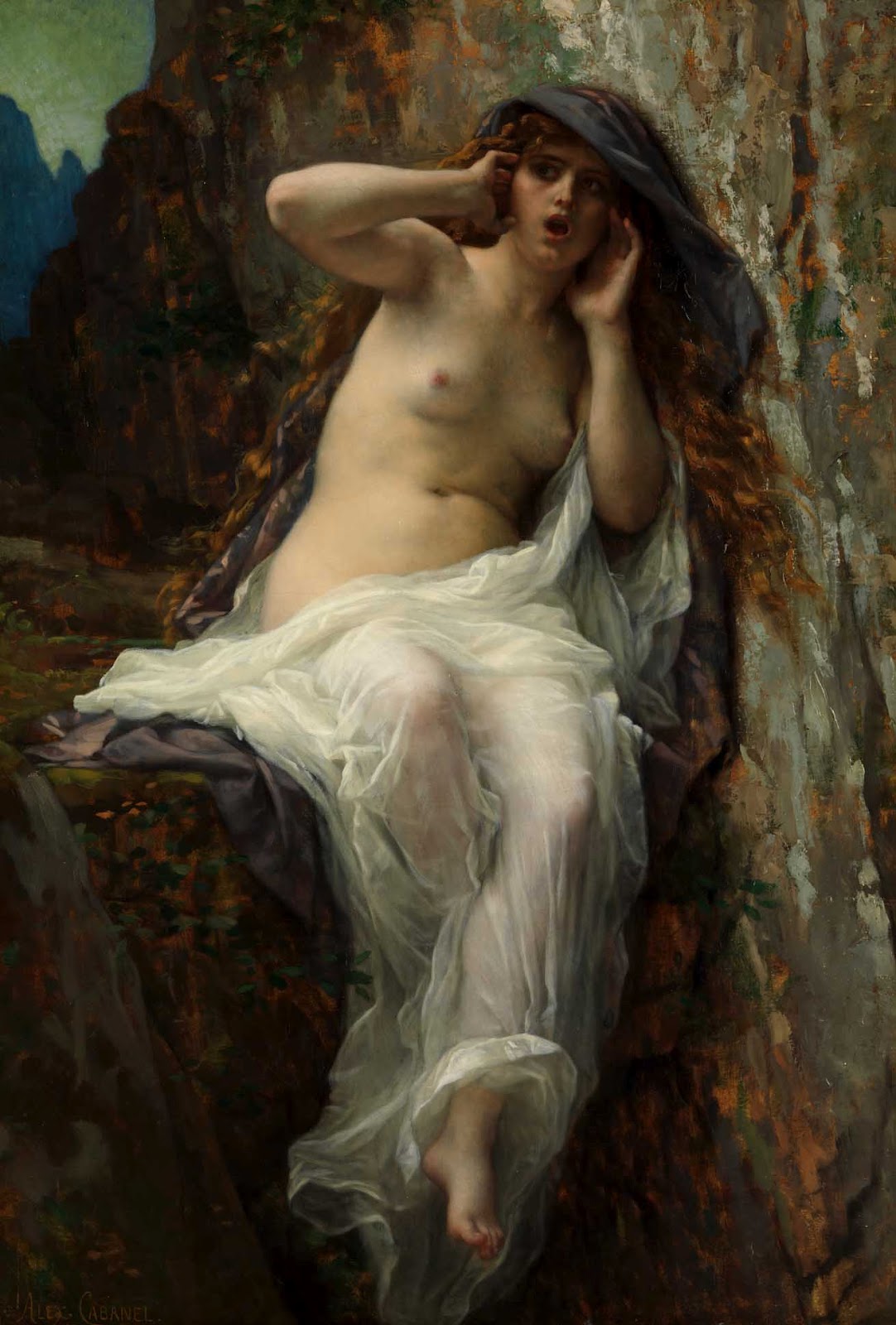
Echo
Painting by Alexandre Cabanel
Then, one day as Narcissus hunted in the forest glades, one of the Oreads, the mountain nymphs, caught sight of him for the first time. Echo was her name, and this moment would forever haunt her destiny. Poor Echo was a cursed being. For it was the sport of Zeus the Thunderer and King of the Gods to make merry with the many nymphs of the world in secret, when Hera his wife's gaze would be averted. Many times would she have caught her husband in the act were it not for stories Echo would tell her, to delay her coming. The time came one day when the deception was laid bare before the fearsome Queen of Olympus, and the roots of the mountains shivered before her fury. "That tongue, for this thy crime, which could so many subtle tales produce, shall be hereafter but of little use". Forever would the nymph be cursed, unable to speak except the words used by others. It is from Echo's name that the aural effect today takes its name. Now Echo clapped her eyes upon the perfect youth stalking the undergrowth. Young Echo was overjoyed to see Narcissus for once alone, for usually he was trailed by a vast entourage of sycophants. But, with tears of frustration, she was unable to speak and put her feelings into words.


Long did she follow him through the woods, desperate to open her heart to Narcissus. Then, at last Narcissus is aware of her presence. Turning to see her, he laughed at her pitiable obsession, and bid her turn away. Crushed by his words, the tearful Echo took to melancholic days in solitary caves, shady glades of the woods and other dark places of despair. But the vengeful goddess Nemesis was angered by Narcissus, and wove her plans of retribution:


                           " There stands a fountain in a darksome wood,
                              Nor stain'd with falling leaves nor rising mud;
                              Untroubled by the breath of winds it rests,
                              Unsully'd by the touch of men or beasts;
                              Hogh bow'rs of shady trees above it grow,
                              And rising grass and cheerful greens below... "
                                        - THE FOREST CLEARING


So fair Narcissus, weary from his long hunt, came to the forest clearing. Wiping the sweat from his brow, he knelt at the side of a crystal pool of cool water. As he bent down to splash water on his heated face, a new kind of warmth flooded through him, as he saw a being of astonishing beauty before him. Such a handsome youth, the very image of the Olympians! Sparkling eyes, hair that Apollo himself would be loath to show. So Narcissus was consumed by the fire that was his own, though he knew not who the perfect being was in truth.


Narcissus Transfixed
Painting by Caravaggio
Long did Narcissus lie there, staring into the pool, thinking not of sleep or food, as his body wasted away, entranced by the passion afire within the calm ripples. To the trees of the glade Narcissus cries, languishing for he cannot ever reach his beloved, cruelly separated as they are by the surface of the pool. "When my arms I stretch, he stretches his. His eye with pleasure on my face he keeps, he smiles my smiles, and when I weep he weeps. When e'er I speak, his moving lips appear to utter something, which I cannot hear". Then the hammer blow falls, when fair Narcissus sees the truth laid bare. "It is myself I see! The happy delusion is a part of me!" A terrible sorrow gripped the proud youth for the vanity of his desire. So totally entranced was he with his own image, he did declare "I wish him absent whom I most desire, and now I faint with grief; my fate draws nigh; in all the pride of blooming youth I die. Death will the sorrows of my heart relieve!" So Narcissus turned back to the pool, as his warm tears splashed upon the surface. Now the image is but ripples and flashes, and the boy's sorrow grows "whither dost thou fly?" he laments. The Autumn began to fade, and the glorious features began to dwindle in Narcissus's form. All those things which made him desired slipped away, but there was one nearby the pool who stood there still. For Echo could not bare to leave his side, and her tears for Narcissus flowed:


                           " She saw him in his present misery,
                              Whom, spight of all her wrongs, she griev'd to see.
                              She answer'd sadly to his moan,
                              Sigh'd back his sighs, and groan'd to ev'ry groan:
                              'Ah youth! belov'd in vain,' Narcissus cries;
                              'Ah youth! belov'd in vain,' the nymph replies.
                              'Farewell', says he; the parting sound scarce fell
                              From his faint lips, but she reply'd, 'farewell'.
                              Then on th' wholesome earth he gasping lies,
                              'Till death shuts up those self admiring eyes... "
                                          - THE FATE OF NARCISSUS


So Narcissus breathed his last, transfixed forever by his own reflection, and ever after one who possesses such vanity has been known as Narcissistic. Echo's heart was broken. Out of respect for her the other Naiads and Dryads sought to gather the boy's remains, but upon reaching the shore of the pool, found not bones and flesh there. In his place stood a stalk of verdant green, crowned with golden blossoms, that most majestic plant which now bears his name...


United Kingdom

Metamorphoses:
Metamorphoses: A New Verse Translation (Penguin Classics)
(A series of poems of Classical Mythology, written by an erudite Roman)

United States

Metamorphoses:
Metamorphoses (Penguin Classics)
(A series of poems of Classical Mythology, written by an erudite Roman)

Wednesday, 6 June 2012

The Judgement of Paris

It is a curious thing how great the influence of one person can be on the course of history. Though they may not know it at the time, one person truly can make all the difference. The Trojan War, the most iconic of its kind in history, which forever bound the great civilisations of the West, and whose heroes are spoken of in awe even today, began because of one such person. But the War (whose story begins here) found its origins in the most unlikely of places...


The Marriage of Thetis and Peleus
Painting by Hendrick de Clerck
One day, far distant in the mists of time, high on the peaks of Mount Ida, there was great jubilation. It was a joyful day, for it saw the wedding of the nymph Thetis to Peleus, a marriage which held the blessings of the gods of Olympus. Great would be their progeny indeed, for one day their union would give birth to the mightiest of champions - Achilles, whose name the world would ever after speak of in reverence. Men, nymphs, gods, goddesses and all manner of magical creatures came from far and wide to celebrate, bearing a dazzling array of gifts to honour the happy day. Even Ares, lord of war, and Artemis, chaste maiden of the hunt, were to be seen in the great ensemble. All were euphoric, the skies rang to the sound of music, and not a sad face was to be seen amid the revelry. All, that was, except for one. For, skulking in the shadows, was the only being who had not received an invitation. Looking on in cold fury at her rejection, Eris, the goddess of discord, whose evil ways had ever left her shunned amid the spirits of the world, conspired to take her revenge, and bring cruel chaos down upon the scene before her now. As she circled in the shade of the trees, she cast her thoughts to how she could bring her malevolent influence to bear. Perhaps she could spread foul rumours amongst the guests? Poison the minds of the many against their gracious hosts? Openly denounce the bridal pair? There was a dark moment, when her rage waxed grave indeed, when she considered, for one brief moment, going to the very depths of the world, to the deepest part of the Underworld, and breaking asunder the Gates of Tartarus, and so releasing the Titans from their infernal bonds, to be unleashed once more upon the world. It was a fortunate thing indeed, that her fear was too great to carry out this dark deed. Instead, her thoughts turned to discord, that thing at which she was adept at spreading above all others.

Taking a Golden Apple from the Garden of the Hesperides (of the very same tree which Heracles had once ventured to, for the story, please click here), the vengeful goddess inscribed upon it "For the fairest". Never before or again would one sentence bring such ruinous calamity upon the world. Eris, proud of her stratagem, took careful aim, hurling the fruit into the midst of the dancing goddesses. All were amazed at the shining seed now before them, but none more so than three of the greatest goddesses - Hera, Queen of the gods, Athena, goddess of wisdom and war and Aphrodite, goddess of lust. From the moment they set eyes upon it, each goddess claimed the Apple for their own. As discord and argument soon spread as to who should rightfully bear the fruit, the three goddesses turned to Zeus, King of all the gods, to judge himself. Knowing well the undying wrath he would earn from the two he did not choose, the Thunderer wisely refused. To a mortal man should fall this mighty burden, the god ruled, as he thought to himself who this soul could be.

There was, not far away on the slopes of Mount Ida, a young man tending his flocks as a faithful shepherd. But this man was no ordinary shepherd. Named Paris, he was an exile of royal blood, cast out of his homeland whilst still a baby. For long ago, the boy's mother, Queen Hecuba of the royal house of Troy, had experienced a terrible nightmare. Just before her son's birth, she saw a vision that she would give birth to a flaming torch. When she awoke with a start, she confided in her husband, King Priam. Priam decided to consult an Oracle as to what this strange portent could mean. The seer Aesacus, when the royal couple retold their worries to him, was gripped with anguish. The child that the Queen would soon bear, the prophet declared, would be the ruin of Troy. The seer urged them to kill the child as soon as it was born, and save Troy from her doom. The day came, however, when Paris entered the world, and from the moment Hecuba and Priam looked upon him, they could bring no harm upon their own flesh and blood. Despairing, Priam handed the child over to Agelaus, his chief herdsmen, to take him away. The shepherd took the young Paris far from Troy's towering heights, but as a he too looked upon the baby, he found that he could not bring himself to slay a child. Vowing to raise the child as his own, he took Paris into his care, where the two lived happily, with a simple life upon the slopes of Mount Ida. It was to Paris that the goddesses of Olympus came now, forever to change his destiny, and that of the world.


The Judgement of Paris
Painting by Rubens
It was with great fear that Paris beheld the sight of Hermes, messenger of the gods, bearing down upon him on that fateful day. " Fling away thy milking-pail and leave thy fair flocks and come hither and give decision as judge of the goddesses of heaven. Come hither and decide which is the more excellent beauty of face, and to the fairer give this apple’s lovely fruit ", the swift footed god declared. Paris stood, transfixed, hardly daring to question, even less refuse the command of Olympus. In a flash of blazing glory, the three goddesses appeared suddenly before him, in all their divine majesty. One by one, the goddesses approached, Athena, lady of war and wisdom first:

          " Come hither, son of Priam! leave the spouse of Zeus and heed not Aphrodite,
            queen of the bridal bower, but praise thou Athena who aids the prowess of men.
            They say that thou art a king and keepest the city of Troy. Come hither,
            and I will make thee the saviour of their city to men hard pressed:
            lest ever Enyo of grievous wrath weigh heavily upon thee.
            Hearken to me and I will teach thee war and prowess! "

Then came Hera, regal mistress of Olympus:

         " If thou wilt elect me and bestow on me the fruit of the fairer,
           I will make thee lord of all mine Asia. Scorn thou the works of battle.
           What has a king to do with war? A prince gives command both to the valiant
           and to the unwarlike. Not always are the squires of Athena foremost.
           Swift is the doom and death of the servants of Enyo! "

Finally, there stood Aphrodite, folly of all men, who simply looked Paris in the eyes, smiling, as she began to speak:

      " Accept me and forget wars: take my beauty and leave the sceptre
         and the land of Asia. I know not the works of battle.
         What has Aphrodite to do with shields? By beauty much more do women excel.
         In place of manly prowess I will give thee a lovely bride, and, instead of kingship,
         enter thou the bed of Helen. Lacedaemon, after Troy, shall see thee a bridegroom! "


Helen
Painting by Evelyn de Morgan
Little did Paris, or the other deities assembled know, that Aphrodite wore a girdle infused with a powerful enchantment. No man which looked upon its wearer could resist base temptation. Still did the words flow from Aphrodite as the son of Priam already offered the Apple to her. Triumphant, Aphrodite raised her glittering prize, mocking her competitors mercilessly. Athena was angered, but it was nothing compared with the fury of Hera. For from this moment the House of Troy and all her descendants had made an eternal enemy of the goddess, and her curse would plague the destiny of the Trojan race. Aphrodite turned to Paris, placing her blessing upon him, declaring that he had the heart of the most beautiful woman in the world. Her name was Helen. With this promise, the goddesses departed, leaving Paris severely shaken. All he could think of now was Helen, far away in the distant lands of Greece. Unable to turn his thoughts anywhere but to her, he resolved to seek her out. Little could he know now the whole world of pain that this decision would unleash...


United Kingdom

Colluthus:
Oppian. Colluthus. Tryphiodorus (Loeb Classical Library)
(The most poetic, and best preserved form of the story)

Colluthus:
http://www.theoi.com/Text/Colluthus.html
(A sample available to read online)

United States

Colluthus:
Oppian, Colluthus, Tryphiodorus (Loeb Classical Library No. 219)
(The most poetic, and best preserved form of the story)

Colluthus:
http://www.theoi.com/Text/Colluthus.html
(A sample available to read online)

Wednesday, 4 April 2012

The Stolen Hammer

Sometimes, it was not just mortals who had to go to incredible lengths in the name of honour. Sometimes, even the gods themselves were forced to endure shame and indignity for a greater good. One famous example of this was the time when the Hammer of Thor, son of Odin, god of Thunder and powerful deity of the Norse pantheon, was stolen...


Mjöllnir
Amulet discovered in Skåne, Sweden
One day, high in the golden fields of Asgard, there was great consternation. For it was that Thor, mighty among the Aesir, had awoken to his greatest fear. As he rose from his bed, he discovered to his horror that Mjöllnir, his legendary Hammer, was no where to be found. The Thunderer let out a shout of rage which shook Valhalla to its very foundations. For Mjöllnir was no ordinary tool of war. Forged by the dwarves deep in their earthly forge (for the story of this, please click here), the thunder god's hammer was more powerful than any other weapon in the cosmos. So great was the Hammer's power that only one who wore megingjörð, the belt of hyper strength, and the Járngreipr, the gloves of iron, could wield it. Understandable, therefore, was Thor's anguish. Roused by the thundering bellow, Loki, the scheming and deceitful ally to the Aesir, came before the dismayed son of Odin. Desperate now, Thor turned to Loki and said:


             " Listen, Loki, to what I am saying,
               what no one knows neither on earth
               or in Heaven: the Hammer of the God is stolen! "
                             - THOR'S PLEA


Freyja
Painting by Nils Blommér
Delighting in chaos, as ever he did, Loki heard Thor's call. The trickster soothed Thor, assuring him that he would look for it. Without delay, both made leave for the goddess Freyja. Renowned throughout the Nine Worlds for her beauty, Freyja was the envy of ladies of every race. Loki bowed to the fair goddess, and asked of her the exquisite cloak of feathers which she possessed, an enchanted artifact which could change the form of any being to an eagle. "I'd give it to you even if it were made of gold", she replied at once, handing the magical plumage over. In a flash, Loki drew the cloak around his shoulders, and in an instant, spread forth his elegant wings, and soared into the sky. On and on he charged through the skies, past the boundaries of the divine house, past the golden plains, past the boundaries of Asgard itself. Soon, the airborn deceiver circled Jötunheim, the cruel land of snow and ice, home of the Jötunn, the fierce race of frost giants (for more on this race, please click here). This was a land hostile to gods, for the giants and the Aesir were locked in perpetual war, but Loki, himself half giant, could enter where gods could not (for more on Loki's past, click here). Spotting a giant from a great distance through his aquiline eye, Loki made haste toward his fellow Jötunn. The giant Thrym, King of Jötunheim, sat high upon a grave mound, tending his monstrous flock. Loki, in uncharacteristic urgency, demanded to know the location of the Hammer, suspecting as he did the evil machinations of the Jötunn. Triumphantly, Thrym replied:


          " I have hidden Thor's Hammer
            eight leagues under the earth;
            no man will ever take it back again,
            unless I am brought Freyja as my wife "
                           - THRYM'S TAUNT


Elated that the location of the Hammer was known, Loki sped forth to return to the Aesir's Halls, unknowing of the indignity of the words he was to bear. The son of Odin leaped to his feet at the approach of the trickster, and leaped higher still when Loki told him of his beloved Mjöllnir. Both friends came once again before fair headed Freyja, and told her of their plight. Snorting in rage, Freyja furiously refused Thrym's request, suffering not the dishonour of living as a Jötunn's bride. Fair though her decline was, great was Thor's dismay. Summoning the Aesir to their glorious array, the Thunderer put forth his ghastly plight. Silent were the words on the Aesir's lips, when out spake far sighted Heimdall, watchman of the gods:


          " Let's dress Thor in a bridal head-dress,
             let him wear the necklace of the Brisings.

             Let keys jingle about him
             and let women's clothing fall down to his knees,
             and on his breast let's display jewels,
             and we'll arrange a head-dress suitably on his head! "
                             - HEIMDALL'S PLAN


Loki conceals Thor
Engraving by Carl Larsson
At once, the Thunderer leaped up in rage. Such outrage! Such indignity! The mightiest of the war gods, dress as a woman! The shame would be the end of him. Then out spake Loki, whose mischievous words were cloaked in honey. He too would don a maid's attire, so that he would not be alone. Only Thor alone could wield Mjöllnir, no other god could lift it. Thor, seething with fury, saw wisdom in Loki's words, and thought only of the Jötunn who would pay. All too conscious of his powerless state, Thor bade the Aesir dress him without delay. Not a moment passed, and both friends made haste to Jötunheim.

King Thrym was overjoyed at the sight before his eyes, and could scarcely believe his good fortune. The two maidens were welcomed into the royal halls, whence forth a magnificent banquet was soon laid. The Jötunn gathered from far and wide for the union of their mightiest kin and fairest god, little aware of the bride's true veil. The night drew in, the fires roared and the places were set. There at the head of the high table sat the king of the giants and his apparent bride. Thor, who had a godly appetite, soon devoured his way through many a plate of roasted meat, oblivious as he was to the countless eyes upon him. The king of the icy realms looked on bewildered, but quick thinking Loki allayed his fears. "For eight days and eight nights the lady has not eaten, so excited was she at the thought of marriage to thee", the trickster explained. Delighted at this, was the king of giants and merrily he beckoned forth more plates. The revelry went on into the night, and when the wine began to take its dark effect, King Thrym leant in to embrace his new wife. A flash of crimson darkened Thor's eyes, as the Thunderer's anger grew, and the Jötunn saw it. Cunning Loki struck up once more, "For eight days and eight nights the lady has not slept, so excited was she at the thought of marriage to thee". The cruel king once again was elated at this news, and the merriment grew. The king of the frozen peaks called for silence to the gathered crowd, and beckoned a servant to enter the hall.

In he came, bearing the most splendid gift fit for the finest of brides, and there, seated upon opulent cushion, was the mighty Hammer of Thor. At the king's command, the gift was laid upon the knees of his bride, and the hall looked on eagerly. A dark smile passed over the bride's face. His moment come at last, the son of Odin tore his veil asunder, seizing the haft of Mjöllnir. A flash of lightning, his true identity revealed, and the Jötunn saw their fate sealed. With a roar that rocked the cosmos, the Thunderer took up the Hammer, and with every muscle in his swing, did verily spare not one thing. A ripple of fear gripped the room, but nothing could save them from their doom...

United Kingdom

The Poetic Edda:
The Poetic Edda (Oxford World's Classics)
(A sizeable collection of stories, telling many of the myths of Norse Mythology, each in a short and accessible poem)

United States

The Poetic Edda:
The Poetic Edda (Oxford World's Classics)
(A sizeable collection of stories, telling many of the myths of Norse Mythology, each in a short and accessible poem)