Showing posts with label Hades. Show all posts

Wednesday, 14 August 2013

Hyacinthus

Envy is a terrible thing. It tears friendships asunder, levels cities and topples nations. An emotion the gods of the pagan world were no less susceptible to than their human subjects. Mortality was never a barrier to jealously, as the curse to never be content with one's lot in life afflicted the Olympians as much as men. Sometime the gods even envied their own worshippers. Here is the story of one.


Zephryus the West Wind
Painting by William-Adolphe Bouguereau
Long ago, before the high days of ancient Greece, in the days before even Agamemnon the High King, the city state of Sparta was in its infancy. Long before the days when Spartans reigned inexorable on land, the richly destined city was little more than a village, deep in the valley of the Eurotas in the shadow of Mount Taygetus. King Amyclas ruled over a modest realm of simple folk, pious and rustic. One day a boy was born to the royal house of Sparta, Prince Hyacinthus was his name. Joy erupted in verdant Sparta, and Spartans far and wide flocked to catch a glimpse of the handsome Prince. Spartan mothers were swift to sing the praises of the boy's beauty, Spartan fathers of the strength in his arms. Not even the Olympians were blind to the event, all celebrating the birth of such a fine heir, and the great grandson of Zeus the Thunderer himself. The spirits of the cosmos were no less taken, and one above others, Zephryus the lord of the West Winds. In the days of the Classical World, it was the societal practice for an older man to take a young boy under his wing, and teach him the ways of the world, free from the constraints and biases of the boy's family. No less so at Sparta, renowned for this custom. The West Wind took a shine to the boy, and moved to greet the Prince.


Apollo & Hyacinthus
Painting by Jean Broc
But it was the golden rays of the Sun which smiled most fondly upon the Prince. Apollo the keen eyed archer, father of the arts, was smitten at once with the Spartan Prince, and moved without delay. "Phoebus Apollo for thee too, Hyacinth, design'd a place among the Gods, had Fate been kind...". In Hyacinthus Apollo 'plac'd his Heav'n, and fix'd his joy". The Sun shone brighter than ever before on the golden valley of the Eurotas, and the Spartans bathed in warmth. The god's hands forgot the string of the bow and chords of the harp, as Apollo's mind was turned to the Spartan Prince. All the while the West Wind blew a gentle breeze, Zephryus pursuing young Hyacinthus, eager to take the boy under his celestial wing. But young Hyacinthus, awed by the light, turned to Apollo of the golden mount. Phoebus Apollo was overwhelmed with joy, delight that his should be the fate of the Spartan Prince. Meanwhile Zephryus lurked in despair and grief, soon to turn to envy and wrath.


Sunlight flooded Eurotas, as Apollo and Hyacinthus ran in the ancient plains. The wisdom of a god Hyacinthus gained from Apollo, the innocence of youth Apollo from Hyacinthus. Then came a day, a day of days, when Hyacinthus was old enough to learn the ways of a man. To the young Prince Apollo yearned to teach the feats of the martial body and of athletic glory. To the noble sport of the discus the sun god turned, a majestic sport for a Spartan boy, to build good strength and competitive spirit. Hyacinthus marvelled at the golden disc, as though the Sun obeyed Phoebus in his hand. Apollo bade the boy watch him well, and took a deep breath and poised for the throw. Divine sinews groaned, and godly muscles unfurled for the feat. With a cry,

 " A well-pos'd disk first hasty Phoebus threw,
   It cleft the air, and whistled as it flew;
   It reach'd the mark,a  most surpising length;
   Which spoke an equal share of art, and strength.
   Scarce was it fall'n, when with too eager hand
   Young Hyacinthus ran to snatch it from the sand... "
          - APOLLO'S DEADLY THROW

The Death of Hyacinthus
Painting by Giovanni Battista Tiepolo
Awed by the supernatural throw, swift footed Hyacinthus ran in pursuit, eager to fetch the discus for his master. To the young Prince the sun god called, but in vain, for Hyacinthus alas could not be swian. Zephryus the Western Wind, his jealousy raw, took a deep breath and blasted raw. The wind then blew the discus from the straight and true, and Apollo looked on, helpless as the mighty disk, flew now a weapon of death. The metallic star slammed into Hyacinthus' head, and with a scream of final innocence, the boy fell to the land, never to rise again. The West Wind smiled in spiteful malice. Apollo shouted in disbelief, and ran over to the dying youth. The coldness spread through the Spartan Prince, and the light left his eyes, as Phoebus Apollo raised his head to the stars and wailed his grief. Taking the nearby herbs of Taygetus, he to the lethal wound vainly applied. "The wound is mortal, and his skill defies". Just as a wilting lily lowers its head, so too now Hyacinthus bowed to Death.

But Apollo would not his Fate accept. "O thou art gone, my boy, Apollo cry'd, defrauded of thy youth in all its pride!". Not now would Hades take his fill, not from so fair a spirit so cruelly snuffed out. "On my tongue thou shalt forever dwell; thy name my lyre shall sound, my verse shall tell". In that moment the sun gods power the young body transfigured. Youthful Prince white in the clutches of Death no more, now a beautiful flower, as yet unnamed, blood from the fatal wound, its petals coloured, mingled with the tears of the god of the Sun. Forever, Apollo decreed, would it bear the boys name. The flower we call Hyacinth today...


United Kingdom

Penguin Classics
Metamorphoses: A New Verse Translation (Penguin Classics)
(A version which favours ease of understanding than high poetry)

Oxford World's Classics
Metamorphoses (Oxford World's Classics)
(A version which favours ease of understanding than high poetry)

United States

Penguin Classics
Metamorphoses (Penguin Classics)
(A version which favours ease of understanding than high poetry)

Oxford World's Classics
Metamorphoses (Oxford World's Classics)
(A version which favours ease of understanding than high poetry)

Wednesday, 10 April 2013

Orpheus and Eurydice

The son of the Thracian King Oeagrus, Prince Orpheus, seemed to many who met him an unremarkable man, neither tall of stature like Hercules, nor divinely handsome as Adonis. He was not a renowned warrior, as Achilles, or even notably silver tongued as Odysseus. The son of a King, and the Muse Calliope, Orpheus did however possess two qualities so rare in the great men of his time. For the Thracian Prince was blessed with a heart of gold, and was gifted lyre player, a trait handed down from his mother and grandfather - the god Apollo. Both of these things would be his greatest asset, and his ultimate ruin...


Orpheus serenades the Nymphs of the Forest
Painting by Charles Jalabert
While the lyre was the creation of the god Hermes, it was Orpheus who perfected it. As a young child Apollo gifted his favoured grandson with a lyre of burnished gold, and his mother, the patron of lofty poetry, taught him many a verse of heroic lore, and the Prince set it all to heart-warming music. Any doubts old King Oeagrus may have had at his son's disinterest in military pursuits were at once silenced the moment young Orpheus began to play, for the hearts of the King and all his court were moved by the heavenly notes. Many a summer's afternoon would young Orpheus spend in the wild forests of Thrace, his refuge of body, his music, his sanctuary of mind. Oblivious he was too, to the enchanting power of his tunes. The nymphs of the forest lay all around, entranced by the Prince's songs, as they had been for his brother Marsyas. The beasts of the glades, boars, wolves and the like all stood alert and spellbound. Even the stones of the forest floor lent their attention to the sound that soothed the air, such was the power of the music that Orpheus created. The Prince's quiet life, however, did not endure for long. As a young man, Orpheus volunteered to join Jason and his fellow Argonauts on their arduous quest to the ends of the Earth for the Golden Fleece (a story which shall be told in the future on this site). The crew of heroes, including mighty Hercules himself, grew to respect and admire Orpheus, whose humble demeanour and beautiful compositions came to their rescue on many an occasion when morale was low, saving the lives of the whole crew when faced with the deadly Sirens.


When at last the voyage was over, Orpheus returned a grown man to his native Thrace, desiring a quiet life as of old. He soon grew to care for a nymph, Eurydice, a spirit who once admired his songs deep in the forest. Over time both Orpheus and Eurydice became deeply attached to one another, and the Prince was overjoyed when she agreed to wed him. The day arrived, and it was wondrous to behold, such was the array of beings present. Apollo made the rays of the Sun touch all the fields and faces that day, his grandson's wedding day. In their tens and hundreds the dryads and naiads marched forth from their abodes, bedecked in garlands and fine robes. It was a happy day, and even high on Olympus the joy was felt. Alas that such calamity would strike utopia that day. In the commotion and revelry, a drunken Satyr chased the bride through the party. Eurydice, surprised, fled into the fields, but ruinous was her fortune. Into the long grass of the meadow she fled. She turned to try and catch a glimpse of her pursuer, but in that moment she felt a lethal pain in her foot. She screamed and looked for the source of her doom. There at her feet, a viper. A glance she stole at Orpheus, face white with raw terror, before death moved to claim her on her wedding day.


The River Styx
Painting by Joachim Patinir
Devastation was the mere beginning of feeling which struck Orpheus now. Holding her close to him, he grieved terribly, and the whole world grieved with him. Shattered as a man, for an age after, a new song pierced the air, but it was not the tune of joy which touched the soul, it was a lament, a tearful mourning indeed. The spirits of the forest could restrain their pity no more. His heart afire with longing and despair, Orpheus refused to accept his loss of Heaven. At the urging of the nymphs, he decided to take the dark road to Hades himself and plead for mercy. So the Prince set off on his morbid journey, one fraught with danger. Seldom had a mortal ventured into the land of the dead and ever seen the light of day again. But even the hearts of the gods on high were with him that day. At his approach, fearsome Cerberus skulked away in the darkness at the gates of death. Eerie silence fell on the Prince's ears. Such a heavy silence the greatest musician in the world had never before heard, and it saddened him. Taking out his lyre, he did the only thing he knew, he played. Even the monstrous guardian of Hell was soothed by the song, and allowed his passage. Charon, the ferryman of the dead, taking pity too, granted him a journey across the River Styx, the true boundary between the Overworld and Hades. The smell of decay grew overwhelming, and at last, to the throne room of the god of the dead himself he came in humility. Hades and his Queen Persephone were astonished at the sight of the broken man, his robes defiled with filth and tears, and heard his call.


Orpheus came forth and spake his mind, "I come not curious to explore thy domain, nor come to boast... My wife alone I seek, for her sake these terrors I support, this journey take". The gods high on Olympus, powerless in the abode of death, wept for Orpheus. The Prince, wavering at the fearsome gaze of Hades, continued:


             " A hope within my heart prevails...
               Let me again Eurydice receive,
               Let Fate her quick spun thread of life re-weave...
               She, when ripen'd years she shall attain,
               Must, of avoidless right, be yours again:
               I but the transient use of that require,
               Which soon, too soon, I must resign entire... "
                  - ORPHEUS' PLEA TO HADES


Orpheus leads Eurydice
Painting by Jacopo Vignali
The Prince's fingers moved toward his lyre, he couldn't help it, it was his only solace now. He began to play, and even the bloodless shades of the dead turned to see. Far in Tartarus,  Sisyphus laid down his mighty burden to listen, far above Ixion squirmed for a glance, and away in the pool Tantalus forgot his hunger and thirst. Even the vengeful Furies relaxed their snarls, tears stinging their ferocius cheeks. The hand of Queen Persephone tensed. Too well did she know what it was like to be torn from a dear one. To her husband, the lord of death did she intercede, asking pity this one time. Not even the cold heart of Hades remained unmoved that day. To the grieving Prince the son of Kronos turned, and declared that he would grant his wish, and restore Eurydice to life, but upon one condition. The rules of the cosmos were absolute - Hades commanded Orpheus to return to the Overworld, but until both he and Eurydice had crossed the threshold of the land of the living, he was forbidden to look behind him into the deadlands. If he did, the pact would be forfeit, and he would lose Eurydice forever. The Thracian Prince nodded gently, and Hades snapped his fingers. A troop of deathly shades approached from the darkness, bearing in their midst the shadowy form of the his beloved. Wincing slightly from the deadly bite, she stopped perfectly still at the sight of her Prince, joy spreading through her body, reviving now with breath, though as yet unable to speak. It was as though her wretched misfortune had never befallen her, as Orpheus, crying with joy, moved to embrace her. Alas they passed through her, for the ritual was not yet complete. Thanking the dead god and his Queen from the deepest chamber of his heart, Orpheus bid Eurydice come with him quick before the Sun set that day, so they might enjoy anew an evening upon the Earth. Leading the way Orpheus put his first foot upon the deathly stairs, rising high above the Halls of Hell.


Immediately his resolve was tested to breaking point, such was his desire and the temptation to look behind. Lost and again found, alas that he was forbidden to look back at his beloved and that he must lead the way!

   
                     " Now thro' the noiseless throng their way they bend,
                       And both with pain the rugged road ascend;
                       Dark was the path, and difficult, and steep... "
                              - ORPHEUS' ESCAPE


Orpheus found the dread silence agony to bear, unbroken by song. For the laws of the cosmos decreed it easy for a man to enter the realm of the dead, but far harder to leave, and both hands did the Prince require on the ascent. As the sweat poured from his brow, he fought his urge to turn and assist, terrified of breaking his oath. He called to her, naught but heavy silence replied. Not until restored fully to life would breath pass her lips again. Trying desperately to cast his thoughts away from horrid visions of his beloved lost far below in the darkness, Orpheus continued his climb.


Eurydice lost
Painting by Christian Gottlieb Kratzenstein
At last, after what seemed days of silent struggle, the black shroud seemed to ease all around. Colour could be seen again, and the harsh, jagged rocks around the tunnel. They seemed as teeth of the jaws of some infernal beast, binding the dead within that realm, never to leave. Orpheus' excitement grew - at last, redemption lay just over the crest! For hours and hours he toiled against the rock, alone to his ears. As the light grew, hand in hand with it walked his paranoia. Was Eurydice still there? Had Hades deceived him? The desire to look grew painful to resist. With every reserve of will, Orpheus forced his head forward. Up and over the last precipice, the rays of the late afternoon Sun struck his forehead, embracing him with their reassuring heat. Ecstatic, he hauled himself up and over, and rushed into the cool air, blazing with light. In that moment his happiness was absolute, unbroken and willed to live for ever. Puzzled he was, however, when the cry of freedom at his side he could not hear. Doubt racked his mind again - was she there? He wheeled around, seeking Eurydice. There she stood after all, she had followed him all the way from the root of the Earth, but something was amiss. He glimpsed her fair face, near full again, but the expression upon it he would never forget. White as snow, a look of terror on her face, a visage to freeze the soul. The joy of Orpheus stopped dead in its tracks. Cold dread flooded every inch of him, as he saw too late his folly. A mere footstep it was from the mouth of the Underworld his beloved stood. Behind it. His legs and arms began to shake, a soft no all he could utter, and his eyes welled up. The word of Hades rang in his ear, and for the second time Death claimed Eurydice, this time for good. One last look of hopeless longing she gave him, before the darkness took her spirit, as Orpheus fell to his knees...


United Kingdom

Penguin Classics
Metamorphoses: A New Verse Translation (Penguin Classics)
(A version which favours ease of understanding than high poetry)

Oxford World's Classics
Metamorphoses (Oxford World's Classics)
(A version which favours ease of understanding than high poetry)

United States

Penguin Classics
Metamorphoses (Penguin Classics)
(A version which favours ease of understanding than high poetry)

Oxford World's Classics
Metamorphoses (Oxford World's Classics)
(A version which favours ease of understanding than high poetry)

Wednesday, 14 December 2011

The Seeds of the Pomegranate

Myths have, in so many civilisations, sought to explain what science could not. As science evolves, so too do myths. For man today ever seeks to understand the world in which he lives, no less than the man of three thousand years ago. One such phenomenon in nature was the changing of the seasons, a thing so critical to man's bond with the land. Here is one such story of how the seasons came into being.


Demeter
Photograph taken by Marie-Lan Nguyen
Sculpture in the Vatican Museums
One of the quieter goddesses, Demeter yet held a honoured position on Mount Olympus. She remained, after all, the sister of Zeus himself, and a daughter of Kronos, greatest of the Titans (for the story of their birth, please click here). Whilst her illustrious brothers reigned at the forefront, diligently watching over the affairs of man and the deeds of heroes, Demeter took a quieter role in the cosmos. For she was the lady of the harvest, to whom all men prayed to grant abundance to their crops. In these most ancient times, the bounty of the Earth was great all year round, as bushels of corn burst forth from the fields each day. There was, however, one thing Demeter treasured above all else. Persephone, her daughter, was renowned throughout the world as a paragon of beauty. Where mother and daughter walked, the sun shone brightly, flowers bloomed, the grasses rippled in the gentle breeze and the maize swelled at their fertile touch. Many gods had sought her favour, but Demeter had refused all suitors to Persephone. One god, more than any other, grazed by Cupid's arrow, was transfixed by her. His cold and dark demeanour could not have been further away from the sun drenched world above. For he was Hades, the god of death and lord of the Underworld, who rued the grisly world gifted to him at the Creation. His divine flesh was tinged with a sickly pallor, deprived of sunlight far below the surface of the Earth, and the light of life was far distant from his eyes. But longingly did he look upon Persephone.


Enna
Photograph taken by Massimiliano Canale
One day, Hades could endure the torment no longer, and came before Zeus, high on Mount Olympus. The Thunderer, surprised to see his brother in the Overworld, was stunned to see the anguish upon Hades' face. The god of the dead bowed before Zeus, and implored him to grant Persephone to him so that she could be his wife. The King of the gods was troubled by this request. For Persephone was also his daughter (incest being an alas regular occurrence in Greek Mythology), and she would never forgive her father for sending her to the dank depths of the Underworld. What was more, Demeter would never allow it, having spurned so many other deities before. Yet Hades was his brother, and he had no wish to offend him. What then, was the King of the gods to do? Torn by his duties, Zeus resigned to neutrality, neither granting Hades' wish, nor denying it, sending his brother away while he deliberated. Time passed, and the lord of the dead grew restless in his black abode. If Zeus had not forbidden it, then he must be allowed to, he thought. His patience gone at last, Hades resolved to take Persephone himself.


Hades seizes Persephone
Painting by Nicolò dell'Abate
Meanwhile, far above on the golden meadows of Sicily, Persephone and her handmaidens were dancing in the rolling fields. Revelling in the summer bloom, the goddesses were picking flowers near Enna, for a magnificent garland. Just then, Persephone noticed the particularly vibrant petals of a narcissus. Leaning over, she clasped the flower. As her soft fingers closed around the stem, a deafening roar shook the Earth. The goddesses screamed and jumped back in fear, for before them a vast fissure had torn the Earth asunder, a pit to the black abyss. Bursting forth from within came the god of the dead himself, in all his deathly glory, on a mighty chariot pulled by four towering black steeds. With a strength belying his ghostly complexion, Hades seized Persephone by the waist and took her into his chariot. With a crack of the whip, the god made haste, and hurtled back to the blackness of the abyss, as the handmaidens looked on, paralysed with shock and terror. The gaping maw of the chasm pulled shut with a roar, and the gateway between this world and the nether world sealed. Where once there was song, only silence prevailed.


Demeter, as yet unaware of Persephone's fate, called out to her daughter. When no reply came, she called again and again. Confused, and worried, the lady of the harvest looked, but did not find. Soon her worry turned to fear, as she could find her nowhere. Across the land she frantically searched, but no trace of her was to be found. For nine days the goddess searched, oblivious to hunger and fatigue. Distraught, soon Demeter found Persephone's belt, lying where she had been seized.


  " When she saw the gate-keepers fled, the house unguarded,
     the rusted hinges, the overthrown doorposts, and the miserable state
     of the silent halls, pausing not to look again at the disaster,
     she rent her garment and tore away the shattered corn-ears along with her hair.
     She could not weep nor speak nor breathe and a trembling
     shook the very marrow of her bones; her faltering steps tottered... "
                              - THE GRIEF OF DEMETER


Weeping, and angry, soon she neglected her duties as goddess of the harvest. Crops failed throughout the land. The grass withered and dried, green became brown, and maize became empty husks.  Wherever she trod, desert spread. Soon cattle, stricken with famine, collapsed in the barren fields. Mankind began to suffer too. Starving, soon people felt death's stricken hand drag them down to the House of Hades. The other gods came to Demeter and begged her to release the world from the deadly grip it was now locked in. But their pleas fell upon deaf ears, for Demeter thought only of  finding Persephone. Crying with frustration, Zeus ordered Hermes, the messenger of the gods, to travel down to Hades' realm, and release Persephone from the dark god's grip.


The Abduction of Persephone
Photograph taken by Steffen Heilfort
Meanwhile, deep in the depths of the Underworld, Persephone lay, a sad and melancholic shadow of her former self. Hades tried in vain to bring her round, and reconcile her with her new life, showing her the wealth that lay below the ground. The god of the dead held a large banquet to celebrate their wedding. Just as Persephone, resigned to her torment, placed her hand upon a pomegranate before her, a blinding light flashed throughout the darkness. Hermes appeared, in all his divine glory, commanding Hades to release his new bride. The dark god dared not disobey a direct order from Olympus, and reluctantly set her free, but with an odd indifference. Puzzled by the ease with which Hades handed her over, Hermes nevertheless took flight upon his winged sandals, bearing the new Queen of the Dead high to Olympus' lofty heights.


The Return of Persephone
Painting by Frederic Leighton
A storm of cheers raised the heights of the Divine Mountain as Persephone tentatively stepped into the banqueting hall, with the array of gods enthroned before her. With a cry of exultation, Demeter threw herself forward and embraced her daughter, tears of joy rolling down her fair cheek. All seemed well at last. The rains came, the drought subsided, and the crops grew plentiful once more. But then, at the moment of triumph, came forth the god Ascalaphus. A servant of Hades, who yearned for favour from his dark master, Ascalaphus, with a look of savage pleasure on his face, informed the assembled crowd that since Persephone had eaten the food of the Underworld, she was forbidden to leave it. The joy broke to silence. Jolted to the very core, Zeus realised he was right. The laws of the Fates were absolute, for it was indeed the law that any who took the food or drink of the Underworld was condemned to spend an eternity there. Persephone broke down in tears, for in her absent minded grief, she had eaten four seeds from the pomegranate at Hades' table. Demeter rounded on Ascalaphus in fury, and in her anger turned him into an owl, and he was forever banished from the domain of the gods. Pleading at the feet of Zeus, she begged the Thunderer for help. The gods debated long into the night. If the Fates were defied, the cosmos would be overturned in Chaos. But if Persephone could not be free, man would, for a second time, be hurled headlong into the grasp of death.

Dawn arrived. Demeter came before Zeus, awaiting his verdict with terror. Torn by inner conflict, the Thunderer decreed that since Persephone had eaten four seeds of the pomegranate, for four months of the year she would dwell with Hades in the Underworld. For the remaining eight, however, she was free to return to the Earth. So ever after, for much of the year the world was bathed in light and burdened under the fruits of the trees. As Persephone's time in Hades approached, Demeter grew sad again, and the land turned a shade of brown, and leaves began to fall from the trees, bringing Autumn. When Persephone descended to the Underworld, Demeter's grief was absolute, and the world was shrouded in white, and ice spread her glittering sheets across the land, bearing Winter. So the comings and goings of the seasons were born...

 United Kingdom

The Library of Mythology:
Apollodorus - The Library of Greek Mythology
(A vast collection of the myths of old Greece, written in ancient times, and a great intro)

The Theogony:
Hesiod - Theogony and Works and Days
(A tale of the beginning of the world, and the creation of the gods, briefly mentioning this story)

The Rape of Proserpina:
Claudian - The Rape of Proserpina
(Here is a link to a poetic retelling of the story, for the adventurous!)


United States

The Library of Mythology:
Apollodorus - The Library of Greek Mythology
(A vast collection of the myths of old Greece, written in ancient times, and a great intro)

The Theogony:
Hesiod - Theogony and Works and Days
(A tale of the beginning of the world, and the creation of the gods, briefly mentioning this story)

The Rape of Proserpina:
Claudian - The Rape of Proserpina
(Here is a link to a poetic retelling of the story, for the adventurous!)

Wednesday, 7 September 2011

The Redemption of Heracles

With one last task standing between Heracles and his ascension to godhood, the mortal hours of the son of Zeus were numbered. Since the curse of Hera eight long years ago, the hero had toiled endlessly in the service of King Eurystheus, travelling far and wide, and facing some of the most terrible creatures which walked the earth (for the previous episode in this saga, please click here). Having thoroughly proved himself on the mortal plain, just one arena remained to be overcome...


Cape Taenarum today
Photograph taken by 'Eliasar'
Having travelled to the furthest boundaries of the Great Ocean, deceived the mighty Atlas and borne the divine Apples of the Hesperides to Tiryns, the contempt Heracles had all along received from Eurystheus was at last turning to reverence. The last enemy that remained to be conquered was death itself. For his final Labour, the King declared that Heracles must descend into the land of the dead, and bring the hound of Hades himself, Lord of the Dead, before him. The beast which guarded the gates to the inner sanctum of the Underworld was no ordinary dog, however. For Cerberus was another of the vile brood of the monster gods Typhon and Echidna (for their role in the Creation, please click here), and brother to such beings as the Hydra, the Lion of Nemea, the Chimaera and the hell hound Orthus. Gigantic in stature, triple headed (some tales speak of a hundred heads), dragon tailed and with serpentine heads bursting from its back, there was no more terrible doorman to the realm of the dead than Cerberus. Excited at the coming end, Heracles enthusiastically departed the mighty walled city of Tiryns on what he hoped would be his final quest. Rumours abound of several gateways on Earth through which one can enter the Underworld. One such one was a deep fissure in the Earth at Cape Taenarum - the most southerly point on Mainland Greece, a prominence which speared forth into the Mediterranean Sea. Southwards the son of Zeus journeyed, until the horizon was the unbroken line of the distant Sea. Finding an eerie silence, devoid of birdsong, the sound of the winds in the trees or the calls of other beasts, Heracles knew he was close. Coming to the pitch blackness of the mouth of a cavern, dauntless, the hero descended into its murky depths.


Cerberus
Painting by William Blake
Deeper and darker the path fell, as the son of Zeus became aware that he was being watched. The shades of the deceased began to stir, and relentlessly approached. With a start Heracles suddenly saw a grim sight before him. Slithering into the faint light, a woman's form, but for a reptilian tail and a head of hissing snakes for hair, the abomination gazed upon the hero. Medusa herself was looking him right in the eye. In a flash, Heracles drew his sword and advanced upon the creature. With a burst of sudden light, Hermes appeared before Heracles and stayed his hand. The messenger of the gods reassured him that this was the domain of the deceased, and Medusa was no more than a ghostly apparition of her former self. The only one of the Gorgons that was mortal, Medusa had been slain by the hero Perseus, and henceforth banished to this realm (for this story, please click here). Her murderous stare died with her. Continuing upon the dark road, Heracles began to see others he recognised. Many souls stumbled forth to embrace the hero, including the hero Theseus, hoping to be rescued from this grim land, but their ethereal hands simply passed through his flesh. Lacking corporeal form, the spirits of the dead were devoid of speech, requiring a sacrifice of blood to grant them awareness. Seeing a paddock of cattle nearby, Heracles started towards it, and slaughtered the largest bull he could find, eager to hear the words of the dead. Their herdsmen, however, was angered that Heracles had dared touch the cattle of Hades, and launched himself at the hero. The two wrestled frantically, the dead circling around them. Using his divine strength, Heracles clamped his arms around the herdsmen's chest, and wrenched with all his might. A sickening crack rent the air, heralding the shattering of the herdsman's ribs. Triumphant, Heracles turned to find himself with Hades himself, god of the dead, and Persephone, Queen of the Underworld.


Heracles and Cerberus
Image taken from a 6th century BC Etruscan Vase
Persephone scolded Heracles for his violence, as Hades demands the reason for his presence in this realm, a realm the living should not tread. The son of Zeus boldly told the god of his task, and asked Hades for permission to take Cerberus. Reluctantly, Hades agreed that he could take him, on the condition that he do so without harming the hound in any way, and that he use no weapons to overpower the beast. Agreeing to this, Heracles ventured deeper into the Halls of Erebus, coming ever close to the Gates of Tartarus. Coming to Acheron, the River of Pain, on the boundaries of the deepest parts of the Underworld (as it is in Dante's Inferno, see here), Heracles glimpsed the hell hound in the distance. Towering, and snarling, Cerberus stood guard over fiery Tartarus. Heracles watched for a moment as the souls of the damned appeared behind Cerberus. Fawning and docile toward any who approached his domain, Cerberus allowed readily any soul to enter Tartarus. But behind, any accursed shade that tried to escape their hellish prison was seized by the hound and brutally slashed. Remembering Hades' warning, Heracles sheathed his sword, but was careful to wrap the lion skin tightly around him. Approaching the Gate, Heracles was relieved to see that Cerberus was calm, expecting Heracles to enter Tartarus. Suddenly diving at the monster, Heracles grappled with its three heads. Like lightning, as though possessed, Cerberus thrashed against the hero. Thrown by the hound's sudden fury, Heracles grip loosened, and Cerberus slammed one of his many jaws shut on the hero's arm. Though in terrible agony from the savage bite, Heracles gritted his teeth and held on for dear life, as Cerberus, and the surrounding Gate, shuddered violently. For an age man and beast struggled, as Heracles began the long, agonisingly slow march back to Tiryns, wrestling the great dog the entire way. With his last reserves of strength, Heracles heaved Cerberus into the hall of King Eurystheus, who was so terrified of the hound he had hidden in a nearby jar. Shouting from within it, he pleaded with Heracles to return it to the Underworld, declaring his tasks and an end, and his oath fulfilled.


The Apotheosis of Heracles
Painting by FranƧois Lemoyne
A wave of euphoria gripped Heracles. At last. At long last he was free. Nearly ten years had passed since he first set out for the Lion of Nemea, and now so much had changed. Now the heroic wanderings of Heracles began, as the son of Zeus travelled far across the known world, revered as a living god by his fellow men. Countless wars were ended by his club, cities were founded in his name, and other fell creatures were hurled to the House of Death by his hand. He fought the first war with Troy, conquered the Giants, travelled with the Argonauts to the Golden Fleece and founded the Olympic Games. It was at the climax of this Golden Age that his final fate unfolded. One day, mighty Heracles arrived in the Kingdom of Calydon, eager to win the hand of the King's daughter, Deianeira, in marriage. Though humbled by the presence of so mighty a man, King Oineus resolved to hold a contest of worthiness. Heracles and the River God Acheloos stepped forward to compete, as the issue would be settled by a wrestling match. Even though Acheloos was a shape shifter, and became the form of a bull, Heracles won with little difficulty, after enduring all he had in his Labours. Delighted, King Oineus gave Deianeira to Heracles for a bride. The two departed happily for new lands, coming to the banks of the River Evenos. By the fast flowing river stood a Centaur, astride a small boat. The Centaur introduced himself as Nessus, and offered to ferry the two across. Seeing that the craft was not big enough for all of them, Heracles bade Deianeira take the ferry, whilst he would swim across. Just as they were halfway across, Heracles heard screaming. True to the debauched nature of Centaurs, Nessus had seized hold of Deianeira, and attempted to steal her away. The Centaur had not forgotten Heracles' slaying of many of his brethren many years ago when he sought the Erymanthian Boar (see here), and determined to take revenge. Furious, Heracles took up his bow and fired an arrow through the Centaurs hind leg. Since the arrows of Heracles were impregnated with the Hydra's poison (see here), Nessus' fate was sealed, as he began to die an agonising death. Seeing one last opportunity to take vengeance, Nessus gave his bloodsoaked tunic to Deianeira, telling her secretly that the blood of Centaurs was a powerful love potion.

Some years later, Heracles prepared to give his final sacrifice to Zeus. Ordering his servant Lichas to bring to him some fine clothing so he could conduct the ritual, Heracles began his preparations. Lichas came before Deianeira with Heracles request. Rumour, however, had reached her ears that Heracles had fallen for a foreign princess. Fearing he would leave her forever, Deianeira took a linen shirt and smeared some of Nessus' blood upon it, confident it would restore her husband's fidelity. Lichas bore the tunic back to his master, who immediately put it on and stood before the sacrificial fire. As the shirt grew warm, suddenly Heracles was struck with blinding agony.

His very skin was as though alight, as white hot pain spread across his body. Unknown to the hero, the tunic was drenched in the blood of Nessus, which in turn was saturated in the Hydra's poison. Heracles, who had used the monster's poison to slay some of the mightiest beasts on Earth, now knew their pain. In desperation, Heracles tried to rip the tunic from him, but his skin was torn with it, so potent was the Hydra's poison. Knowing that his death was at hand, Heracles was struck mad by the intense agony, and hurled Lichas from a cliff, believing him to have done this. When word reached Deianeira of what had happened, she hanged herself in shame. Resolving not to die like this, Heracles built his own pyre, as his strength rapidly dwindled. Climbing on to it, Heracles desperately called for someone to set it alight and end his suffering. Poias, a faithful Argonaut, moved to tears at what he saw, was the only one willing to do so. In return, Heracles bequeathed his great bow to him, as the flames began to lick his body.

The fire blazed, and with mighty tremor and roar of thunder, Heaven suddenly opened in the sky, and the clouds parted. In a glorious flash of lightning, Zeus himself came down to Earth to claim Heracles. The fire had burned away the hero's mortal side, but his immortal spirit was untouched. The Thunderer bore his son up to Mount Olympus, and at last, Heracles entered the light. Moved by his suffering, Hera at last took pity on Heracles, and declared her feud at an end. Welcomed in Heaven, Heracles had earned his place in the company of gods...


United Kingdom

The Library of Greek Mythology:
The Library of Greek Mythology (Oxford World's Classics)
(A vast collection of stories from old Greece, written and compiled in ancient times)

United States

The Library of Greek Mythology:
The Library of Greek Mythology (Oxford World's Classics)
(A vast collection of stories from old Greece, written and compiled in ancient times)

Wednesday, 8 September 2010

Perseus and Medusa

Even today the monstrous Medusa, whose gaze spelled doom for all who looked upon her dread visage, is an iconic figure in our shared psyche, featured in Greek verse, Roman poetry, Renaissance painting, Baroque sculpture and modern cinema alike. But how many know the story behind the serpents? How many know for example, that Medusa was once a normal, mortal woman, who became a hideous creature cursed by the gods? Where is this stuff written? - The story, one of the earliest stories of heroes and monsters, can be found in many places; the two most prominent places being in a poem called The Metamorphoses and in one of the many stories which make up the Library of Greek Mythology.

Perseus
Sculpture by Benvenuto Cellini.
The story begins one day when King Acrisius of Argos (a powerful city on the eastern shores of Greece) heard from the Oracle of Delphi that should his daughter, DanaĆ«, give birth to a son, he would die at his hands. So as to prevent the prophecy from ever coming to pass, Acrisius imprisoned DanaĆ« in a high tower, forbidding her any visitors. The machinations of man were mere playthings to gods however, and the barred windows of the lady’s cell were no barrier to the King of the Gods. Zeus took the form of a shower of gold and cascaded through the bars and gave DanaĆ« a son – Perseus. Acrisius was furious and bound DanaĆ« and the demigod in a chest and hurled them into the sea.

DanaĆ« prayed desperately to the gods, and the Thunderer heard her prayers. The chest washed up on the shore of the isle of Seriphos, where it was found by the fisherman Dictys. Dictys raised Perseus in the humble life of the fisherman until he was a man. Dictys’ brother Polydectes was a cruel and scheming man however, and the King of Seriphos. He desired to take DanaĆ« for himself, and destroy the young Perseus. One day Polydectes summoned all his friends to him, and told them he was collecting contributions in order to be wed to the lady Hippodameia. Many gave horses as a gift to the king, but Perseus had no horse to give, and so asked the king to name anything and he would bring it. Polydectes seized his chance and ordered Perseus to bring him the head of the Gorgon.

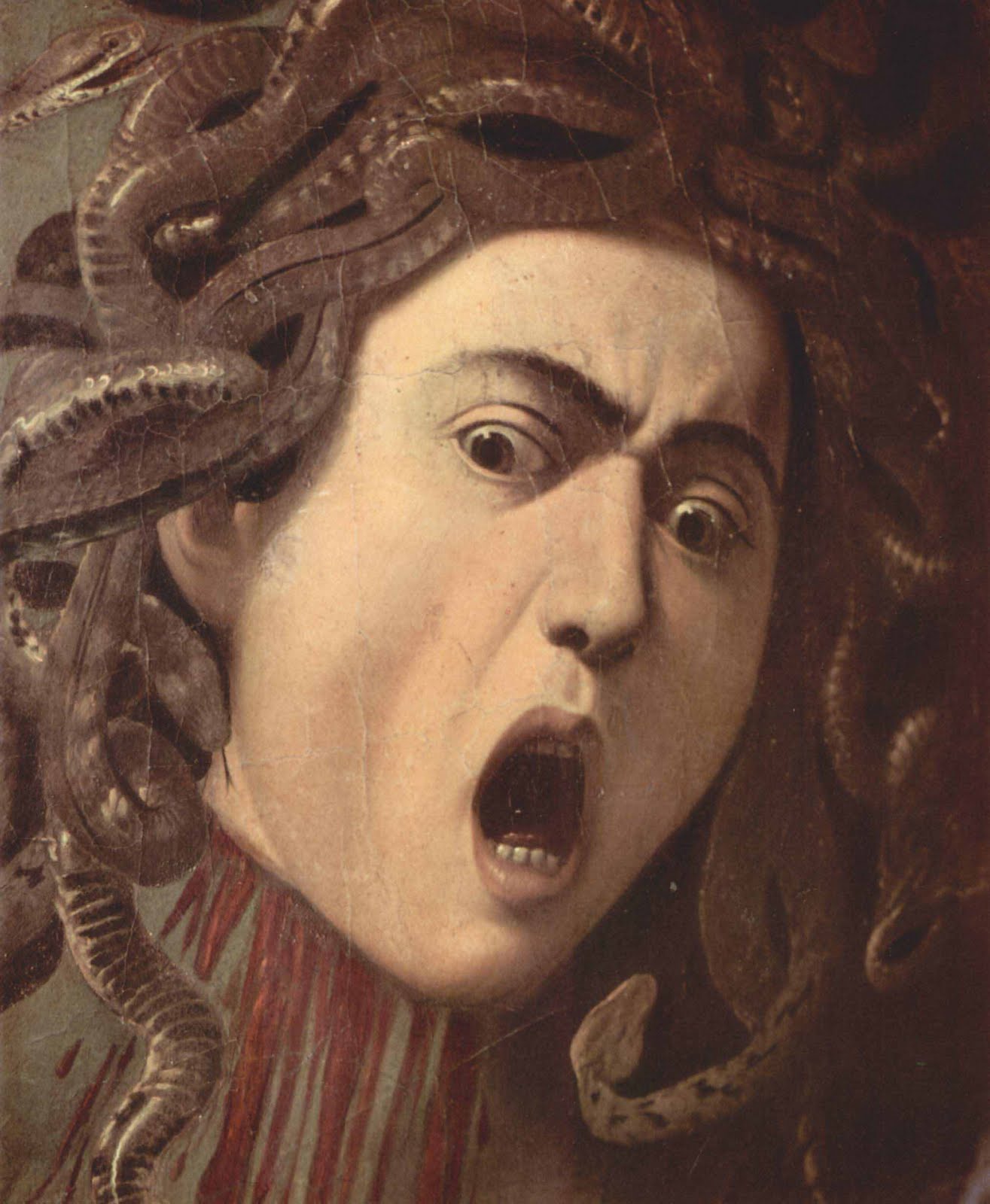
The Gorgons were three sisters by the names of Stheno, Euryale and Medusa. They were grotesque beings with snakes for hair, tusks like those of a boar, hands of bronze, wings of gold and their glance was death to man. Of the three, only Medusa was mortal and vulnerable, having once been a woman:


Medusa
Painting by Caravaggio.
“Medusa was once an exceedingly beautiful maiden,

Whose hand in marriage was jealously sought by an army of suitors,

According to someone who told me he’d seen it, her marvellous hair

Was her crowning glory. The story goes that Poseidon the sea god

Defiled this glorious creature inside the shrine of Athena.

The daughter of Zeus screened her virginal eyes with her aegis in horror,

And punished the sin, by transforming the Gorgon’s beautiful hair

Into horrible snakes.”
                        - PERSEUS RECOUNTS THE TALE OF MEDUSA


So Perseus set out to vanquish the blasphemous monster. Athena came to his aid, and told him to seek the nymphs known as the Hesperides, who possessed weapons which could conquer the Gorgon. Perseus sought out the old witches, and asked where he might find these nymphs. The witches were the sisters of the Gorgons, old women from birth who shared but a single eye and a single tooth between them. At first the witches taunted and mocked Perseus, and refused to reveal the nymph’s whereabouts. Through cunning and trickery, Perseus seized the eye and tooth, and offered them back only if they gave him what he needed. Reluctantly, the witches told him all they knew.

Perseus came to the Hesperides, where the nymphs gave Perseus a magnificent set of gifts to aid him against Medusa. The nymphs gave him a magical wallet to contain the Gorgon’s head and then the enchanted helm of Hades, which had been forged by the Cyclopes during the War of the Titans, which rendered the wearer invisible. The gods themselves also gave, and Hermes lent to Perseus his winged sandals so as to grant him the gift of flight, as well as an adamantine blade to pierce Medusa’s reptilian hide. Athena gave a fine shield, whose polished bronze surface rendered the perfect reflection. Armed with his divine tools, Perseus took flight across the vast Ocean, to the ends of the Earth and arrived at the Gorgon’s cave. Over to the sleeping beasts he crept, eyes fixed on their ghastly reflection of in his shield, and with a mighty strike he severed Medusa’s head. From her bleeding neck sprung the winged horse Pegasus. Out too came Chrysaor – the result of her and Poseidon’s violation in Athena’s sanctuary. Medusa’s fellow Gorgons awoke with a start and gave chase, but Perseus quickly slipped the foul head into the wallet and made good his escape, shielded under Hades’ helm.

On his return to Polydectes, Perseus stopped in the land of Ethiopia, kingdom of Cepheus and his queen Cassiepeia. Cassiepeia proudly declared herself to be more beautiful than the Nereids (The sea nymphs) themselves, bringing down upon her kingdom the wrath of Poseidon, who unleashed a terrible Leviathan upon the people. An Oracle told the people that the land could be saved only by sacrificing the Princess Andromeda to the monster, and so King Cepheus mournfully gave the order to chain her to the rocks. Perseus offered to slay the creature if he could take Andromeda as his wife. The King eagerly agreed, and Perseus flew to the princess’ rescue:

Perseus rescues Andromeda
Painting by Paolo Veronese.
“Poised on his swift wings, Perseus eluded his ravening enemys’ jaws

And went for his weak points, hacking away with his hooked sword,

Now at its barnacled back and then at the ribs, then again

At the narrowest point of the tail where it tapered into a fish.

The monster spewed forth seawater mingled with crimson blood...”
                                               - PERSEUS SLAYS THE LEVIATHAN

Perseus was hailed as a hero, and was given Andromeda as his bride. However the brother of Cepheus, Phineus, demanded Andromeda for himself and confronted the hero. Perseus revealed the Gorgon’s head and turned Phineus and his fellow conspirators to stone.

Perseus shows the Gorgon's head to Phineus
Painting by Luca Giordano.
Returning home to Seriphos triumphant, he found his mother and the fisherman Dictys in hiding from cruel Polydectes, who now received his wish – the Gorgon’s head. Indeed he even got to look the evil thing in the eye, and was transfixed in bloodless stone. Perseus gave the throne to the fisherman Dictys and set off to confront the man behind all of this – Acrisius, who had fled Argos when he heard of the hero’s coming. Perseus competed in the pentathlon at the athletic games in the land of the Pelasgians (northern Greece), whereupon he hurled his discus. The gods made the wind blow suddenly strong, carrying the disc into the head of Acrisius, sending him to the Underworld in a single blow. The prophecy at last fulfilled, Perseus buried Acrisius outside the walls of Argos, as he himself became King of Tiryns and founded Mycenae. Andromeda gave birth to many sons and daughters, the first son taking the name of Perses – from whom the Persian race claimed origin. Perseus and Andromeda lived long lives and became the progenitors of the Danaan race, to whom many great dynasties of Greece would claim descent, even to the day they had all been trodden under the iron shod boot of the Roman legions. To be descended from the Thunder god himself was to have powerful blood flowing through your very veins. To trace your lineage through one the god’s most illustrious sons was to add even greater lustre to the sheen.

The story of Perseus is one of the most famous in Greek mythology, and both Perseus and Medusa are famous cultural icons across the West. The stories are as enchanting in the original poetry as they were read aloud. The story can be found easily and at a discounted price at Amazon:

United Kingdom

Penguin Classics:
Metamorphoses: A New Verse Translation (Penguin Classics)
(The famous poem of Publius Ovidius Naso, a joy to read and 'the poetic account')

Oxford World's Classics:
The Library of Greek Mythology (Oxford World's Classics)
(A library of mythology, less poetic but contains the whole story of Perseus)

United States

Penguin Classics:
Metamorphoses (Penguin Classics)
(The famous poem of Publius Ovidius Naso, a joy to read and 'the poetic account')

Oxford World's Classics
The Library of Greek Mythology (Oxford World's Classics)
(A library of mythology, less poetic but contains the whole story of Perseus)

Wednesday, 25 August 2010

The War of the Titans

We start with a story which probably captured your imagination as a small child, it certainly did mine. We go to the earliest myths of Greece, those of the birth of the gods of Olympus and their defeat of the Titans and ascension to mastery of the Heavens. ‘Where is this stuff written?’ is a question I am often asked. It is all in a short poem called the Theogony (The birth of the gods). As far as Creation myths are concerned, this one is truly awe inspiring. Its words tell of the birth of the original creation of the Earth and Sky from Chaos (a Greek word meaning ‘The Chasm’, which did not acquire the meaning of confusion and disorder until more recent ages).


The War of the Titans
Painting by Rubens
The union of Earth and Sky gave birth to Night and Day, Air and Ocean, Nymph and Titan. The youngest of the Titans, Kronos, was then born. A ‘crooked schemer and the most fearsome of children’, Kronos hated his father for his immoral passions and lay ever in wait to take his place as Master of the Cosmos. His chance soon came, when Earth gave birth to the Cyclopes and three monstrous sons. They were known as the Hecatonchires, fearsome Giants who had a hundred arms and fifty heads, and ‘Strength boundless and powerful was on their mighty form’. Sky despised them and hurled them into the Underworld, devoid of light. Earth was displeased with the treatment of her offspring, and appealed to her others to help her. Kronos alone rose and swore to punish Sky. He did just that. One day he ambushed Sky and severed his manhood, which fell to the Ocean and gave birth to Aphrodite, the goddess of lust. Kronos now stood triumphant, and the Titans were now supreme. Night then gave birth to Doom, Fate, Sleep, Death, Jeer, Misery, Resentment, Deceit, Old Age, Intimacy, Strife, Toil, Neglect, Starvation, Pain, Battle, Combat, Bloodshed, Slaughter, Quarrels, Lies, Pretence, Argument, Disorder, Disaster, Oath and accursed Old Age. In short, the Cosmos became polluted with the things which destroy goodness.

Then came the gods and goddesses that we know. Kronos had by his sister Rhea five offspring:

                  " Hestia, Demeter, and gold sandalled Hera,
Mighty Hades who lives under the Earth,

Merciless of heart, and Poseidon the booming Shaker of Earth,

And Zeus the resourceful, father of gods and men,

Under whose Thunder the broad Earth is shaken. "
 
                                        - THE CHILDREN OF KRONOS
But Kronos heard a prophecy that he would be overcome by his own child, so he proceeded to swallow his children to make sure his rule would never end. Rhea, like Earth before her was displeased. When Kronos was about to swallow Zeus, she substituted a great stone in his place, while Zeus was raised in secret on Crete. When Zeus grew up, the War of the Titans (the Titanomachy) began. Zeus made Kronos throw up his siblings, and the stone. The stone was later placed on the Earth at Delphi, to mark the very centre of the cosmos (which is still represented at Delphi today).

The War reached its tenth year and was brutally destructive, yet no side had the advantage. Zeus went to the Underworld and offered the Giants freedom from their chains if they would side with him. They agreed, and the Cyclopes forged thunderbolts for Zeus, and the Hecatonchires were unleashed upon the Titans:


" Both sides displayed a feat of main force; and the boundless sea roared terribly round about, the Earth crashed loudly, and the broad sky quaked and groaned. Long Olympus was shaken to its foundations by the onrush of the immortals..."
                                                             - THE WAR OF THE TITANS IS BEGUN

The Titans were overpowered by the Giants and the lightning from Zeus. The younger gods hurled the Titans down to Tartarus, the deepest and darkest part of the Underworld, and sealed them behind gates of Adamantine. So deep below the Earth was Tartarus, one could drop a bronze anvil from the Earth’s surface, and it would fall for nine days and reach Tartarus on the tenth. But Earth was displeased that Zeus had imprisoned her brood. Two terrible monster gods were born to her – Echidna and Typhon. From their union, all the famous beasts of Greek myth were created – the fifty (Not three) headed canine guardian of the Underworld Cerberus, the baleful Hydra, the monstrous hybrid that was the Chimaera, the savage Lion of Nemea, the deceitful Sphinx and the demonic hound Orthus. These creatures would roam the Earth terrorising man, until great heroes would conquer them.

Mount Etna, under which Typhon was imprisoned by Zeus.
Photograph by Josep Renalias
Typhon himself was a fearsome beast, the greatest and most lethal monster in Greek mythology, with a hundred snake heads which spat fire so hot that the very Earth itself began to melt. So tall was he that his shoulders reached the stars, and his roar was so intense that all the gods but Zeus fled in panic. Zeus began a titanic battle with Typhon, which shook the Cosmos so severely that even the Titans down in Tartarus quaked in fear. Zeus launched a thunderbolt at each of Typhon's heads and hurled Mount Etna at the monster, pinning him under the Earth (The Greeks believed the eruptions of Etna to be fits of Typhon's rage, when he tries to break free, covering the land in fiery lava).

The victorious gods divided the Cosmos between them, Zeus became the King of the Gods and lord of thunder, Poseidon was given the Seas and Hades was given the Underworld to rule. So the current order was established, and the Olympians became the Masters of Heaven. A fascinating story is it not? This is the very foundation of Classical Greek mythology and identity, apart from a great story. Inspiring stuff, which forged the common links between all Greeks in a time where there was no Greece, only warring city states.

The Theogony is a short, quite readable poem and available extremely cheaply at Amazon:

United Kingdom

Penguin Classics:
Hesiod and Theognis (Classics)
(Slightly academic, but not dull)

Oxford World's Classics:
Theogony and Works and Days (Oxford World's Classics)
(Nice and readable)

Loeb Classical Library:
Hesiod: Theogony, Works and Days, Testimonia: v. 1 (Loeb Classical Library)
(For something a bit special, including the original Greek text alongside)

United States

Penguin Classics:
Hesiod and Theognis (Penguin Classics): Theogony, Works and Days, and Elegies
(Slightly academic, but not dull)

Oxford World's Classics:
Theogony and Works and Days (Oxford World's Classics)
(Nice and readable)

Loeb Classical Library:
Hesiod: Volume I, Theogony. Works and Days. Testimonia (Loeb Classical Library No. 57N) (v. 1)
(for something a bit special, including the original Greek text alongside)